Showing posts with label Encyclical. Show all posts

Saturday, October 14, 2017

A convert reflects on Mysterium Fidei and the state of the Church


Edited by Frank J. Sheed, "Prayer for Paul VI" (October 13, 2017):
Pope Paul VI’s 1965 encyclical on the Eucharist, “Mysterium Fidei,” was the first place I saw anyone say that the body and blood, soul and complete divinity of Christ was actually present in the consecrated species. Having been raised in Remi de Roo’s Victoria in the 1970s, I had naturally never heard anything at all about the Eucharist. The understanding that Catholics believed what they believe about it came as a bit of a shock...

... The encyclical, the very first I ever read, was also a marker for me of a personal turning point. It was the first time I had ever seen Catholic eucharistic doctrine clearly and – most importantly – unapologetically stated. It came right out and said something so astounding, something so completely unlikely, that I had to admit that it left very few logical possibilities. Like C.S. Lewis’s assessment of the claims by Christ of His own divinity, this pope was either mad, bad or telling the plain truth. Read more >>

Thursday, May 26, 2016

Surprise! Surprise!

Damian Thompson, "Pope used Argentinian 'ghostwriter' for controversial document on the family, claims Vatican expert" (The Spectator, May 25, 2016):
The leading Vatican commentator Sandro Magister – a conservative Catholic detested by the Pope’s entourage – this morning published an article that will severely embarrass Francis as he tries to clear up confusion over the Church’s teaching on Communion for the divorced and remarried.

Magister, stripped of his Vatican accreditation last year after leaking a draft of the Pope’s encyclical on the environment, claims that Francis employed a ‘ghostwriter’ for key sections of Amoris Laetitia, his 200-page official response to last year’s Synod on the Family.

Magister provides chapter and verse – that is, side-by-side comparisons of Amoris Laetitia, published in April, and the writings of the Pope’s friend Archbishop Víctor Manuel Fernández, Rector of the Pontifical Catholic University of Argentina.

Here is a link to Magister’s post, which deserves to be read in full.

Wednesday, May 25, 2016

Fr. John Hunwicke: "nasty and dirty" footnote 329

Fr. John Hunwicke, "Nasty and Dirty" (Fr. Hunwicke's Mutual Enrichment, May 17, 2016):
Many people very much more holy and learned than I am have spoken of the great riches and beauties which are to be found in Amoris laetitia. Since, we are told, portions of it were added at the request of the CDF, I see no reason why this should not be true. But I think footnote 329 is thoroughly Nasty and Dirty. It is dealing with the idea that "remarried" divorcees might live together as brother and sister. But, in the course of doing this, it quotes Gaudium et Spes. Since the Conciliar Document is referring ad locum to the spacing of families by married couples, this misrepresents the Council. It is always Nasty and Dirty to tell lies, particularly when it is a case of radically misrepresenting the teaching of an ecclesiastical organ ... an Ecumenical Council ... to which Christian people might feel they owed a duty of respect.

And, finally, this footnote appears to accept by implication the proposition that the Grace of God is not able to give Christian people the strength to live in accordance with His will. That is Nasty and Dirty. The Church has always taught that Chastity is within the reach of those who live in God's grace. Millions of Christians have found this to be true. 
Read more >>
[Hat tip to L.S.]

Thursday, April 28, 2016

Just what the German hierarchy has been waiting for


Sandro Magister, "The German Option of the Argentine Pope" (www.chiesa, April 28, 2016): "Cardinal Kasper and the progressive wing of the Church of Germany have gotten what they wanted. On communion for the divorced and remarried, Francis is on their side. He made up his mind a while ago, and has acted accordingly."

Thursday, April 21, 2016

For the record: a thermonuclear response to Amoris Laetitia

Christopher A. Ferrara, "Amoris Laetitia: Anatomy of a Pontifical Debacle" (Remnant, April 18, 2016), collates reactions on all sides, from Cardinal Burke to Eduardo Echeverria; offers reflection on having to "sift the good from the bad -- again"; then a detailed analysis of Amoris Laetitia, chs. 1-7("Intimations of Subversion"); a penetrating and exhaustive critique of ch. 8 ("An Essay in Subversion"); and, finally, a Conclusion ("Damage Assessment"). Read it and weep.

Thursday, April 14, 2016

"Bad papal eggs"

Joseph Martin, "Bad Papal Eggs" (Imprimatur, April 13, 20106):
The ever irenic Fr. Geo. Rutler breaks an egg or two... [referring to George Rutler's "The Curate’s Egg: A Reflection on Amoris Laetitia" (Crisis, April 13, 2016), which follows]:
There was a Victorian member of the Royal Academy who boasted that his paintings were the best because they were the biggest. More perceptively, Cicero and Pascal and Madame Recamier and Mark Twain made opposite apologies: each had written a long letter because they did not have the time to write a short one. Not only is verbosity indicative of muddled thinking, it is the rhetorical indulgence of the modern age. The documents of the Second Vatican Council are wordier than the extant records of all the other ecumenical councils combined. The recent apostolic exhortation, Amoris Laetitia, is nearly two-thirds the length of all the Vatican II promulgations.

The literary quality of Amoris Laetitia does not challenge the claim that the Authorized Version, or King James’s Bible, is the only successful work of art composed by a committee.In his encyclical celebrating Pope Gregory I, Iacunda Sane, Pope Pius X makes a point of the way that great pope’s clarity of thought issued in the beauty of his Latinity. That thought also posed no contradiction between truth and mercy: “It will certainly be the part of prudence to proceed gradually in laying down the truth, when one has to do with men completely strangers to us and completely separated from God. ‘Before using the steel, let the wounds be felt with a light hand,’ as Gregory said (Registr. v. 44 [18] ad Joannem episcop.).


Bishop: “I’m afraid you’ve got a bad egg, Mr. Jones.” Curate: “Oh, no, my Lord, I assure you that parts of it are excellent.” (From the November 9, 1895 issue of Punch, illustrated by George du Maurier.)

But even this carefulness would sink to mere prudence of the flesh, were it proposed as the rule of constant and everyday action…” (n. 26).Much, perhaps too much, has already been said about this apostolic exhortation, often revealing as much about the commentators as their commentaries. It is true that there are parts of it that are eloquent, but most of them are quotations of God and Saint Paul. The Word does have a way with words, and the charity of the Apostle gave him the tongue of an angel. In contrast, there are a lot of gongs clanging and cymbals clashing in the contradictions and redundancies of much of the exhortation’s diction.

Parts like the affirmation of Humanae Vitae settle the text in the sacred tradition, but there is also the muddled treatment of moral culpability that almost nods to the neuralgic interpretation of the “fundamental option” theory rejected by St. John Paul II (Veritatis Splendor, nn.65, 67). This had been addressed earlier by a formal declaration of the Holy See: A person’s moral disposition “can be completely changed by particular acts, especially when, as often happens, these have been prepared for by previous more superficial acts. Whatever the case, it is wrong to say that particular acts are not enough to constitute a mortal sin” (Persona Humana, December 29, 1975, No. 10).

A lack of clarity in the text might endorse the conceit already expounded in some media interviews, which says contrition is not a necessary element in petitioning for mercy. Any parish priest should wonder at the description of the confessional as a torture chamber. While it is only human when conflicted by guilt and uncertainty to approach the Sacrament of Reconciliation with trepidation, the radiance of that sacrament is inestimable in the life of the typical priest and penitent alike, and the agony of many souls and of the Church in our day can be traced in great measure to neglect of the gracious confessional. Speaking only of my own parish, in my confessional is a picture of the Prodigal Son and not the Grand Inquisitor. Dramaturgic references like that to torture are straw horses, and a straw horse is the rhetorical device of a weak argument. It was characteristic of the aforementioned Pope Gregory the Great, a systematic thinker, that he abstained from mocking his opponents, and did not advertise humility. By grace, God can help all of us emulate that to some modest extent so long as we submit to the realities of revealed and natural law.

In describing natural law, it is fascinating that the Catechism cites Cicero of pagan Rome, the same Cicero who did not have time to write a short letter (and the Robert Harris novel Dictator about him is worth reading): “For there is a true law: right reason. It is in conformity with nature, is diffused among all men, and is immutable and eternal; its orders summon to duty; its prohibitions turn away from offense… To replace it with a contrary law is a sacrilege; failure to apply even one of its provisions is forbidden; no one can abrogate it entirely” (n. 1956). Cicero’s own domestic life was not unblemished, but neither was the marital fidelity of that other orator Martin Luther King, Jr., who is quoted in the exhortation, but the principle, if not the practice, obtains.

Thursday, July 16, 2015

R.R. Reno on the strengths and weaknesses of Laudato Si


R.R. Reno, editor of First Things, says in his substantial article that the conjunction of concerns in the Pope's recent encyclical is fitting [emphasis mind]:
The end of the Cold War has allowed global capitalism to develop as the world’s dominant system. Capitalism has many virtues, but there are “externalities,” as economists call them—social and environmental harms and costs that may end up being very significant. Global capitalism also resists political control, posing a challenge to existing governmental and regulatory institutions. Most important of all, perhaps, this global system requires and encourages a technocratic elite that now dominates political and cultural debates. As a result, it’s increasingly hard to imagine an alternative.
Pope Francis, he says, discusses these issues and more, making "a much-needed effort to grasp and respond to today’s global realities." Then he adds, "But, taken as a whole, Laudato Si falters." While advancing strong criticisms of the secular technological project driving modern capitalism, many aspects of the alternative he proposes "draw upon the achievements and methods of that very project."

Pontiffs who venture beyond instructing the faithful to exhorting the whole world by means of book-length encyclicals open themselves to scrutiny and criticism and manipulation by the media from multiple quarters in ways unimaginable in the past. Reno, a faithful Catholic, offers filial criticisms (as well as appreciations) of points in the Pope's publication. Interesting. Here is an abridgement:
Chapter 1, “What Is Happening to Our Common Home,” outlines Francis’s take on environmental issues.... If it were just a matter of landfills, industrial waste, and the failure to recycle, we’d be okay.... The issue is much larger, however. Francis addresses the mother of all problems—and the central ecological issue today—which is global climate change.

The position put forward is the worst-case consensus. It holds that the fossil fuel–dependent economies of the developed and developing world have set in motion a process of global warming that will accelerate.... The rhetoric of crisis runs throughout the document. “Doomsday predictions can no longer be met with irony or disdain. We may well be leaving to coming generations debris, desolation and filth.”

The encyclical then turns to a diagnosis of the theological and social-cultural roots of the ecological crisis, spelling out its social dimensions. Chapter 2, “The Gospel of Creation,” calls for us to acknowledge creation as a gift from God, our Father....

... God-forgetfulness is at the root of our global problems today: social, economic, and ecological.

This line of criticism follows a long tradition....

Chapter 3, “The Human Roots of the Ecological Crisis,” analyzes what Francis takes to be the perverse spiritual logic of a scientific-­technological culture....

... A “Promethean vision of mastery” and “excessive anthropocentrism” lead to the same ecological and social disasters as ­God-forgetfulness.

At this point, Francis develops his fullest account of the crisis he believes we face.... Global capitalism is a Shiva-like force in human history—the Great Destroyer driving global warming.

... Francis is keen to point out that this suppression of larger ethical and spiritual questions allows the rich and powerful to disguise their unjust advantages and ratchet up still further their global oppression of the poor.

Given this dark picture of the global system, it’s not surprising that Francis calls for “a new synthesis,” “radical change,” and “a bold cultural revolution.”

There’s something to be said for his particular suggestions in Chapters 4 (“Integral Ecology”) and 5 (“Lines of Approach and Action”). Calls for action to address climate change are needed, as is a spiritual alternative to consumerism. But my concern is with the cogency of the encyclical as a whole. A great deal of what is commended as an alternative to the global system sounds to me like just another version of it.

Thursday, June 25, 2015

Douthat: Pope's side in debate between dynamists and catastrophists

Ross Douthat, "Pope Francis’ Call to Action Goes Beyond the Environment" (New York Times, June 20, 2015):
What everyone wants to know, of course, is whether the pope takes sides in our most polarizing debate. And he clearly does. After this document, there’s no doubting where Francis stands in the great argument of our time.

But I don’t mean the argument between liberalism and conservatism. I mean the argument between dynamists and catastrophists.

Dynamists are people who see 21st-century modernity as a basically successful civilization advancing toward a future that’s better than the past. They do not deny that problems exist, but they believe we can innovate our way through them while staying on an ever-richer, ever-more-liberated course.

Dynamists of the left tend to put their faith in technocratic government; dynamists of the right, in the genius of free markets. But both assume that modernity is a success story whose best days are ahead.

Catastrophists, on the other hand, see a global civilization that for all its achievements is becoming more atomized and balkanized, more morally bankrupt, more environmentally despoiled. What’s more, they believe that things cannot go on as they are: That the trajectory we’re on will end in crisis, disaster, dégringolade.

Like dynamists, catastrophists can be on the left or right, stressing different agents of our imminent demise. But they’re united in believing that current arrangements are foredoomed, and that only a true revolution can save us.

This is Pope Francis’ position, and the controlling theme of his encyclical. It includes, as many liberals hoped and certain conservatives feared, a call to action against climate change, which will no doubt cause Republicans to squirm during political campaigns to come.

But reading “Laudato Si’ ” simply as a case for taking climate change seriously misses the depth of its critique — which extends to the whole “technological paradigm” of our civilization, all the ways (economic and cultural) that we live now.

... the encyclical’s most pungent lines are apocalyptic: “Doomsday predictions can no longer be met with irony or disdain. We may well be leaving to coming generations debris, desolation and filth.”

... its urgency, sweep, and apocalyptic flavor may make “Laudato Si’ ” more immediately influential, more likely to make both audiences think anew.

However, its catastrophism also leaves this pope more open to empirical criticism. For instance, he doesn’t grapple sufficiently with evidence that the global poor have become steadily less poor under precisely the world system he decries — a reality that has complicated implications for environmentalism.

Nor are questions related to population growth successfully resolved....

Finally, it’s possible to believe that climate change is happening while doubting that it makes “the present world system ... certainly unsustainable,” as the pope suggests.
[Hat tip to Fr. D. Jones]

Wednesday, June 24, 2015

For the record: Mullarkey on Laudato Si'

[Disclaimer: Rules ##7-9]
Maureen Mullarkey, "Where Did Pope Francis’s Extravagant Rant Come From?" (The Federalist, June 24, 2015). What, First Things wouldn't publish this? Heads will explode, if not roll:
Subversion of Christianity by the spirit of the age has been a hazard down the centuries. The significance of “Laudato Si” lies beyond its stated concern for the climate. Discount obfuscating religious language. The encyclical lays ground to legitimize global government and makes the church an instrument of propaganda—a herald for the upcoming United Nations (UN) Climate Change Conference in Paris.

... Take no comfort from “Laudato Si’s” restatements of the Catholic Church’s traditional positions on the sanctity of life, the primacy of the family, and rejection of abortion. In this context, orthodoxy and pious expression serve a rancid purpose. They are a Trojan horse, a vehicle for insinuating surrender to pseudo-science and the eco-fascism that requires it.

... Replete with cooing reference to Francis of Assisi, “Laudato Si” ignores the single aspect of Assisi’s “Il Poverello” most relevant to our time. It is not the fey proto-hippie of high-fructose legend that speaks best to us now. It is the would-be martyr who sailed to Egypt alongside Crusaders to preach the gospel to a Muslim sultan.

Resurgent Islam and the spread of Sharia are the church’s enemies, not oil, coal, and gas. None are poorer than those who live, despised, in the path of ISIS. Where, then, is the encyclical calling for the conversion of Islam away from its murderous climate of hatred? Instead, the Vicar of Christ calls all the world—intending primarily the West—to “ecological conversion.”

Intellectual and moral confusion of such magnitude is a judgment on the ecclesial culture that produced it and the popular culture that consents to it.
[Hat tip to M.G.]

Monday, June 22, 2015

How encyclicals have changed through Catholic history

Boniface, "The Curiosity of the Modern Encyclical" (Unam Sanctam Catholicam June 18, 2015):
... The encyclical developed from the papal bull. The bull was a primarily juridical instrument used as a means of promulgating an authoritative judgment of the Holy See, either in matters of doctrine or governance. These could often be very short; we marvel today at reading something like Boniface VIII's Unam Sanctam (1302) - which famously declared that submission to the Roman pontiff was necessary for salvation - and is only a page long! Papal bulls in the old days knew what they wanted to say and they said it.

The modern encyclical developed out of the Enlightenment period as the popes realized that broader literacy and intellectual challenges to Christian revelation necessitated using the papal bull as a means of educating the flock on Catholic teaching, and hence by the time of the French Revolution the bull had begun to transform into the encyclical, the teaching letters of the modern pontiffs.

The encyclicals of the 19th and early 20th century are lucid and clear. Their purpose is to expound Catholic doctrine and defend it against modern errors, which they do very admirably. A friend recently commented to me that in thinking back on great documents like Pascendi, Quas Primas, Casti Conubii and so forth, one can immediately recall the substance of of them and the force of their arguments. Pius XII taught that the encyclical was the normative means by which the Roman pontiff exercised his teaching office. The same cannot be said about modern encyclicals - who can easily summarize what Redemptor Hominis or Populorum Progressio are about except in the vaguest terms?

... somewhere along the way the popes seemed to have dropped the declarative aspect of the encyclical in the overly optimistic hope that if we could just explain our teaching to the world - just walk them through our thinking step by step - then maybe the world would accept the Church's message. Maybe if we simply "proposed" our rationale for belief humbly instead of declaring that we "had" the truth, the world would reciprocate and enter into a "fruitful dialogue" with Christianity that would mutually enrich everybody?

Fruitful dialogue. Reciprocate. Mutually Enrich. Sorry, my post-Conciliar vocabulary started taking over for a moment.

Seriously though, the problem with this approach is fourfold:

(a) The world does not reject the Gospel because it has not been adequately explained. They reject it "because the light is come into the world, and men loved darkness rather than the light: for their works were evil" (John 3:19).

(b) Even when its has opted for explaining rather than declaring the Church's teaching, the Church has done a poor job of it because it has chosen to explain its teachings in terms of humanist phenomenology rather than having recourse to the Church's traditional pedagogy.

(c) By focusing so much on the explanation and presentation over the declaration, the Church has unwittingly given the false impression that the validity of its teachings are bound up with the force of her argumentation, a kind of false intellectualism. She feels shaky and inadequate simply saying, "Such is the voice of the Church; such is the teaching of our Faith"; she feels she must offer a humanistic centered explanation for everything - an explanation that will "suit" the needs of "contemporary man" - with the effect that her message has become completely man-centered. "He taught as one who had authority" (Matt. 7:29) said the people of old about Christ; but when the Church forgets the supernatural force that stands behind her teaching and opts instead for an anthropomorphized message, she no longer "speaks with authority", in the sense that her words lose their force. Hence people shrug at the latest papal document and move on.

(d) Finally, because the popes have sought for novel means to propose their teachings, encyclicals lose their strenght as teaching documents and become instead opportunities for the popes to foist their own theological or literary tastes on the Catholic people. The phenomenology of John Paul II, the Balthasarian-Hegelian-Teilhardism of Benedict XVI, and now the sort of "literary theology" of Francis. Each pontiff has opted not use traditional pedagogy, which means every pope has to "try something new" in how they choose to teach.

Thus, while retaining its authority in the juridical sense, from a strictly pedagogical viewpoint, the modern encyclical tends to become a rambling, sprawling mess that lacks the force to move minds and hearts. There have been exceptions; Humanae Vitae certainly did its job, as did Ordinatio Sacerdotalis. Fides et Ratio was profound. But by and large they have failed to really educate the Catholic flock on the substance of the Church's teaching and are too cumbersome to be accessible to the average pewsitter. There is reason why going on and on is called "pontificating."

Interpretations of Laudato Si'


I plan to update this listing periodically. [Disclaimer: The views of the linked articles do not necessarily reflect my views, as most readers (and my seminary students) will know. Some are polite and charitable; others abrasive and bitter; still others inveterate fantasy. Advisory: I consider it important to arm oneself with a variety of perspectives -- See: Rules ##7-9] But remember, when all is said and done, what is far more important than any encyclical, or sorting out the cacophony of voices vying to interpret it, is the zeal and joy with which you embrace your life as a Catholic. To know the Faith requires no more than a Penny Catechism; and if you know your Faith, you will know how to live it, love it, and serve our Lord Jesus Christ.

First Things' R.R. Reno compares Laudato Si' to Pius IX's Syllabus of Errors

Don't you LOVE being Catholic?!!

R.R. Reno, "The Return of Catholic Anti-Modernism" (First Things, June 18, 2015), begins his essay thus:
Commentators are sure to make the false claim that Pope Francis has aligned the Church with modern science. They’ll say this because he endorses climate change. But that’s a superficial reading of Laudato Si. In this encyclical, Francis expresses strikingly anti-scientific, anti-technological, and anti-progressive sentiments. In fact, this is perhaps the most anti-modern encyclical since the Syllabus of Errors, Pius IX’s haughty 1864 dismissal of the conceits of the modern era.
At which point you may be wondering, as I, whether Reno is writing entirely tongue-in-cheek, or whether he's serious. Well, read to the end, and I think you'll see.

Fr. Rutler on the "promise and peril" of Laudato Si'


Fr. George Rutler, "Mixing Up the Sciences of Heaven and Earth" (Crisis, June 18, 2015), writes:
It is noteworthy that Pope Francis would have included in an encyclical, instead of lesser teaching forms such as an apostolic constitution or motu proprio, subjects that still pertain to unsettled science (and to speak of a “consensus” allows that there is not yet a defined absolute). The Second Vatican Council, as does Pope Francis, makes clear that there is no claim to infallibility in such teaching. The Council (Lumen Gentium, n.25) does say that even the “ordinary Magisterium” is worthy of a “religious submission of intellect and will” but such condign assent is not clearly defined. It does not help when a prominent university professor of solid Catholic commitments says that in the encyclical “we are about to hear the voice of Peter.” That voice may be better heard when, following the advice of the encyclical (n.55) people turn down their air conditioners. One awaits the official Latin text to learn its neologism for “condizione d’aria.” While the Holy Father has spoken eloquently about the present genocide of Christians in the Middle East, those who calculate priorities would have hoped for an encyclical about this fierce persecution, surpassing that of the emperor Decius. Pictures of martyrs being beheaded, gingerly filed away by the media, give the impression that their last concern on earth was not climate fluctuations.

Saint Peter, from his fishing days, had enough hydrometeorology to know that he could not walk on water. Then the eternal Logos told him to do it, and he did, until he mixed up the sciences of heaven and earth and began to sink. As vicars of that Logos, popes speak infallibly only on faith and morals. They also have the prophetic duty to correct anyone who, for the propagation of their particular interests, imputes virtual infallibility to papal commentary on physical science while ignoring genuinely infallible teaching on contraception, abortion and marriage and the mysteries of the Lord of the Universe. At this moment, we have the paradoxical situation in which an animated, and even frenzied, secular chorus hails papal teaching as infallible, almost as if it could divide the world, provided it does NOT involve faith or morals.

Read more >>
[Hat tip to C.B.]

Friday, June 19, 2015

"No Catholic is free to dissent from the teaching of Laudato Si’"

Fr. Ashley Beck, "No Catholic is free to dissent from the teaching of Laudato Si’" (Catholic Herald, June 19, 2015), is quite clear about what he thinks of dissent, at least, if a little less clear about what, exactly, this encyclical teaches that makes it uniquely important just now. Surely it's more than: "Look up from your phones and encounter each other"

Fr. Beck identifies the encyclical as falling "in the tradition of papal encyclicals, beginning with Leo XIII’s Rerum Novarum in 1891, right up to Benedict XVI’s last encyclical from 2009, Caritas in Veritate ...." That's good company.

He writes:
This encyclical, deep and astute in so many ways, is not a work about the environment, or economics, or political theory – rather, it is theology... papal social encyclicals like Laudato Si' are part of the ordinary Magisterium of the Church....

What this means is that while the Church does allow for divergent viewpoints on some issues (Laudato Si’ 61), we are simply not free to dissent from the teaching of this encyclical, any more than we are free to dissent from Catholic teaching about other moral issues.
Curiously (or maybe not so curiously, considering the times), while Fr. Beck says that this encyclical is "deep and astute," he nowhere says what the encyclical's teaching is. He doesn't even try. Which makes me wonder whether he even knows for sure. Could he summarize its message in 25 words?

Which, in turn, makes me wonder why he is so eager to prevent "dissent" from the encyclical's teaching that he emblazons that prohibition across the top of his article as its headline.

Does this remind you just a little of the tenacity with which some Catholics insist that one must give full assent to the "teachings of Vatican II" (which was not a dogmatic council), and yet those same Catholics would usually be hard pressed to define what uniquely-important doctrines are given expression by the Council that were not clearly resident in previous Sacred Tradition? Is "ecumenism" a doctrine? Is "ecological conversion"? What do they mean?

Bit wait, there's also this: Danny Wiser, "Obama calls for world leaders to heed Pope Francis's message" (Catholic Herald, June 19, 2015). Wiser writes: "The US president hails the Pope's intervention as 'clear and powerful'." Maybe he can tell us what it means. Why, do you think, is he so giddy about this encyclical?
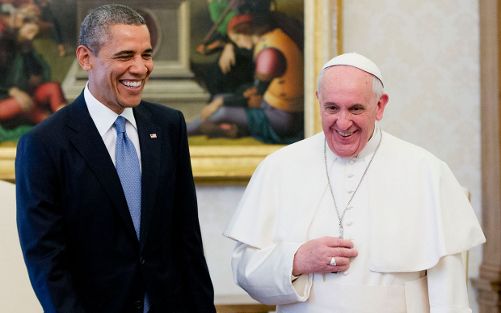

Then there's this question: regardless of whether Mr. Obama knows what Pope Francis means by his encyclical, Mr. Obama apparently has good reason for affirming what it means to him; and is there a shred of doubt in anyone's mind that this meaning is amicable or even benign vis-a-vis the Gospel of our Lord Jesus Christ? What larger purpose do you think Mr. Obama wants this encyclical to serve; and how does that purpose compare and/or contrast to the purpose Pope Francis has in mind?

I'm reminded of two elderly church ladies who came out of a Methodist church where they had just finished hearing Paul Tillich preach. "Wasn't it beautiful," exlaimed the one. "Yes, but what did it mean?" asked the other. And they smiled at one another and made their way home.

Yes, I've read the encyclical. I'm sure if we asked every person (like Hans Joachim Schellnhuber) who apparently had a hand in writing the document, we'd get quite different accounts as to its meaning. I should like to hear Cardinal Gerhard Müller, Prefect of the Congregation for the Doctrine of the Faith, offer a summary of what it means, so I may know what I'm assenting to, beyond all the traditional Catholic doctrines that are already in the Church's deposit of Faith.

Thursday, June 11, 2015

What is the appeal in looking like a branch of the UN?

Guy Noir - Private Eye, our underground correspondent we keep on retainer in an Atlantic seaboard city that knows how to keep its secrets, also seemed quite excercized about this, as he communicated recently:
Much better to sound like a government official than a Pope, even if we insist we are no NGO. When there is a "Speaker's Line Up" and an "official presentation," you realize we have ceased to be dealing with religion and are instead competing with government and celebrity machines. How long before we see The EarthKeeper's Bible or Spiritual Disciplines for the Environmentally-Aware...?
Here were are: Augustinus, "For Pope's Environment Encyclical, an unusual line-up of presenters for official Vatican press conference, including climate change radical" (Rorate Caeli, June 10, 2015):
he Vatican has just revealed in today's Bollettino the line-up of speakers for the official presentation of the "Environment Encyclical", Laudato Si, on June 18 at the New Synod Hall.
The most interesting is probably Prof. John Schellnhuber, Founding Director of the Potsdam Institute for Climate Impact Research, proponent of a "zero-carbon world," known for his "aggressive stance on climate policy," and for having famously declared in 2009 that the "carrying capacity" of the Earth is less than one billion people! He is also known, according to Augustinus, for his "intense advocacy of rapid de-industrialization in order to stave off global warming." You've really got to read the quotes to believe this guy's for real. And, last but not least, he is an advocate of a real form of "World Government," something advanced also in the cause of climate control. One has to wonder why the Vatican selected him to be the sole layman and environmental "expert" to present on the occasion of the debut of the Pope's new encyclical. Really.

Monday, November 10, 2014

Interesting debate between Jimmy Akin and Louie Verrecchio on "whether Mortalium Animos is still the faith of the Catholic Church"

Posted as: The Ecumenical Question, beginning with an opening statement by Jimmy Akin on November1st.

Comments are closed, but there is an independent Forum where readers can comment elsewhere.

The debate was publicized by Verrecchio on November 4th HERE, and was provoked initially by a challenge he posed to men like Karl Keating, Michael Voris, Jimmy Akin, Marcellino D’Ambrosio and others HERE. Only my friend Jimmy Akin has responded so far, and the dialogue has been courteous and constructive, as far as I have read it.

As Francis A. Schaeffer used to insist: "Serious answers for serious questions."

Friday, July 05, 2013

New Encyclical: Lumen Fidei

The encyclical carries the name of Pope Francis, who acknowledges in it that actually it was substantially the work of Benedict XVI, nearly completed in its first draft before his resignation to supplement what he (Benedict) had said about charity and hope. Francis gratefully acknowledges the work of Benedict, adding that he (Francis) took up this work and added "a few contributions of my own."


ENCYCLICAL LETTER
LUMEN FIDEI [The Light of Faith]
OF THE SUPREME PONTIFF
FRANCIS
TO THE BISHOPS
PRIESTS AND DEACONS
CONSECRATED MEN AND WOMEN
AND ALL THE LAY FAITHFUL
ON FAITH

[Hat tip to Rorate Caeli]