Showing posts with label Confession. Show all posts

Wednesday, April 17, 2019

Tridentine Holy Week Masses & Devotions in metro Detroit


Please note: Red font indicates confirmed events. Contact all other parishes to confirm Holy Week events & times.

Maundy Thursday


Good Friday


Holy Saturday


Easter Sunday


* NB: The SSPX chapels among those Mass sites listed above are posted here because the Holy Father has announced that "those who during the Holy Year of Mercy approach these priests of the Fraternity of St Pius X to celebrate the Sacrament of Reconciliation shall validly and licitly receive the absolution of their sins," and subsequently extended this privilege beyond the Year of Mercy. These chapels are not listed among the approved parishes and worship sites on archdiocesan websites.

Sunday, February 17, 2019

Tridentine Community News - Four priest trained in the EF in Idaho and Detroit; Confessionals on Trains; Tridentine Masses this coming week


"I will go in unto the Altar of God
To God, Who giveth joy to my youth"

Tridentine Community News by Alex Begin (February 17, 2019):
February 17, 2019 – Septuagésima Sunday

Four Priests Trained on the EF in Idaho and Detroit

One of the brightest spots in the Church today is the ever-increasing interest of priests in learning to celebrate the Traditional Mass. The last two weeks have been the busiest ever for Extraordinary Faith’s Celebrant Training Program, as four priests took part. Tom Lester, chair of the Treasure Valley Latin Mass Society in Boise, Idaho, arranged for three priests of the Diocese of Boise to learn to offer the Extraordinary Form:

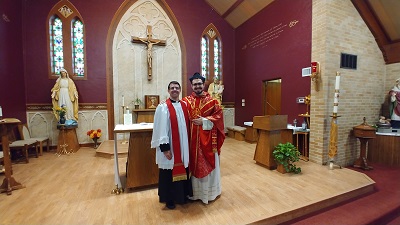
Fr. Pako Godinez, Pastor of St. Nicholas Parish in Rupert, Idaho, celebrated his first Mass in the Extraordinary Form on Wednesday, February 6. He was joined in the training session by Fr. Justin Brady, Pastor of Our Lady of the Snows, Sun Valley and St. Charles Borromeo, Hailey, Idaho. Also present was Idaho 5th District Judge Jon Brody, who made time in his busy schedule to learn how to serve the Traditional Mass.


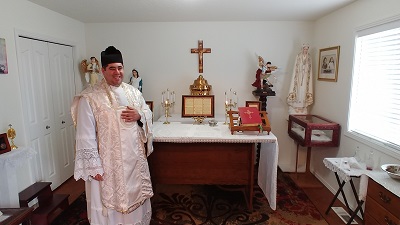
Fr. Camilo Garcia, Pastor of Corpus Christi Parish in Fruitland, celebrated his first Holy Mass in the Extraordinary Form on Friday, February 8, in his private chapel. Fr. Camilo retrieved an altar missal and missal stand from a mini-museum of pre-Vatican II items in his church. Previous pastors thought they would never be used again, but they were wrong!


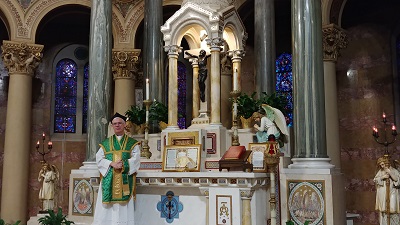
At an evening gathering of the Treasure Valley Latin Mass Society in Boise during the week, a talk was presented about the history of the TLM in metro Detroit and Windsor. Lessons learned here can and should help others elsewhere. Upon seeing the above photos, members remarked about the genuine joy observed on the faces of the priests following this significant moment in their priestly life. Back here in Detroit, Fr. Tony Blount, SOLT, Associate Pastor of historic Holy Redeemer Parish, offered his first Holy Mass in the Extraordinary Form on Wednesday, February 13. Featured in Extraordinary Faith Episode 13 - Detroit Part 1 of 2, Holy Redeemer is a massive, ornate church designed to resemble St. Paul Outside the Walls. It has hosted several special Tridentine Masses over the years, though none yet celebrated by a priest of the SOLT order that administers the parish.

Special thanks to Br. Javier Ebertowski, a SOLT seminarian in residence at Holy Redeemer who arranged the training.

This column will report when public Masses are planned by Fr. Blount, whether at Holy Redeemer or elsewhere.


Confessionals on Trains

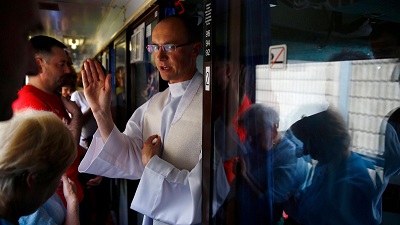
A November 29, 2018 story on Quartz (www.qz.com) reported that on December 21 and 24, the publicly owned Lesser Poland Railways was going to provide priests on their trains to hear Confessions. A beautiful sign of the pervasive Catholic culture in Poland, organized by the state, no less.


Tridentine Masses This Coming Week
  • Tue. 02/19 7:00 PM: Low Mass at Holy Name of Mary, Windsor (Feria)
  • Sat. 02/23 8:30 AM: Low Mass at Miles Christi (St. Peter Damian, Bishop, Confessor, & Doctor)
[Comments? Please e-mail tridnews@detroitlatinmass.org. Previous columns are available at http://www.detroitlatinmass.org. This edition of Tridentine Community News, with minor editions, is from the St. Albertus (Detroit), Academy of the Sacred Heart (Bloomfield Hills), and St. Alphonsus and Holy Name of Mary Churches (Windsor) bulletin inserts for February 17, 2019. Hat tip to Alex Begin, author of the column.]

Sunday, March 18, 2018

Fr. Perrone: the precious gift of God's mercy and the serious danger of "mercy abuse"

Fr. Eduard Perrone, "A Pastor's Descant" [temporary link] (Assumption Grotto News, March 18, 2018):
My subject today concerns whether Christ might be suffering from mercy abuse -- surely an eyebrow-raising topic. We have been fortunate to have had in recent years a much trumpeted exposition of the Divine Mercy. Both in the liturgy and in devotional life, in the canonization of two saints (John Paul II and Sister Faustina), in sermons, literature, and film, the theme of Christ's inviting welcome to sinners has assumed a significant place in the Catholic Church. There must be providential reason for this. It's due, I believe, to the fact that Christians have been much adrift in an environment increasingly hostile to their faith. They have needed to know that there is a safe haven whither they can turn, confident of being able to find God securely amidst the maddening clamours of secularism. Also, Christians themselves have too often wandered off like the proverbial erring sheep into sordid byways. Affected by the moral pollution surrounding them, they have themselves succumbed to the powerful downflow of a putrid culture. Guilt resulting from having sinned grievously and committed various serious crimes (think of abortion, sodomy, divorce, cohabitation, contraception, drug addiction -- just for starters) will inevitably lead sinners, should the devil only succeed, to total despair -- sin being a real torture to the Christian when he awakens conscious of his former wickedness. Since such grave sins would spell certain spiritual death (viz. hell) for so many, Christ in His great compassion and love for souls has wished the message of His mercy to be emphatically publicized as an encouragement for them to have hope. Such, anyway, is my analysis for the urgency of the message of Divine Mercy in our time.


... with a firm purpose of amendment!

If the need for divine mercy is truly great, how is it that I question here there be such a thing as mercy "abuse"? A long time back, when attending public high school, I first heart the criticism leveled against Catholics that forgiveness for them is cheap because they have ready access to Confession -- the implication being that for other transgressors forgiveness has to be earned by heart wrenching pleading in a near desperate hope that mercy will be accorded them. At the time, it was a shock to my innocent Catholic ears to hear that Confession was considered by some to be an easy thing. I had always been taught that Confession called for serious preparation, integrity, and determination to make amendment of life.

I fear that some may be using Confession as a catharsis (mental relief), that is as a natural remedy for their guiltiness as opposed to supernatural act which remits sins and confers grace. Do some people use Confession merely to shake off guilt but don't have the firm intent never to commit sin again? The fear of a positive reply to this question is the reason for my writing. Is our Lord perhaps being abused by those appealing to His ready forgiveness while lacking a determined will never again to sin? The question is meant to be probative. Mercy abusers confess the same sins every Confession on account of the guilt feelings they have but they lack the steely intention to refuse the next opportunity temptation makes its round. Fod for thought -- thought for change.

On a different subject. Today is Passion Sunday in the traditional liturgical calendar for it inaugurates a shift in the prayers and chants, focusing them more nearly on the approaching days when our Lord will undergo His sufferings and death for our salvation. Today would be the feast of Saint Joseph but this must be deferred until tomorrow on account of the precedence of the Lenten Sunday. Don't however neglect to honor the good Saint on Monday. There is prepared a fine St. Patrick's Day Lunch after the 9:30 & noon Mass today: $8/adults, $3/children.

Next Sunday is Palm Sunday -- already! -- the gateway to Holy Week. Altar boys who wish to serve the principal Palm Sunday Mass at 9:30 with the procession of palms must come to a practice in church this Saturday, March 25 at 1:00 p.m. The rehearsal should last only about an hour. Our altar boys will also have their annual retreat, beginning on Wednesday evening of Holy Week. For this they need to submit the registration forms provided for them today.

Fr. Perrone

Tuesday, December 05, 2017

Pardon and Peace: The Joy of Confession

Why Pay a Shrink for What the Catholic Church Does for Free?

By Oswald Sobrino, a review of Pardon and Peace: A Sinner's Guide to Confession, by Fr. Francis Randolph (Ignatius, 2001)

On Holy Thursday, 2001, Pope John Paul II wrote to all priests to encourage them to focus on the sacrament of Penance, or Confession. In doing so, the Holy Father referred to the recent “crisis” of this sacrament. Certainly, it is no surprise in Western countries to find that the loss of a sense of sin, and certainly of a sense of grave sin, has had a significant effect on whether Catholics avail themselves of this great sacrament. Yet, as noted in the Catechism of the Catholic Church, this is the sacrament where continuing Christian conversion takes place. As described by John Paul II, Confession is a dramatic encounter between Christian and Christ, an encounter fraught with the majesty of man’s freedom and Christ’s eager offer of grace.

The following thoughts on Confession arise from considering two books with the same title Pardon and Peace, but published over 50 years apart. The first Pardon and Peace, written by Fr. Alfred Wilson, C.P., appeared in 1948 and has been reprinted by Roman Catholic Books. The current Pardon and Peace was published in 2001 and was written by Fr. Francis Randolph, an English priest. In spite of a half century of tumultuous change in the Catholic Church, the fundamental thrust of the books is the same: Take advantage of this astonishingly approachable but powerful sacrament and its richness. While the books understandably differ in their emphasis on certain issues, both authors end up in the same place: A buoyant and cheerful Catholic will find his sustenance in Confession.

Sunday, November 19, 2017

It's almost Thanksgiving ... and Fr. Perrone goes to Confession!

Fr. Eduard Perrone, "A Pastor's Descant" (Assumption Grotto News, November 19, 2017)
This week we observe the second of the three great holidays, Thanksgiving Day. Second? Yes, when one figures in Halloween which, according to news reports, is the second most celebrated American holiday, second only to the December one which everyone used to call Christmas. (Word is out that President Trump has declared that it's once again OK to say, "Merry Christmas." That may be reassuring to some, but to those who never championed political correctness it is, in an ironic bit of pointing the finger, "fake news.")

Thanksgiving Day is worthy of Christian endorsement so long as we recall that there's an object to our thanks -- namely God -- to whom we owe our very existence as well as everything we have. As I remarked in a pastor's column of some past year, secular society gladly embraces Thanksgiving Day for its commercial potential (kicking off, as they say, the holiday spending spree) and for the momentary reprieve of work. One may openly express thankfulness for anything whatever if it is left unsaid that the gratitude must be direct to the Almighty.


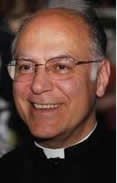
Just this past week I made thanksgiving to God for one of the most precious of His gifts to me as a Catholic: the absolution of my sins. (In case you didn't know, priests not only hear confessions but make themselves penitents of other priests.) It so happened that this confession was in close proximity to my birthday (the admission of which is not meant to cue a raucous rendition of the familiar dirge). Confession, I would say, is a great Catholic way of celebrating one's birthday, compelling one to recollect one's utter dependence upon God for forgiveness, for His grace, for life itself. Going to confession ought not to make one grumpy and cross. I'm reminded of what I once read about a composer Igor Stravinsky who would faithfully go to confession on his birthday, the prospect of which would put the composer, in his own words, "in a mood," that is, crabby.

The confession of my sins reminds me of my lowly place under God's infinitely vast empire and that I must ever be grateful to Him for His merciful indulgence to my sinful self. Going to confession also reminds me of what it is to be a penitent in my confessional who must not only accuse himself of his sins before God, but who must also own up to his wrongdoings before a priest, one who is as fallible as another -- so that I will not easily to be compassionate and understanding of penitents. I have posted a few choice scriptural quotes on the door of my confessional. These help me to be kindly disposed to those beggars of divine mercy who come to me to be freed of the burden of their consciences. Should ever I fail in this and get uppity or impatient with you in confession, do me the charity of asking me to read the bible verses on my confessional door. That should awaken a needed humility and spare me a severe judgment from the Judge of judges.
Last week's somewhat panicky pastor's Descant forecasting a gloomy future for our parish Forty Hours devotion appears to have been overwrought. Attendance for the closing Mass at noon last Sunday was good and there always seemed to be someone adoring our Lord during the hours of Exposition. The real credit for the devotion, of course, goes to the benevolent Christ who makes Himself and His graces available during this sacred time. I want to make the Forty Hours a great spiritual success for our people and I would be sad to let go of it when we have held on to it so tenaciously these many years. Accordingly, I have asked a small committee to be formed for securing the future of the Forty Hourse Devotion in our parish. They would meet in September next year to plan for a greater participation and greater solemnity for this traditional parish service.

You will note the near completion of the handicapped entrance ramp on the church's south side, a project that has taken an unduly long time to come to completion. If its serviceability matches its fine looks, I would say that we will have a worthy addition -- or rather replacement entryway -- to our majestic church structure.

Fr. Perrone

Sunday, September 24, 2017

A Pastor's Catechesis on Confession

While some of the material in the following article is specific to a local parish, it offers a rare opportunity to "listen in" on the counsel of a good Catholic pastor concerning the Sacrament of Confession -- which readers may find edifying whether they are Catholic or Protestant. My Protestant readers may wish to remember that one of their favorite authors, C.S. Lewis, went to confession weekly and defended the practice, although he never left the Anglican Church where confession is not a Sacrament. It may be worth asking what Professor Lewis may have missed by never becoming a Catholic, especially since so many converts, I included, find the Sacrament of Confession one of the most beautiful things this side of heaven, save, perhaps, for the Sacrament of Holy Communion.

Fr. Eduard Perrone, "A Pastor's Descant" (Assumption Grotto News, September 24, 2017):
A pastor's page on the topic of Confession has been long overdue. In the main, this ought to be a corrective for some but also a refresher for everyone in some of the basics which may, over time, have gotten a little fuzzy in the mind. To conserve space, I will utilize an outline format ('bullet points').
  1. At this parish Sunday Confessions are a concession for those who live at a good distance from the parish. You should show your appreciation for this by coming to the church early, that is, well ahead of Mass time. You should not be standing in line while trying to hear Mass; you should be in place before Mass begins. When I am in the confessional and the moment the flow of incoming penitents ceases, I leave the confessional and do not wait around for latecomers.

  2. The confession of sin should be to the point, that is, the sin should be immediately identified with specifics only in what concerns essential information on the sin or its circumstances that may affect the gravity of the sin; mentioning the number of times a sin has been committed applies, strictly speaking, only to mortal sins. Unnecessary narration of this kind ought to be avoided: "When I got together with my friends at a birthday party recently we began to talk after dinner about our work environments and the people who work with us. I had the feeling that, sooner of later, we'd get into some negative talk about these people (they're goo people, really) and, sure enough, we did." (Note that the plural "we" is evasive.) What should have been said: "I committed a sin of distraction."

  3. In the above, notice that the corrected statement is self-accusing. Confession must be that precisely and not something of this kind: "I know I need to work on closing my mouth when the subject of other people comes around." That is not material for absolution and therefore a priest cannot absolve it. Similarly 'conditional accusation' is not valid matter for absolution, e.g. "If I have committed any sins of impure thought, I am sorry."

  4. Confessing sins should be straightforward, not hiding or misleading the priest in anything that is mortal sin. Otherwise the confession is invalid.

  5. Sorrow for sins must be sincere and be directed towards God who is the One offended. What we call "guilty feelings" or self-regret are not sufficient for contrition. One must also be sorry for the sins that have been committed and not be selectively sorry for this or that one. Contrition must be heartfelt, but need not be emotional. This sorrow necessarily must include the intention never to do that sinful thing again. If the sin has involved other people, one must sincerely quit or avoid as much as possible that person's company or friendship, or "relationship." If that (the firm purpose of amendment) is lacking, the confession is invalid, no sins are forgiven by it, and another sin is incurred for the insincerity.

  6. The Act of Contrition prayer has various forms that suffice, but not all of them are equally good. The "traditional" acts of contrition include these points: that the sorrow for the sins is directed towards God who was offended by them; that the penitent has hatred for the sins committed; that the motivation for being sorry is best when the contrition is perfect, that is, when its only intention is to make up to God our of love for Him rather than to be sorry merely to avoid God's punishments for the sins.

  7. The "penance" the priest assigns the penitent to perform is a measure of compensation to God for the evils done to Him. Penances may not necessarily be enough reparation for sins but the priest's assigned prayers (or other deeds) are obligatory. One may not do some other penance, even a harder, more strict one, than what the priest has assigned. In addition to the penance the priest assigns, however, more good works can (and usually should) be done. The penance should also be done soon after one has been absolved so that one will not forget to do it or forget what it was. Even if one lapses into mortal sin before the penance has been fulfilled, performance of the penance is still obligatory (though in that case the compensation-value of the penance is lost).

  8. Those without mortal sins should not come to a Grotto Sunday confession every Sunday as this is a burden to other needy parishioners. One should recall that an act of contrition cancels venial sins (though the sorrow there must be directed towards all the sins that were committed, even though one need not advert to them all specifically).

  9. Those who do not confess for a year's time but who have held onto mortal sins in that time commit another mortal sin for neglecting the good of their souls.

  10. Someone who has a mortal sin on his conscience may not receive Holy Communion after making a private act of contrition, eve an act of perfect contrition. Confession of mortal sin is necessary before receiving Holy Communion.

  11. If one has committed no sins since the last confession, in order to be absolved the penitent must confess some specific sin already forgiven in a past confession for which is now sorry again.
Lastly, confession for some can be an ordeal of fear or embarrassment. This is not necessarily all bad since that very discomfort can be an added weight to diminish some of the punishment due to the sins confessed. In confession one should be humble, sorry to God, concise in confessing sin, and firmly resolved not to relapse into sin. -- End of catechesis for today.

Fr. Perrone

P.S. Classes for adults intending to convert to the Catholic faith witll be held Tuesday evenings beginning October 3 at the rectory from 6:00 to 7:00 p.m. Please call the rectory to reserve a place.

Monday, June 27, 2016

Fr. Perrone: how to deal with seemingly ineradicable, habitual sins

Fr. Eduard Perrone, "A Pastor's Descant" (Assumption Grotto News, June 26, 2016):
This past week the Church celebrated the feast of Saint Aloysius, that paragon of virtue and high sanctity. He was known to have so trained his will and so disciplined his mind that, after his death, his priest confessor could testify that the saint had probably never committed a mortal sin all his (rather brief) life.

Reading his biography in the breviary each year I feel a holy envy for this most remarkable young man who managed to preserve his innocence -- not in a social vacuum but surrounded by the many enticing evils proposed to him by the noble class into which he was born. With his eyes ever downcast (he never looked into a woman's eyes), with long hours of prayer and many bodily penances, Aloysius always carefully guarded and conserved the treasure of sanctifying grace in his soul. Yet these impressive means, assiduously practiced, could not of themselves account entirely for his unsullied life. There's no possible way for anyone to merit (in the literal sense) the grace of sinlessness. As a grace properly so called, it is a God-given gift which our Lord freely (and rarely, it seems) grants. That said, however, one may surmise that God grants this special preservative grace only to certain souls in view of the fact that they pursue with unrelenting persistence the path of sanctity. I mention this being both a sinner myself and a confessor who knows the great desire to cease committing sin and to be perpetually pleasing to God in every aspect of life. And yet, sin appears to have a kind of inevitability about it. Try as one may, sin happens as sure as metal tarnishes, weeds sprout, and dust settles. Yet this dim view of the inevitability of moral failings -- a form of determinism -- is false. Man always retains internal moral freedom such that no one ever must succumb to sin. This is the point of doctrine. And yet, there is the near universally experienced feeling that sin cannot be entirely avoided, which is true only in the cas of venial sin unless God were to confer that special preventive grace mentioned above.

No one then can "buy" the grace of perseverance. There is no "insurance policy" such that one can pray hard or pledge many good deeds so as to ward off the possibility of succumbing to future sin. All one can do is to pray regularly and undertake appropriate penitential disciplines in the hope that by these means one would have the strength always to resist sin -- with the help of divine grace. If there is a relapse into sin, the sincere Christian understandably become distraught. Recidivism is a cause of anguish for many penitents. How, one asks himself, is it possible to have failed God yet once again? Despondancy, despair, however is never the right response to the feeling of helplessness that can grip the sinner who relapses into sin. As an attempt at offering consolation to the recurring sinner, I offer a few thoughts.

The first is that God has a reason for permitting all things that happen, sin included. That may sound slightly blasphemous since God abhors sin, yet there's a distinction between His willing sin (an impossibility) and His permitting it to happen. In this latter sense God may allow acquiescence to sin as a means of humbling the proud sinner, of making him pray more fervently, of moving him to admit his sins to the priest, of leading him to acquire a deep contrition, of learning compassion for the failings of others, or of demonstrating and proving His mercy and compassion. Another thing to consider is that sin easily becomes accustomed, ingrained behavior, embedded into the emotional system as a kind of reflexive response. Hence sincere attempts to eradicate sin must contend with a powerful, compelling force.

These attempted rationales for the ongoing commission of sin should not be taken as dismissive of its true malice and its consequences, nor should they slight the requirement for the repentant sinner to make a decisive, firm intention to sin no more. Sin truly is evil, and the result of unpardoned mortal sin is eternal hell after death. The reform of one's life must be the unrelenting duty of everyone, and no one may excuse himself from frequenting the confessional. God who permits sin has also provided its remedy in the sacrament of Confession. My purpose in writing you on this subject is to give you encouragement. You are not alone in being a sinner. Sin is one of the (unfortunate) unifying things about the human reace for nearly everybody (Our Lady and John the Baptist for sure, Saints Aloysius and Therese probably). Come then to confess your sins with childlike simplicity and with a straightforward honesty which recognizes that God's compassionating goodness and forgiveness is far greater than the regrettably wretched commission of your sins.

Fr. Perrone

Sunday, April 17, 2016

Fr. Perrone: psychological & spiritual effects of lack of love for our Savior

Fr. Eduard Perrone, "A Pastor's Descant" [temporary link] (Assumption Grotto News, April 17, 2016):
Once I heard it said, by a Catholic psychiatrist, I believe, that the root cause of all mental illness is the lack of love. It's an idea I'm well-disposed to accept. I observe the suffering of many people of the world at large, and at much closer range of people I know and care a great deal about -- you are among these -- and I'm much troubled over the spiritual want that causes such suffering and agonizing distress. God made the world for love -- for love of Him. When we have the love of God in us, poured into us, as St. Paul would say, by the Holy Spirit, we are then 'right' and consequently are fulfilled. The beauty of love, the poetry of life, the harmony of nature, the ecstasy and serenity of contemplative prayer, the silence and the intoxicating power of music which enraptures the heart, moving it to want to repose in God -- all these spiritually human and properly-speaking divine things are being cut off from our experience in this unloving, ugly, pragmatic, techno world. What can result other than suffering from a stifling of the soul? La tristesse du monde (the French language seems best to convey this: "the sadness of the world"). God's holy word had warned us that all the desires of the world are vanity, a "chasing after the wind." Yet we seem not to be able to escape the entrapment of modern life created by our concupiscences. "Do not love the world, or the things in the world. If anyone loves the world, the love for the Father is not in him. For all that is in the world -- the lust of the flesh, and the lust of the eyes, and teh pride of life -- is not of the Father but is of the world (1 Jn 2:15-16). St. James remarks similarly: "whosever wishes to be a friend of the world makes himself an enemy of God" (4.4).

The one place of refuge in this unhappy world for us Catholics ought to be in church, at Mass and before the most Blessed Sacrament. As we know so well, even this has often been taken from us, where the Mass is secularized and the tranquility which ought to attend the Blessed Sacrament in our churches and chapels is often ruffled by active busyness and discourteous impudent talking.

I write and speak about these problems of the 'difficulty of being' Catholic in the modern world because I too have to fight off the allurements of the world and of the flesh, and the blandishments of the devil and must run for asylum in the solitary quiet of the Lord's presence where I discover all that my aching heart desires. Those few stabilizing moments of daily prayer are surrounded by the worries, duties, noises and problems of banal existence. I want to fly away like a bird to the mountain (Ps. 10:2) to be at peace with God. This is, I would say, a veiled expression of the desire for heaven itself, a yearning for the plentitude of eternal life for which cause we were created. "Our hearts are restless until they repose in Thee," wrote St. Augustine.

Often when newcomers visit our parish church, or come for Mass here, they note a difference from other churches in finding a certain restfulness (for lack of a better word). I would not say that I am satisfied in having attained to the perfection of this, but I have tried mightily to avoid the most rudely invasive agitators that cause the disquiet in many churches and its liturgies. You yourselves, upon coming into our church, bring in with you, unwittingly, much of the commotion and disturbances you acquired from the world during the past week. It takes time for the sanctifying, calming power of the Lord's words and Presence to do their work to restore the spiritual equilibrium you need to face yet another week of temptation, trial, burden of mundane deportment, and harsh realities of everyday life.

We need so much less of much that we have in order to possess much more of God, of love, of beauty, of serenity -- even of sanity itself. Are we willing to sever those attachments to things we can do without in order to have the greater things and the greatest of all things? It's a question to be pondered and to be acted upon in light of the graces received. God wants us to be at peace, in His holy grace, with our minds and our loves riveted upon Him and upon our eternal goal.

We injure ourselves and cause much unhappiness for ourselves and for others by evading the eternal truths.

Fr. Perrone

Sunday, October 11, 2015

Fr. Perrone: Confession as a condition of forgiveness; obligatory confessions vs. "confessions of devotion"

Fr. Eduard Perrone, "A Pastor's Descant" [temporary link] (Assumption Grotto News, October 11, 2015):
It’s no secret that many Catholics have been avoiding the confessional in recent years. The reason is very simple: they don’t like to admit their guilt. Who does? Vanity and pride are native to our fallen state, and so we have a hard time saying, ‘I’m sorry,’ and an even harder time saying what we are sorry about. Our Lord made confessing a condition for being forgiven, however, and so, coughing up our sins is not optional. Unlike non-Catholic Christians who can have only a vague hope (never a certainty) for mercy without Confession, we Catholics realize that Christ would not have instituted the sacrament of Confession if there were another, easier way to be rid of the guilt of sins. When He said to the apostles on Easter night, “Whose sins you [apostles] forgive, they are forgiven them; whose sins you retain [i.e., do not forgive] they are retained,” the presumption must be that the apostles would need to know exactly what the sins are that they would forgive or decline to forgive. In other words, the power to forgive sins (or not) must include the knowledge of them gained from the sinner through confessing. There’s no way around it. Confession is a necessity. Those who tell themselves that they can be forgiven by their private, secret prayers are deceiving themselves. One may succeed in such deception of oneself, but God cannot be fooled.

Confession is required for all mortal sins. Venial (meaning ‘pardonable’) sins can be remitted through an act of contrition because a soul in venial sin still retains its capability of effective pleading. Once a mortal (deadly) sin has been committed, however, the person is so spiritually debilitated that he cannot raise himself from deadly sin to a state of grace through prayer and contrition alone. Here recourse to the Sacrament of Penance is necessary.

What brings this doctrinal lesson to mind is a problem developing at the Grotto on Sundays before and during the Masses. Many are taking advantage of the priests’ availability there to make frequent, even weekly “confessions of devotion,” which is to say, of confessing venial sins only where no mortal sins have been committed. Of course, from one perspective, a priest who has the good of his parishioners’ souls can only rejoice that his parishioners did not sin mortally and are eager to confess their venial sins in order to grow in virtue and grace. On the other hand–and this today is a rather rare problem–with so many making such Confessions of devotion, our lines outside the confessionals on Sundays has become lengthy to the point that some less frequent penitents must wait a long time in line for their confessions to be heard. This is also causing some strain on your beloved priests and reducing their words of necessary counsel to what is less than the ideal. (This reminds me that the Sunday confessing slot is not the time to be asking for spiritual advice unless it pertains directly to the sins being confessed. Spiritual direction may be had in some other setting, some other time.)

In the past, and especially when we had more priests at the parish, I often encouraged (and still do) people to confess frequently. In our new circumstance, I find, however, that Fr. John and I need to ask that those who make confessions of devotion confess somewhat less often so as to allow others the opportunity to receive the Sacrament. If one has mortal sins, Confession is imperative. Understood. If one has only venial sins, Confession should be–say–once or twice per month, a sufficient stretch of time for allowance gaining the plenary indulgences of the Church.

I surely do not like to ask people to confess less. It goes against my pastoral sensibility. I am thinking of the good of all the parish in asking for a little consideration for your fellow sinners who sometimes must wait the entire duration of the Mass, standing in a confessional line. I consider our parish fortunate to have a problem such as this. It means that our people are serious about their spiritual lives. A sincere act of contrition for venial sin is a good daily habit and as long as one is sincerely sorry for all his venial sins and makes an act of sorrow for them with the requisite intention to sin no more, these venial sins are forgiven. I hope you understand the good reasons I have had to write to you in this way. I would never deprive you of a spiritual advantage I could give you. Yet, if forgiveness for venial sins can be had without sacramental Confession (though admittedly without the grace of the Sacrament), I ask for your consideration in making a little less frequent use of this Sacrament.

Fr. Perrone

P.S. This admonition comes, ironically, after having seen the splendid and most inspiring Vianney production on our gym stage. Saint John Vianney was one of the great advocates of the confessional. The play fired my priestly zeal the more. Those of you who missed it on account of doing something less worthy of your time last Sunday, I have this word to say to you: Shame on YOU!

Wednesday, September 09, 2015

Fr. Perrone: the weight of guilt & need for a good confession vs. loud-mouthed exposés or the concealing of sins

 Fr. Eduard Peronne, "A Pastor's Descant"  (Assumption Grotto News, September 6, 2015)
Recently, I think, an ex-satanist told the sordid, frightening, and even gruesome story of his former life as high priest of iniquity. The once reprobate man is, marvelous to tell, now a believing, practicing Catholic. His is a tale so horrible I can’t countenance telling it, nor even think about it. One revealing aspect about his confession, however, was making known the activity of satanists inside abortion clinics. This was a confirmation of what many had suspected: there’s even more evil inside abortion chambers than we dared to admit.
  
Leaving aside the rest of the man’s story – it’s gory details are unnecessary to know–I was surprised to find myself a bit annoyed at the disclosure of his former perversities, not so much because of the shocking specifics told but rather because of the overall public manner of his recital, a forum that has now become popular. This practice of being outspoken, telling-it-all about one’s evil past, is not always  inappropriate, nor always without benefit. The lives of the saints, for example, often edify and inspire, when after a great conversion, a sinful life turns into a holy one. With that kind of story everyone can identify to some degree and profit by it in a more resolute pursuit of righteousness and holiness. But the modern manner of  public disclosure is different. It panders to sensational and lurid tastes, satisfying morbid curiosity rather than the thirst for goodness and wisdom. This practice is prevalent in a lot of modern writing, TV talk shows, radio interviews and films. There the objective is not honorable, aiming to satisfy sinful appetites by hearing about the odd, macabre, bizarre and, most often, lecherous and prurient. Tellers of  these misdeeds typically have no or little remorse, either before God or before humanity, but evince instead a braggart spirit that masks guilt in an supposedly honest admission.

There’s irony in this modern openness, this “transparency” (now a favorite jargon in some quarters), and it is this: while many today are bold and brash in telling their shameful deeds publicly, there’s so little humble and honest divulgence of sins in our confessionals which remain–in most parishes at least – grossly neglected. The reason for both the loud-mouthed exposés and for the concealing of sins is the same: guilt. The arrogant boaster and the cowardly evader of truth suffer alike from guilt and try to alleviate their accusing consciences by inappropriate and utterly ineffective means. The only way to be free from the sting of guilt for sin is the way invented by God in a three-fold act: contrition, confession and absolution. The happy result of this is relief for the throbbing soul. It requires, on the part of the offender, humility and integrity and–on the Other side–divine forgiveness. Because sincere openness and use of the confessional are little in evidence, we’re becoming an ever sicker people, unavailing of the proffered divine mercy that maintains good spiritual and mental health. The Church in Confession holds the remedy for wounded souls in her priests’ hands in such a way that the dignity and privacy of the disclosing penitent is  respected. But many would rather deny their guilt and keep it locked inside them where it corrodes, rots and torments their consciences; or else they would rather boast about their sins and ridicule moral norms. A psalm expresses well the mind of a truly repentant sinner: “Blessed is he whose sins are forgiven...in whose spirit there is no deceit. For when I was silent about my sin, my body wasted away through groaning all day long. But then I acknowledged my sin to You and I did not hide my iniquity.  I said: ‘I will confess my transgressions to the Lord’ and then You forgave the guilt of my sin” (Ps. 31). 

People who do not admit their guilt with humility and complete honesty in Confession (and with sincere amendment) must suffer the burden of guilt throughout their lives and afterward must face the dread judgment  of God. Confession, however, is the removal of guilt such that a sinner emerges from a good Confession free of blame before God (though before mankind he may yet have to face other consequences for his misdeeds), his conscience now being at peace. For the repentant and restored man, his confessed and absolved sins will not be charged against him at the Judgment.

With such a marvel of divine clemency as is found in  the Sacrament of Confession dare anyone deny himself access to this unspeakably great benefit? The aforementioned Psalm ends this way: “Rejoice in the Lord and  exult, O you just ones, and be glorified, all you upright in heart.”

Boast, then, O  Christian, not of your shameful sins, but of the goodness of Christ whose mercies are  without end.
Fr. Perrone

Tuesday, September 01, 2015

Pope Francis: Catholics may licitly receive sacrament of confession from SSPX priests during Year of Mercy

The official announcement comes from the Vatican Bullettino in the form of a "Letter of the Holy Father Francis to the President of the Pontifical Council for Promoting the New Evangelization at the approach of the Extraordinary Jubilee of Mercy," dated September 1, 2015. The relevant paragraph comes at the end.

The announcement appears also on the usual websites, such as Rorate Caeli today; although I first caught wind of it from the often-comic site of Amateur Brain Surgeon, who can be found conceding that he has "lost a fight" as a "among the most strident opponents" of the SSPX, to whom he now offers his congratulations.

How the future will unfold waits to be seen, although the fireworks between Church Militant's Michael Voris and SSPX-supporting traditionalists (like Michael Matt, Chris Ferrara, Louie Verrecchio, and John Vennari) will likely continue unabated.


Cartoon courtesy of Fr. Z's Blog

Sunday, June 14, 2015

Tridentine Community News - EF Masses to be celebrated by Fr. Tim Ferguson, Bishop Boyea; EF Mass at Newman Ctr, Lincoln, NE; Confessions at Solanus Casey Center; Mass times


"I will go in unto the Altar of God
To God, Who giveth joy to my youth"

Tridentine Community News by Alex Begin (June 14, 2015):
Fr. Tim Ferguson to Celebrate Mass at St. Josaphat

Many of our readers know Fr. Tim Ferguson from his days as a parishioner at St. Josaphat and in his former role as a Canon Lawyer for the Archdiocese of Detroit. He was recently ordained to the priesthood for the Diocese of Marquette, Michigan. His first Holy Mass after ordination was in the Extraordinary Form, with at least two metro Detroiters in attendance. Fr. Tim will return to St. Josaphat next Sunday, June 21, to celebrate the 9:30 AM Tridentine Mass. He has been assigned to St. Peter Cathedral in Marquette, which perhaps not so coincidentally was the site of Extraordinary Form Masses formerly celebrated by current Oakland County Latin Mass Association Chaplain and fellow Canon Lawyer Msgr. Ronald Browne.
First EF Mass at Newman Center, Lincoln, Nebraska

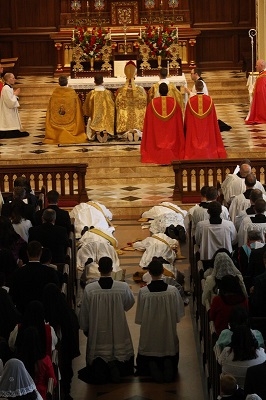
An astute reader reported some good news concerning the new Newman Center in Lincoln, Nebraska, a new church constructed in the traditional style which was featured in our May 31 column. The very day before, on May 30, 2015, the Newman Center hosted its first Holy Mass in the Extraordinary Form, an ordination Mass for the Priestly Fraternity of St. Peter. Bishop James Conley ordained six priests there, a most fitting choice considering that the previous site for FSSP ordinations, the Cathedral of the Diocese of Lincoln, has often been noted for being too modern architecturally for such ceremonies.
Confirmations in the EF at the OCLMA

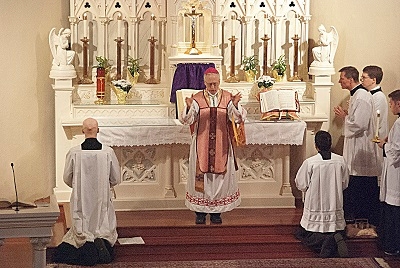
A reminder for those who have not yet heard: The Oakland County Latin Mass Association has been granted permission to have the Sacrament of Confirmation in the Extraordinary Form administered to those who express a desire and are prepared. Confirmations will take place at the 9:45 AM Mass on Sunday, November 8, 2015 at the Chapel of the Academy of the Sacred Heart in Bloomfield Hills. His Excellency Donald F. Hanchon, Auxiliary Bishop of the Archdiocese of Detroit, will administer the Sacrament. Those with an interest are urged to speak with Chaplain Msgr. Ronald Browne promptly, or to contact us via e-mail at: info@oclma.org. Since there are few occasions to receive this Sacrament in the Extraordinary Form, candidates from the entire Detroit metropolitan area are invited to apply.

Bishop Boyea to Celebrate EF Mass on June 26


Bishop Earl Boyea of the Diocese of Lansing has a long track record of celebrating Holy Masses in the Extraordinary Form, dating back to 2005 at St. Josaphat. His Excellency will offer the monthly Last Friday Mass for Juventútem on June 26 at 7:00 PM at St. Patrick Church in Brighton. A social and dance for young adults age 18-35 will follow the Mass; those of all ages are, as always, invited to the Mass. [Photo of Bishop Boyea at Old St. Patrick, Ann Arbor from the Unam Sanctam Cathólicam blog]

Confessions at Solanus Casey Center

A reader suggested that we make known the fact that the Sacrament of Confession is available six days per week, for many hours of the day, at Detroit’s [Fr.] Solanus Casey Center. Also known as the Capuchin Monastery of St. Bonaventure, the Solanus Center is regarded as the “Starbucks of Confessions” for its convenience. It’s not a secret; there is almost always a (short) line of penitents waiting, no matter the day or time. Visitors also have the opportunity to pray at the tomb of Fr. Solanus.

Confessions are heard Monday through Saturday on the hour at 10:00 AM, 11:00, 12:00 Noon, 2:00 PM, 3:00, and 4:00. The priest remains until all Confessions have been heard. There are two confessionals; a second priest helps out when the line gets long.

It is worth mentioning that the Confessions are heard without hurry, and absolution is given in proper (Ordinary) form. The Solanus Center is located at 1780 Mt. Elliott St. at Kercheval, approximately one mile north of Jefferson. Guarded parking is available in the lot on the north side of the property, with the vehicle entrance off Kercheval.

A little-known fact about St. Bonaventure’s is that there is a hidden chapel, located behind the now-unusable High Altar of the modernized main chapel, which, unlike that main chapel, is fairly traditionally arranged, including its own High Altar.

Tridentine Masses This Coming Week
  • Mon. 06/15 7:00 PM: Low Mass at St. Josaphat (St. Vitus & Companions, Martyrs)
  • Tue. 06/16 7:00 PM: Low Mass at Holy Name of Mary (Votive Mass of the Sacred Heart of Jesus)
[Comments? Please e-mail tridnews@detroitlatinmass.org. Previous columns are available at http://www.detroitlatinmass.org. This edition of Tridentine Community News, with minor editions, is from the St. Albertus (Detroit), Academy of the Sacred Heart (Bloomfield Hills), and St. Alphonsus and Holy Name of Mary Churches (Windsor) bulletin inserts for June 14, 2015. Hat tip to Alex Begin, author of the column.]

Sunday, March 01, 2015

The virtual inevitability of sin, the blessing of repeatable confession & absolution, and the increase of Christ in us

Fr. Eduard Perrone, "A Pastor's Descant" [temporary link] (Assumption Grotto News, March 1, 2015):
Life is not a continuous movement either in progress or regress. There are the ups and downs of living which, in the spiritual life, can be sorely disheartening. Once having set one’s feet on the way of Christ, determined to be a loyal and observant Christian, one soon discovers that there is no security, nor lasting guarantee of one’s new-found fidelity. There’s always the possibility of reversion to old bad ways and to wicked habits. “The dog returns to its vomit” (2 Peter 2:22); an expelled demon says, “I will return to my house from which I came” (Mt 12:44). Sanctifying grace is given to the soul as a “habit” (to use the traditional theological term), that is, as a permanent possession. Of itself it’s stable and meant to remain in the soul (in-habiting there) with the potential for increase through the exercise of the virtues, prayer, and the reception of the sacraments. Somehow–and it is enough of a common experience–a new situation arises in which evil begins to work its magical, seductive influence and–alas!–a moral fall is immanent. Anyone who has ever made a good confession with the sincere intention of sinning never again and who, nevertheless, falls back into the hated sin knows this unfortunate instability and delicacy of his spiritual state. According to the wishful thinking manifest in some Protestant circles, all one needs do to be saved is to make a once-and-for-all confession of belief in Christ as the Savior and then all will inevitably be well, right up unto entry into heaven. Would that it were so! The obvious fact is, however, that a person who can make such a declaration of faith in Christ by a free act of the will can also, by another act of will, make a counter decision to be disloyal and disobedient to Christ. With this reality of the changeableness, the inconstancy of the will our Lord instituted the sacrament of Confession for sins committed after baptism. The pledge is therein renewed, sins absolved, and one sets out from theconfessional determined to avoid sin and be henceforth invariably pleasing to God.

“Nothing is forever in this life.” I think about this every time I use some manufactured thing with its built-in, planned obsolescence which fails to work right. Too bad this saying applies as well to the inconstancy of decision to be faithful to God’s commandments and decrees. To train the mind and will to be unvarying in goodness is part of the reason why we need to be rather hard on ourselves in Lent. (Certainly, it must not be for morbid pleasure of the hardship. Lent is not to feed a pathological human condition but to remedy one.) Like an athlete who does repetitive movements to perfect his skills, the Christian needs the determined and constant exercise of moral disciplines to achieve regularity, consistency, fidelity. I doubt that anybody can ever ease up on self vigilance, no matter how advanced he may be along the way to spiritual perfection. The chances of slipping back, of regression, are always a possibility, though they should become more remote as one moves forward.

In a morning meditation from the writings of St. Gertrude, I read that Christ told her that every little act done in union with Him was as a pleasure to Him. That thought inspired the whole time of my prayer, thinking that our Lord might be so pleased with so little if only I would have a good intention and a clean soul. Making our beloved Lord pleased is that other motivation that should bestir us to be diligent in our Lenten promises. Not only we, but Christ Himself, would be the beneficiary of them, though for Him that can be so only in an analogous sense since He can’t become any greater, better or happier than infinite perfection already accords Him. Christ can only be ‘increased’ in the sense of a greater extension of His presence and influence in our souls, that is, exteriorly. And so, if this is case, we should wish Him to abound more and more in us. Lenten self-imposed practices attempt to make it so that obstacles to this are put down or at least weakened. How odd to think that I can get in Christ’s way of taking over myself!

A closing reminder that Fridays we have the Lenten fish fry (from fresh, not frozen, fish–I am told). While there, you would do well to hear the talk given on the Last Things–a good way to keep going forward this Lent.

Fr. Perrone

Tuesday, November 11, 2014

"Time to get onto a war footing"

Fr. Z expressed this sentiment back in the middle of the synodical proceedings in Rome on October 14th, but it's timely ever as it was then, as I'm increasingly convinced.

So we simply reiterate here what he said then: the weapons of our warfare are not carnal (physical). They include the following: Go to Confession. Pray the Rosary. Go to reverent celebrations of the Holy Mass (Father, as you know, stresses the Extraordinary Form). Fast. Offer up mortifications.

Now, more than ever, it is important not to let yourself stray into habitual sins, which emotionally cut you off from God and objectively cut you off from the graces of the Sacraments. Sin not only weakens you; it weakens the Church. Which is why the Sacrament of Reconciliation involves resolving your alienation from God but also reconciling yourself with the Church. Stay close to your Confessor(s).

Oremus invicem.

Monday, July 07, 2014

"PALE GAS" anyone?


Twenty seconds of PALE GAS as you lay in bed every night before you drift off to sleep can be good for your soul!

Saturday, March 02, 2013

Don't believe in mortal sin?

Cardinal Arinze explains the situation to you (from Fr. Tim Finigan, Hermeneutic of Continuity, via Fr. Z, March 2, 1013)


Fr. Z. writes:
I love this guy! He doesn’t mince words.

Card. Arinze (Cardinal Bishop of Velletri-Segni! HURRAY!) dismantles the notion that people can’t really commit a mortal sin unless they do something over and over again with the intent to separate from the God blah blah blah… the so-called “fundamental option” approach to sin.

He lays it down on the line about mortal sin.

By the way, let people who think that there isn’t really anyone in Hell – except maybe Hitler – reflect on the Cardinal’s words about mortal sin. MORTAL sin, right? It kills the like of grace in the soul. No sanctifying grace at the time of death? Then what happens?

When I hear some liberals say that they would like to have a Cardinal from Africa… heh heh… okay! They are pretty much like Card. Arinze when it comes to faith and morals.

Saturday, October 22, 2011

Forgiveness in Hollywood

Mark Moring, "Downey Jr. Pleads: Forgive Mel Gibson" (CT Entertainment, October 18, 2011).

Yes, of course, there is no mention of forgiveness by those whom were directly wronged, much less divine forgiveness. What is nevertheless good about Downey's speech is its clear embrace of our human need for forgiveness -- his own, Mel Gibson's, everyone in the audience, and the rest of us. As well as the need to own up to one's responsibility. Call it a secular analogue to Sacramental Confession.


[Hat tip to J.M.]

Saturday, December 06, 2008

Tridentine Community News, December 7, 2008

Extraordinary Form Confessions Now Available

Confessions are now being heard according to the Classic Form of the Sacrament beginning at 1:30 PM every Sunday at Windsor’s Assumption Church. Penance now joins Baptism, Requiem, Matrimony, and of course the Holy Sacrifice of the Mass as Sacraments available in the Tridentine forms in metropolitan Detroit. Fr. Peter Hrytsyk will assist first-time penitents in becoming accustomed to the Traditional formula.

St. Josaphat Church continues to offer Confession at 9:15 AM each Sunday according to the Ordinary Form. If you are interested in having Confession according to the Traditional Form at St. Josaphat, please inform Fr. Borkowski of your interest, so that he may consider familiarizing himself with the Extraordinary Form. If you write or e-mail, please provide your name and contact information, as anonymous requests will not be considered.

Below we reprint (an updated version of) our column of August 12, 2007, to reacquaint our readers with the Tridentine formula for Confession. From the perspective of the penitent, the Extraordinary Form of Penance is not all that different from what one would experience in a more traditional Novus Ordo setting.

The penitent enters the confessional and says, “Bless me Father, for I have sinned.”

The penitent makes the Sign of the Cross while the priest says, “The Lord be in Thy heart and on thy lips, that thou mayest rightly confess thy sins. In the name of the Father †, and of the Son, and of the Holy Ghost. Amen.”

The penitent tells the priest how long it has been since his last Confession, then recites the number and kind of his sins. The penitent concludes with a statement to the effect of, “For these and all my other sins, which I cannot presently remember, I am heartily sorry.”

The priest may ask some questions and give some advice. The priest will assign a penance.

The priest then says: “Misereátur tui omnípotens Deus, et dimíssis peccátis tuis, perdúcat te ad vitam ætérnam. Amen.”

(In English: “May almighty God have mercy on thee, and forgive thee all thy sins, and bring thee to life everlasting. Amen.”)

Holding his right hand over the penitent, the priest says: “Indulgéntiam, absolutiónem, et remissiónem peccatórum tuórum tríbuat tibi omnípotens et miséricors Dóminus. Amen.”

(In English: “May the almighty and merciful God grant thee indulgence, absolution, and remission of all thy sins. Amen.”)

Still holding his right hand over the penitent, the priest removes any impediments to the validity of the absolution he is about to give: “Dóminus noster Jesus Christus te absólvat; et ego auctoritáte ipsíus te absólvo ab omni vínculo excommunicatiónis, (suspensiónis,) et interdícti, in quantum possum et tu índiges.” If the penitent is a layman, the word “suspensiónis” is omitted.

(The English translation: “May our Lord Jesus Christ absolve thee; and by His authority I absolve thee from every bond of excommunication, (suspension,) and interdict, in proportion to my power and thy need.)

The priest recites the words of absolution while both the priest and the penitent make the Sign of the Cross. A bishop makes the Sign of the Cross three times: “Deínde ego te absólvo a peccátis tuis, in nómine Patris †, et Fílii, et Spíritus Sancti. Amen.”

(In English: “Thereupon, I absolve thee from thy sins, in the name of the Father †, and of the Son, and of the Holy Ghost. Amen.”)

Finally, the priest says a prayer for the remission of temporal punishment due for sins: “Passio Dómini nostri Jesu Christi, mérita Beátæ Maríæ Vírginis, et ómnium Sanctórum, quidquid boni féceris, et mali sustinúeris, sint tibi in remissiónem peccatórum, augméntum grátiæ et præmium vitæ ætérnæ. Amen.”

(In English: “May the passion of our Lord Jesus Christ, the merits of the Blessed Virgin Mary, and of all the saints, whatever good you shall have done, and evil you shall have endured, be to you unto remission of sins, increase of grace, and reward of eternal life. Amen.”)

Note that the Extraordinary Form of the Sacrament does not require the penitent to make an Act of Contrition. The priest does retain the option to request this, a sensible and laudable custom, prior to giving absolution.

Also note that canonically, a priest does not have the right to remove every kind of bond of excommunication. That is reserved to the diocesan Ordinary (bishop). Therefore, the prayer is careful to say, “in proportion to my power”. A priest must refrain from absolving difficult cases and refer the matter to a bishop.

The concluding prayer for remission of temporal punishment is a beautiful and appropriate follow-up to absolution, and is unique to the Extraordinary Form. The wording of the whole Sacrament helps to remind us that absolution is a serious matter, and emphasizes that the priest is acting in persóna Christi.

[Comments? Ideas for a future column? Please e-mail tridnews@stjosaphatchurch.org. Previous columns are available at www.stjosaphatchurch.org. This edition of Tridentine Community News is that of the St. Josaphat bulletin insert for November 30, 2008, with minor editions. Hat tip to A.B.]