A BOOK CRITIC’S IMPRESSIONS OF A LIVING CLASSIC
by Kenneth Colston
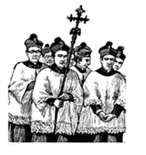
One scorching Corpus Christi in the first decade of this millennium, as an occasional book critic with a little time on my hands, I checked out the Traditional Latin Mass (TLM) that had been recently imported from France into my violent American city. I entered a surprisingly crowded but spookily silent neo-Gothic church that had been marked for demolition until the French order of priests took it over. It wasn’t hard to find: the steeple was 300 feet high. The gilded 52-foot-high reredos and a 40-foot-wide carved altar rail would have dropped Attila the Hun to his knees. Cassocks and fiddleback chasubles were back, auricular-only confession lines jammed, genuflections and signs of the cross abundant, brown scapulars visible, long dresses and covered shoulders
de rigueur, fasting obvious, and fertility robust.
Even though I taught Latin at a classical school, I couldn’t keep up with the intoned rises and falls. No worry, a priest said later, I
wasn’t talking to you. Procession and benediction around a decrepit inner-city block left thousands of rose petals on potholed streets. I didn’t get loose for three hours and felt that I had fallen in and out of an artistic and sartorial time warp. Thinking as a book critic, I suspected, even at first glance, that this blast from the past portended more than a restoration in liturgy alone.
I was in the presence of a living classic.
Two movements were slowly trending together in this diocese. Month after month, year after year, the suburban pews in Pizza Hut pagodas purged themselves of polo shirts and Bermuda shorts, of music ministries imitating the 1970s pop group Tony Orlando and Dawn, and of jolly priests roaming the pews with mics like local reporters at a ribs festival. Meanwhile, this German-crafted church was filling with young faces behind fine-lace veils and shoulders-back pressed suits. Inside a nave 130 feet long and 70 feet high, congregants said they were drawn by a more fitting beauty, and they professed piety and virtue with the example of their lives. What do they mean, why are their many children so well behaved, and why do they have their stuff so manifestly together?
First, more precisely, what accounts for this kind of antique beauty, and why should it animate followers of Christ, who wrote no treatise on aesthetics? An account of beauty challenged St. Thomas Aquinas, who no doubt occasionally heard Latin in Cologne or Paris, if not in Orvieto, chanted flat, out of measure, or poorly phrased. He wondered how the transcendentals were associated. Is
pulchrum a universal transcendental property of being, he asked, like bonum and verum? He made the following distinction:
Although the beautiful and the good are the same in the subject — because both clarity and consonance are included in the nature of the good — they are conceptually different. For beauty adds something to the good, namely, an order which enables cognition to know that a thing is of such a kind. (De Divinis Nominibus)
There it is: beauty helps us recognize the good and true. Moreover, it “gives pleasure.” The good and the beautiful are the same in the subject but are different notions. Aquinas explicates:
For the good, which is what all things desire, properly has to do with the idea of an end; for appetite is a kind of movement toward an end. Beauty, however, has to do with knowledge, for we call those things beautiful which please us when they are seen. (Summa Theologiae)
What are the necessary elements of the beautiful things, which “please us when they are seen”? Aquinas names them:
integritas (“perfection” or “lacking nothing”),
consonantia (“proportion” or “harmony”), and
claritas (“brightly colored”). Apply them to any artwork or liturgy, modest or grand, miniature or magnificent, and you can judge whether it’s beautiful and whether it can be associated with the true and good. Unlike pornography, which is brightly colored but out of proportion and lacking nearly everything, you both know beauty when you see it and you can define it. Thomas adds a gentle touch: Beauty gives not only pleasure but also “peace.”
This classical, objective view of beauty cannot, however, completely account for the majestic aesthetics of the
usus antiquior, for the post-Vatican II
Novus Ordo Mass (
NO) that knows its place within the genre can have a restrained integrity, minimalist harmony, and spare clarity. The
NO has the lean suggestiveness of Henry David Thoreau’s prose, Seneca rather than Cicero: short, sober homilies; simple hymns
a cappella (sometimes no music at all); the priest occasionally unaccompanied — provided the congregation be generally silent and prayerful enough for the Word to soak in and evangelize, which happens sometimes in early-morning weekday Masses but is almost always absent on Sundays. Sometimes, even in wall-to-wall, indoor-outdoor carpet, I actually enjoy the
NO, as I am fond of E.B. White’s essays and folk tales and Shaker hymns, especially when it approaches the quality of a first-rate Wednesday-night Protestant Bible study or when, as J.F. Powers once joked, I don’t hear much.
What is lacking in Aquinas’s account — but certainly not in the
usus antiquior itself, as Aquinas would have known it — is perhaps best explained by the famous Romantic element of the “sublime” elaborated by Edmund Burke in
A Philosophical Enquiry into the Origin of Our Ideas of the Sublime and Beautiful (1759), by which the object of beauty arouses
subjective feelings of terror. Nobody in the long procession of a Solemn Pontifical High Mass, not even the grammar-school altar boys, cracks a smile, glad hands, or forgets that it heads toward a
commemorated sacrifice. The rumbling bass notes of the organ can freeze you in the pew; the clanking thurifer chases away demons and occupies the kids; the plaintively chanted
mea culpas and lingering kyries beg for mercy through vowels that ache for infinite pardon. The Solemn High Mass is not merely reverential, for good manners and appropriate silence can achieve that. It is
sublime because we are brought to the edge of death, to the bar rail of a holy Niagara Falls, to the rim of a sacred volcano of sacrificial love.
The sublime is part of high aesthetic appreciation, but, contrary to the beautiful, it does not immediately give peace, pleasure, or relaxation. Burke claims it is “terrible,” “painful,” “tragic,” and “great.” The sublime is not “clear” but “obscure,” and the
usus antiquior, even the low version, solemnizes and imitates a mystery with its unfamiliar, complicated, even strange language, sounds, and vestments. The beautiful, arousing pleasure is “smooth, polished, light, delicate”; the sublime, arousing pain is “great, massive, dark, gloomy.” Though the sublime can even be “rugged and ugly,” these are not its defining qualities. Burke occasionally allows the same object to be both beautiful and sublime, but the categories are nonetheless distinct. The sublime exhibits “power,” “violence,” and “strength.” Its sources are “magnificence” and “magnitude,” like the “starry heavens,” a “rugged and broken vastness,” and the several “privations” of “darkness, solitude, and silence.” Verily, the sublime characterizes “the God of scripture,” in Burke’s account, for “wherever [He] is represented as appearing or speaking, everything terrible in nature is called up to heighten the awe and solemnity of the divine presence.”
Job testifies to God’s power over men, who cannot draw out Leviathan with a hook, and over the young, who hide from Him seated in the streets. In the Psalms, God’s anger makes the earth tremble, and He bows the heavens. Burke notes that the sublime also characterizes Satan, God’s counterfeit in John Milton’s Paradise Lost: Burke does not wish to make the sublime a transcendental of being. We don’t know whether Burke’s Catholic mother took him to Holy Mass, but his account of the sublime captures it perfectly. Through endless “succession and uniformity,” not only in Ciceronian collects and prefaces but also in the pillars and domes of “old cathedrals,” in which the
usus antiquior emerged and still prospers, one source of the sublime is “artificial infinity.” The associations with the majestic Creator are manifold.
Occasionally handsome, but never sublime, the NO makes no one tremble. It is meant to put one at ease, to reach out to the nations, to welcome into the fold, and so it soft-pedals its duty of propitiation, of atonement for sin. Today especially, however, comfortable sinners need to be afflicted. No less of a classical pianist and book critic than Pope Benedict XVI noticed the frequent absence of the sense of sacrifice and propitiation in the modern spirit of the liturgy. On the other hand, giving pleasure
and pain, the
usus antiquior is both beautiful
and sublime, even if it is not so in every respect of each, and it is particularly appropriate for our swollen times.
Alas,
mea maxima culpa, as dawn only suspends night,
post hoc if not
propter hoc, is it a surprise that divorce and apostasy often follow tepidity? Can the liturgy turn marriage away from sin, and children from infidelity? Over many years, as I attended the TLM and eventually joined the parish, I came to know the community. It is not composed, as a friend accused, of aesthetes merely “re-enacting,” like Confederate play-actors mustering once a year for a long-lost battle. The congregants are dead serious about worshiping in such a profound way that beauty should elevate their moral lives and so, as one put it, “eventually restore Christendom.” Even more stunning than the gorgeous Masses and devotions are the old-form parish activities that keep springing up: ballroom dancing, sacred-art studios, medieval craft guilds, chant classes, etc. Did the liturgy inspire these?
To put the question more expansively: Does liturgical exactitude, even the good taste acquired simply by following scrupulously the work of superior minds, beget moral virtues? Old forms, Burke and G.K. Chesterton agreed, contain forgotten but still valid and active wisdom, for sane conventions make it easier to be good even when they are not understood.
Lex orandi, lex credendi is the old formula: the manner of praying is the manner of believing. We might add,
lex orandi, lex vivendi, for why do the partisans of the TLM, especially the young, seem to have their catechism down cold and their many children
gently in tow, even if the occasional tattoo bespeaks wild oats gone to seed? Burke’s analysis offers two answers: the sublime evokes “terror, fear, astonishment, amazement, wonder, and awe” — words, he claims, etymologically interrelated in Latin and Greek (and in French and English) — and fear of the Lord is the beginning of wisdom. Second, “beauty,” Burke claims, “is a name I shall apply to all such qualities in things as induce in us a sense of affection and tenderness.”
Platonic aesthetics may say even more. Socrates, “no expert on modes” but a lover of moral wisdom, notes in the Republic that the various musical modes encourage specific characters: the Lydian encourages lamenting; the Ionian, drinking and relaxing; the Dorian, courage; and the Phrygian, moderation. For his well-ordered city, which both forms and flows from well-ordered souls, Socrates banned the first two sets of modes encouraging disorder, but he prized the virtues of courage and moderation promoted by the latter two, one “pleasant,” one “stern.” In addition, amateur musicologist Socrates banned certain instruments: the many-stringed harp and zither and the wide-ranging flute, which promote “luxury.” His musicology exhausted, he suggested that the maestro Damon be consulted for banning words and rhythms that express “meanness, insolence, madness, and other evils,” and for keeping those that express their opposites.
The eight basic Gregorian modes, derived from three of these Greek modes, similarly contain liturgical “affects,” which is a way of saying that they operate on our will through our bodies. In order, they include one solemn mode, one somber (Dorian courage), one mystic, one eternal (Phrygian moderation), two happy (Lydian lamentation), one grave, and one perfect (Mixolydian). It’s fascinating and fitting that the Ionian, or relaxing, Greek mode is absent from Pope Gregory’s scheme, and that the other one Socrates banned from his militarized
polis; the Lydian, or lamenting, is present twice (pure and mixed), paradoxically, with an incongruous “happy” affect. These surviving three, lamenting, courageous, and moderate, depend scrupulously on the echoing Latin vowels of Jerome’s Latin Vulgate and are always at the service of the two theological benchmarks of the Church seasons: the Incarnation and the Resurrection, or Advent-Christmas-Epiphany and Lent-Easter-Pentecost. The muted modes of the third short season, Septuaginta, unique to the TLM, initiating the 70 years of Babylonian captivity, when idolaters were in exile, seem written for our benighted, chaotic age, as does the “somber,” lonely
kyriale of Lent, when the organ is silent. Not alone in explaining comportment and not even its primary cause, these liturgical affects counsel in gentle sound-sermons sympathy, strength, and temperance. Unlike the classical city, moreover, the Christian
polis (the fading form of Western conglomerations), more aware of its own sinfulness, needs especially to express Lydian sorrow, a sorrow that expresses also, not so surprisingly for a Christian, a sighing happiness of the
felix culpa (“fortunate fault”).
Do you want to know why TLM families have their stuff together, why these web designers and IT experts read classics, learn chant, look after farm animals, sit still at classical-guitar concerts, churn raw-milk butter, form sewing guilds, organize black-tie ballroom dances, produce sacred art, and, of all things, bore wood with drill braces? “Mark the music,” answers Lorenzo in Shakespeare’s
Merchant of Venice. “The man who hath no music in himself, nor is not moved with concord of sweet sounds, is fit for treason, stratagems, and spoils.”
Of course, steadfast catechesis in a moral theology built on the natural moral law, the universal blueprint for human happiness, forms minds, but hearts are inspired and cultivated by the solemnized human voice and the resounding pipe organ, respectively “given pride of place” and “high esteem” by
Sacrosanctum Concilium, Vatican II’s “Constitution on the Sacred Liturgy.” They lift “up the mind” to “God and heavenly things,” with the domes and arched walls the powerful soundboard of fitting architecture. Sacred music is the ancient school of Christ, and an electric mic
non decet.
Is any direction other than “up” more needed in deeply fallen times? The two ancient throwback instruments of created grace — voice and organ — generate solemn order, quiet joy, humble piety, steadfast courage, and a gentleness that comes from looking
up and looking
for, along with a constant dose of the sobering “fear and trembling” of the sublime. As the U.S. Catholic bishops wrote, the human voice, “created in the likeness of God, is the primary liturgical instrument,” and it is best supported by the pipe organ, which resounds for large gatherings with “the fullness of human sentiments” and reminds us of “the immensity and magnificence of God” (
Sing to the Lord: Music in Divine Worship, 2007).
I know less about Gregorian modes than Socrates knew about the Greek ones, but maybe they stanch the flow of adrenalin and help us love our enemies. Or maybe it’s the curious do-si and fa-mi half steps, the single-sex monophony, or the haunting Solesmes
arsis and
thesis (rise and fall). I only know this: Stumble out into the mean streets after such otherworldly high-brow worship, like leaving a movie theater set in a magical land, and weep that cacophony, tom-toms, primal screams, and rap educate vice. “If music be the food of love, play on,” said Orsino in
Twelfth Night. He might as well have been talking about the voice and pipe organ’s “most holy foreplay” in the TLM. The adults become both more responsible and child-like,
mirabile dictu, and their children more ordered and wholesomely playful. Let’s face it: Good liturgy involves good taste, and, as Burke said in “On Taste,” taste depends on rational judgment, emotional maturity, and education — that is to say, the virtues.
My desperate hope for the TLM in the present pontificate, therefore, clings to reports that Pope Francis loves Italian opera and tango and doesn’t use a computer.
I’m not saying that chant cures skin cancer or shields off tornadoes, but I have watched this “nuclear fission of love,” as Benedict XVI called the Eucharist, mushroom in this gang-infested city even in the year his successor slammed down
Traditionis Custodes. A Chesterbellocian distributist Guild of SS Joachim and Anne sprang up and called for members to learn and teach the traditional crafts of sewing and woodworking. A homeschool cooperative with children’s catechisms took off, along with a sacred artist’s atelier, which had produced an oil portrait of St. Augustine commissioned for Benedict XVI and a towering study of Tiepolo’s
Immaculate Conception.
Bonum diffusum est — it is the nature of the good to flow forth, even into the barren spaces of blighted neighborhoods. One sermon boldly proposed the rare “thirty-fold harvest” of Josephite marriage, the “sixty-fold harvest” of widowed continence, and the “hundred-fold harvest” of perpetual virginity. The priests, including a few sent from generous bishops, were clocking a thousand confessions a month. Parishioners petitioned for adult catechism: first sessions covered three hours on
acedia, the sin of our
saeculum, as expounded by Evagrius of Pontus and Aquinas, followed by chanted Vespers. I swear I saw a six-year-old return on his knees across the marble floor during the consecration of a First Friday Mass. The young rector rules as a prudent
paterfamilias; French manners
d’une bonne éducation rule the oblates. Unafraid of manual labor, the French priest — in
soutane en laine, not
bleu de travail — helped restore the former convent’s slate roof and install a 58-rank Wilhelm organ with 2,760 pipes. Wise scholastic aphorisms whisper from confessionals and resound from the pulpit. The bulletin has warned with Salesian wisdom against would-be liturgy warriors on the front page: “The Holy Spirit does not enter the house where there is complaining, arguing, or quarrels.” (I hope I’m not guilty with this panegyric.) A Lenten pledge to fast from electronic media was promoted. A longstanding St. Vincent de Paul conference increased its activity during the pandemic. A 380-mile penitential pilgrimage to a backwoods monastery in Oklahoma carried several cars southwest.
I know I gush, but might the TLM be a material cause of this stately, measured, and sublime outpouring of the Spirit? It exposes an exception to Burke’s thinking that the great could not be beautiful but only sublime. And yet the staggering surprise of the orderly resurgence of behavioral orthodoxy from partisans of the
usus antiquior itself offers evidence that the natural elements of chant and finely tailored vestments beg also for a supernatural explanation. The Holy Spirit is evidently pleased with not only charismatic ecstasy but also quiet awe and joy in age-old forms. Seen up close or heard at a distance, who could wish this gone (our present Pope notwithstanding)?
Indeed, when
Traditionis Custodes fell like a hammer, a modest counter-reformation within the diocese was quietly infusing suburban worship, where a few energetic priests were taking up the cassock, singing Vespers with traditional canons, and peppering plainsong antiphonies and commons onto the music selections. Once chalice veil and burse showed up on the altar, and candle-bearers began to illumine the Gospel, modest veils popped up, reception on the tongue and kneeling occurred spontaneously, and confession lines and processions lengthened. In one parish, just off the soccer field, a life-size, outdoor
corpus was mounted by crafty sons of Bavaria, and an outdoor Corpus Christi procession intrigued unbaptized children, like pagan babies carried away by a Eucharistic revival. A dynamic diocesan seminary professor mounted another TLM oratory with studied schola within another gasping city parish. A Catholic study center at a local Jesuit university offered a kneeler, and veiled coeds sprang from the dorms. The extraordinary form was sowing tangy mustard seeds of penitential liturgical fusion back into the Roman rite, even as attendance shrank from COVID restrictions.
Summorum Pontificum had propagated this ressourcement. In the foreseeable distance was a time when an enriched
NO might have blended into a low TLM. If
Traditionis Custodes is ever read in continuity with the earlier motu proprio on the liturgy, however, it will find its fruit in a simultaneously more terrible and more peaceful beauty.
One more point: especially in middle-brow times, the
usus antiquior takes work and study by all, as the Greek root of “liturgy” suggests. It is an acquired taste, close to tragic opera in genre, and yet, at the same time, like opera, while unflinchingly highbrow, the Solemn Pontifical High Mass commands awe in first-time participants, whether peasant, accountant, or tinkerer. To be sure, holy Catholics attend NO Masses, and I still attend them by convenience and find them particularly satisfying when accompanied by chant, organ, and expressive lectors. To master a sublime spiritual experience is a way to get closer to a challenging God, however, and the traditional missal, Latin language, architectural setting, and music theory are huge helps. The payoff is that something this immediately arresting and yet also so complicated is less likely to become boring. It cannot be an argument against it, however, that we no longer have enough time for it. That might be only an explanation for why some wish it to disappear. There’s a Greek pun that sums up it and the Great Books:
kalepa ta kala (“Difficult, the beautiful things”).
What do the explosions and subsequent suspensions of the TLM portend for culture generally? Russell Kirk claimed that conservatives humbly look to the past because they are more aware of their own endemic sinfulness, marked, in St. John Henry Newman’s magnificent peroration, by some “terrible aboriginal calamity out of joint with the purposes of the Creator” (
Apologia pro Vita Sua), throwing a “curtain” over man’s “futurity” and yielding “the disappointments of life, the defeat of good, the success of evil, physical pain, mental anguish, the prevalence and intensity of sin, the pervading idolatries.” Penance is one of the distinctive rhetorical notes of both traditional worship and personal responsibility. It yields wizened joy rather than mere joviality, attempts to bring back ignored transcendence in the world, and is sorely needed now. I’ve been surprised to find sorrowful personal stories, cases of neglect and abandonment and self-abuse, alongside the teeming wholesome young families, at the
usus antiquior. I’ve seen the broken homeless there on their knees. They are drawn to sublimity, solemnity, and reverence, to be sure, but also to the minor-key, grief-stricken
mea maxima culpas of the second Confiteor, when fists triple-thump the broken heart. Who can’t notice the enormous desire to make resolute amendments of life in cooperation with mercy and the cry for propitiation? The irony of ironies that bites both sets of liturgy warriors, traditionalists and inculturalists, in different ways is that the
usus antiquior has flourished in the very culture credited with the supposed innovation or “development of doctrine” of Vatican II — America, Land of Religious Liberty — and yet is now resisted by the supposed defenders of Vatican II with the repressive, ultramontane tactics of which those defenders accused the pre-Vatican II Church.
As a patient priest one generation younger than the recently empowered Guardians of the New Tradition once told me, “We’ve got these guys a while longer.” The true believers of a New Order in pastoral practice now possess, like aging college administrators, the authority they once questioned. They pushed iconoclasm in their youth, and it is genuinely hard for them to see the jewels they had regarded as bling. Such custodians cannot go gently into the night. Their resistance to restoration is also, in part, a question of taste, and unexamined taste cannot be disputed. It can only be brought to examination. They bristled in their youth at Latin, moral-theology manuals, rote memory, votive candles and altar rails, genuflection and reception on the tongue, and all manner of formality as liturgical fussiness and intellectual narrow-mindedness, and so they can’t believe today’s abandoned young crave that from which they had worked so hard to liberate the Church, which they see as vain and speechless idols, sounding gongs, or even amulets. They judge lacework vestments not as exquisite offerings to God but as the “dress of grandmothers.” They once misread the human heart and material reality, and now, in their graying years, as this book critic judges, they are misreading the times.
If not gently, the Guardians of the New Tradition will still go. And yet I do not believe that restorationists in aesthetics and culture, given to formalism in poetry, the natural law in morality, draftsmanship in painting, complementarity and chastity in male-female relations, balance and detail in architecture, mystery in dramaturgy, dignity in dress and speech, gentleness in manners, awe in attitude, and judicious humility in all things, however slight and circumscribed, will perish from the earth.
Kenneth Colston’s articles and reviews have appeared in Logos: A Journal of Catholic Thought and Culture, Saint Austin Review, The New Criterion, Homiletic & Pastoral Review, Crisis, and First Things.
©2023 New Oxford Review. All Rights Reserved.
The foregoing article, "
Does Good Liturgy Beget Moral Virtue?,"
was originally published in the June, 2023 issue of the New Oxford Review and is reproduced here by kind permission of New Oxford Review
, 1069 Kains Ave., Berkeley, CA 94706.



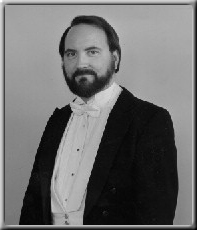 St. Joseph Church offered the most Tridentine-y Novus Ordo Latin Mass of all, celebrated ad oriéntem with a full crew of altar servers and an ambitious music program led by the late Thomas M. Kuras. Tom offered a comprehensive repertoire encompassing Gregorian Chant, Ambrosian Chant, and sacred polyphony, with an Aspérges at the beginning of Mass and Benediction after Mass every Sunday. This writer served at the altar there during the heady years of the 1980s and 90s when the holy and tradition-friendly Fr. Thomas Bresnahan was pastor.
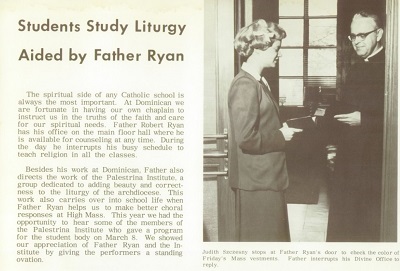 From the article: “The curriculum was thorough and well-conceived with instruction in Gregorian chant, chant notation, singing, breathing (an important element in the proper rendition of chant), chironomy (chant conducting), and accompaniment. Instruction in the liturgy, church law, music theory, ear training, history, choir technique, vocal pedagogy with a specialty in boy choirs, organ registration, modulation, improvisation, diocesan legislation, bibliography, how to deal with pastors and choirs, and the deportment of a church musician.” The full curriculum is documented in great detail in the article. [Photo of Palestrina Institute Assistant Director Fr. Robert Ryan from the 1962 Dominican High School Yearbook]
Though one might think that the glory days of the Palestrina Institute are in the past, as recently as 2018, there was a short-lived effort to bring back the Institute, this time with a primary focus on instruction on playing the pipe organ. However, the two individuals who were pushing for its resuscitation ended up leaving the employ of the Archdiocese of Detroit, and the idea has been shelved for the time being. Hopefully diocesan leadership will see the value of training the next generation of music directors and keeping Detroit a center for traditional liturgy.
From the article: “The curriculum was thorough and well-conceived with instruction in Gregorian chant, chant notation, singing, breathing (an important element in the proper rendition of chant), chironomy (chant conducting), and accompaniment. Instruction in the liturgy, church law, music theory, ear training, history, choir technique, vocal pedagogy with a specialty in boy choirs, organ registration, modulation, improvisation, diocesan legislation, bibliography, how to deal with pastors and choirs, and the deportment of a church musician.” The full curriculum is documented in great detail in the article. [Photo of Palestrina Institute Assistant Director Fr. Robert Ryan from the 1962 Dominican High School Yearbook]
Though one might think that the glory days of the Palestrina Institute are in the past, as recently as 2018, there was a short-lived effort to bring back the Institute, this time with a primary focus on instruction on playing the pipe organ. However, the two individuals who were pushing for its resuscitation ended up leaving the employ of the Archdiocese of Detroit, and the idea has been shelved for the time being. Hopefully diocesan leadership will see the value of training the next generation of music directors and keeping Detroit a center for traditional liturgy.