Showing posts with label Bible. Show all posts

Sunday, February 24, 2019

Fr. Perrone: a foreboding of the world falling into darkness under some impending, overpowering evil

Fr. Eduard Perrone, "A Pastor's Descant" (Assumption Grotto News, February 17, 2019)
You may wonder from time to time, as I do, where we may be in the line of human history. Are we in its last days? Or are we nearing a time of great tribulation like that which preceded the outbreak of the two great World Wars, when the forces of evil were gathering strength but awareness of them was slight and th strength to resist them wanting? I think about this (as I mused in a recent sermon) with reference to Germany just before its takeover by the Nazi party. There's a feeling of apprehension in the air that some overpowering evil is about to descend upon us -- the USA and the Catholic Church. There have been times of mounting tension in society and in the Church where things somehow worked themselves out without the worst happening. I'm trying to understand if ours is but a passing moment testing our endurance or the prelude to some great catastrophe.

Along comes my reading of the Divine Office -- the prayerbook every priest is obliged to say everyday -- where the following passage is given for this Wednesday past, a portion of Saint Paul's Second Epistle to Timothy. It reads like a prepared script characterizing people of our time in surprisingly accurate detail. "In the last days, dangerous times will come. Men will be lovers of self, covetous, haughty, proud, blasphemers, disobedient to parents, ungrateful, criminal, heartless, faithless, slanderers, incontinent, merciless, unkind, treacherous, stubborn, puffed up with pride, loving pleasure more than God, having a semblance of piety." One would be hard put to amass a better compilation of adjectives to describe people at this time. In another letter, the Apostle writes, "There shall come a time when men will not endure sound doctrine, but according to their onw desire they will heap to themselves teachers, having itching ears, and will indeed turn away from hearing the truth, but will turn to fables." Translation: people hearing only what they want to hear.

I get tired of the endless regression of things, from bad to worse. No matter where I turn, in education, politics, jurisprudence, the Vatican, and just about anywhere else, good initiatives are shot down, those of good will are stymied or punished, and the wicked go from success to success. Priests doing the things they're supposed to do are being squeezed in on two fronts -- opposed by their parishioners from below and chastised by their superiors from above. "Catholic" politicians promote child killing and sodomy with impunity by the Church and are reelected to office. Abortions can't be stopped. Innocent children are being hopelessly trapped in addictions to electronic media, porn, and in gender uncertainty. Most people seem oblivious to the dissolution of civilized society and to the crisis in the Church. All bad news. The single exception to the barrage of distressing reports is the economy which is doing very well, I'm told. But might this not also be a veiled misfortune signifying that our love of money (Mammon) prevails over every other concern?

I know this is a confused mixture of secular and ecclesiastical woes. And that's the point. They're coming together as in a strange coalition (dare I say, collusion?) such that one wonders whether some nefarious Mastermind is so arranging events in the world and in the Church to conspire in a huge eruption of wickedness incapable of abatement. In that case, "last days" would not be a far-fetched estimation of our present moment. In any case, the times are out of joint. My recourse to this unrelenting assault of evil is to implore God's intervention through more focused and frequent prayers of reparation.

Maybe this alarming message, whatever its intrinsic value, is a good inroad to Septuagesima, the pre-Lenten season which opens today for Latin Mass goers but which can be useful to everyone as the season of penance approaches. Speaking for myself, I'm going to give thought to how my Lenten practices might manage to sway our Lord to bring relief from the evils plaguing us. You also should get mentally ready for Lent now so as to greet its arrival eagerly, like true soldiers ready to do battle for the cause of Christ. Like it or not, you may find yourselves embroiled in the conflict.

Fr. Perrone

P.S. Before I take leave of you, don't forget Dr. Blosser's philosophy class today (Sunday) in the lounge after the noon Mass. Feed your mind!

Friday, October 20, 2017

Bibles

From one of my readers, worth reading:
VERY interesting ...

A Jew in the court of King James...
"...more than any other English translation of Scripture, the KJV is driven by an 'idea of majesty' whose 'qualities are those of grace, stateliness, scale, [and] power.'"
Also, Leland Ryken's "What Makes the King James Version Great?" (Reformation 21, January 2011) ...

"Schuyler Canterbury KJV" (Lectio, January 10, 2017).

Meanwhile there is also this ... Alex Blechle, "A Millennial's thoughts on Bible Translation" (Catholic Bibles, September 12, 2017).

The comments are interesting.
[Hat tip to JM]

Sunday, October 15, 2017

Fr. Perrone: without an intense, devout life, Catholics will not survive the age

Eduard Perrone, "A Pastor's Descant" (Assumption Grotto News, October 15, 2017):
The saintly priest, learned theologian, and catechist extraordinaire, Fr. John A. Hardon, was fond of saying that without an intense, devout life Catholics will not survive the age. I admit that at the time I thought this a ruse to shock his audience into taking their faith seriously. The longer I live in this age, however, the more I become convinced that this priest got it right. In recent decades we've seen great numbers of Catholics cease to practice their faith while others have exited the Church for small community non-denominational churches or trendy mega-churches that offer swingin' and swayin' worship services with an appealing "prosperity" message. I've heard many a sorrow-laden complaint from Catholics who have lost family members or relatives to such groups. It seems that no family has been wholly exempt from the defection. I did a little checking among my own family and close relatives to see how things stacked up in this regard. In a fast count from a pool of 52 family members and close relatives on my mother's side only (my siblings and their children, uncles, aunts, and first cousins), there were only 20 out of 52 still practicing the Catholic faith in which they were reared and living in a Christian manner.

These facts may make us wonder about many things. First, of the necessity of faith in Christ and of keeping His commandments. Without whole-hearted acceptance of all that Christ has revealed by His Church and without a state of grace, one cannot hope to be saved. Then, about the Church. It is by definition one, founded by our Lord: "Upon this rock I will build My Church" with Peter as its rock foundation (Mt 16:18). It is this Church which holds the true doctrine of Christ since it alone is "the pillar and bulwark of the truth" (1 Tim 3:15). Christ's apostles and their line of successors were handlers-on (transmitters) of 'tradition,' that is, of their authority, powers, the truth and the practices they received from Christ. Efforts to deviate from that apostolic inheritance were made from the earliest days of the Church. Thus were the faithful flock warned of those who would deceive and mislead the flock, false teachers and false prophets (Mt 24:24; 2 Tim 4:3-4), those "even of your own number" who would "draw away the disciples after them" (Acts 20:30). On account of the ever present danger of being misled and of departing from truth, Saint Paul admonished succeeding generations of the Church to "guard the truth that has been entrusted to you" (2 Tim 1:14) and to "hold to the traditions which you were taught by us, either by word of mouth of by [written] letter" (2 Thes 2:15).

The Catholic Church is the only Church which has existed uninterruptedly from apostolic times, unbroken in historical continuity. This is an indisputable fact. You will find the Catholic Church in every year since the first day of the Christian era. While the church as Christ's body has matured and organically grown in acquiring a greater clarity in its beliefs (the creed), in a more developed way of celebrating the Christian "mysteries" (the liturgy and the sacraments), and in a worldwide institutional expansion, yet she has remained true to her divine charter, being essentially as she has always been from the beginning and as she is destined to remain until the Lord returns.

The claim is made, of course, that the Catholic Church at some point erred and went astray from what Christ had intended from the beginning. [But] with the publication and now easy availability of the Fathers of the Church (and especially of the Apostolic Fathers -- those who immediately succeeded the apostles) and other early Church writings, it is clear for anyone who would care to investigate the matter that the early Church is the same Catholic Church we know today in all essential aspects. From these documents we learn many things: how Mass was said and the sacraments celebrated; the deeper theological understanding of the faith revealed in time by the Holy Spirit (who "will teach you all things, and bring to remembrance all that I have said to you" (Jn 14:26) and which was formulated in the ancient creedal statements; how holy orders were transmitted from bishop to bishop, and from bishop to priest; etc. Only the Catholic Church did all these things from the beginning of the Christian era and only she continues to do them faithfully.

The problem of defection from the true Church and from its faith plagued the Church from its earliest days. Already in the Book of Revelation we find mention of a sect known as the Nicolaitans (e.g. 2:6). St. Paul wrote against the beliefs of the Gnostics. Aberrant sects claiming to be some manner or other of 'church' apart from the unique historical body of the Catholic Church are fraudulent. There can't be a 'spontaneous generation' of a new Christian body claiming to be in any sense authentic. There must be, and is, but 'one body, one Spirit, one hope, one faith, one baptism, one God' (cf. Eph 4:4-5).

Of course, in our families there are those who are simply non-practitioners, those who still regard themselves as Catholics but who can't be bothered going to Sunday Mass or to Confession. Our Lord warned that the way to salvation was a narrow one, that few would find it (Mt 7:14), and that when He would return to earth there might be but a few who would have kept the faith (cf. Lk 18:8).

there are many diverse reasons why people cease to practice the Catholic faith or who leave holy Church for something other. The lure of sensuality and worldliness -- always a powerful force -- is not to be discounted. There's also the scandalous lives of bad Catholics which are discouraging; the incredible permissive things we now hear coming from Rome, from certain bishops, "theologians," and priests; the fallout from the clergy scandals of recent times; the enormous ignorance of Catholics about their faith and their history; the irreverent way priests and laity deport themselves at Mass such as to belie the doctrines of the Real Presence and the sacrificial nature of the Mass; the great number of divorces with remarriages of Catholics outside the Church; the Church's condemnation of all forms of artificial birth control; the circulation of the pernicious teaching that "one religion is as good as another" (indifferentism). Take all these things together and ... voilà! ... you have all that's needed for a great exodus from the true Church.

Christ is not indifferent about truth, about fidelity to the practice of the faith, or about His Church. The only Church which has perdured through the centuries since the time of its founding is the one, true Church of Christ: the Catholic Church, a truth "which nobody can deny, which nobody can deny."

Fr. Perrone

P.S. Today, Sunday, marks the fourth anniversary of my Mother's death. Mom and Dad were devout believers both. How profoundly grateful I am for the faith my parents passed on to me! I pray for them and I pray to them for the return of our family members who have strayed from the one truth Catholic Church.

Saturday, August 26, 2017

"All words have lost their meanings now."


For a man whose favorite mode of communication seems to be carrier pigeons, our underground correspondent somewhere in an Atlantic seaboard state, Guy Noir - Private Eye, seems surprisingly savvy about contemporary electronic technology. He used some sort of messenger app on his smart phone (didn't know he even had one) to contact me today as I was sitting at my computer. All of a sudden, there he was, bushy beard and all. One might have mistaken him for one of them mountain men up in the hollers of the Appalachian mountains.

Anyway, he blurts out: "Peter Kreeft has a new book out on world religions. [This is the one I think he had in mind.] At Amazon, one reviewer calls him an 'exclusivist.'"

At which point Noir, without letting me get a word in edgewise, contorts his bearded face and simply yells into his phone: "TO WHICH I REPLY, ALL WORDS HAVE LOST THEIR MEANINGS NOW!"

"Well, what do you mean?" says I.

And he replies: "I esteem Kreeft and his writing, but he engates in wishful thinking and his solutions are compromises of the Wojtyla-Ratzinger-Bergoglio sort."

"Whaaaa???" says I.

"They do not solve problems but amplify them," says he. "Ratzinger has a book called Faith and the Future, which is like a political pamphlet in its effort to please."


"This is more on point ..." says he, "old but useful." And he sends me while still on messenger (don't ask how, I wouldn't know), sending me a link to this article by Stan Guthrie, "Whose Submission? A Muslim-Christian dialogue," a critical review of Kreeft's Between Allah and Jesus: What Christians Can Learn from Muslims from some years back.

Guthrie begins his review by quoting the first line of Kreeft's earlier classic, Between Heaven and Hell, about three luminaries -- John F. Kennedy, Aldous Huxley, and C. S. Lewis -- who each died on November 22, 1963. In the first line from that book, JFK asks, "Where the hell are we?"

Guthrie observes that he had a similar reaction after reading Kreeft's later work, Between Allah and Jesuss, noting that it seems to stand the earlier one on its head, making a Muslim protagonist "a stand-in for the Lord," even having him claim to be "a better Christian than his Christian foils." Of course, given the state of Christian catechesis these days, this may not be too far from the truth in some cases.

In any case, Kreeft, Guthrie, and Noir all raise an important question to think about: Have our words lost all their meanings now, or, at least, are we in danger of our words losing their meaning? If we accept von Balthasar or Fr. Barron's hypothesis that hell could be empty, or nearly empty, for example, has our use of the word 'salvation' or 'redemption' lost all meaning? It's a fair question. And the same could be asked of our 'pastoral' use of words like 'love,' 'mercy,' and 'forgiveness,' in venues where there is almost no reference to 'repentance' or 'contrition.' If all religions present genuine paths to God and all non-Christians, Protestants, and members of sectarian religious cults have a reasonable expectation of finding themselves in heaven in the world to come, then what's the point of converting to the Catholic Faith? For that matter, what's the point of the New Evangelization? Sweet, merciful Jesus could be so severe at times:
Enter by the narrow gate; for wide is the gate and broad is the way that leads to destruction, and there are many who go in by it. Because narrow is the gate and difficult is the way which leads to life, and there are few who find it. (Matthew 7:13-14)

Thursday, August 24, 2017

Wow!! Whole verses missing from a popular Protestant translation of the New Testament!!


I just heard this today from a Catholic program and didn't believe it; so I had to look up these allegedly missing verses and see for myself. The following verses are missing from the New International Version, a popular Protestant translation; and if you don't have a copy at hand, you can check online by going to Bible Gateway and selecting "New International Version" ("NIV" for short) and looking up the following verses. It may help to have another version that includes these verses open in another screen to check them side by side. Often you can see that the omission is explicitly tendentious. There things they don't want the reader to see. Here you go:
  • Matthew 17:20
  • Matthew 18:11
  • John 5:4
  • Acts 8:27
  • Acts 15:34
  • Acts 24:7
  • Romans 16:24
Check them out. They're not there!!!

Several years ago I pointed out something else about this same translation of the Bible that I actually learned from a very honest Protestant theology professor of mine at Westminster Theological Seminary. He had written an article in The Reformed Journal (no longer extant) about the disingenuous work of the translators. I wrote about it in "Retrieving a lost Catholic vocabulary" (Musings, June 11, 2014):
On my journey to the Catholic Faith, which began in 1987 before being received in the Church in 1993, those who sought to dissuade me constantly pitted the "living Word of God" (the Bible) over against the "vain traditions of man" (Col. 2:8) allegedly represented by Catholicism. So entrenched was this animus against Catholic tradition, that one of my Protestant theology professors, James Payton, Jr. to his credit pointed out that the evangelical New International Version (NIV) of the Bible explicitly attempts to "de-Catholicize" those passages where Paul commends the Church's traditions (1 Cor 11:2, 1 Thes 2:15; 3:6) by translating the Greek word for "traditions" as "teachings," while translating the remaining ten references which are all negative as "traditions" (as in vain and empty "traditions of man").
You hear about these sorts of things, but half the time you don't really believe them until you go and check for yourself. This is awful, and I commend James Payton, Jr., for his integrity and honesty on this point.

[Hat tip to "The One True Faith Revisited: Where Did The Bible Come From?" The Download, August 11, 2017 for the reference to missing Bible verses in the NIV.]

Monday, April 17, 2017

A faithless retired Episcopal priest's demythologized Easter 'homily'


Harry T. Cook, "On Easter, an alternative approach to resurrection" (Detroit Free Press, April 15, 2017):
The Easter story is not the work of journalists. No good can come from torturing it into news, good or otherwise. It is a story with meaning. What is its meaning? It cannot be that a convicted revolutionary who was executed on a Friday walked out of his grave on Sunday to the profound amazement of his followers. Is it possible that the meaning of the story is that while you can kill a human being, you cannot kill what he or she has been or done?
Pitiful. Pitiful that good people ever come to believe such complete nonsense. Pitiful in the way St. Paul says that we would be of all people most to be pitied if Jesus hadn't been raised from the dead as claimed (providing an intricate logical syllogism to that effect in 1 Corinthians 15).

Even on empirical grounds, how pitiful is it to believe that miracles "can't happen" because, well, just because "miracles don't happen." Even if all the stars in the heavens arranged themselves so as to spell "Jesus saves," such individuals would probably respond: "Why, goodness me! What a remarkable coincidence! It almost looks as if someone has played some sort of optical trick on us."

There are accounts of other resurrected deities? Like Dionysus? Yeah, so what? Where have they left a paper trail of witnesses and martyrs like Jesus has? The Apostles must have been deceived about Jesus' resurrection? You think? One can be deceived about lots of things, but some things are just too big to be deceived about. A resurrected man is one of these. I doubt one could be anymore deceived about a man being resurrected from the dead than be deceived into thinking that exactly 37 pink pigs with wings are hovering in the air like hummingbirds just outside one's window.

But it could have been in the Apostles' self-interest to believe the Jesus rose from the dead. True. But it could also be in your own self-interest to believe that exactly 37 pink pigs with wings are hovering in the air like hummingbirds just outside your window if I offered you $1 million to believe that. Trouble is, our honest beliefs aren't quite under our control the way our ordinary choices are. I can't really bring myself to believe something just because someone offers to pay me money to believe it.

If course, I could say I believed it, even if I didn't. So maybe the Apostles conspired to lie about Jesus' resurrection? You think? When each of them (except for John) went to his martyrdom knowing that all he'd have to do is refuse to go along with the lie anymore, to just break and tell the truth and admit that Jesus didn't rise from the dead? Furthermore, each of these conspirators would have known that each of his fellow conspirators was lying through his teeth in the face of terrible persecution, torture, and the threat of death, and all that would have to happen if for one of them to break and tell the truth, and the whole resurrection story would go down in flames as a failure not worth being martyred for.

So we have a story people just can't be mistaken about of someone rising from the dead, and a story that the Apostles' couldn't possibly have conspired to lie about, given the fact that each of them (except John), knowing that it is human nature to break under torture, nevertheless willingly gave his life as a martyr for the authenticity of the story with not one of them throwing in the towel and denying its authenticity. Not to mention centuries of martyrs and witnesses to lives changed, relationships redeemed, bodies and souls healed in expectation of life eternal.

Pray for Harry T. Cook. Poor man. Pitiful.

Sunday, April 09, 2017

If There's an Antichrist, What About an Antimary?

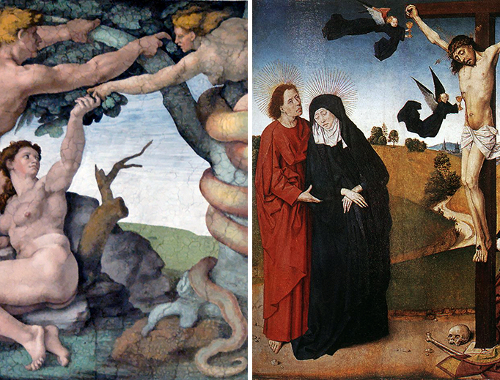
LEFT: Michelangelo, “The Fall of Adam and Eve and their Expulsion from the Garden” from the Sistine Chapel. RIGHT: Master of the Life of the Virgin, “Christ on the Cross with Mary, John and Mary Magdalene”, between 1465 and 1470.
* * * * * * *

Carrie Gress, "If There's an Antichrist, What About an Antimary?" (National Catholic Register, January 27, 2017): No matter how strong the “spirit of antimary” may be, Mary still remains the most powerful woman in the world:
While researching my latest book, The Marian Option: God’s Solution to a Civilization in Crisis (Tan Books, May 2017), I was struck by a new theological concept. I kept running across the notion that Mary is the New Eve—an idea that goes back to the early Church Fathers. Mary as the New Eve is the female complement to Christ, the New Adam. In Scripture, St. John speaks of an antichrist as a man, but also as a movement that is present throughout history (1 John 4:3, 2 John 1:7). This got me thinking: if there is an antichrist, perhaps there is a female complement, an antimary?

What, then, would an antimary movement look like, exactly? Well, these women would not value children. They would be bawdy, vulgar, and angry. They would rage against the idea of anything resembling humble obedience or self-sacrifice for others. They would be petulant, shallow, catty, and overly sensuous. They would also be self-absorbed, manipulative, gossipy, anxious, and ambitious. In short, it would be everything that Mary is not.

While behavior like this has been put under a microscope because of the Women’s March on Washington, D.C., the trend of women-behaving-badly is nothing new. There is, however, ample evidence that we witnessing something, because of its massive scale, quite different from run-of-the-mill vice seen throughout history.

The treatment of motherhood is one of the first signs that we are dealing with a new movement. Mothers (both spiritual and biological) are a natural icon of Mary – to help others know who Mary is by their generosity, patience, compassion, peace, intuition, and ability to nurture souls. Mary’s love (and the love of mothers) offers one of the best images of what God’s love is like – unconditional, healing, and deeply personal.

The last few decades have witnessed the subtle erasing of the Marian icon in real women. First through the pill, then the advent of abortion, motherhood has been on the chopping block. Motherhood has become dispensable, to that point that today the broader culture doesn’t bat an eye when a child is adopted by two men.

Saturday, April 01, 2017

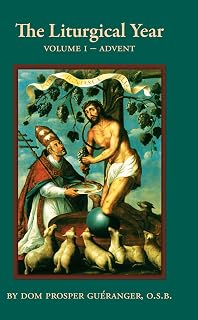
Guéranger: the Church reminds us of the apostasy of the Jewish nation - Part II

Continuing from last week our examination of supercessionism in Volume 5 of Dom Prosper Guéranger's The Liturgical Year,the Gospel reading for Friday of the second week of Lent is from Mt 21, where we find the Parable of the Vineyard whose husbandmen eventually kill the owner's heir, that is, his very own son who was sent to them.

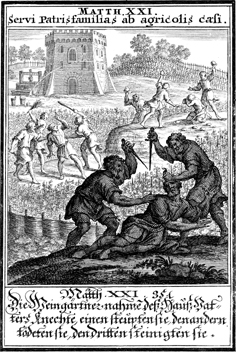
Here we have more than the mere figures of the old Law, which show us our Redeemer in the far distant future; we have the great reality. Yet a little while, and the thrice holy Victim will have fallen beneath the blows of His persecutors. How awful and solemn are the words of Jesus, as His last hour approaches! His enemies feel the full weight of what He says; but, in their pride, they are determined to keep up their opposition to Him, who is the Wisdom of the Father. They have made up their minds not to acknowledge Him to be what they well know He is -- the stone, on which he that falls shall be broken, and which shall grind to powder him on whom it shall fall. But what is the vineyard, of which our Lord here speaks? It is revealed truth; it is the rule of faith and morals; it is the universal expectation of the promised Redeemer; and, lastly, it is the family of the children of God, His inheritance, His Church. God had chosen the Synagogue as the depository of such a treasure; He willed that His vineyard should be carefully kept, that it should yield fruit under their keeping, and that they should always look upon it as His possession, and one that was most dear to Him. But, in its hard-heartedness and avarice, the Synagogue appropriated the Lord's vineyard to itself. In vain did He, at various times, send His prophets to reclaim His rights; the faithless husbandmen put them to death. The Son of God, the Heir, comes in Person. Surely, they will receive Him with due respect, and pay Him the homage due to His divine character! But no; they have formed a plot against Him; they intend to cast Him forth out of the vineyard, and kill Him. Come, then, ye Gentiles, and avenge this God! Leave not a stone on a stone of the guilty city that has uttered this terrible curse: 'May His Blood be upon us and upon our children!' [Mt 17:25] But you shall be more than the ministers of the divine justice; you yourselves are now the favored people of God. The apostasy of these ungrateful Jews is the beginning of your salvation. You are to be the keepers of the vineyard to the end of time; you are to feed on its fruits, for they now belong to you. From east and west, from north and south, come the great Pasch, that is being prepared! Come to the font of salvation, O ye new people, who are gathered unto God from all nations under the sun! Your mother the Church will fill up from you, if you be faithful, the number of the elect; and when her work is dome, her Spouse will return, as the dread Judge, to condemn those who would not know the time of their visitation. [Lk 19:44]

Sunday, March 26, 2017

Discovering Guéranger's rare and insightful Biblical commentary

A very generous friend recently sent me the 15-volume set of Dom Prosper Guéranger's The Liturgical Year. I had run across that name and title numerous times in reading liturgical history, but never picked up a copy and read it. Till now. At first the books just looked sort of like a very traditional hardback version of the 'Magnificat' periodical with lectionary readings from (and commentary) on the traditional Latin rite liturgy.

But then I started to read the commentary on the readings for each day of Lent, and the commentary -- in my humble opinion -- is some of the most profound and most accessible Catholic Biblical commentary I have ever encountered. The magnitude of the project (15 volumes) is nothing short of breath-taking. You can use each volume as a substitute for a 1962 Missal because it has all the ordinary parts of the Mass as well as the Propers for each day of the season.

Any student of Aquinas and his Summa Theologiae knows there are more senses to the meaning of a Biblical text than the fundamental literal or historical sense. There's the allegorial, anagogical, as well as other spiritual senses of Scripture. This is where Gueranger's commentary is particularly rich. He draws parallels that wouldn't have occurred to me in my wildest dreams; and the thing is, they're usually utterly compelling. To read them is to have new horizons opened up before oneself that wouldn't have occurred to you previously.

It's always been a temptation of mine to assume that Protestant writers had a better handle on Scripture than Catholics -- and in the last 80 years, chances are, that could be be right. But even twenty years ago, my assumption began to erode as I read books about where we got our English translation of the Catholic Bible, for example; and as I read some of the commentaries by Jerome and Augustine and Thomas and others. But Gueranger is simply amazing. Just amazing. There is a gold mine here for any priest interested in material for homilies.

Sunday, March 12, 2017

Fr. Perrone: How to rid yourself of sins this Lent

Fr. Eduard Perrone, "A Pastor's Descant" (Assumption Grotto News, March 12, 2017):
Lent is a time for self-reflection on our sins: how we got into committing them, how we rid ourselves of them, and -- this is important -- how we can compensate for them. Perhaps we think little of that latter thing. We have more often in mind our sins as transgressions of reason and God's laws and we feel the need to be freed of them through Confession. Yet we should also recognize that our sins have disrupted the objective moral order, causing external damage, so to say, as well as the interior harm done to ourselves. This needs to be redressed. The scales of justice have to be balanced after the objective order has been disturbed.

The Church and sacred scripture borrow the language of commerce to explain sin and its redress as a kind of spiritual transaction. (God's side is another matter. His it is to pardon, to forgive as He pleases, usually through absolution of the priest.) On our part, sin has contracted a debt owed to the offended majesty of God. This is the objective 'damage' done to Him by our sins. Such debts incurred through our misdeeds demand repayment, satisfaction. We must have some means of paying this debt; hence the necessity to do good works: prayer,d enial of the use of some good things, giving alms to the needy, etc. Of ourselves we are unable to make full repayment for sin to the all-holy God. While He may have written off the debt of sin without requiring any satisfaction, He did not do this. He asks, demands compensation from us, even though He substantially paid the whole debt Himself by becoming man and by suffering and dying for our justification and salvation. That redemptive act of Christ more than compensated for all the offenses contracted against God. Yet, out of justice, He expects satisfaction to be made also by the offenders, each one contributing some part. Through belonging to the great society oand union of the Church we are able to offer God Christ's acquired sum of good works He did for us as payment for the debts of our own sins. (An aside: This seems unfair. How is it that we can borrow from another's accumulated 'treasure,' appropriate it to ourselves and use it in payment for our sins? A mystery!) We know that we can indeed offer from the pool of wealth that is the merit of our Lord's Passion and death, and the added sum of merits of the Blessed Virgin Mary and the saints, against our indebtedness to God for our sins. One draws from this 'bank account' when gaining indulgences (grants given through the Church) and when one offers Christ's sacrifice of Himself in the Mass, in union with the priest; or when one says, in the chaplet of Divine Mercy, "Eternal Father, I offer You the body, blood ... of Jesus." We offer God a sum not our own. This is possible through our incorporation into the Church by which we have, so to speak, a joint bank account of the merits of christ, Our Lady, and the saints.

We should all want to leave this life, when we die, debt free. Otherwise, we shall remain in purgatory until we will have "paid the last penny" in payment of the whole amount of our debt to God (cf. the servant in the parable threatened with being sold in payment of a debt). Only when it will be fully paid will the scale of justice in our regard be rightly balanced and we will become justly fit for heaven where "nothing defiled" can enter.

Lent is now here. We ought to do two things: 1) pay off the debt of our sins by works of penance; 2) draw upon the merits of Christ and the saints by our prayers, the co-offerings of Mass, and gaining the Church's indulgences for ourselves and for the souls in purgatory -- helping them pay their debts out of our love for them.

Do as much good as you can while you have time for yourselves and for others. "Now is the acceptable time." This is the reason we have Lent.

P.S. James Likoudis will be here today after the 9:30 Mass for a book-signing. Jim is an outstanding layman -- he would no doubt blush to hear his praises -- author and lecturer, defender of the faith. Onetime national president of Catholics United for the Faith (CUF) which in a time of terrible confusion and revolution in the Church fought to preserve our Catholic patrimony in doctrine, worship, and catechesis. (Believe it or not, there was a time in recent history when things were worse than they now are. CUF is one of the reasons for the betterment of the present state of the Church in this country. I welcome Mr. Likoudis, who has written compellingly about the rapprochement of the Orthodox Churches with the Catholic church. We wish him much added grace and rich blessings.

Fr. Perrone

Saturday, March 04, 2017

Two Bible texts that look like they were written for today

  • "Alien let in is whirlwind let in, that shall alienate from thee all thou hast." (Ecclesiasticus 11:36, Knox translation)

  • "O God, why has thou cast us off unto the end? why is thy wrath enkindled against the sheep of thy pasture? ... see what things the enemy hath done wickedly in the sanctuary. And they that hate thee have made their boasts, in the midst of thy solemnity.... They have set fire to thy sanctuary: they have defiled the dwelling-place of thy name on the earth. They said in their heart, the whole kindred of them together: Let us abolish all the festival days of God from the land. Our signs we have not seen, there is now no prophet: and he will know us no more." (Psalm 73: 1, 3-4, 7-9, Douay-Rheims translation)
[Hat tip to ABS for Ps. 73 reference]

Saturday, December 24, 2016

A Christmas Reflection: What if the Biblical Narrative were True?

It's time to reconsider the reason for the season and the challenges offered by the drive-by "experts" of the day who intend to cast the entire Biblical narrative concerning the Blessed Nativity into doubt. Consider again the Biblical narrative:
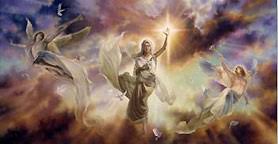
And suddenly there was with the angel a multitude of the heavenly host, praising God, and saying,
Glory to God in the highest and on earth peace, good will toward men.
And it came to pass, as the angels were gone away from them into heaven, the shepherds said one to another,
Let us now go even unto Bethlehem, and see this thing which is come to pas, which the Lord hath made known unto us.
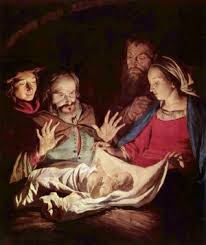
And they came with haste, and found Mary, and Joseph and the babe lying in a manger. And when they had seen it, they made known abroad the saying which was told them concerning this child. And all they that heard it wondered at those things which were told them by the shepherds. But Mary kept all these things, and pondered them in her heart. And the shepherds returned, glorifying and praising God for all the things that they had heard and seen, as it was told unto them. (The Gospel According to Luke, Chapter Two, Verses 13-20)

Here we are again, on the first day of the Christmas season. It has become something of a Christmas tradition for me to engage the following text by C.S. Lewis in connection with the above quoted Scriptures. The reason will be obvious.

Nearly every Christmas, it seems, NEWSWEEK or TIME or some television special will feature the "latest scholarship" questioning the "authenticity" of the Christmas story. I am not concerned with the question about whether the Nativity of our Lord occurred on December 25th. That's a matter of Church tradition and incidental to my concerns here. What concerns me is how the Biblical narrative itself is invariably called into question or even dismissed as mere "myth" -- the account of the shepherds, the Angelic host, the Christ Child in a manger, the Star and the Magi from the East, Herod's slaughter of the innocents, the flight of Mary and Joseph and the Christ Child into Egypt, etc.

The scholarly authorities typically interviewed, whether Catholic or Protestant, are consistently and incorrigibly one-sided, quite thoroughly corrupted by the Humean and Kantian philosophical presuppositions undergirding the historical-critical reading of the Biblical narrative. Typical is the About.com website, where Internet browsers frequent to learn "the facts" about this or that -- a site where one finds this sort of thinking gone to seed in an article by Austin Cline, "Nativity vs Gospels: Are the Gospels Reliable About Jesus' Birth?" (About.com), where the partisan skepticism of such historical critical assumptions is abundantly evident in his suggestions that all the key ingredients of the Nativity story in the Gospels were concocted fictions of various kinds.

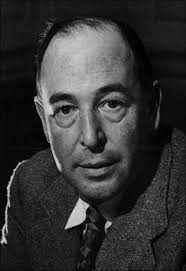
The lack of critical circumspection, if not patent fantasy, in all of this would be amusing if it were not so destructive. The upshot is always the same: that the Gospel writers are unreliable and not to be trusted, and certainly not to be taken at face value. Just how ludicrous this all is, however, can be seen easily by anyone with a modicum of familiarity with literature, mythology, and history. One of the best examples of a powerful antedote to this kind of foolishness -- and one I keep using because it is simple -- is a little essay by C.S. Lewis entitled "Modern Theology and Biblical Criticism," which is available in a collection of essays by Lewis entitled Christian Reflections (1967; reprinted by Eerdmans, 1994). The following are some excerpts from Lewis' essay, which begins on p. 152 and contains four objections (or what he calls "bleats") about modern New Testament scholarship:
1. [If a scholar] tells me that something in a Gospel is legend or romance, I want to know how many legends and romances he has read, how well his palate is trained in detecting them by the flavour...

I have been reading poems, romances, vision-literature, legends, myths all my life. I know what they are like. I know that not one [of the stories in the Gospel of John, for example] is like this... Either this is reportage - though it may no doubt contain errors - pretty close up to the facts; nearly as close as Boswell. Or else, some unknown writer in the second century, without known predecessors or successors, suddenly anticipated the whole technique of modern, novelistic, realistic narrative...

2. All theology of the liberal type involves at some point - and often involves throughout - the claim that the real behaviour and purpose and teaching of Christ came very rapidly to be misunderstood and misrepresented by his followers, and has been recovered or exhumed only by modern scholars... The idea that any... writer should be opaque to those who lived in the same culture, spoke the same language, shared the same habitual imagery and unconscious assumptions, and yet be transparent to those who have none of these advantages, is in my opinion preposterous. There is an a priori improbability in it which almost no argument and no evidence could counterbalance.

3. Thirdly, I find in these theologians a constant use of the principle that the miraculous does not occur... This is a purely philosophical question. Scholars, as scholars, speak on it with no more authority than anyone else. The canon 'if miraculous, unhistorical' is one they bring to their study of the texts, not one they have learned from it. If one is speaking of authority, the united authority of all the Biblical critics in the world counts here for nothing.

4. My fourth bleat is my loudest and longest. Reviewers [of my own books, and of books by friends whose real history I knew] both friendly and hostile... will tell you what public events had directed the author's mind to this or that, what other authors influenced him, what his over-all intention was, what sort of audience he principally addressed, why - and when - he did everything... My impression is that in the whole of my experience not one of these guesses has on any one point been right; the method shows a record of 100 per cent failure.

The 'assured results of modern scholarship', as to the way in which an old book was written, are 'assured', we may conclude, only because those who knew the facts are dead and can't blow the gaff... The Biblical critics, whatever reconstructions they devise, can never be crudely proved wrong. St. Mark is dead. When they meet St. Peter there will be more pressing matters to discuss.

However... we are not fundamentalists... Of course we agree that passages almost verbally identical cannot be independent. It is as we glide away from this into reconstructions of a subtler and more ambitious kind that our faith in the method wavers... The sort of statement that arouses our deepest scepticism is the statement that something in a Gospel cannot be historical because it shows a theology or an ecclesiology too developed for so early a date...

Such are the reactions of one bleating layman... Once the layman was anxious to hide the fact that he believed so much less than the Vicar; he now tends to hide the fact that he believes so much more...
Lewis, of course, was hardly a naive ignoramus. He knew all the critical objections to Christianity because for the first part of his life he was himself a confirmed agnostic. He was anything but "soft-minded," to use the Jamesian idiom. He taught philosophy at Oxford briefly before going on to teach Medieval and Renaissance literature at Magdalen College, Oxford, and conclude his prolific academic career teaching at Cambridge. An account of his conversion can be found in his Surprised by Joy: The Shape of My Early Life,in which we find the following quotation:
You must picture me alone in that room in Magdalen, night after night, feeling, whenever my mind lifted even for a second from my work, the steady, unrelenting approach of Him whom I so earnestly desired not to meet. That which I greatly feared had at last come upon me. In the Trinity Term of 1929 I gave in, and admitted that God was God, and knelt and prayed: perhaps, that night, the most dejected and reluctant convert in all England. I did not then see what is now the most shining and obvious thing; the Divine humility which will accept a convert even on such terms. The Prodigal Son at least walked home on his own feet. But who can duly adore that Love which will open the high gates to a prodigal who is brought in kicking, struggling, resentful, and darting his eyes in every direction for a chance of escape? The words “compelle intrare,” compel them to come in, have been so abused be wicked men that we shudder at them; but, properly understood, they plumb the depth of the Divine mercy. The hardness of God is kinder than the softness of men, and His compulsion is our liberation. (emphasis added)
Lewis, an Anglican, was a man of deep Catholic habit of mind, probably because of his immersion in medieval literature; and many have wondered why he never himself crossed the Tiber. Walker Percy even compared him to Moses, who led many others to the Promised Land, though never himself crossing over. A number of books have been written about this, like Joseph Pearce's C.S. Lewis and the Catholic Church,and Christopher Derrick's C.S.Lewis and the Church of Rome.The most probable reason is cultural: his father was an Ulsterman. Whatever the reason, his common sense criticisms of those Biblical "experts" who attempt to dismantle the entire Biblical narrative under the influence of Enlightenment prejudices, can be accepted with gratitude.

For further reading: Merry Christmas everyone!

Monday, December 05, 2016

Fr. Perrone on Advent: Killjoy or comfort?

Fr. Eduard Perrone, "A Pastor's Descant" (Assumption Grotto News, December 4, 2016):
Advent proposes to us multiple senses of Christ's coming: in the historical past, the present, and the yet to come. One aspect of this most of us would rather not ponder is His coming as the Judge of every man's conscience. I have been meditating on this in my early morning orisons of the past week only to rediscover its poignancy to affect the deep interior of my soul.

Meditating on the Last Judgment is about self confrontation as much as about being judged. I wonder whether my life's evaluation then will set me among the sheep sequestered from the goats (the hymn Dies Irae). A standard of self-measure is whether I will have been found a friend or an enemy of christ's cross. The feast of Saint Andrew last Wednesday brought this to my mind. When he beheld the cross that had been prepared for his own death, he exclaimed, "O desired cross, receive a disciple of Christ: by means of you may He receive me." Applied to myself, I wonder whether I will have been so converted from my selfness as to have become worthy of the cross of Christ -- or in St. Paul's words, whether I had been crucified with Christ so as to have taken on His life. Like a simple home self-administered medical-test, I can guage somewhat where I will stand before God.

This sober reflection takes some of the saccharine coating off of our pre-holiday frivolities -- sorry to be the killjoy. But what use is the pretense of yet another Christmas season if we have not assumed a Christian identity, that of a son of God with an inheritance of Christ's eternal riches?

You owe it to yourself to picture the arrival of the Judge, and yourself beneathHis judgment seat when all your life's story will be an open book. Every thought, desire and deed ... made public. I can't bear now to anticipate the terrible sound of anger in the voice of the Just Judge in pronouncing His verdict for the damned, "Depart from Me." I need rather to imagine His encouraging word that gives me the hope that my repentance now will have been sincere enough, that my amendment of life sufficient so as to hear His voice of comfort (the word literally means strength) mediated through the Church: "speak tenderly to Jerusalem for her guilt is expiated" (Isaiah). Living now, in the time before the final judgment, I must ever be somewhat uneasy, unsure. Whether I will be set on the right or the left I cannot know with certainty. With neither presumption nor despair, I have hope to see my God face to face -- His of a radiant, rapturous look of divine love. This is the advent I long for. That I'm unworthy of it goes without saying; but I have no other goal in life but this. For the present time, this advent, I pray for deliverance from the evils I can yet commit, the only obstacles to the attainment of my desire. I could never have this hope without the invasion of divine grace into my miserable soul and the steadying patronage of the holy Virgin Mary. This for me is advent. Speaking of Her reminds me that Thursday coming is a holy day of obligation, in Her honor: the Immaculate Conception. Under this title She is patroness of our country for which we have been praying daily. Masses on Thursday will be as on a Sunday (6:30, 9:30, noon) plus an evening Mass at 7:00 p.m. (To anticipate your question: 'No. The evening Mass on Wednesday will not be of the holy day.')

Fr. Perrone

Sunday, November 13, 2016

The other (neglected) side of biblical mercy


Remember that wonderful Psalm about mercy and loving kindness and compassion? (Psalm 135 in the older Catholic numbering and Psalm 136 in the newer common numbering) People who know it love its refrain: "... for His mercy endures forever." Other translations have "for His steadfast love endures forever," or "for His loving kindness endures forever." But one of the most common translations is 'mercy.' Both the Douay-Reims and the King James Bible use 'mercy.'

But however this tender, compassionate, loving word is translated into English, there's another side to it that is often neglected. You know that if you stand for anything, you have to oppose something, right? If you love justice, you have to hate injustice. The Bible is very clear on this 'other side' to love, compassion, kindness, and, yes, mercy. Though it's easy to lose sight of this in today's pervasive and oft-too-giddy talk of 'mercy.'

I'm about half-way through Holy Scripture once again in one of my periodic read-throughs, which I cannot recommend highly enough. The blessings and riches of the Bible are beyond telling. So I'm in the Psalms, and I've just been reading the Psalm in question. And half-way through last night, I noticed the following which made me sit up and take notice in a way I hadn't before -- probably precisely because of all the recent talk of 'mercy.' Here are the verses in question from the Msgr. Ronald Knox translation of the Bible [Note: the spelling of 'Pharao' is Knox's]:
Eternal his mercy, who smote the Egyptians by smiting their first-born ...
Eternal the mercy that drowned in the Red Sea Pharao and Pharao's men ...
Eternal the mercy that smote great kings ...
Eternal the mercy that slew the kings in their pride, Sehon king of the Amorrhites,
His mercy is eternal,
And Og the king of Basan,
His mercy is eternal.
Think about it. Why are these smitings and drownings and slayings 'merciful'? It's not as obvious as you'd think. Yes, He's merciful to those whom He saved from these oppressors. But start down that rabbit hole and you'll find much more!

Wednesday, October 26, 2016

There he goes again ...

I just saw this article by Edward Pentin: "Pope Francis: Rigid People Are Sick" (National Catholic Register, October 24, 2016). In this article, convention Catholics who insist on believing and practicing what the Church has always taught are told by the Holy Father that they suffer from a "pathological sickness" which renders them "heretics, not Catholics," that they are advocates of a "self-absorbed promethean neopelagianism," and need to loosen up and embrace the God of mercy whose gifts are "meekness," "benevolence," and "forgiveness," but "never rigidity."

I couldn't help thinking of Matthew 5:17-20 and wondering what the Pope of Mercy would have to say about the words of Jesus:
“Do not think that I came to destroy the Law or the Prophets. I did not come to destroy but to fulfill. For assuredly, I say to you, till heaven and earth pass away, one jot or one tittle will by no means pass from the law till all is fulfilled. Whoever therefore breaks one of the least of these commandments, and teaches men so, shall be called least in the kingdom of heaven; but whoever does and teaches them, he shall be called great in the kingdom of heaven. For I say to you, that unless your righteousness exceeds the righteousness of the scribes and Pharisees, you will by no means enter the kingdom of heaven."
Why is the Gospel made to appear in the words of some Church leaders like a wax nose, which can be bent easily to serve the whims of prevailing ideologies?

[Hat tip to K.J.]

Monday, September 19, 2016

Two demurrals from Mirus

Edward Peters, "My I demur re Mirus this once?" (In the Light of the Law, September 13, 2016):
Pretty much everything Dr. Jeff Mirus writes is worth reading, but his latest column, correctly defending Pope Francis against charges of heresy based on his endorsement of the Buenos Aires Directive, overstates the argument in one small, technical regard and, I think, misses a larger, more important point in another. I basically agree with everything Mirus wrote, except as follows. Read more >>
Dr. John Lamont, "Dr. Jeffrey Mirus on marriage and the Eucharist" - via "Op-Ed: 'Adultery as a venial sin' -- and other absurdities of trying to defend the indefensible Francis Doctrine" (Rorate Caeli, September 15, 2016):
Dr. Jeffrey Mirus has recently published an article entitled ‘Not heretical: Pope Francis’ approval of the Argentine bishops’ policy on invalid marriages’ [available here]. The object of this article is to argue that Pope Francis has not asserted or endorsed heresy in approving of a recent document issued by some Argentinian bishops concerning the apostolic exhortation Amoris Laetitia. To justify this conclusion, Dr. Mirus makes a number of claims about moral behaviour and the discipline of the sacraments.

These claims urgently need to be addressed. Read more >>
Related: And now a response from Dr. Jeff Mirus, "Papal governance by sleight-of-hand strains my grasp of culpability and Canon Law" (CatholicCulture.org, September 16, 2016).

Thursday, September 01, 2016

Huzzah! Shattered glass!

One brick through the pane glass window of established scientific wisdom ...

Dwight Garner, "Tom Wolfe’s ‘The Kingdom of Speech’ Takes Aim at Darwin and Chomsky" (New York Times, August 30, 2016)
... and another brick though the stained glass window of much of the ruling class of the Catholic Church ...

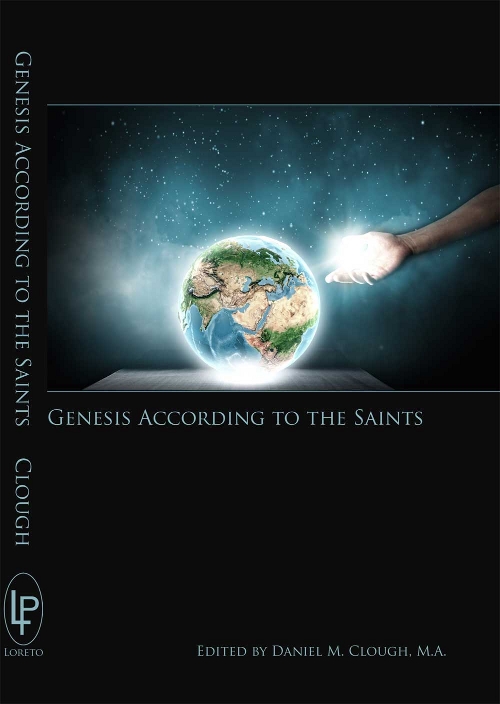
Edited by Daniel M. Clough, Genesis According to the Saints (Loretto Publications, 2016).
Brilliant!

[Hat tip to JM]

Monday, July 04, 2016

"Learning to Love Leviticus"

An older post worth reading, by John Barach (Theopolis Institute, December 9, 2014). As Guy Noir says:
Point 2 especially should strike a chord with us. Canon law, the Latin Mass, indulgences, St. Rose of Lima.... Yes, as freshly-scrubbed and World Youth Day-ready as we all want to make the faith appear, we all also know that at its base it is both amazingly true-to-life and relevant and at the same time foreign, otherworldly, and weird. No matter how many interviews we set up between atheists and popes...
Yes, worth reading.

I had a professor once, whom I eminently respect, H.E. Runner, who used to suggest that most Christians get the Bible wrong by trying to read the New Testament as though that alone were their Bible. Exaggerating to make his point, he would say: "The New Testament is nothing more than an appendix to the Old Testament to show us that its promises come to be fulfilled."

Sunday, June 19, 2016

Fr. Perrone: Catholics sometimes "leave the Church" because the treasures they forfeit thereby are often hidden by dissent and confusion

Fr. Eduard Perrone, "A Pastor's Descant" (Assumption Grotto News, June 19, 2016):
The word is sometimes heard from disaffected Catholics -- those who may have got their feelings hurt by something a priest told them, or who perhaps have been perpetually bored by the vacuous preaching and inane liturgical antics in their parish churches -- that they have decided to "leave the Catholic Church." (I wrote recently on this with regard to certain relatives of mine.) What these people probably do not know is that there is no other Church whither they may go. There is only one Church, and it must be the Catholic Church, the Church of the ages, the one that has apostolic lineage and belief. Never mind whatever alleged corruptions may ave entered into her over the centuries. As a body of humans, the Church cannot be without fault. But as a divine institution, the one created by Christ, she must be that of which Saint Paul wrote: holy, spotless and without wrinkle.

The unfortunate, ignorant defector from the Church may one day come to the realization that there is nothing good outside the Catholic Church that she herself has not always had, and that, to boot, other Christian groups came into existence on account of their departures from the true doctrines espoused by the only Church.

One would not get very far in saying the Apostles Creed to realize that without the Catholic Church there would be no certainty of what to believe about nearly anything. Let's see, for example: "I believe in God the Father almighty ..." How is one sure that in God there is paternity, and that He is limitless in power? (Note that this is only the first line of the creed.) One may attempt to answer by saying that Jesus taught the existence of the Father. But was this meant merely to be taken as a figure of speech, when He only meant to indicate divinity, pure and simple; or perhaps did Christ mean that there is indeed a distinct Person in God who is called the Father? This question in turn leads one to ask: Who is this Jesus to speak authoritatively, such that one is compelled to believe that there is a Father in God? Is this speaker, Christ the "Son" Himself God, or does He merely bear a relationship to this Father-God in a way like a human son to his dad? One might ask further whether this Father is truly "almighty" (in the creed) or whether He may be limited in some way: Can He do literally all things? (At one time there wre heretical Christians who denied this.) And finally: Is the teaching of Christ, upon which this opening phrase of the creed is derived, accurately reported in the bible? In other words: Is the bible itself a reliable record of what Christ said? Yet further: Who said that the bible ought to be the norm and measure by which we are to believe anything? Could it perhaps be merely a series of pious documents -- admirable perhaps -- but not binding on the prospective believer for his salvation?

None of these questions can be settled with certainty without the authoritative teaching of the Catholic Church which has the guarantee of infallible truth. Should one depart from it, one must necessarily lose the stability, the footing upon which faith must depend. In such case, one would be set adrift in a sea of any number of alternative possibilities of what may be true about God and other spiritual realities. The Catholic Church is the "pillar and ground of truth," in the words of Saint Paul, who came to understand this, not from the bible (which then did not exist as such), but directly from Christ and from the apostles who proceeded him in the one truth Church. The Church then must be a supernatural reality and not a mere human institution (even though it is composed of men). The Church, in fact, is the body of Christ, an extension of Himself (its Head) into His members. When one leaves the true Church in search of anything other, he necessarily departs from Christ Himself. This he may do with little or even not culpability, depending on what he knew he was doing thereby, but the significance of taking leave of the Church is most serious.

I write this because I know there are Catholics who have no idea of what the Church is. They were badly catechized and were left substantially ignorant about it. Some of them, coming to an awakening of spiritual sensibilities, became dismayed over their local Catholic parish and its secular, silly, half-hearted religiosity, and left the true Church for some other exciting, interesting expression of Christian belief. Others became so bored by their spiritually lifeless parishes that they simply dropped out and bothered themselves no further with religion.

You, dear people, need to have at least a vague sense of appreciation of the necessity of the Church for your salvation. Without the one and only Church established by Christ you'd be literally astray, lost, and off the only track that can bring you to salvation. As I indicated, you cannot even profess the Creed, nor can you rely on the veracity of the bible, unless the authority of Christ's church were the foundation of those beliefs.

After this brief lesson in the foundation for even the most elementary truths of the faith, how would you ever be able to profess more complex expressions such as "consubstantial with the Father," or "begotten, not made;" or "proceeds from the Father and the Son;" -- unless you had the Church assuring you of their truth?

Outside the Catholic church there is only falsehood, and perhaps a simulation of truth, a semblance, a substitution for its truth -- what Plato called opinion, as opposed to truth. That you are a Catholic is due to the sheer benevolence of God. Your gratitude to Him should know no bounds.

Fr. Perrone