Showing posts with label Converts. Show all posts

Sunday, March 11, 2018

"Despondent Converts"

Thomas Howard, "Despondent Converts" (CatholiCity, March 8, 2010):
Reprinted with permission.

I receive, not infrequently, inquiries by mail from recent converts to the Church who, after a year or so as new Catholics, find themselves wondering about this and that. All of these letters are from former Evangelicals who have read themselves joyfully into the Church. With their earnest, muscular, biblically oriented background in the free churches, or in the Episcopal Church to which they had migrated because of its liturgy, at some point they had come upon such books as Newman's Essay on the Development of Christian Doctrine, or Karl Adam's The Spirit of Catholicism, or The Catechism of the Catholic Church, or one of the volumes from the recent flood of testimonials from erstwhile Evangelicals recounting their own itinerary to the Ancient Church.

In most cases, they have, in the course of this reading, been dazzled by the sheer serenity of the Catholic Church, derived from its immense antiquity, its undoubted apostolicity, its liturgy and sacraments, its Magisterium, and its unswerving fidelity to the Deposit of Faith over the last two millennia – often in the face of heresies, war, tyranny, and sin in the camp. The marks of their own piety hitherto have been the great marks of Reformation and Evangelical Christianity: sedulous personal study of Scripture, with its corollary of exhaustive familiarity with the whole Bible; an atmosphere of talkative friendliness and "sharing" of spiritual matters among their fellows; meaty biblical preaching on the part of the clergy; a somber distrust of the pitfalls to be found in 19th-century German historical/critical methods of Scripture scholarship; and a strong sense of "knowing the Lord Jesus Christ as personal Savior" on the part of every individual. Until their entry into it, these good people understood the Church to be, quite simply, the dispersed aggregate of all individuals scattered across the globe who believe in Christ.

Any lifelong Catholic reading this will anticipate straightaway the questions such a convert finds himself entertaining: Why does no one greet me at Mass? There's not much animated Christian fellowship around here. Nobody sings the hymns – and there seems to be an impoverished fund of hymnody in any case. I'm not sure what to make of the preaching: As often as not, it doesn't sound like the fruit of studious and prayerful preparation. But most puzzling of all, the pastor seems to have identified himself with the dissenters in the Church. He appears to have espoused what Popes Pius IX and X would have called "Modernism." The homilies often seem to reflect popular notions on morals and politics championed by the New York Times, NPR, and the Washington Post.

How shall I respond to my correspondent? What would you say? What would Benedict XVI or John Paul II or Cardinal Newman say?

A start might be made by encouraging our friend to reflect on the question as to what the Catholic Church is. Certainly the ambience in a Catholic parish is different from that found in the Evangelical churches of his background. The observations are understandable; so it may be helpful for him to canvass again the reasons that moved him to make his obedience to this ancient Church in the first place. What is the Catholic Church?

It is what it claims to be. It is the Church of God's New Covenant with man, built by Jesus Christ on the foundation of the prophets and apostles. And – as was the case with Israel, who was the bearer of God's earlier Covenant with her – the Church is God's people. But it is God's people – human beings who turn out to be weak, wayward, and often untrustworthy. The Hebrews, as often as not, made a hash of things. Their very first high priest (Aaron) made them a golden calf to worship. They had wicked priests, wicked kings, unfaithful prophets, and no shortage of bad men in their midst.

But God looked on them as His Spouse, as He does on the Church. In both cases, the very thing that God Himself was bringing into being was shot through with human sinfulness and failure. God's forbearing grace was at work, century after weary century. A faithful Catholic does not throw in the sponge over the phenomenon of bad Renaissance popes, other than to deplore their evil doings: the Church, Christ's Mystical Body, does not stand or fall with the faltering fidelity of us mortals. (It is interesting to note in this connection that no pope, be he never so wicked, ever taught from Peter's chair that his simony, avarice, luxury, nepotism, and lechery were anything other than sin. He never substituted the euphemism "style of life" for the stark category "sin." Dante, a fierce Catholic, had half of his popes in hell.)

Whereas Protestantism, when discord, heresy, or scandal arises, can always split off and start a new parish or denomination, the Ancient Church has no such option. As was the case with the Hebrew Covenant, earnest and faithful men had no warrant to hive off into the wilderness and start things over if there was unfaithfulness in the camp. We recall Elijah and Hezekiah, and Simeon and Anna and Joseph and Mary: faithful Hebrews in the temple, and eventually the synagogue that fell under the power of "scribes, Pharisees, and hypocrites." These faithful men and women never thought of starting up a new, pure sect.

Fortunately for us, the Church has been served by godly and faithful pontiffs for a very long time now. It is an article of faith that the Church Herself will never teach falsehood. If a given priest or bishop ever sponsors novel or unscriptural ideas in place of the Deposit of Faith, it is of course to be deprecated, and parishioners in such a parish or diocese have to try to fix their gaze on what the Catholic Church teaches. If Father X, in the name of affability, is distributing Communion to non-Catholics, or tacitly endorsing abortion, or winking at moral disorder in the parish, we know that confusion, infidelity, and disobedience are at work here. But the Catholic Church is a hierarchical Church. Only rarely might it ever fall to a layman to try, on his own authority, to set things right. He may, in a pinch of course, venture inquiries. But the Catholic's ordinary duty is fidelity to the Church and to her teaching – which is to say, of course, to Sacred Scripture, the Magisterium, and the Petrine authority in Rome.

But all of this brings us to the question as to why we go to Church in the first place. A Protestant goes for the preaching primarily, and then for the fellowship. Why, on the other hand, does a Catholic go to Church? We go to offer the Sacrifice of the Mass; to join ourselves with the ancient and apostolic Church as she joins herself to her Head and High Priest, Jesus Christ, in his eternal self-offering to the Father, which offering was made present in our history, once and for all, at Calvary, as a perfect oblation of thanksgiving, and as the propitiation for our sins.

A Catholic lives there. This is the lodestar, the anchor point of everything, the Still Point of the Turning World. All other aspects of Catholic life – private prayer, the rosary, the divine office, the sacraments, retreats, pilgrimages, and works of mercy – find their wellspring here. This has been going on for 2,000 years. Other factors – war, plague, one's own weaknesses and sins, domestic tragedy, clerical infidelity – can never dry up this fountainhead of Catholic life.

These remarks, of course, do not bring easy consolation to a confused or distressed new Catholic who finds things different from what he may have expected. But he will find that fidelity in his own prayer life, habitual participation at Mass, and an attitude of self-effacing expectation will draw him gradually into the ancient company of Simeon and Anna, and Bede, and Brother Lawrence, and Francis de Sales, and all men and women who have made up the body of the faithful from the beginning.

Thomas Howard is retired from 40 years of teaching English in private schools, college, and seminary in England and America.

© 1996-2018 The Mary Foundation · 501(c)3
Related:
Thomas Howard, Evangelical Is Not Enough (1988)
_______________, Lead, Lindly Light: My Journey to Rome (2004)
_______________, On Being Catholic (1997)
_______________, Chance or the Dance? A Critique of Modern Secularism (1969, 2018)
[Hat tip to J.M.]

Friday, January 12, 2018

Russ Voris (1929-2018), father of Michael Voris, R.I.P.

Russ Voris was born on October 24, 1929. He served in the U.S. Air Force from 1950–1974, and spent most of his military career in various assignments that included tours in England, France, Texas and the Philippines.

He met his wife Anne on his first assignment in England in 1952, and married her in July 1953. They were blessed with two sons (both Notre Dame grads—Go Irish!), Marshall and Michael.

A convert to the Faith since 1957, Russ had a deep love for the traditions of the Holy Catholic Church and shared them with all those he met. Russ was always a firm and enthusiastic supporter of his son Michael's work at the apostolate, and was instrumental in its founding.

Russ passed away peacefully at 7:56 p.m. ET on January 11, 2018, in the state of grace, surrounded by his loved ones.

Read more at: Russ Voris, R.I.P.; and also watch the video (scroll down) celebrating the 60th anniversary of Russ' reception into the Church.

Saturday, October 14, 2017

A convert reflects on Mysterium Fidei and the state of the Church


Edited by Frank J. Sheed, "Prayer for Paul VI" (October 13, 2017):
Pope Paul VI’s 1965 encyclical on the Eucharist, “Mysterium Fidei,” was the first place I saw anyone say that the body and blood, soul and complete divinity of Christ was actually present in the consecrated species. Having been raised in Remi de Roo’s Victoria in the 1970s, I had naturally never heard anything at all about the Eucharist. The understanding that Catholics believed what they believe about it came as a bit of a shock...

... The encyclical, the very first I ever read, was also a marker for me of a personal turning point. It was the first time I had ever seen Catholic eucharistic doctrine clearly and – most importantly – unapologetically stated. It came right out and said something so astounding, something so completely unlikely, that I had to admit that it left very few logical possibilities. Like C.S. Lewis’s assessment of the claims by Christ of His own divinity, this pope was either mad, bad or telling the plain truth. Read more >>

Saturday, July 22, 2017

Google, Marshall McLuhan, and Catholicism

Google makes a point of ignoring the birthdays of traditional celebrities of the western tradition. It wouldn't be caught dead celebrating the feast days of Catholic saints. Instead, it makes a point of celebrating the 'feast days' of offbeat, marginalized figures, non-whites, often women, often unknown, sometimes of dubious distinction. This isn't a bad thing as such, except insofar as it leads to ignorance about meritorious figures in the traditional western canon of celebrities. It is most certainly, however, a very politically correct thing.

When Google chose the Canadian pioneer of media theory, Marshall McLuhan, as its 'saint' for the day (his birthday was July 21, 1911), I have little reason to believe that they had in mind feting this Canadian professor for having converted from agnosticism to the Catholic Faith. Here are the delicious facts, however, lifted directly from Wikipedia:
While studying the trivium at Cambridge, he took the first steps toward his eventual conversion to Roman Catholicism in 1937, founded on his reading of G. K. Chesterton. In 1935, he wrote to his mother: "[H]ad I not encountered Chesterton, I would have remained agnostic for many years at least." At the end of March 1937, McLuhan completed what was a slow but total conversion process, when he was formally received into the Roman Catholic Church. After consulting a minister, his father accepted the decision to convert. His mother, however, felt that his conversion would hurt his career and was inconsolable. McLuhan was devout throughout his life, but his religion remained a private matter. He had a lifelong interest in the number three (e.g., the trivium, the Trinity) and sometimes said that the Virgin Mary provided intellectual guidance for him. For the rest of his career, he taught in Roman Catholic institutions of higher education. From 1937 to 1944, he taught English at Saint Louis University (with an interruption from 1939–40 when he returned to Cambridge). There he taught courses on Shakespeare and tutored and befriended Walter J. Ong, S.J. (1912–2003), who went on to write his Ph.D. dissertation on a topic that McLuhan had called to his attention, and who also became a well-known authority on communication and technology.
Who was it that said "even a blind pig can find an acorn once in a while"?

Sunday, June 18, 2017

The impact of Catholic culture on Hemingway

Hemingway rejected the sentimental piety of his mother and the liberal 'social gospel' of the Methodism in which he was raised in the Chicago suburb of Oak Park. After witnessing the brutalities of war in Europe, he could no longer accept the conceits about the 'perfectibility of man' found in his erstwhile suburban Methodist religious culture.

Hemingway was not, however, insensitive to religious ideas and practices -- particularly those found in Catholic cultures -- as is abundantly clear from Matthew Nickel's "Young Hemingway's Wound and Conversion" (Pilgrim: A Journal of Catholic Experience, 2013), excerpted and adapted from the first chapter of his recent work, Hemingway’s Dark Night: Catholic Influences and Intertextualities in the Work of Ernest Hemingway (Wickford, RI: New Street Communications, 2013).

One of the most striking early remarks by Hemingway is in a letter to Ernest Walsh, dated January 2, 1926, in which he refers to himself a Catholic in connection with the Sacrament of extreme unction given to him on the battlefield:
If I am anything I am a Catholic. Had extreme unction administered to me as such in July 1918 and recovered. So guess I am a super-catholic.... Am not what is called a ‘good’ catholic.... But cannot imagine taking any other religion seriously.
Nickel then observes:
It is impossible to know exactly what occurred on the battlefield between Hemingway and the priest, but regardless, there is ample evidence that Hemingway practiced Catholic rituals and that he talked and wrote to others about being a Catholic after World War I. Also, the results of a canonical inquest into Hemingway’s standing in the Catholic Church by the Archdiocese of Paris – which on April 25, 1927 reported he was “certified a Catholic in good standing” -- are telling.
One cannot, of course, sidestep the brute fact of his subsequent depression and suicide in Idaho in 1961. But there is clearly more than meets the eye in the standard secular accounts of Hemingway's life and work.

[Hat tip to Christopher Blosser]

Friday, October 28, 2016

Unkilled for so long: on Sir Arnold Lunn


Joseph Martin, "Unkilled for so long" (Imprimatur, October 28, 2016). Now I See, says Martin, was a 'find' - dated but still recommended. This is a detailed and thorough treatment of a convert to the Catholic Faith who was received into the Church on 13th July, 1933, by Mgr. Knox, unleashing thereby on a de-Christianised society one whom Evelyn Waugh called "the most tireless Catholic apologist of his generation." A post well-worth reading!!

Monday, May 23, 2016

Fr. Perrone on grave implications of defecting from the true Church

Fr. Eduard Perrone, "A Pastor's Descant" [temporary link] (Assumption Grotto News, May 22, 2016):
Another one bites the dust

What triggers the quotation of this well-worn, if abused, cliché indicating defeat? It's the knowledge that one more relative of mine has ceased to practice the Catholic faith and is now attending a non-Catholic "church." I didn't do a calculation to get an exact number of these family defectors, of those who have abandoned the faith, but it's a higher number than I'd like to admit. My reason for telling you this dark family secret is to give you that scant consolation of commiseration. These relatives of mine, only a few years ago, had been Catholics. Technically speaking, they are still Catholics: "once a Catholic, always a Catholic." However, these relatives do not regard themselves as being Catholics any longer, and this is a literal shame for me and a shame on them.

There's no greater misfortune that can befall man in this life than to be out of the true Church. It's a dogma of faith that there is no salvation outside the Church. Since there is only one Church, the one Christ founded, this amounts to saying that there's no salvation outside the Catholic Church. A dogma means a necessary teaching, one that's demanded by the very nature of the Christian faith. While interpretations of this dogma are various (and I do not intend to delve into them there), my purpose in reviewing it is to indicate how grievous a sin it is to abandon the true Church for any other.

I don't know of any family where all the relatives have kept the Catholic faith. The widespread defection is symptomatic of this age of unbelief, but it's also the result of the gross negligence of irresponsible priests, catechists and parents for failing to teach the faith, for misleading and deceiving their charges about the real meaning of the Church's teachings, or else for trivializing the liturgy by their impiety. When people are left ignorant by vacuous religious instruction or scandalized by silly, irreverent liturgies, they may at some point come to a religious consciousness and ask themselves, Can this be the true Christian religion? Upon discovering the bible and sincere Christians of some sect or other, they may easily be swayed to league up with them and depart from the Church. In such cases, culpability for leaving the Catholic Church may be mitigated, or even be entirely non-existent due to the fault of others. God knows. But one should not err on that account in believing that though they have left the true Church, that at least they now love the Lord and are better off than had they remained non-practicing Catholics. Objectively speaking, to leave the true Church is a grave evil. Subjectively one may not be accountable for this, depending on circumstances, depending on circumstances, but this does not refute the substantive evil of defection from the faith. For the faithful, it is truly a suffering to learn that someone has converted to a sect. (I speak nothing here about apostates -- those who have left Christianity for a pagan religion or a cult: this is an even worse evil.)

Today is Trinity Sunday. The dogma of the Blessed Trinity is a truth revealed to us by the Church, not by the bible alone, which does not clearly specify this dogma. And so, the dogma of the Trinity is an example of the necessity of the Catholic Church to explicate and impose its divinely revealed teachings upon, us, without which we would be doctrinally sunk, unsure about anything supernatural were we made to rely solely upon the many and diverse interpretations of the bible.

Let us cherish the true, orthodox, Catholic faith in all its fullness. Let us pray never to be unfaithful to it, trembling upon recollection of our Lord's words, "When the Son of Man comes again, will He find faith left on earth?" We, unhappy witnesses of the disintegration of the Catholic faith and of a massive defection from the Church in our time, need to pray steadily for the return of lapsed Catholics and to show them the good example of our patience and love which may, in the end, prove most convincing of all proofs of the truth of our holy faith.

Next Sunday is Corpus Christi Sunday. After the noon orchestral Mass there will be a procession (outdoors, as possible) with the Holy Sacrament and adoration of the One whom we love and revere as true God and true Man. Following the Procession, food at a nominal cost will be made available by our trusty ushers.

Fr. Perrone

Friday, April 15, 2016

Welcoming converts and reverts to a hijacked church

How is it possible? It's certainly tough. Anne Roth Muggeridge, in Desolate City, even admits to times when she and others felt inclined to discourage inquirers from seeking church membership, simply because of all the confusion. When you're read enough to see that many of the practices and beliefs encountered in typical suburban parishes are simply not Catholic, the task is even more daunting. What to do ...

In this one-and-a-half minute free video clip, Michael Voris brings an uncomfortably clear focus to the issue.

Converts or reverts undergo a life-changing experience and seize upon the nearest suburban 'Church of Nice' parish as a God-sent answer, completely oblivious to the fact that the parish is riddled with abuses. Then someone comes along and points out that this isn't the way things are supposed to be. You're asking people to make, first, a psychological jump from a way of viewing the world that was completely un-Christian to a new Christian worldview; and then you're asking them to make another jump because this new Christian life in the local AmChurch parish is also filled with errors. This is asking a lot of a person psychologically; and as Michael Voris suggests, it is fraught with dangers.

Friday, March 11, 2016

The endlessly insightful Newman - and Jaki on Newman

A well-read polyglot and good friend writes (and I publish his words with his permission):
I discovered Fr. Jaki on Newman in my favorite magazine, Christian Order, in 2002. I immediately ordered a copy of Newman to Converts. When I asked Fr. Ian Ker about it he wrote: "While Fr. Jaki is an expert on science and religion, he knows nothing about Newman". With that endorsement, I never looked back and ordered all five of Fr. Jaki's books on Newman one by one: Apologetics, Church of England, Neo Arianism, Justification and Challenge.

No books in my long life as a Catholic (nurtured on Ronnie Knox and Christopher Dawson) have given me such pleasure. Fr. Jaki notes that Newman believed that only in his letters does a man reveal himself. Newman is combative. His Anglican Difficulties is a satire on the Church of England. His book on the Arians is the only place you will learn why the Arians were such a threat and not dialogue partners as Rowan Williams would have it.

It is a scandal that these books have never been reviewed in the principal theology journals. The carefully constructed portrait of Newman the Anglican is blown sky high by the reality of Newman the Catholic. The fact that Fr. Jaki's books on Newman were self published is no excuse. They are the best books on theology to be published in my lifetime and all appeared in the new century.

I [must also] mention that you would probably find Fr. Jaki's Apologetics as Meant by Newman the most interesting as it deals with the Grammar of Assent, the marks of the Church, and the idea of a university.

I discovered today a really interesting article [by Deborah Ostrovsky], "The Freudian Became a Catholic" at the Tablet, a Jewish journal published in London. I've always felt a kinship with Karl Stern, who was welcomed into the Church by the same Montreal Franciscan priest who married my grandparents.
Where you can order the late Fr. Stanley L. Jaki's books on Newman (and a whole lot more!): Real View Books.

Stanley Ladislas Jaki (1924-2009), a Hungarian-born Catholic priest of the Benedictine Order, was Distinguished University Professor at Seton Hall University, South Orange, New Jersey. With doctorates in theology and physics, for over forty years he specialized in the history and philosophy of science. The author of over fifty books and over three hundred and fifty articles, he served as Gifford Lecturer at the University of Edinburgh and as Fremantle Lecturer at Balliol College, Oxford. He lectured at major universities in the United States, Europe, and Australia. He was an honorary member of the Pontifical Academy of Sciences, membre correspondant of the Académie Nationale des Sciences, Belles-Lettres et Arts of Bordeaux, and the recipient of the Lecomte du Noüy Prize for 1970 and of the Templeton Prize for 1987.

Tuesday, February 23, 2016

Call for a moratorium on papal interviews, synods, and 'non-magisterial' documents

Well, certainly one can dream.... It would do us a lot of good, I'm sorry to say. Just imagine what a decade (or even a year) of blessed silence would be like!

I do not speak for the majority of Catholics, obviously. I am a lowly convert, an interloper, a pew peasant in the back row just happy to be in my parish church on Sunday. So I speak for myself and perhaps, to a degree, for other converts.

Too many Catholic converts, like myself, have had to learn the hard way that the Church's "official teaching" isn't necessarily to be found in what any given local pastor or bishop may say, or even what this or that pope may say in an interview. Sad to say. Where do you go to find it then? You have to dig for it. It's in the catechisms, at least if you have an accurate catechism (not like, say, the notoriously revisionist Dutch catechism); it's in the conciliar documents (at least where they're relatively clear); it's in papal encyclicals (at least where they're not weighing in on topics about which they have no expertise); it's in the sedimented records of Sacred Tradition.

Converts who have awakened to this fact have had to push back against a fairly recalcitrant sort of post-Vatican II Ultramontanism, which insists on taking every word of the reigning pope as the distilled nectar of authoritative magisterial Church teaching for our day. It's especially hard, for some, to learn that papal infallibility doesn't eliminate the fact that any given pontiff has feet of clay. It's good to remember that it was St. Peter, who betrayed our Lord and on one occasion had to be corrected by St. Paul who resisted him "to his face," that was the first in line (hand-picked by Christ) for that venerable office.

In that vein, Michael Voris' latest Vortex is a great tonic for this sort of ailment, and puts Pope Francis' recent foibles in historical perspective. I highly recommend it. It's called "A Disgrace to the Chair of Peter" (Church Militant, February 23, 2016).

Tuesday, November 24, 2015

When Rome gives Catholicism a bad name and apologists sound like odious windbags of optimism

One of our readers (call him Mr. Z.) must have been in a bad mood. Or something. He sent me an email referencing an article entitled "Why we'd all be Catholic if we really thought about it" (CWR, November 23, 2015). The article isn't bad, really. The writer is honest about how badly his piece is apt to be misunderstood. He says, for instance:
In the modern world, where we shouldn’t presume to tell others what’s true and false, good and bad, or right and wrong, saying we’d all be Catholic if we really thought about it is sure to provoke scorn and ire. What about happy and generous Buddhists, Muslims, Lutherans, atheists? Didn't this sort of close-minded thinking go by the board a hundred years ago?
So perhaps it was just Mr. Z's indigestion. Or something. But at the same time, I think his rant is something that bears repeating here. Call it Food for thought in times like ours for odious windbags of optimism. He writes:
I am Catholic, but this piece rubbed me the wrong way. Given our current season, when the Church's claims so often seem like paper ones at best, I have to actively remind myself why I chose to convert. "We'd all be Catholic if we really thought about it..." Um, OK, but that zinger can easily boomerang as a rephrased "We'd all be Catholic if we insisted on thinking and thinking about it..." Against many presently hard-to-miss arguments to the contrary. The fact we seem to have the better case than jaded Nihilists (!) Moslem suicide bombers (!!) is hardly a consolation prize. Other versions of Christianity may have weaker historical claims, for instance, but few seekers are historians: most live in the present, where there are strong arguments against entering The Church currently being given strength by Rome's zany sounds.

And a line like "While Catholics reverence Scripture, they don’t believe the Bible is the sole source of Divine wisdom, or believe that everything in the Bible should be taken literally" simply dumbfounds, since I have met few if any souls who actually do. In fact, this is a canard the gay church movement would typically bring out.

I would not be a Catholic if I didn't believe the Church's claims. And yet, post-conversion zeal, I have gradually realized that yes, one can be a consistent and rational Protestant or Jew. We don't have the only argument game in town. In fact, I think it takes the grace of God to actually see the truth in some of the more detailed arguments for The Church, especially in the face of the drastic facelifts it has undergone in the past century. "What else is there?" seems not so much triumphalist as rather dourly reductionist. I'd join an easier-to-hang with church if the truth didn't compel me to stay. And if I hadn't unfortunately "thought about it." Only half tongue in cheek I say, "What else is there?" should be paired with "Come on in! The water stinks!" But yes, at least it's wet.
If any of you run into Mr. Z, be sure to invite him to a good Theology on Tap session, or to the Argument of the Month Club, or SOME place where being a Catholic doesn't make you feel like a moron or hypocrite for wanting to be Catholic but having some serious concerns about the state of the Church these days.

Being a Catholic. Making it hard. I remain, yours Pertinaciously, Papist.

Thursday, October 29, 2015

Is it just me, or do we seem to be entering a very weird period of Church history?

I don't really think it's just me. I think many of us feel it. Like Galadriel again. We feel that the world is noticeably changing. We "feel it in the earth." We "smell it in the air." The world seems to be slipping precipitously into a deep spiritual darkness as ominous clouds gather on horizon.

In some ways, it is the best of times, as well as the worst of times. We have far more solid resources at our fingertips than anyone has ever had in previous generations -- all sorts of biblical and theological resources, ecclesial and historical documents, the Catechism of the Catholic Church, publishers like Ignatius Press, networks like EWTN and Catholic radio stations for the morning commute.

On the other hand, there is a certain growing anxiety about the confusing voices emanating from the Vatican, chancery offices, local parishes, as well as from the debates in print and online about what is going on. And not a little ennui and general weariness from information overload and the taxing strain of following every unfolding story, scandal, or crisis.

Or, for example, this missive [slightly edited below], which popped into my email inbox just two days ago. The author is a self-identified former Methodist and Catholic convert, and he writes here, not with any evident regret about his conversion, but with palpable sorrow, perplexity, and frustration at the confusing state of affairs in the Church:
The princes of the Church don't seem to realize it, but their posturing before the world (most recently exemplified by their Synodical performance), places the whole Catholic project on a greasy plane that slides towards Alfred Loisy [an early Catholic modernist theologian]. Would everyone stop what they are doing and read Maisie Ward on Insurrection Versus Resurrection?And realize that she conducted the layman's definitive if now obviously premature autopsy on Modernism? Then we will realize that the 'resurrection' she sees is now being slowly undermined? Yes, "New Springtime," in a Church that encourages prayers to postconciliar popes? And who speaks for the Church today? Pope Francis? Cardinal Schönborn? Fr. Jim Martin? ... Forgive me Lord, but all I can muster right now is, "Wow..."
Pray without ceasing, my friends, and drink deeply of the Sacraments! These are our lifelines.

Thursday, September 24, 2015

Hamish Frasser (1913-1986): Catholic convert from Communism

A convert well-worth knowing: Here is a bit on his biography, and here something about his views, both from Apropos, successor magazine to Approaches, which was edited by Fraser. He was a keen student of the Spanish Civil war, and was associated with Michael Davies and Fr. Paul Crane as a leader of traditional Catholics in the UK when the Latin Mass was taken away.

[Hat tip to Sir A.S.]

Monday, September 07, 2015

What could a Marxist possibly like about traditional Catholicism?!

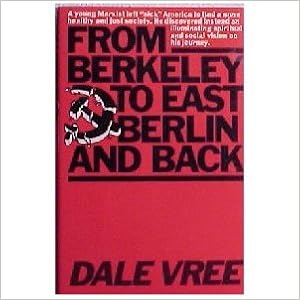
The story of Dale Vree, founding editor of New Oxford Review, needs to be told again and shared abroad. The latest example is evidently found in John Beaumont's The Mississippi Flows Into the Tiber: A Guide to Notable American Converts to the Catholic Church(Fidelity Press, 2014), a tome weighing in at 1,013 pages. In the latest issue of New Oxford Review, now under the amply capable management of his son, Pieter, the elder Vree's story is briefly rehearsed as a thumbnail sketch in a review by Barbara E. Rose. She writes:
... Dale Vree, editor emeritus of this magazine, came through the civil-rights and peace movements, and Marxism-Leninism [and a period of living in the former East Germany], before landing in the Church. In Catholicism, Vree "could emphatically affirm both the rights of labor and the ancient creeds, reject both abortion and the use of nuclear weapons, affirm both lifelong marriage and the dignity of the poor, reject both laissez-faire capitalism and do-your-own-thing morals."

Another telling example touched upon is the Jamaican-American writer and poet Claude McKay. Rose writes:
Harlem Renaissance poet and writer Claude McKay for a time professed communism and atheism but came to believe in God and to love Catholicism. In the March 1946 issue of Ebony, the newly converted McKay warned black Americans to beware "the materialistic Protestant god of progress," and he called the Church "the greatest stabilizing force in the world today -- standing as a bulwark against all the wild and purely materialistic 'isms' that are sweeping the world."

Just a couple of details, maybe; but I know it was the little things, the tiny clues to the meaning of things, which helped me along my way, initially, toward the Church.

Sunday, May 10, 2015

Which is the nursemaid and which the mother, the RC Church or the Evangelical denomination?


The great Thomas Howard is one of those Catholic converts who I admire because he doesn't make the cornerstone of his Catholic identity a broadside attack on his own Evangelical background. Yes, the Catholic Church offers the fullness of the Faith in her Sacred Tradition, Magisterium, and 2000 years of fathomless resources. But he would defend to the end the invaluable role Evangelicalism played in his own development as a spiritual nursemaid.

In one way, you would almost have to have "been there" to understand why. But short of talking to Tom Howard yourself, about a good a glimpse into why as you're likely to get is offered by Tim Callies in "The Most Important Thing My Parents Did" (Challies.com, April 9, 2015).

Now if only those managing the stores over at Catholic Inc. [TM] could back off from pushing Care Bears, Jellycats, Pillow Pets, and Barney and Friends long enough to allow their customers to begin to re-discover that their spiritual offerings go a tad beyond feel-good fuzzy plush toys, we might have a fighting chance to stave off complete bankruptcy. As things stand, Latin America is quickly becoming a show case for how Pentecostals and other Evangelicals are harvesting a bumper crop of Protestant converts from the nursemaid of contemporary Catholicism -- or should I say "Catholic Inc. [TM]"?

If my mother were still living and I were to write a Mother's Day tribute to her, what I would say about her (along with my father) would probably be something very similar to what Tim Challies says.

Thursday, April 30, 2015

Rome as others see her: Called to Communion? to be Catholic? to Denial?

It's always helpful, in my opinion, to get a second opinion; in this case, to get a sympathetic outsider's take on Rome's performance. It goes without saying, of course, that any outsider (even a sympathetic one) is going to lack a faithful insider's commitment and the perspective that offers. Yet even an outsider can help us to see what message we're communicating and how it's being perceived and received.

In "Which Call?" (Old Life, April 29, 2015), D. G. Hart comments on a conference on polarization in the Roman Catholic Church in the United States hosted by The University of Notre Dame’s Center for the Study of Religion and Society. (See the plenary session round table here.)

Hart notes that while the folks at Notre Dame recognize diversity in the Church, conservative Catholics tend to see unity as the "real" condition of their communion, ignoring the large groups of problem children within the Church.

From here, Hart compares and contrasts the "Called to Communion" paradigm of such Catholics with an older liberal "Called to be Catholic" proposal revisited recently by Commonweal here. He closes by bringing up a third possibility after remarking as follows on the Commmonweal discussion:
Not much there about motives of credibility, papal audacity, Thomas Aquinas, or John Henry Newman.

So which is it? Is it Called to Communion or Called to be Catholic? You can only chalk up such questions to Protestant perversity for so long before you finally admit a problem. Or you change your theme to Called to Denial.
The problem isn't Sacred Tradition, as such, but the lack of clarity about the professed relation of contemporary Catholicism to that Tradition. As one reader recently wrote:
"Rome: please share.... just what IS the authentic faith? Helping people? Seeing the goodness of all, and simply basking in God's redemptive action as an accomplished fact? Or declaring sin, salvation, and the peril of the present moment?

"Because based on the words I read online, I have no idea where Church leaders' hearts are. And I know I am not alone. How about some real, man-to-man and man-to-woman frankness, as opposed to common man posing? Just what is it that you believe? From Rome, I would argue the message right now is anyone's guess. 'God has spoken.' OK, can we hear what he had to say, clearly and reliably and without coy set reporter spin?"
[Hat tip to JM]

Sunday, March 22, 2015

Tridentine Community News - EF Triduum venues, plummeting RC wedding & convert stats since 1965, new U.S. choir school plans, TLM Mass listings


"I will go in unto the Altar of God
To God, Who giveth joy to my youth"

Tridentine Community News by Alex Begin (March 22, 2015):
Tridentine Triduum Opportunities

The Traditional Latin Easter Triduum services are a profound liturgical experience. Each of the three days contains elaborate ceremony and ritual commemorating our Lord’s Passion. We are fortunate to be able to experience these services at multiple local sites. The below locations have announced Triduum services according to the Extraordinary Form.

Musically, the Triduum promises to be special: Wassim Sarweh will direct a full choir at the Academy of the Sacred Heart and Holy Name of Mary. Members of Windsor’s St. Benedict Tridentine Community professional choir will join in singing at the Academy.
Holy Thursday
Academy of the Sacred Heart Chapel, Bloomfield Hills: 7:00 PM
Celebrant: Msgr. Ronald Browne
St. Josaphat Church, Detroit: 7:00 PM

Good Friday
- St. Josaphat: 12:00 Noon
- Academy of the Sacred Heart: 1:30 PM
Celebrant: Fr. Louis Madey
- Holy Name of Mary Church, Windsor: 5:30 PM
Celebrant: Fr. Peter Hrytsyk

Easter Vigil
- Academy of the Sacred Heart: 8:00 PM
Celebrant: Fr. Louis Madey
- St. Josaphat: 8:00 PM
LMS Charts Weddings and Receptions into the Church

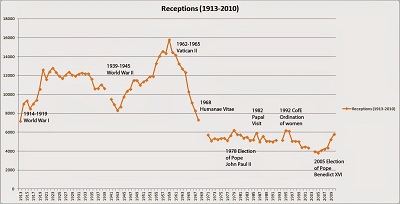
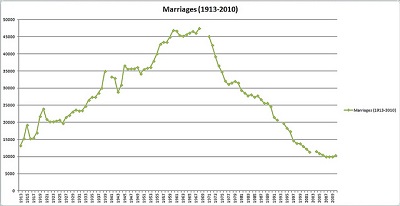
Following up on our March 1 column, in which statistics were published showing a precipitous decline in vocations to the priesthood in the United States from 1965 onwards, on March 10 Dr. Joseph Shaw, Chairman of the Latin Mass Society of England and Wales, published charts showing the number of receptions into the Catholic Faith in England over the past several decades, as well as the number of Catholic weddings. Once again, 1965 proved to be a watershed year, with numbers dramatically falling thereafter.


Granted, society experienced significant upheavals in the 1960s, but one cannot escape the fact that 1965 also happened to be the year the Catholic Church began to implement major changes to the Holy Sacrifice of the Mass that had far-reaching effects in the life of the Church. It is not unreasonable to attribute some cause and effect. If one accepts that line of logic, is the solution to press ahead with yet more changes, or to return to the apparently more successful pre-1965 practices? Faced with an analogous situation, the Coca Cola Company took swift action in the 1980s, with one key difference: The reintroduction of Classic Coke was not restricted to a few selected retailers; every store that carried their product line stocked both the new and old formulas. The market decided which product would succeed.

Dr. Shaw offers the following suggestions to bring the numbers back up: Make the Church “serious, demanding, and holy”, and return to the clarity of pre-Conciliar teachings. In other words, raise expectations, and more people may just come to the table.

Third U.S. Choir School Planned

For decades, the United States has only had two full-time Catholic choir schools: St. Paul’s Choir School in Cambridge, Massachusetts, an all-boys program; and the Cathedral of the Madeleine Choir School in Salt Lake City, Utah, with both boys and girls. Plans have now been announced for a third, at Most Pure Heart of Mary Parish in Topeka, Kansas. The parish’s [part-time] 45-member boys-and-girls Schola Cantorum will be integrated with the 400-member parish school, with the result being a [full-time] choir school-within-a-school. Though the parish does not (yet) offer the Extraordinary Form, the repertoire of the Schola Cantorum is predominantly Latin, much as it is at St. Paul’s Choir School.

Tridentine Masses This Coming Week
  • Mon. 03/23 7:00 PM: Low Mass at St. Josaphat (Feria of Passiontide)
  • Tue. 03/24 7:00 PM: Low Mass at Holy Name of Mary (Feria of Passiontide)
  • Fri. 03/27 7:00 PM: Low Mass at St. Josaphat (Feria of Passiontide) – First Tridentine Mass of Fr. Stephen Pullis. Reception for young adults age 18-35 follows Mass, organized by Juventútem Michigan
[Comments? Please e-mail tridnews@detroitlatinmass.org. Previous columns are available at http://www.detroitlatinmass.org. This edition of Tridentine Community News, with minor editions, is from the St. Albertus (Detroit), Academy of the Sacred Heart (Bloomfield Hills), and St. Alphonsus and Holy Name of Mary Churches (Windsor) bulletin inserts for March 22, 2015. Hat tip to Alex Begin, author of the column.]

Tuesday, February 03, 2015

A provocative defense against the charge of a "pandering" pontiff

Dr. Maike Hickson, a convert to the Catholic Faith, has written an open letter to Pope Francis as a sort of Cri de Coeur for clear leadership. In many ways it is a thought provoking piece. In one place she says:
"I am a convert of ten years, born in 1972 and raised in Germany and now living in the United States. I came out of a world that is now more and more subverting and invading, if not permeating, the life of the Catholic Church and a world to which you now seem to bow down and to pander."
Hmmmmmm ...

Yet one of our own readers writes in with the following observation about this very statement:
The palpable frustration felt by so many tends to obscure a certain possibility. The Pope may not be kissing up to the world, or trying to sabotage the Church. He may just be sincere. His whole approach, if we are honest, is that of Vatican II. He is trying to woo a world that he thinks is just not all that bad. People are well-intentioned, but just muddled. If that is so, trying to speak their language is not betrayal but empathy.
Again: Hmmmmmm ....

The reader goes on:
But [Hickson's] is the FOX News mentality, and I agree with [mainline conservatives] here. In the final analysis she may sound slightly naive. Such phrases communicate only something about our own exhaustion. If we are frustrated, angry, or bitter, it should be at the institutional Church Francis represents and of which he is its natural born child. He is not an aberration but a growth. 50 years of Vatican II, of canonizations of John Paul the Great and Pope John, of seeing Papa Ratzi[nger] as the Second Coming of Thomas Aquinas and proposing the likes of [Evangelical convert apologists] as updates of Fulton Sheen or Joseph Fenton... Decades of hardly blinking at gay priests or parish libraries stuffed with titles by Richard O'Brien, Raymond E. Brown, and Sister Joan... Years of bewailing bad liturgies, anti-Jesus Jesuits, anti-Catholic Catholic universities and unbiblical Biblical scholars... And we think the Pope a sudden phenomenon, an usurper versus a carefully-groomed prototype? Is Francis pandering? No, probably not in his mind. No wonder he and his fellow more liberal Catholics take offense: they are not pandering, but simply being. Just who they are. We may have provoked a schism-worthy situation simply by being afraid to be less than deferential to papal authority, and now we have no place in the pecking order of a hen house afflicted with heretical gradualism. Its like allowing public school to educate your kids, gushing over all their friends, both better and worse, and then accusing them of pandering to their queer friends when they refuse to comment negatively on them or decide to mimmic them. Just what did you expect?
[Diclaimer: Rules 7-9]

Tuesday, December 16, 2014

Kreeft: Why everybody in the world should be a Roman Catholic


Dr. Peter Kreeft, "Seven Reasons to be Catholic" -- a loose transcription (courtesy of M.W.)
I will give you 7 reasons why everyone in the world should be Roman Catholic. They are, respectively, from:

1. Walker Percy,
2. Cardinal Newman,
3. C. S. Lewis,
4. The Nicene Creed,
5. Thomas Aquinas,
6. St. John of the Cross, and
7. Palestrina.

1. When Walker Percy was asked why he was a Catholic, he answered ”What else is there?” That was St. Peter’s answer to Christ’s question “Will you leave me also?”: “To whom else should we go? Thou alone have the words of everlasting life.” As a philosopher, I like to lay things out logically in order. There are 8 options or choices that any seeker of truth has to make.

(1) The very first choice he has to make is to be honest or dishonest. There is only one reason anyone should believe anything at all: because it is true. If that seems too simple or too tough minded to any of you, I ask “Do any of you believe in Santa Claus?” You did when you were three. And believing in Santa Claus when you were three gave you two of the most important things in the world: it made you very happy and it made you very good, generous, and moral. Do you remember how happy you were and how good you were before Christmas? Well, if you believed in Santa Claus now, you would probably be a better person and a happier person. And does not everyone want to be good and everyone wants to be happy? So, why don’t you believe in Santa Claus? Because it is not true. Truth trumps everything.

(2) The second choice is whether you love the truth, whether you’re passionate about it, whether you desire it. The Bible, both Old and New Testaments, separates people into two groups. Not those who know the truth or not, but those who seek the truth and those who don’t. God says to Jeremiah “You will seek Me and you will find Me when you seek Me with all your heart.” And Jesus says repeatedly “All who seek find.”

Pascal said there are three kinds of people in the world: Those who have sought God and found Him, those who seek God and have not yet found Him, and those who do no not seek and have not found him. There is no one in the fourth class, those who found Him without seeking Him. Those in the first class, those who have found Him are reasonable and happy. They are reasonable, that is honest and wise, because they sought and happy because they have found. Those in the third class, those who did not seek, are not reasonable, because they did not seek, and not truly happy because they have not found. Those in the second class, those who seek but have not yet found, are reasonable because they seek and not yet happy because they have not yet found. However, everybody in that second class is guaranteed entrance into that first class. So the most important thing in the world is to seek the truth. You do not find it without seeking it.

Bertrand Russell asked one of the best questions ever asked by an atheist. A preacher asked him on his death bed, “What if you’re wrong, and there is a God? What would you say to Him?” Russell replied “Fair enough. I think I would ask Him ‘Why didn’t you give us more evidence?’”