Showing posts with label Apologetics. Show all posts

Friday, April 07, 2017

A film in which Christians and non-believers are not cast as natural enemies


Well, this is interesting. I've never cared much for overtly 'Christian' films, which tend in my experience to be too long on didacticism and too short on artistry. But here's what Steven D. Greydanus has to say about 'The Case for Christ,' based on Lee Strobel’s best-selling conversion story:
The atheists and nonbelievers in The Case for Christ don’t have horns and tails, or even mustaches for twirling. They aren’t out to crush believers into dust or banish their beliefs from respectable society.

The believers aren’t persecuted, marginalized victims, but capable, respected professionals in fields ranging from medical science and health care to archaeology, New Testament studies, philosophy, journalism and more. The conflict turns on faith and unbelief, but believers and unbelievers aren’t cast as natural enemies.

In other words, The Case for Christ is far from the paranoid, agonistic world of the two God’s Not Dead films, for which Pure Flix Entertainment is best known. Producers Elizabeth Hatcher-Travis and Pure Flix CEO Michael Scott collaborated on all three films — and Lee Strobel, the protagonist of The Case for Christ, cameoed as himself in God’s Not Dead 2. Yet The Case for Christ is the furthest thing from a God’s Not Dead 3.

The differences start with the real-life story behind The Case for Christ, Strobel’s conversion story from atheism to Christianity. Where the God’s Not Dead films offer lurid distillations of fundamentalist urban legends, The Case for Christ is about real people — at least, about as much as an average fact-based Hollywood drama. Read more >>
[Hat tip to JM]

Monday, July 25, 2016

Indeed. Where does one start?

David Warren, "Where Does One Start?" (The Catholic Thing, July 22, 2016):
In my own experience -- the only experience I have -- it is not easy to explain Catholic beliefs. The condition is progressive: it becomes more difficult every year.

... The Greek and Roman world was, to a remarkable degree, capable of reason, and of being reasonable. It had many attitudes incompatible with those the Christians were expounding; but it had also the habit of listening to an argument. ... it is easier to lay foundations, and build upon, hard ground. Christianity advanced the cause of reason; but reason also advanced the cause of Christianity.

... The world we face today is not like Greece and Rome. It is much more like the ancient East: a swamp in which reason finds little purchase. In order to evangelize, we must forego leaps. We must not assume premisses shared by all men of reason and good will. We must start with the very premisses.
[Hat tip to JM]

Thursday, July 21, 2016

A decade plus of apostolates ...


Steve Skojec has this interesting account of the demise of the Catholic blogosphere, entitled "Austin Ruse on the Catholic Toxosphere" (1P5, July 15, 2016), based on an article by Austin Ruse in Crisis Magazine.

The main thing I like, however, is this adorable photo of our friend, Mark Shea. Who could possibly NOT admire it?!

[Hat tip to JM]

Sunday, May 22, 2016

A Krehbiel classic: the Bible and the Catholic apologist

A tune-up for Catholic apologetics

By  Greg Krehbiel (Crowhill Weblog, July 1, 2004)

Back in 1992 I had a near miss with the Catholic Church. I almost converted. For the next seven years or so I couldn't shake the habit of falling into online discussions, arguments, dialog and, let's face it, fights, with other Christians. This nasty habit is usually called apologetics.

My almost-Catholic-yet-vigorously-and-reluctantly-Protestant status was like a bull's eye painted on my email address.  Apologists of every stripe tried to do their best and some to bring me into the church and some to pull me away from the precipice. I learned what it's like to be apologetic prey. Generally speaking, I didn't mind. I like a good fight. But the experience has given me a taste of the ugly side of apologetics. From almost eight years of struggling to be an almost Catholic, I developed a unique perspective on both the Protestant and Catholic versions of this nasty business.

But before I share my reflections on apologetics, let me clarify one thing. I am a Catholic and I believe everything the Catholic Church teaches. That doesn't mean I accept every garden-variety argument used to support those teachings, and I hope you can keep that distinction in mind as I criticize some common apologetic arguments.

One more thing. Yes, I know the Protestants make their mistakes too. When I was a Protestant, I picked on them. But let's get the log out of our eye before we take the splinter out of our brother's.

The Church is Infallible and So Am I

The Church is the community of those people who have been called out of the world and filled with the Holy Spirit. It is the Body of Christ in the world, and certain things are true of the church because of its participation in the life of Christ. For example, it cannot fail, and it will come to know all truth. (Jn 16:13) One manifestation of this is the infallibility of the church's Magisterium in certain cases.

Of course the doctrine of infallibility is a big subject of dispute between Catholics and Protestants. But there's another side to it, which could be illustrated by a fight on the playground.

"Well my daddy's an engineer, and he says ...," by which Junior wants you to hear "I know what an engineer knows, and I say …."

The Church's decrees on doctrine and morals are infallible, but how do you know you understand and apply them properly? Furthermore, sometimes the church holds to a doctrine without necessarily endorsing how we should prove or demonstrate it. Even if you understand the church's position, the argument you use to convince others may be faulty. There is such a thing as a bad argument to support the right conclusion.

The Catholic apologist has to guard against believing that his methods are right because his conclusions are right. A more healthy approach would say, "This is the Catholic faith as I understand it, and this is why I find that position reasonable. But please go to the church's official documents and check it out for yourself."
BAD HABIT: Assuming that you are right because the church is right.
REMEDY: Listen to your critics. Yes, even to non-Catholics. You may not know as much as you think you know.
Proper Conclusions Don't Fix Bad Arguments

Sunday, January 17, 2016

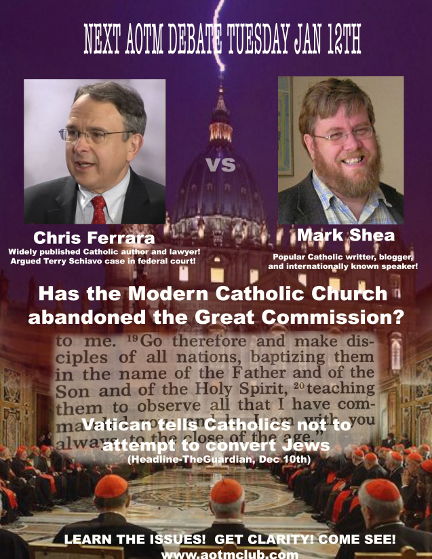
Recent debate: Shea vs. Ferrara

This would have been fun to witness:


The Argument of the Month (AOTM) Club promises to have the audio of the debate available at their site soon (check the 'Media' link on the previously linked site). They have a before-the-fact "preview" of the debate on the above website, and there's also this pre-debate discussion between Ferrara and Michael Matt. My hunch is that it would have been pretty predictable; yet it would have been fun.

Monday, September 21, 2015

Evangelism and ecumenism: promise and the pitfalls

Tim Challies, "Fool's Talk" (Challies.com, September 15, 2015) - a review of a book on persuasion by Os Guinness, who thinks that we too often focus on "victory" as apologists for the Christian faith.

The reader who sends the linked article writes:
Perhaps this is the sort of thing Francis means to convey on evangelism? You have to be vary careful of drawing such parallels: John Paul II embraced Billy Graham, and yet they were quite different, even if both were gigantic religious leaders. Francis is similarly supposedly quite affirming of voices like Luis Palau... Regardless of those connections, Os Guiness here sounds the exact same notes Frank Sheed was groping towards decades ago. Two accomplishes writers both of who need to be more widely read.
[Hat tip to JM]

Tuesday, April 07, 2015

Easter Reflection: Were the Apostles Deceived? ... Deceivers?

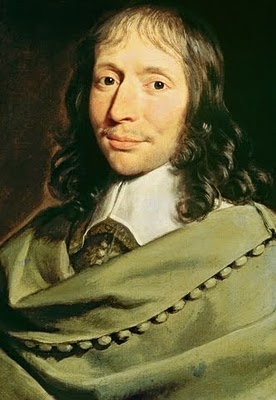
Let's come clean with the alternatives: Blaise Pascal writes in his Pensees, No. 322,
The Apostles were either deceived or deceivers. Either supposition is difficult, for it is not possible to imagine that a man has risen from the dead.

While Jesus was with them he could sustain them, but afterwards, if he did not appear to them, who did make them act?
Former Notre Dame Philosophy Professor, Thomas V. Morris comments, in his book, Making Sense of It All: Pascal and the Meaning of Life (Eerdmans):
If what the apostles reported about Jesus was false, then either they believed it and so were themselves deceived or they knew it was false and so were just deceivers. How plausible is either of these alternatives?

First, consider the claim that the followers of Jesus were themselves deceived, wrongly believing in his miracles and resurrection when no such things had ever actually happened. On this supposition they were themselves just mistaken. But there is something interesting about the concept of a mistake. I can be walking down the street and think I see an old friend approaching but on getting closer realize that I have made a mistake. I can mistakenly believe that today is Saturday when it's Friday. I can make some pretty big mistakes. We call can. But a mistake can only be so big. I cannot mistakenly think I see exactly 419 pink and purple elephants outside my office window, suspended in mid-air. I can't mistakenly think I have twelve arms.
Consider the claim that dismisses the literal interpretation of the resurrection, substituting for it the fuzzy intellectual abstraction that would have us believe that in one sense, a spiritual sense (or in a sense in which we can admit of a spiritually transformed body), Christ is risen, but in another sense Jesus' bones may still be moldering in some Palestinian grave. This is the sort of interpretation that is embraced by urbane contemporary sophisticates who would find the simple notion that Jesus could have arisen, bones and all, from the grave, as impossible to believe as that one sees exactly 419 pink and purple elephants outside his window, or that he has twelve arms. The point, however, is that the biblical Resurrection, like the Cross of Christ, is something scandalous -- something unbelievable in ordinary terms. One can't just mistakenly believe something like that. Morris continues:
The apostles reported detailed encounters with the risen Christ sometime after his death and burial. Would it have made much sense for loved ones to respond to such reports by saying, "Calm down, dear. It was just your imagination"? Pascal says that it is not possible to imagine that a man has risen from the dead. That's too extreme to be a mistake. And there were no cultural expectations in first-century Judaism that a single man might be raised from the grave by God into a new, yet recognizable, form of life. Hallucination is not plausible. Repeated, convergent mass hallucinations are even less plausible, much less plausible. Pascal finds this suggestion absolutely incredible, strictly speaking.

So what of the other possibility? If the testimony of the apostles is false, and it is utterly implausible to think of all of them as deceived by appearances concerning such extraordinary events, then the other possibility, as Pascal points out, is that they never believed for a minute these stories they told about Jesus but were themselves just deceivers. How credible is this supposition?
In another passage in his Pensees, No. 310, Pascal writes:
Proofs of Jesus Christ. The hypothesis that the Apostles were knaves is quite absurd. Follow it out to the end and imagine these twelve men meeting after Jesus' death and conspiring to say that he had risen from the dead. This means attacking all the powers that be. The human heart is singularly susceptible to fickleness, to change, to promises, to bribery. One of them had only to deny his story under these inducements, or still more because of possible imprisonment, tortures and death, and they would all have been lost. Follow that out.
Morris comments:
Lying is hard work. When you tell a lie, you don't have reality to back you up. When you tell a lot of lies, one building on the next, you get yourself in an even worse fix. Such deceit requires extraordinary powers of memory as well as imagination. Most of us have a hard enough time remembering things that have actually happened. And when we forget, we can usually rely upon the fact that the truth leaves traces of itself behind -- footprints, documents, memory impressions in other people's minds. But when we concoct an alternate reality, a history contrary to what really has happened, we have only our own memories to rely on concerning what we said happened.

A conspiracy of lies is even more fragile. This is from the beginning an exceedingly odd sort of agreement - a number of different people get together, concoct a story, and agree to lie about it, each promising not to break and tell the truth. It is crucial to their agreement that they're all liars, but how in the world can you trust liars to keep their end of an agreement? Any supposition that the apostles of Christ met after his death and entered into this sort of agreement is especially hard to swallow. Here a number of ordinary men from walks of life in which the truth mattered, who had just spent an extended period of time with a charismatic leader whom most non-Christians recognize as one of the greatest moral teachers in history, are supposed to have met together after the death of their leader and, to further his work, agreed to tell outrageous lies about him? This is just too bizarre. And worse, Pascal points out, from these lies they would have had little to gain and much to lose, as circumstances developed. Only one of them need have cracked and the whole conspiracy would have unraveled. And each of them, knowing that each of the others was lying against the grain of his own personality, would surely have suspected that one of the others would crack, and so would have been all the more prepared himself to tell the truth and cut his losses, distancing himself from the others in times of increasing pressure and persecution. Further, recall that we are talking about a message that itself emphasized the importance of walking in the truth. The hypothesis that the followers of Christ were just deceivers is just too out of step with everything we know about them, about their circumstances, about their message, and about human psychology.
The citations from Thomas V. Morris's Making Sense of It All: Pascal and the Meaning of Life are from pp. 173-176 of that volume. The quotations from Pascal's Pensees are also from Morris's book.

Also highly recommended: