Showing posts with label Pope Francis. Show all posts

Thursday, March 15, 2018

"Et Tu, Benedict? (Wrinkles in Time & Theology)"

Prefatory note:

Dionysius the Areopagite was a 1st century convert of St. Paul mentioned in the Book of Acts; but the man who wrote under his name in the late fifth or early sixth century and transposed the whole of pagan Neoplatonism from Plotinus to Proclus into a distinctively new Christian context is more aptly called "Pseudo-Dionysius."

Frank J. Sheed (1897-1982) was an Australian-born lawyer, Catholic writer, publisher and speaker who was married to Maisie Ward, who together with her lent his name to the famous English imprint Sheed & Ward and was a forceful speaker in the Catholic Evidence Guild; but the man who, under the name of "Frank J. Sheed," is the author of the contemporary blog from which the following article is taken should perhaps better be known as "Pseudo-Frank J. Sheed," since, like "Pseudo-Dionysius," he conceals his own identity behind a pseudonym taken from the name of someone he wishes to honor. -- Editor


Pseudo Frank J. Sheed, in "Et Tu, Benedict? (Wrinkles in Time & Theology)," introduces his subject as follows:
When you read Joseph Ratzinger/Pope Benedict XVI, it can be a faith-rewarding exercise or a head scratcher. I, for one, am very grateful for his Gospel, Catechesis, Catechism, his book on the Infancy Narratives, his Handmaid of the Lord, and Ignatius Press’ volumes of weekly teachings as pope like A School of Prayer. Not to mention his output at the CDF, which considering the possibilities he prevented seems heroic.

But then there are other scattered books, like Principles of Catholic Theology, Introduction to Christianity, In the Beginning, and Highlights of Vatican II. These often seem ambiguous on key points, and suggest a mind conditioned by the more liberal currents of the 60s and 70s. For the conservative crowd, that’s lamentable. Which all that in mind, I was both irked and intrigued by Hilary White’s column. It follows here, and as you’ll discover, she takes no prisoners.
Indeed, there is much here "irk and intrigue" most anyone.

Yes, by all means: Caveat emptor! But by the same token, know that those who neglect acquaintance with many of the dark details here related do so at their own peril of blissful ignorance. [Disclaimer: Rules ## 7-9]

Saturday, January 20, 2018

Exclusively EF Trappist Abbey shuttered by Vatican

"Mariawald Trappist Abbey Closed Down -- Summorum Undone by Current Vatican Regime" (Rorate Caeli, January 19, 2018):
The Trappist Monastery of Mariawald, in North Rhine-Westphalia, Germany, was probably the only monastic house in the world to make use of the provision present in Article 3 of the motu proprio Summorum Pontificum that allowed for the whole conversion of such a house to the exclusive use of the Traditional Rite.

...

Now, the inevitable outcome arrived: as GloriaTV reports, the old abbey is being closed and completely dismantled. What two world wars could not destroy, Bergoglianism could:
German Old-Rite Trappist Abbey Will Be Closed Down

The old-rite Trappist abbey of Mariawald, Germany, will be closed down. The Vatican, the Trappist order, and the Diocese of Aachen on whose territory the abbey is located, have announced this in Mariawald.

The monastery was inhabited by the Trappists since 1909. All employees lose their jobs. The monks will be transferred to other monasteries.

During this year, the monastery and all its possessions will be handed over to Aachen diocese. The monastery and church of Mariawald will probably remain closed forever.

In a letter dated November 21, 2008, Benedict XVI granted the abbey the privilege to return to the old usages of the Trappist Order in liturgy and monastic life. This concerned especially a return to the venerable Old Rite. The pope saw this project as a "renewal of the church in the spirit of tradition". Now this renewal is over before it could get off the ground.

Friday, October 06, 2017

Ed Peters: "On arguments that may be, and sometimes must be, made"

Edward Peters, "On arguments that may be, and sometimes must be, made" (In Light of the Law, October 5, 2017):
I have taken no position on the Correctio Filialis. I know and respect some of its signatories as I do some of its critics but, as the document itself seems to fall within the boundaries of Canon 212, I say, ‘Have at it folks and may the better arguments prevail’. That said, some recent arguments against the Correctio are, in my view, subtly deficient and, time permitting, I will reply to them.

But even before that, I wish to reply to an attitude I perceive emerging against the Correctio, one that attempts to dissuade Correctio supporters from their position by alleging a disastrous—but supposedly logical—consequence of their being right, something along these lines: If Amoris laetita and/or Pope Francis and/or his Vatican allies are really as bad as the authors of the Correctio seem to believe, then all petitions, Dubia, and corrections will do no good. Prayer and fasting would be more advisable.

Hmmm.

Setting aside that several of these scenarios are not asserted in the Correctio and that the evidence concerning some others is not yet in, underlying this doomsday-like retort of the Correctio is, I think, a certain despair about the importance of argument itself in this matter. At the very least, such a bleak conclusion disregards the duty of certain Catholics precisely to engage in such debates.

Canon 212 § 3 has been invoked by those supporting the Correctio to point out that the Church herself recognizes the right of certain persons “to manifest to sacred pastors their opinion on matters which pertain to the good of the Church and to make their opinion known to the rest of the Christian faithful”, namely, those persons who possess “knowledge, competence, and prestige” in regard to the matter under discussion. Indeed. But Canon 212 § 3 says something more.

Canon 212 § 3 states in regard to persons with special knowledge, competence, and prestige in regard to ecclesiastical matters, that they “have the right and even at times the duty” to express their views on matters impacting the well-being of the Church (my emphasis). The duty. Not just the right.

Thus to the extent that some qualified signatories and/or supporters of the Correctio have realized a duty (expressed in law) to address these matters, they are not simply acting under the protection of law (as are those exercising a right), they are acting in accord with its directives (as do those under an obligation). Now, to be sure, Canon 212 is not self-interpreting and several prudential considerations must be considered when applying it. But in its very terms is the expression of a duty incumbent upon certain Catholics who are qualified by their education, experience, and Church positions to make serious arguments on matters impacting the Church. And I see no exception in the law for those whose positions might imply the existence of other problems for the Church or for those who arguments seem unlikely to be acted upon.

Cdl. Caffarra said “only a blind man could deny there’s great confusion, uncertainty, and insecurity in the Church.” Much of that confusion turns, obviously, on the meaning of technical terms and on the content of intellectual assertions. Those blessed with advanced training in such technical terms and intellectual assertions may be, and at times should be, at the forefront of these debates.

And, yes, all participants in these debates should be engaged in extra prayer and fasting.

Monday, September 25, 2017

Lifesite petition supporting the "filial correction" of Pope Francis for allowing the propagation of confusion and heterodoxy

In July of 2016, an international group of 45 scholars, academics and pastors petitioned Pope Francis for clarification on his Apostolic Exhortation, Amoris Laetitia. Later that year, four cardinals published their now well-known five questions, or "dubia" (Latin for "doubts") concerning Amoris Laetitia, after receiving no response from Pope Francis. In July of 2017, 62 scholars, pastors and others, sent Pope Francis a "filial correction" (or Correctio) accusing him of "propagating heresy" by equivocal passages in Amoris Laetitia and by "other words, deeds and ommissions." Again, after a month of waiting in vain for a response from Pope Francis, the authors of the Correctio have published their document.

The the document is over 25 pages long, some of it in untranslated Latin, and can be found online at various sites. Clear summaries can be found here and here.

Now I see that LifeSite has launched a PETITION where others can add their names to the signatories. I also see that, despite the Correctio's framer's original intention to voluntarily exclude bishops and cardinals, that Rene Henry Gracida, Bishop Emeritus of the Diocese of Corpus Christi, has sent in his name to be added to the original list of signatories. Others will probably follow suit.

Just one comment. The whole idea of sending a "correction" to the Pope sounds radical. Some have called it 'epochal.' Yet it may be important to bear in mind that the document does not accuse Pope Francis of formal heresy. Rather, it argues that the Pope has allowed heterodox opinions to proliferate by his silence when asked for clarification (as by the four cardinals last year), by his prolix and confusing declarations in interview, and his appointment to positions of influence within the Church men who publicly dissent from Catholic teaching on the sacraments. It is, in short, a filial cri de cœur directed to the Holy Father asking for him to raise the torch of truth and illumine the darkness amid the sea of benighted confusion in which so many feel as if they are drowning.

Please pray for His Holiness, Pope Francis, for the whole Church, and for all affected by the confusion abroad.

Sunday, September 10, 2017

"George Weigel: The Swan Song of the Catholic Neocons"

[Disclaimer: Rules ##7-9]

A Review of George Weigel’s Lessons in Hope: My Unexpected Life with St. John Paul II (Basic Books, 2017), by Dr. Jesse Russell, Fetzen Fliegen (A Remnant newspaper blog, September 7, 2017):
The notorious journalist and friend of Catholic traditionalist Patrick Buchanan, Hunter S. Thompson once wrote in his famous essay “The Hippies”: “The best year to be a hippie was 1965, but then there was not much to write about, because not much was happening in public and most of what was happening in private was illegal.”

A similar statement could be made of Catholic neoconservatives: the best year to be a Catholic neoconservative was 2001. September 11 had given the green light to the destruction of any country that stood in the way of the New World Order’s goal of global hegemony. With magazines like First Things and books such as Witness to Hope and The Spirit of Democratic Capitalism, the very polite triumvirate of neoconservative leaders, Fr. Richard Neuhaus, George Weigel, and Michael Novak, had not only complete control over the American reception of John Paul II’s life and work, but increasing access to the White House of President George W. Bush.

Many bishops such as Charles Chaput, Francis George, and Timothy Dolan (whom Weigel refers to as an “old friend”) were the under the spell of Weigel, Neuhaus, and Novak. Even the lumbering, felt-banner-adorned battleship of old liberals called the United States Conference of Catholic Bishops was turning toward the shores of the “new” Catholic conservativism born from Fr. John Courtney Murray and Jacques Maritain.

But then something happened. Like a Greek tragic hero, the Catholic neocons at the apex of their power, fell from grace.

Pope Francis further democratizes liturgy


Jason Horowitz, "Pope Francis Shifts Power From Rome With 'Hugely Important' Liturgical Reform" (New York Times, September 9, 2017):
VATICAN CITY — Pope Francis, who has used his absolute authority in the Vatican to decentralize power from Rome, made a widespread change Saturday to the ways, and words, in which Roman Catholics worship by amending Vatican law to give national bishop conferences greater authority in translating liturgical language. Read more >>
See also New Catholic, "Breaking: Motu Proprio 'Magnum Principium' granting authority on liturgical translations to Bishops' Conferences" (Rorate Caeli, September 9, 2017), which has an English translation of the Motu Proprio, analysis of "Canon 838 in the Light of Conciliar and Post Conciliar Sources," and, further, "A key to reading the moto proprio 'Magnum principium'" by X Arthur Roche, Archbishop Secretary, Congregation for Divine Worship & the Discipline of the Sacraments.

Wednesday, August 30, 2017

"Still a bulwark of sanity in our big and zany Church"?

Those, paraphrased, are the words of Guy Noir - Private Eye in a recent message to me via carrier pigeon, as per usual lately. He was commenting on an article by Thomas Joseph White, "Catholicism in the Modern World" (First Things, August 25, 2017), which is, indeed, reassuringly sane.

After linking to this other article and remarking, "much as I've carped over JPII’s TOB overreach or Jos. Ratzinger’s exegesis of Genesis, more than a little do I miss them," he then turned to White's article, saying about it (his actual words):
There is also this fascinatingly fusionary list, with Newman, Garrigou-Lagrange (!) and Ratzinger too. Somehow reassures me there is still a bulwark of sanity in our big and… being kind, zany… Church.

Saturday, August 26, 2017

Catholic Doomsday clock set to "Magisterial"


[Disclaimer: see Rules ##7-9]

Eccles (!!), "Catholic Doomsday clock set to 'Magisterial'" (Eccles is saved, August 25, 2017):
The Catholic Doomsday clock was initiated in 2013, as a way of warning against the inevitable meltdown that would follow should Pope Francis attempt to say anything "infallibly".

Whereas previous popes have refused to "go nuclear" since infallibility was defined in the 19th century [well, that's not quite true: Pius XII's Munificentissimus Deus was declared infallibly in 1950], there has been an increasing risk that Pope Francis would say something mindlessly stupid ex cathedra.
Provocative article. But there's also a cryptic banner at the top that reads: "This is the spiritual journey of me, Eccles, my big brother Bosco, and my Grate-Anti Moly. Eccles is saved, not sure about Bosco, and we've got real problems with Anti." What does it mean? I'm not sure. "Eccles" could refer to the Church (from the Greek: 'Ecclesia'). Not sure though. Any thoughts?

'Eccles' continues:
Is the Vatican about to go nuclear?

The Pope has so far used a variety of weapons in an attempt to impose a new version of Catholicism: probably the least aggressive are tweets (produced by a teenage intern), which are indistinguishable from the platitudes of the Dalai Lama; more striking are his "air attacks" consisting of new off-the-cuff doctrines expressed on aeroplane journeys, and usually "explained" and "interpreted" afterwards; he is also a dab hand at deploying sockpuppets (Spadaro, Ivereigh, Faggioli, Marx, Daneels, oh there's too many to name...) to say the unthinkable, usually with a healthy dose of abuse thrown in.

Then we come to Amoris Laetitia, ghost-written, not based on anything agreed at the synods it followed, not even properly read by the Pope. A ticking bombshell, which brave bomb-disposers have attempted to defuse with DUBIATM technology. Still it continues to tick, tick, tick...

We may ignore Laudato Si', an attempt at building a "green" bomb which would destroy minds but not doctrine. Well, everyone else does.

Now, however, the threat level has reached "Magisterial". All the changes due to Vatican II, even the ones which are nothing at all to do with Vatican II, have been declared "irreversible".

Like his Popemobile, Pope Francis has no brakes, and no reverse gear.

Yes, the Spirit of Vatican II has won, and the threat level is now Magisterial. Pope Francis can repeal decisions made by his predecessors, such as Benedict XVI, John-Paul II, Pius X, Pius V, Peter, ... and even Jesus. BUT NOBODY ELSE HAS THE NUCLEAR CODES.
"Excuse me," writes Eccles, "while I head for my bunker."

[Hat tip to J.M.]

Friday, August 25, 2017

"Did Amoris Laetitia's ghostwriter just respond to the dubia?"

Steve Skojec, "Did Amoris Laetitia's ghostwriter just respond to the dubia?" (1P5, August 22, 2017). Excerpt:
There’s no turning back.” Fernández told Mickens. “If and when Francis is no longer pope, his legacy will remain strong. For example, the pope is convinced that the things he’s already written or said cannot be condemned as an error. Therefore, in the future anyone can repeat those things without fear of being sanctioned. And then the majority of the People of God with their special sense will not easily accept turning back on certain things.
Guy Noir - Private Eye responded in a crumpled note carried over the mountains by an exhausted carrier pigeon: "I tend to think he's right. If a 'magisterium' can turn like a weathervane, it loses all authority. This is the tragedy of the last several papacies. Rome's voice has been muffled on too many points."

Remember this? (See below)


Monday, August 14, 2017

Contra Ivereigh: not just 'converts' are worried about the Church

Dan Hitchens, "It’s not just converts who are worried about the Church" (Catholic Herald, August 10, 2017):
In the last few years, many Catholics have become uneasy about statements coming out of Rome, and about the general direction of the Church. But which Catholics? According to a recent article in the Vatican newspaper, the “main obstacle” is “a good part of the clergy”. Then again, an article in Crux last year identified those “going against the Pope” as “almost always lay”.

Some believe that the issue is geographical: Massimo Faggioli describes an unease about the Church changing its style “from a Western one to a global religion”. Conversely, Cardinal Walter Kasper has said that the recalcitrant tend to be African or from “Asian or Muslim countries”....

This brings me to Austen Ivereigh’s latest piece suggesting that the epicentre of current anxiety is neither priests nor the laity, neither Westerners nor Africans, but converts. Ivereigh diagnoses “convert neurosis” in a range of writers, from “elegant commentators such as Ross Douthat” all the way down to “ex-Anglicans in my own patch such as Daniel Hitchens of the Catholic Herald.” Our neurosis reveals itself in disproportionate anxiety at the state of the Church; a horror of doctrinal development beyond our favourite period of Catholic history; and a failure to trust that “the Holy Spirit guides” Pope Francis. In sum, “their baggage has distorted their hermeneutic”.

I’m wary of this kind of psychologising: it is hard, even with those we know best, to say how their psychological issues affect their opinions. And in this instance the psychoanalysis seems needless, since there are at least as many cradle Catholics who have the same worries as us converts....

... I’m sorry to go over this again, but it seems worthwhile, since there is a determined effort in some quarters to change the subject. The concerns are about the sacraments and about doctrine. Nothing on this earth is more beautiful and precious than the sacraments, and it is natural for Catholics to be alarmed about the abuse of them. Scarcely anything is as necessary for our happiness as sound doctrine, and it is normal for Catholics to worry that doctrine is being contradicted or confused. There have been as many saints who were relaxed about heresy as there have been saints who despised the poor.

So of course converts and cradle Catholics will be dismayed by sacramental abuses and doctrinal confusion. And it is hard not to use such terms when we read Malta’s bishops claiming that avoiding adultery may be impossible; when we hear of priests, bishops and even cardinals abandoning the Church’s practice on Communion; when papal teachings are used – without contradiction from Rome – to justify novel approaches to divorce, euthanasia and extramarital relationships....
[Hat tip to JM]

Wednesday, August 09, 2017

Poverty of spirit: different Papal styles


In his Vicars of Christ: A History of the Popes(Arcadia: Tumblar House, 2014), 380-90, Charles Coulombe makes the following insightful observation about the difference in 'style' between Benedict XVI and Francis:
The generation of westerners of which [Francis] is a part was marked -- in Church, State, and indeed, in every field -- by what can only be called a sort of "personalization" of authority. That is to say, that the traditional division in perception between an office and the current holder of that office -- which allowed people of wildly differing, sometimes even opposed, views to collaborate out of shared respect for the office under whose direction they functioned -- has been blurred or even obliterated. Such folk, when in authority, tend to downgrade or do away with traditional symbols of their office while emphasizing their own personalities in pursuit of some nebulous "authenticity." So it is that morning dress and uniforms disappear from presidential inauguration and legislatives openings, and royals love to appear in casual wear. The difficulty with such an approach is that it tends to weaken respect for the office in the eyes of its subjects, who in turn begin to believe that their loyalty to it is dependent purely on their personal feelings for the occupant of the moment. Seeing the problems this had created, Benedict XVI began to restore the symbolic side of the Papacy, for all that formalism and display ran extremely counter to his nature. But it is not an issue that one of Francis's generation could be expected to understand -- quite the contrary.... Despite the lack of tiara noted earlier, piece by piece [Pope Benedict] restored bits of the papal wardrobe that his immediate predecessors had discarted: the fur-lined mozzetta, the camauro, the fanon, and -- most annoying to some -- the traditional red shoes, symbolizing the fact that as Pope he walked in the footsteps of the martyrs.
Commenting on this passage, Prof. Peter A. Kwasniewski writes about Benedict:
This humble Bavarian who shied away from the limelight saw that it was necessary to elevate and accentuate the sacramental iconicity of the pontiff in order to move beyond the cult of personality inadvertently started by John XXIII and vastly augmented in the charismatic athlete, actor, poet, and playwright of John Paul II. With Pope Francis, we see a return both of the cult of personality and of the false conception of poverty, this time applied not only to liturgy but also to doctrine itself.
By "poverty of doctrine," Kwasniewski explains, "I refer to the superficiality, messiness, ambiguities, contradictions, and unclarity of this pope's teaching, in contrast to the rich truthfulness of those of his predecessors who take seriously the Lord's command to 'let what you say be simply 'yes' or 'no' (Mt 5:37); cf. 2 Cor. 1:17-19, Jas. 5:12. (Peter A. Kwasniewski, "True Poverty of Spirit in the Splendor of Worship," The Latin Mass: The Journal of Catholic Culture and Tradition, Vol. 26, No. 2 (Summer 2017), p. 14.

Saturday, July 22, 2017

Slippery slope from non-Catholic to non-Christian 'saints'?

Peter Crenshaw, "Pope Francis Opens Door to Non-Catholic Saints" (Remnant, July 12, 2017).

Comment by Guy Noir - Private Eye: "Does anyone really think there will be a long gap between the emergence of protestant Saints and the emergence of non-Christian ones? There's the rub!"

The Marcello Pera interview: a political interpretation of Pope Francis

President of the Italian Senate Marcello Pera is a classical liberal Catholic and friend of the former Pope Benedict XVI, with whom he co-authored a book: Without Roots: The West, Relativism, Christianity, Islam. Here he is interviewed by Corrado Ocone (Il Mattino, July 9, 2017), translated by Rorate Caeli in "THE ULTIMATE INTERVIEW to Understand all About Pope Francis: Marcello Pera, Italian politician and close Ratzinger friend" (Rorate Caeli, July 14, 2017).

Wednesday, June 21, 2017

Monsignor Bux: We Are in a Full Crisis of Faith

Edward Pentin (National Catholic Register, June 21, 2017) writes: "Theologian and former consulter to the Congregation for the Doctrine of the Faith calls on the Pope to make a declaration of faith, warning that unless the Pope safeguards doctrine, he cannot impose discipline." Read more here >>

[Hat tip to JM]

Monday, June 05, 2017

Is Pope Francis a 'Postmodernist'?

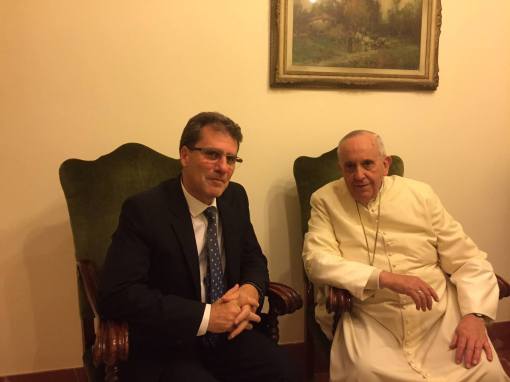
I'm not sure the discourse of the Holy Father rises (or 'sinks') to the level of academic abstraction sufficient to qualify him as a 'Postmodernist,' but when you read some of the seemingly hyperbolic praise he heaps on the likes of nihilistic Postmodern writers like Michel de Certeau (right), you can see how someone might come up with an article like that of the pro-life activist, Fred Martinez, "Pope Francis and Nihilism" (Catholic Monitor, Sunday, May 28, 2017).
[Hat tip to J. Likoudis]

Friday, June 02, 2017

"Pope Francis never ceases to amaze"


Alessandro Zangrando, Culture and Arts editor for the Venice desk of the national newspaper Corriere della Sera and Rome Correspondent for The Latin Mass magazine, writes:
Pope Francis never ceases to amaze. For readers in Argentina he has created a new weekly edition of L'Osservatore Romano. As director he has named Marcelo Figueroa, the Argentine Protestant pastor of the Presbyterian Church and director for twenty-five years of the Argentine Bible Society. Figueroa is a longtime friend of Bergoglio, who accompanied him on the famous trip to Lund, Sweden, for the celebration of the five hundredth anniversary of the Lutheran Reformation. [Source: The Latin Mass: The Journal of Catholic Culture and Tradition, Vol. 26, No. 1 (Winter/Spring 2017), p. 5]

"Pope Francis, pray for us"???


Commenting on Confitebor's observations about the shameless papalotry represented by this pewter cross in a Catholic religious store -- a cross bearing the image of the Holy Father and the words, "Pope Francis, pray for us" -- Guy Noir - Private Eye, now our mid-Atlantic Piedmont correspondent, declared:
If every recent pope ends up canonized, what should we expect?

The cult of the saints becomes "cult like," encouraging veneration of people that ought to go to God's Son.

I used to think canonizations were exercises in papal infallibility. That confidence has been completely eroded. The modern Church has pushed its credibility on this score past the breaking point, with John Paul II himself, sadly, leading the way via removing the Devil's Advocate. Another example of how the Church's leaders do not seem overly keen to protect its enduring credibility in an age of disbelief. I just don't get it. Sanctity should not need overly aggressive PR hacks.

Saturday, May 27, 2017

Fr. Hunwicke on why Pope Francis is not a heretic

Some interesting reasoning here. [Advisory: Rules ##7-9]

Essentially, Fr. John Hunwicke seems to be suggesting that, whatever the material content of the Holy Father's locutions, they lack sufficient theological sobriety and propositional restraint to rise to the level of formal heresy. Here's the first of four posts he has on the topic: "Is the Pope a heretic? (1)" (Fr. Hunwicke's Mutual Enrichment, May 18, 2017):
To this question there can only be one answer: NO. And NO means, as Mrs Brexiteer May might put it, NO. Pope Bergoglio has NEVER, to my knowledge, formally enunciated doctrines which are unambiguously heretical. The claim one sometimes hears, to the effect that he has formally, as if from his chair, made doctrinal assertions which the Church has formally defined as heretical, is NONSENSE. When such assertions tip over further, into the idea that he has ceased to be pope because of his alleged errors, the mistake is even more grievously EVIL because it runs the risk of detaching souls for whom Christ died from the Ark of Salvation, from the One Fold of the Redeemer.

One easy reason for being confident that the Sovereign Pontiff has not formally taught heresy is the simple fact, confirmed pretty well every time he opens his mouth, that he despises theology and holds doctrine in not-even-barely-concealed contempt. To be a heretic, or, more precisely, to be a formal heretic, it is in practical terms necessary to operate within the respectable constraints of propositional discourse. The fact that Bergoglio does not do this is proved by the fact, written large over this whole pontificate, that nobody ever quite seems to be sure what he means. The DUBIA which the four Cardinals put forward provide a good example of this. Four men of erudition (not to mention seniority) thought they needed to ask the Bishop of Rome what he meant. His tardiness, so far, in exercising the Petrine Ministry of Confirming his Brethren demonstrates his resolute determination not to be tied down by propositions. I do not believe that it is possible to convict such a man, operating such a policy, of being a formal heretic. Those who wish to do this are walking up quite the wrong garden path. And I will argue that they are guilty of a genre-error.

Further parts will follow. No comments will be enabled until they are all finished.
Here are the subsequent posts: Part 2; Part 3; Part 4. In Part 4 he concludes: "Is this a dangerous pontificate? Not nearly as much as panicky people fearfully imagine. Come off it! And cheer up! The ease with which Pope Francis and his associated ideologues, while studiously "not changing doctrine", in fact over-ride and ignore the Magisterium of his predecessors, will make it pitifully easy for his successors to dump his 'teaching' with only the most perfunctory of formalities, and then to restore the simple lucidities of the Tradition handed down through the Apostles, the Deposit of Faith.... Just hold tight whenever the roller-coaster seems to be going dangerously fast, and remember that her Immaculate Heart will prevail. This is Fatima Year!"

[Hat tip to L.S.]

Saturday, May 20, 2017

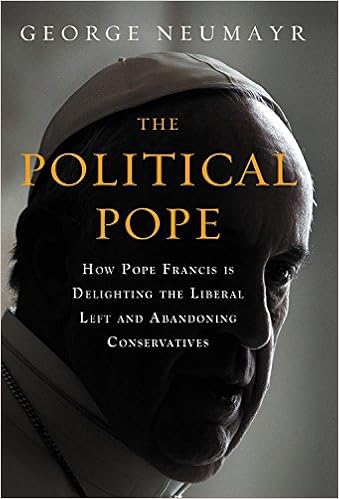
Book: The Political Pope, by George Heumayr


This is more about the politics of the Holy Father than his theology, though some might beg to differ; but it's a book that's catching quite a bit of attention. It's by George Neumayr, who is contributing editor to and former executive editor of the conservative American Spectator.

Maike Hickson recently published "An Interview with George Neumayr, Author of The Political Pope" (OnePeterFive, May 6, 2017).