Saturday, February 14, 2015

Tridentine Masses comming this week to the metro-Detroit and East Michigan area


Tridentine Masses This Coming Week

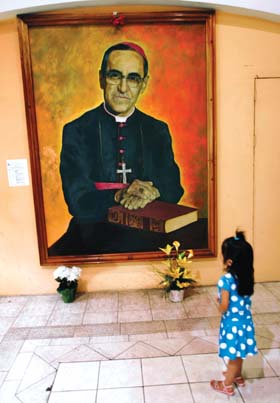
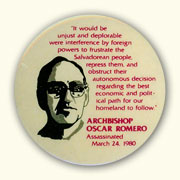
Oscar Romero's Portrait Session


From our undercover correspondent we keep on retainer on assignment in an undisclosed location south of the border, Guy Noir - Private Eye:
Oscar Romero... a fascinating case in the saint making process. Here is Dwight Longenecker weighing in: "My doubts about Oscar Romero" (Crux, February 4, 2015).

I also recall Kenneth Woodward's detailed account of the man in Making Saints. Romero seemed heroic. What would the contemporary churchgoer make of the fact that no one from Rome even attended the guy's funeral, or that St John Paul the Great gave the man a dressing down for his outspokenness only years before his martyrdom? Or how does Bishop Cupich's distaste for public protest of abortion look compared to Romero's attempts to speak truth to power. How much and how strangely the world has changed in 25 plus years! Then there is this perspective that I admit had already crossed my mind as well... Zoe Mintz, "Pope Ends ‘Doctrinal Logjam’ By Calling Salvadoran Archbishop Oscar Romero A Martyr" (International Business Times, February 3, 2015):
Romero was not always considered progressive. In fact, he was appointed archbishop because he was considered a safe and conservative choice. Romero changed his stance after he witnessed the suffering of El Salvador’s poor while serving as a bishop of Santiago de María. On March 12, 1977, the Rev. Rutilio Grande, Romero's longtime friend and a Jesuit priest, was assassinated. This propelled Romero into the political spotlight. He suspended masses the following Sunday at area churches and demanded justice. Pope Francis may have gone through a similar intellectual experience. While serving as Jesuit provincial of Argentina, or the order's leader in the country, he did not display an especially strong tendency to advocate for the poor. After he became archbishop of Buenos Aires, witnessing widespread poverty and the limitations traditional methods like charity had to address people’s needs, his public stance changed. “In this sense Bergoglio [Pope Francis] mirrors a similar conversion that Oscar Romero himself underwent,” Bretzke said.
But then note this subtle switch:
Despite Romero’s association with the controversial ideology, everyday Salvadorians don’t necessarily see him as a face for liberation theology. “Rather, he seemed to be a temperamentally and theologically conservative person who was genuinely moved by the plight of ordinary people under a repressive government,” Bill Portier, a theology professor at the University of Dayton (Ohio) who specializes in U.S. Catholic history, told International Business Times.
That hardly suggests an intellectual change. Isn't it a bit more likely, in the case of Romero and Francis both, that there in fact was an intellectual change, only one that remained rather ethereal or easy to miss given the retention of Catholic vocabulary and ritual and the assumptions of the average churchgoer. The same phenomenon is at work within the large group of Evangelicals who have already "sainted" Bonhoeffer without any recognition whatsoever of his advocacy of "religionless Christianity."


But those versed in liberal theology mince no words. Try on these for size: "Thereis much that this former Archbishop of San Salvador shares with Pope Francis. Both are seen as champions of the people, with an especially keen sense of the godlessness of any system that oppresses and subjugates the poor. Both are unlikely leaders in the Roman Catholic Church, given their support for conservative theology and 'order' prior to their elevation as leaders in the Church. Both surprised their supporters in taking a much more critical stance toward the abuses of capitalism than would have been expected of a conservative leader." There is much more here, and look at the source: Gene Robinson, "Pope Francis Knows: Oscar Romero is the People’s Saint" (Reuters, February 8, 2015). Elsewhere, Frank Raga ["The Church flowed from the Second Vatican Council?" (Shield of Faith, February 5, 2015)] is convinced that as a symbol Romero is the third panel in the uneasy but insistent Vatican II Canonization triptych that includes Popes John and John Paul II and cements a legacy for the Church of Vatican II.


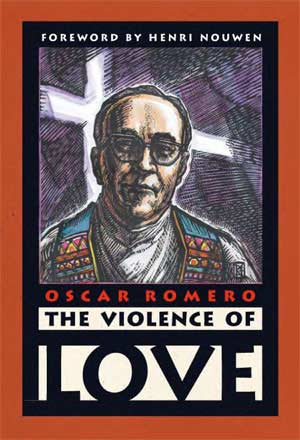
You can judge for yourself, since Plough books is offering an anthology for free: Oscar Romero, The Violence of Love (Plough, 2014).

The trouble with Kasper's "Mercy"

In the apparently-not-yet-avilable-online March issue of First Things, Daniel Maloney offers an excellent review of Walter Kasper's Mercy: The Essence of the Gospel and the Key to Christian Life (New York: Paulist Press, 2014):
Recently, there’s been an odd conversation in Catholic circles about the nature of mercy. Francesco Miano, one of the married attendees of the recent synod on the family, said it centered on the “tension between mercy and truth.” In this debate, the “traditionalists” were in favor of truth (you can’t receive Communion if you are in a state of sin; if you intend to have relations outside a valid marriage, you are in a state of sin; ergo, etc.), while the “progressives” were in favor of mercy (shouldn’t those who have had a conversion after a divorce and civil remarriage be able to approach the Eucharist?) Since instructing the ignorant and admonishing sinners are among the traditional “works of mercy” -- not to mention that Scripture tells us that Jesus is both merciful (Luke 6:36, Titus 3:5) and the Truth (John I4:6) -- opposing mercy to truth is an unfortunate place for Catholic discussions to be.

Cardinal Walter Kasper seems to be the reason why the Catholic Church has been speaking about mercy so frequently these days. Pope Francis, who chose God’s mercy as the theme of his first Angelus address on the Sunday after his election, credited the influence of Cardinal Kasper on his choice of topic: “In these days, I have been able to read a book by a cardinal -- Cardinal Kasper, a talented theologian, a good theologian -- on mercy. And it did me such good, that book, but don’t think that I’m publicizing the books of my cardinals. That is not the case! But it did me such good, so much good. . . . Cardinal Kasper said that hearing the word mercy changes everything. It is the best thing that we can hear: It changes the world. A bit of mercy makes the world less cold and more just. We need to understand God’s mercy well, this merciful Father who has such patience.” Ever since then, mercy has been on the Pope’s lips, and in book titles -- as in The Church of Mercy, a collection of speeches by Pope Francis.

Cardinal Kasper’s scope in Mercy: The Essence of the Gospel and the Key to Christian Life is wide. He attempts to address the question of just what mercy is, in God and in man, in theology and in politics. He begins the book with the complaint that “this topic, which is so central for the Bible and so relevant to the present experience of reality, appears at best in the margins of the lexica and handbooks of dogmatic theology.” He calls this “catastrophic,” especially given the current moment, “when many contemporaries have become discouraged, without hope and without orientation.” Mercy is for Kasper a pastoral virtue, meaning one that brings love (and Christ) to people where they are. Kasper thinks that to be “pastoral” is basically the same as to be merciful, and so failures in pastoral practice are failures in mercy.

Kasper thinks that the Catholic theological tradition doesn’t talk about mercy enough and that the classical concept of God, which sees God as perfect and unchanging, is “pastorally ... a catastrophe.” To most people, “such a God appears to them to have little or nothing to do with the situation of the world, in which almost daily horrible news reports come, one after the other, and many people are deeply troubled by anxieties of the future.” To counter this, we need a new dogmatic theology of divine mercy: “What is now required is to think through anew the entire teaching about God’s attributes and, in the process, to allow mercy to assume its proper place.”

10 Blog Blow-bys for Your Consideration

Quality rare gem select, from Guy Noir - Private Eye:
  • Carl Olson, "Abp. Cordileone: 'Catholic schools exist to help young people attain holiness in their lives...to become saints.'" (Catholic World Report, February 9, 2015). G.N.:
    "IN SAN FRANCISCO, NO LESS!!! Read the lines about Chastity and the Handbook. Clarity .... from a Bishop....I am almost confused!! I wonder if they need any teachers!"
  • Nathaniel Givens, "The LDS Church and Gay Rights" (First Things, February 10, 2015). G.N.:
    Read the comment by the guy who points out that Christans ARE anti-gay.

    The the subsequent comment in the box: Christians continually talk about opposition to same-sex marriage, but that is a secondary and resultant from their opposition to homosexuality itself. (But "inferior," no, and "immoral" only if indulging in their sexual desires. At least that's the Christian perspective, not one I expect nonbelievers to share). Hence speaking of 'Gay' as an identity sets them up to loose the argument, since 'gay' and homosexual activity are hard to separate.
  • Ross Douthat, "Obama the Theologian" (New York Times, February 7, 2015). G.N.:
    Douthat good as usual.
  • Maureen Mullarkey, "Beauty Bits & Pieces" (First Things, February 9, 2015). G.N.:
    From what patch of Heaven comes this woman dispatched to tweak the ears of 60s theologians and Millennial posers?! I don't know or care, but another great piece.
  • D. G. Hart, "Humbly Separate Church and State In the Name of Christ (of course)" (Old Life, February 9, 2015). G.N.:
    Oh no! I agree with Michael Sean Winters! "I confess I am very wary of the Pope’s addressing Congress." Then again, you have to be a fool to not be!
  • Anthony Esolen, "Treasure in the Basement" (The Catholic Thing, February 10, 2015). G.N.:
    Esolen cavetching again, and right. I do not oppose book-burnign in extreme cases. Extreme cases include 50 Shades of Grey and Gather In.
  • "Balloons Replace Doves at the Vatican" (That the bones you have crushed may thrill, January 26, 2015). G.N.:
    Perfect
  • Damian Thompson, "The march of the new political correctness" (The Spectator, February 7, 2015). G.N.:
    A nice counterpoint to the current blather.
  • Carl E. Olson, "A Tale of Two Bishops" (Catholic World Report, February 9, 2015). G.N.:
    Olson says there is so much he could not share. He shares enough.
  • Carl E. Olson, "More on Merton" (Catholic World Report, February 8, 2015). G.N.:
    Fr. Barron engages in so many imprudent speculations that even his fan club occasionally feels compelled to reign him in. Given their esteem for the man, that's really something. But this was, and is, necessary and helpful.

Friday, February 13, 2015

Liturgist of the renewal: translation changes the form, which changes the rite

Fr. Joseph Gelineua, S.J. was described by Archbishop Annibale Bugnini, the chief architect of the New Mass, as “one of the great masters of the international liturgical world” in his The Reform of the Liturgy: 1948-1975 (Collegeville, MN: Liturgical Press, 1990), p. 221. It is interesting, and telling, to go back and read what was being written back in those days. Here is an excerpt from a book by Joseph Gelineau, S.J., The Liturgy: Today and Tomorrow, tr. by Dinah Livingstone (New York: Paulist Press, 1978), p. 11 (emphasis mine):
Let's make no mistake: translating does not mean saying the same thing in equivalent words. It changes the form. And liturgy is not information or teaching, whose only importance is its content. It is also symbolic action by means of significant 'forms'. If the forms change, the rite changes. If one element changes the total meaning changes. Think back, if you remember it, to the Latin sung High mass with Gregorian chant. Compare it with the modern post-Vatican II mass. It is not only the words, but also the tunes and even certain actions that are different. In fact it is a different liturgy of the mass. We must say it plainly: the Roman rite as we knew it exists no more. It has gone. Some walls of the structure have fallen, others have been altered; we can look at it as a ruin or as the partial foundation of a new building.

We must not weep over ruins or dream of an historical reconstruction. The liturgical renewal is a sign of the church's will to live -- just as the missionary and biblical renewals are. When the poor are dying of hunger because no one breaks the bread of the Word for them, something must be done. When we know what treasures of hope are contained in the liturgy but find that the 'key of knowledge' has been taken away and 'those who were entering hindered' (Lk. 11:52), we must open new ways to the sources of life, or we shall be condemned as Jesus condemned the Pharisees. But it would not be right to identify this liturgical renewal with the reform of rites decided on by Vatican II. This reform goes back much further and forward beyond the conciliar prescriptions. The liturgy is a permanent workshop.
One thing is abundantly clear: some of the liberals in the liturgical movement understood the radical revisionist implications of the movement far more clearly than many of the conservatives.

Thursday, February 12, 2015

"Isn't experience more important than doctrine?"

Gerald McDermott, "Isn't experience more important than doctrine?" (Patheos, January 22, 2015).

As Noir comments:
But this is CCD basics. Mercy and its priority is a doctrine. Pastoral Disposition is simply applied doctrine. If doctrine doesn't matter, pastoral practice doesn't matter. The point is not to win souls in order to make the Church bigger -- we are not entrepreneurs or salesmen -- but to win should because the truth demands it.

Tuesday, February 10, 2015

Heartfelt letter from an Archbishop concerned about the state of the Church

If you haven't seen this letter over at Rorate Caeli, it's worth a read. It's by a man who completed his priestly studies in an underground Seminary in the former USSR, who was ordained in secret by a pious bishop who suffered for the faith, who has been expelled from a country by the KGB ... Some fascinating detail.

Monday, February 09, 2015

Is this insightful, hilarious, pathetic -- or all three?

... and I'm asking about Fr. Z's comments as much as anything ...

Fr. Z, "What on earth is Pope Francis up to and why?" (Fr. Z's Blog, February 9, 2015), commenting on Andrea Gagliarducci at his weekly Monday Vatican post (Fr. Z's comments in red, his emphasis in bold):
The week that begins today and ends with the creation of 20 new cardinals may represent the turning point of Pope Francis’ pontificate....

Before the arrival of Pope Francis, the main themes of discussion in the Church have had solid theological roots. But even the question concerning the pastoral care of divorced and civilly remarried Catholics, as well as for homosexual couples – both of which were the object of a heated debate at the last Synod of Bishops – are in the end based on theological foundations, and deal with the application of doctrine. Moreover, even the criticisms aimed at the pope’s plan for curial reform – the other issue at currently at stake in this pontificate – are founded on theological and juridical grounds.

Nevertheless, Pope Francis demonstrates that he is moving on completely different grounds. It is not by chance that one of his favourite quotes about ecumenism is taken from the conversation between Bl. Paul VI and the Patriarch of Costantinople, Athenagoras: “If we were to close ourselves off in a room together and leave the theologians outside, we would accomplish ecumenism in one hour.” In similar fashion, leaving theological discussions aside, Pope Francis wants to propose a model of a Church that evangelizes through attraction, and not because of the strength of its concepts. [At first glance, this seems like madness. On the other hand, consider that, under the onslaught of the dictatorship of relativism and the destruction of education resulting in the loss of reasoning skills along with wide-spread ignorance, people can’t or don’t accept reasoned arguments anymore. Gorgias has won. We have to hold up shiny objects in front of people’s eyes, and rattle them as a bunch of keys before a fussing baby. Is that too harsh? I have to exaggerate to get my point across. So, Francis might be on to something.]

Pope Francis’ choices in two consistories mirror this intention. Beyond choosing a few candidates with strong institutional ties, Pope Francis has selected as cardinals mainly bishops whose primary interest is not found in some or other theological position, but in pastoral practice. Pope Francis’ Church bypasses theological discussion and aims at going straight to the heart of the people. [I think that that distinction of “theological” versus “pastoral” is flawed, but…. In any event, this is why our sacred liturgical worship of God is pivotal in any effort we undertake in evangelization or new evangelization.]
And much, much more >>

My head hurts.

Amy Welborn: why they shouldn't have dropped Septuagesima, as even a 7th grader would have known!

... with good links to Lauren Pristas, of whom I am a big fan: Amy Welborn, "Septuagisima" (Charlotte was Both, February 1, 2015), begins:
This is one of those (many, perhaps) aspects of the post-Vatican II liturgical changes that really, really makes you go, “Huh?”

It’s bizarre for many reasons having to do with the normal reasons of upending tradition via committee work, but also because it’s such an unecumenical move, and, on paper at least, Vatican II was, we hear, informed by ecumenical concerns....

So..... what happened?

As usual, it was determined that all this was too hard for us.

A good summary is offered by Dr. Lauren Pristas here (it’s a pdf file)

In short, the committees appointed to reform everything about the liturgical life of the Church after the Council decided to ditch it. I’ll quote a bit here, but do check out the rest – it’s not long, although her specifics regarding the Collect prayers (her specialization) may not be of as much interest to you. The options developed by the committee were:
  1. Either the names of the Sundays or the prayers are preserved, but the penetential aspect abolished
  2. Or the season itself is abolished, but the prayers used at another place in the Church year
  3. Or the season is abolished and the prayers used in the last three Sundays before Lent.
As Pristas points out, the two options that are not there are either making no change at all or abolishing everything, names, prayers, season – which is, of course, what happened.
My underpaid correspondent, Mr. Noir, writes this about it:
In my mental rolodex under Amy there are tabs for Amy Grant, Amy Tan, Amy Irving, Amy Adams, Amy Winehouse. and ...

Amy Welborn .... a very good writer, and I'd say a Catholic with reliable instincts (not that she needs me imprimatur). I used to love reading her blog when I was trying to make heads or tails of Vatican II and Catholic Biblical scholarship. Like me, she seemed to want to be contemporary, but also sensed that many things were just not quite right. Her comments were always intelligent, insightful, literary, and gracious. When she wrote of her husband dying suddenly of a heart attack, I felt like it had happened to my neighbor. Things subsequently changed, and she moved off to the shoulder of the Catholic blogosphere, retreating into motherhood, homeschooling, and a less intense Catholic presence. (Far fewer shoutouts from Mark Shea and Fr. Z -- such was her broad fan base). A friend jokingly said to me at the time, "OK... I get grief and wanting a change of scenery and all , but packing up a suitcase and heading off with the kids for 6 months to Sicily....Might not be a good sign." LOL. Whatever the case, she blogs much less frequently, but remains a voice that says things worth hearing.

Sunday, February 08, 2015

Holes or cracks in the Dutch dike: Schillebeeckx and other Nouvelles

Another couple of comments from Guy Noir on why he sometimes think that certain nouvelles may by offering not marzipan but (in a nod to CS Lewis) turkish delight...
I visited the Europe over 20 plus ago as a high school student. On a train we sat in a car with three Dutch youths. To this day I remember their incredulous remarks about the religiosity of America. So that cheery youthful ‘contempt’ they exhibited came back to my mind as I read this disturbing description of the spiritual aridity of Holland. Even 20 years ago the churches we visited were empty museum pieces — I wonder what impression it would all make on me now. But I do not wonder at all at the enabling role of theologians like Edward Schillebeeckx and even more well-meaning Nouvelles in the fallout form a perfect storm of modernism. Once again I remember someone telling me that people and tides do not ‘sit still’ in the spiritual life. We are constantly moving in one direction or another.

And with such a window box as a backdrop, this next linked item rings true. The problems in Church governance seem more like cracks than like holes in the dyke. Things won’t collapse as much as get so porous Catholics and non-Catholics alike will just be palling amidst a slough. Or are we already?
And then, there's this (also from him):
So I then decided to google Edward S[chillebeeckx -- although some also like to call him Sillybeecks].

This is telling. He sounds like he would be quite the Man of the Hour with a couple of very minor tailorings. I also saw that in addition to Ratzinger and von Balthasar, founding members of COMMUNIO included none other than Kasper and Lehman. I believe that tells us something significant:
The Rev. Edward Schillebeeckx, a prominent member of a wave of Roman Catholic theologians who helped reshape Catholicism during the Second Vatican Council and whose writings were later investigated for heresy, died on Dec. 23 in Nijmegen, the Netherlands. He was 95.

He died after a short illness, according to the Edward Schillebeeckx Foundation in Nijmegen, which preserves his work.

Although born and raised in Belgium, where he entered the Dominican religious order, Father Schillebeeckx (pronounced SKIL-uh-bakes) joined the theological faculty at the Catholic University of Nijmegen (now Radboud University) in 1958. He soon became a leading adviser to the Dutch bishops, especially during the four sessions of the Second Vatican Council, a marathon reassessment of Catholic life held in Rome from 1962 to 1965.

There he entered into discussions of the council’s documents, which eventually allowed celebration of the Mass in today’s languages rather than only in Latin, endorsed religious freedom, removed many barriers between Catholics, Protestants and other faiths and promoted a positive engagement with contemporary culture.

After the council, Father Schillebeeckx continued pressing for the kind of changes it had initiated. He published and lectured widely on basic theological matters like the nature of revelation and salvation, and on issues of church discipline he argued for democratic procedures in church governance and the ordination of married people, both men and women, to the priesthood.

He helped prepare the “New Dutch Catechism,” which the Dutch bishops published in 1966 and which sold widely.

From 1968 to 1981, the Vatican began three investigations of his writings for heresy. They all ended inconclusively with admonitions, complaints and requests for clarification but with no formal censures or penalties.

Like many Catholic theologians who influenced the council, Father Schillebeeckx had reacted against the neo-scholastic theology that the church adopted in the 19th century as a bulwark against hostile modern ideas. Distilled from the thought of Thomas Aquinas but frequently handed on without any examination of Aquinas’s writings or their medieval context, this neo-scholasticism articulated the faith in series of abstract concepts and propositions presented as absolute, ahistorical and immutable. Father Schillebeeckx found alternative intellectual resources in modern phenomenology, with its meticulous attention to the actual experience of consciousness. And by studying Aquinas in his medieval context, he recovered a Thomism that expounded the presence and mystery of God in far less rationalistic and conceptual ways than did its neo-scholastic versions.

Strong emphases on human experience and on the importance of examining church teaching in historical context became hallmarks of Father Schillebeeckx’s work.

His early writing on the sacraments, for example, portrayed them as personal encounters with God rather than mechanisms for the distribution of grace. In two books — “Jesus: An Experiment in Christology” (1974) and “Christ: The Christian Experience in the Modern World” (1977) — he recast classical Catholic teachings about Christ around the experiences that gave rise to his followers’ faith in Jesus as messiah and the son of God.

These were groundbreaking attempts at rethinking church doctrine in light of the scholarly research about the historical Jesus that had accumulated in previous decades. But the fact that Father Schillebeeckx did not begin with Christianity’s great creedal statements about Jesus and the Trinity but instead focused on the subjective experience of the first generations of believers, as expressed in the New Testament accounts, stirred considerable controversy and a Vatican investigation.

Critics asked, for example, whether Father Schillebeeckx, by treating the resurrection largely in terms of the “conversion” experiences that Jesus’ disciples underwent after his death, was either denying that Jesus actually rose from the dead or suggesting that it did not matter.

Father Schillebeeckx said he was doing neither. His intention, he said, was to help contemporary people on a journey to belief by portraying the parallel journeys of Jesus’ first followers.

Not all of Father Schillebeeckx’s critics were theological conservatives. Some simply thought that he fell short in his ambitious efforts to master huge amounts of biblical scholarship or philosophical theory and that he consequently opted for arresting but unwarranted positions.

An emphasis on experience led Father Schillebeeckx to much reflection on large-scale human suffering and on salvation as liberation from it. For him, faith in Jesus required not just a mental assent but also a this-worldly response to suffering. Edward Cornelius Florentius Schillebeeckx was born on Nov. 12, 1914, in Antwerp, Belgium. He was the sixth of 14 children in a middle-class Flemish family.

He attended a Jesuit-run secondary school, and joined the Dominicans in 1934. After a brief military service, he was ordained to the priesthood in 1941. In 1946, postgraduate studies took him to the Sorbonne in Paris and to Le Saulchoir, a nearby Dominican house of studies, where he encountered Marie-Dominique Chenu and Yves Congar, pioneers of the “new theology” that would be a major influence at the Second Vatican Council.

Father Schillebeeckx was variously described as “reserved” and “charming.” Mary Catherine Hilkert, a professor of theology at the University of Notre Dame who edited a volume of essays on Father Schillebeeckx, described him as “utterly gracious.”

Extraordinary Community News - How to Make a Holy Hour, EF vs. OF texts, New BC Church in a Traditional Style, Mass schedules


"I will go in unto the Altar of God
To God, Who giveth joy to my youth"

Tridentine Community News (February 15, 2015):
How to Make a Holy Hour

One of the most fruitful forms of devotion is spending a Holy Hour of Adoration before the Blessed Sacrament. Countless authors have written of the spiritual benefits to be gained, for oneself and others, by participating in this practice. Holy Mother Church herself grants a Plenary Indulgence, under the usual conditions, to those who spend at least 30 minutes in Eucharistic Adoration.

So how does one make a Holy Hour? The Church does not specify what must be done, allowing it to the good judgment of each member of the faithful to spend the time as he or she sees fit. A Holy Hour can be made privately or as part of a public devotion. It can be made before the Blessed Sacrament exposed in a monstrance or before the Eucharist reserved in a tabernacle. One does not need to pray according to any particular formula; one can simply quietly sit in the Lord’s presence, pray following a formula or in one’s own words, meditate, or do some spiritual reading.


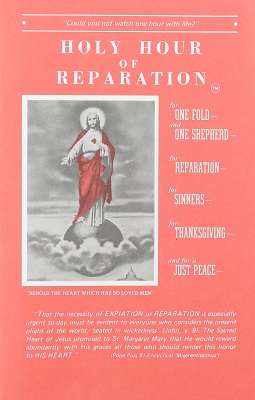
For many Catholics, having structured prayer works well. Prayer of a traditional nature is likely to appeal to readers of this column. One excellent resource for making a Holy Hour consisting of traditional prayers is the 31 page booklet, Holy Hour of Reparation, published by CMJ Marian Publishers ($3.00 at www.cmjbooks.com). Available in English, Spanish, Polish, Italian, and German, the booklet was originally published in 1945 and republished in 2001. It contains a solid hour of classic prayers of petition, reparation, thanksgiving, and adoration.

Looking for a place to pray this devotion publicly? Every Friday following the 12:15 PM (Ordinary Form) Mass, Old St. Mary’s Church in the Greektown area of downtown Detroit offers a Holy Hour in which this entire booklet is prayed. While an exclusively Ordinary Form parish, Old St. Mary’s is worth a visit not only for the Holy Hour, but also because of its well-preserved traditional architecture, its custom of kneeling at the Altar Rail for Holy Communion, opportunities for Confession before every weekday Mass, Sunday Ordinary Form Mass in Latin, and splendid First Saturday Devotions.

Comparison of Ordinary and Extraordinary Form Mass Texts

In 2008 this column published a 15-part series comparing the Ordinary and Extraordinary Forms of the Mass, side by side. Several readers have since requested that the comparison be republished as one continuous document. The recent talk that this writer gave after Mass at the Academy of the Sacred Heart provided an appropriate incentive to complete the task. An updated version of the comparison also required a revised version of the Ordinary Form side using the new English translation.

The new comparison document may be downloaded at: www.windsorlatinmass.org/wtnews/ofefcomparison.pdf. It will also be distributed after Mass in Windsor on February 8 and at the Academy on February 15.

New BC Church in a Traditional Style


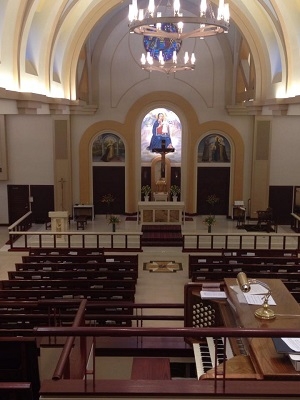
Via Fr. Paul Nicholson comes word and a photo of a newly constructed church in a traditional style: Our Lady of the Assumption in Port Coquitlam, BC, in the Archdiocese of Vancouver, sports a raised central altar, a Communion Rail, a choir loft in the back, and abundant traditional art. While this parish does not offer the Extraordinary Form of Holy Mass, we must nevertheless applaud all efforts to re-traditionalize our Catholic churches, as art and architecture have a lasting effect on the mindset of the faithful. With all of the advances in technology, we are able to build better, longer-lasting buildings than ever before, if we want to. Why not invest our very best efforts to transmit the faith in imagery through these durable assets?

Next Tridentine Mass at Our Lady of the Scapular, Wyandotte

Continuing with his plan to offer the Extraordinary Form approximately once per month on a major Feast Day, Fr. Mark Borkowski will host the next Tridentine High Mass at Our Lady of the Scapular Parish on the Fourth Sunday of Lent, Lætáre Sunday, March 15 at 12:00 Noon.

Tridentine Masses This Coming Week
  • Mon. 02/09 7:00 PM: Low Mass at St. Josaphat (St. Cyril of Alexandria, Bishop, Confessor, & Doctor)
  • Tue. 02/10 7:00 PM: Low Mass at Holy Name of Mary (St. Scholastica, Virgin)
  • Sun. 02/15: No Mass at St. Albertus
[Comments? Please e-mail tridnews@detroitlatinmass.org. Previous columns are available at http://www.detroitlatinmass.org. This edition of Tridentine Community News, with minor editions, is from the St. Albertus (Detroit), Academy of the Sacred Heart (Bloomfield Hills), and St. Alphonsus and Holy Name of Mary Churches (Windsor) bulletin inserts for February 15, 2015. Hat tip to A.B., author of the column.]

Saturday, February 07, 2015

Tridentine Masses coming this week to the metro Detroit and East Michigan areas


Tridentine Masses This Coming Week

Light on the Argentine ethos of José Bergoglio, his background, and rise to prominence.


Boniface, over at Unam Sanctam Catholicam, offers an interesting retrospective on the election of José Bergoglio as our current Pope Francis, with links to (1) an article he did at the time entitled "First Impressions" upon his elections, which is as engaging for the comments following the article as it is for the article itself; and (2) an article entitled "Who is Pope Francis?" [PDF] by Jack Tollers, an Argentine traditionalist who contacted Boniface at the time, and who compiled this "anguished essay" on Bergoglio in light of the culture of Argentina, which he calls a "make believe country." Toward the end of his article, Tollers says of José Bergoglio that "he's the perfect example of an Argentine, Peronist, Jesuit of the second half of the Twentieth Century."

Then, this observation from Guy Noir, who sent me the Boniface link:
I am convinced JPII and Benedict XVI were/are godly men, smart men, and nobly-intentioned ones (Francis too). And I am increasingly convinced they were /are tragic ones, in that they believed in and wanted to maintain the Deposit of Faith, but also were unwilling to endure uncomfortable dissonance with the modern ideas they assumed to be givens, or maybe even to entertain the idea that the Gospel and world happiness might be mutually exclusive in certain eras. Witness youth unemployment as the primary concern of a pontiff. And hence they bequeathed to us the rapid disintegrating reality of a Church that wants to proclaim absolutes but is absolutely uncomfortable with antagonizing the world. Pretty much anything seems preferable to having to endure the thought of being caricatured as Mean Old Men. When by the World's standards, that is how they should see the hierarchy!

Friday, February 06, 2015

Principles of Catholic Theology and Careful Readers

Just a brief aerogram today from Guy Noir in Rome, where he was apparently luncheoning with some friends among the papal paparazzi last Saturday. Always the Socratic gadfly, seizing upon every possible means of prodding me and provoking me to THINK, he scrawls out (in a remarkably florid John Handcock-esque hand) the URL to the mighty War Against Being blog of James Larson, and, with the words: "I believe this is depressingly right," refers to the following title and excerpted quote: "The Synod on the Family, Joseph Ratzinger, And the Destruction of the Catholic Mind" (WAB, January 22, 2015):
If that bishop possesses a mind which has fallen prey to the denial of substantiality inherent in Modern Physics, and if he is also an evolutionist: then, despite the fact that the good instincts he has inherited from the past may indeed have led him to vote correctly, he is not at all established in those foundational principles which are necessary for truly “thinking with the Church”. His orthodoxy, his conservativism, in other words, is built on sand, and is eventually bound to crumble – if not in himself personally before his death, then in his spiritual children. He may believe in the indissolubility of marriage, but he has no substantial basis for so believing. He may believe in the concepts of mortal sin and sanctifying grace, but these beliefs fly directly in the face of his being in bed with Science and Evolutionary Theory. He has feet of sand.
To which Noir adds a bit of text in Saxon Runes in mockery of my ignorance of them ...

... which he then "generously" condescends to translate for me as follows:
"... Which explains the ongoing tragedy that we witness unfolding in the well-meaning but impossibly-conflicted papacies of the last six popes. Meanwhile we witness the incredible spectacle of Ignatius Press adding more bricks to its literary memorial to Vatican II.(And I do mean bricks: peruse Fr. De Lubac's Paradoxes or More Paradoxes for confirmation; also note his biggest fan of late is John Milbank)."
Well enough. I never found Milbank rewarding enough to read anyway. I liked de Lubac's The Drama of Atheist Humanism,which shed some interesting new light on Auguste Comte and Ludwig Feuerbach, but I remain in two minds about some of his other work. My head hurts.

[Disclaimer: Rules 7-9]

Let the Burke-haters cue up ...

Our undercover correspondent we keep on retainer in an Atlantic seaboard city that knows how to keep its secrets, Guy Noir- Private Eye, recently sent me a shivering courrier with the following telegram:
I am not always a Tony Esolen fan. He has his many moments. But I also think he can over-reach and take some overly-wide swipes. But then again, so can Voris and I really appreciate him.

So there is this piece, which I was ready to dismiss as breast-beating but is instead very on target when it comes to the gender problem in the Church. JPII may have OK'd altar girls, but that doesn't make the idea all that A-OK. Here are some very prescient reasons why...
Anthony Esolen, "More Ways to End the Vocations Crisis" (Crisis, February 5, 2015). Very good.

My recent article on the self-inflicted crisis of vocations to the Catholic priesthood engendered a lot of discussion, from which I conclude that my suspicion is correct. Many Catholics are content with strategies of suicide, because they do not really want the Church to prevail in her war against a world deranged. Since in our day the derangement is most obviously about things having to do with marriage, sex, children, the family, and those differences between men and women that are attested and variously respected by every culture that has ever existed, in every geographical area and at every stage of technological development, that means that they want the sexual revolution to change the Church rather than the Church to defeat the revolution. They are anti-missionaries, come to preach the gospel of chic hedonism. In our time, when someone says, “I don’t agree with all of the teachings of the institutional Church,” you can bet your house that the disagreement has nothing to do with three Persons in one God, but rather two persons in one bed.

Do the obvious things that will attract men. You want men? Go get them. Tell them that you need them to do the job, which is true. Set up a men’s reading group, and read real works of theology and Catholic philosophy, works that are daunting in their significance for a deadening secular world....

Let them forge friendships in the vicinity of the sacraments. Announce a monthly meeting for men, for confession, discussion, and fellowship. Make sure there is food and beer.

The hymnals have been neutered. Get rid of the neutered hymnals. If you do not have the funds to replace Worship III, Gather, Glory and Praise, and others of that ilk with real hymnals, then incorporate into your worship some of the old manly hymns of the Church militant. We have copier machines; this can be done. At least once a month, sing one of those hymns. That is not much to ask! Sing Soldiers of Christ, Arise, or Fight the Good Fight, or Rise Up, O Men of God. The women will be happy to sing these too, if truth be known.

Return all attention at Mass to the action of Christ. What good and true man wants to give his life to a coffee klatsch? And Mass is not a coffee klatsch. It is not a comfy gathering of nice people with a taste for spirituality. It is the sacrifice of Christ, reenacted by the priest in persona Christi; it is the single holiest thing in the world. When J. R. R. Tolkien was writing to his son Michael, during the dark days of the German bombing of Britain, he told him to bind his heart to the Eucharist: “Out of the darkness of my life, so much frustrated, I put before you the one great thing to love on earth: the Blessed Sacrament … There you will find romance, glory, honour, fidelity, and the true way of all your loves on earth, and more than that: Death.” Yes, Death, which on earth ends all, but whose foretaste in the Eucharist, says Tolkien, gives the dimension of depth and reality to all that we seek and love on this side of the grave.

So put the tabernacle where it belongs, in the central place of honor. Get every layman out of the sanctuary after the prayer of the faithful. Put the chair of the priest on the side. Get the singers out of the view of the aud –, I mean, the congregation. If you don’t have baritones, find one.

Semper fidelis. If you are teaching in RCIA, and you do not warmly embrace the doctrines of the Church, moral and theological, then you need to do plenty of praying on account of your confusion, and you should recuse yourself immediately....

You have to remember what boys are. If your worldly business depended for its survival upon attracting them, you would not be so foolish as to dismiss what your eyes tell you, not to mention the entire human race. You would say, “Since this is the job to be done, these are some clear measures to take.” Take them. The Lord who chose twelve men to be His apostles, and knew how to do it, will bless you.
Huzzah!! Read the whole article! There's even more that's better!