For those interested, my colleague has just updated his remarks in the last half of my post, "One covenant or two? The Jewish-Catholic question briefly revisited" (Musings, January 5, 2016).
A blessed feast of the Epiphany to all our readers: "20 + C + M + B + 16" (for those who understand the tradition)!

Wednesday, January 06, 2016
Tuesday, January 05, 2016
GrottoCast!!!
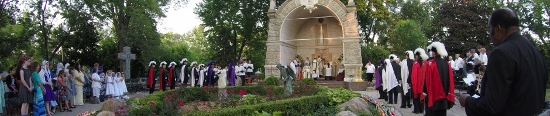
I realize what a privilege it is to be able to assist at Mass at a perish where homilists are as good as confessors, where old Catholic customs are observed with affection, and one can imagine what the Church must have been like a generation or two ago.
For anyone interested in looking through a window, as it were, into this world, and in listening in to such homilies, there is no better place than GrottoCast , a new website that shares Fr. Eduard Perrone's (and his guest celebrants') homilites in audio format. Fr. Perrone, of course, is a priest of the Archdiocese of Detroit serving the Assumption Grotto parish.
Here, for example, are the 2015 Christmas Homilies: Fr. Logan & Fr. Perrone (GrottoCast, December 25, 2015), which are both worth a listen, along with pictures. I'm told that a series of Carmelite retreat talks will be featured this year. As the church bulletin notes, the site will also be used to share video clips from some devotional and liturgical events. Furthermore, using the archive drop down in the sidebar, you can find a Corpus Christi procession video from June of 2015; and there is a provision (also in the sidebar) for subscribing to email notifications that will send you a link as soon as items are posted.
God bless you everyone!
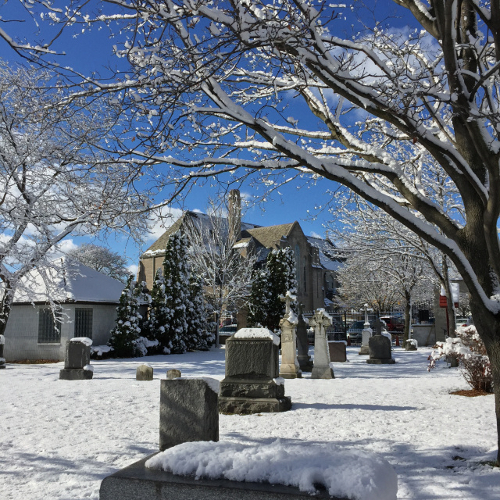
One covenant or two? The Jewish-Catholic question briefly revisited
After reading Canonist Ed Peter's post on the recent Vatican document on Catholic-Jewish relations, as well as the exchange between Peters (in his above-linked post) and Jimmy Akin; and after a discussion with one of my colleagues who actually thought the Vatican document was a helpful theological advancement, I was provoked to do a little investigating of my own.
Following up on my earlier posts on said document (in "New Vatican Document on Judaism Provokes Controversy," Musings, December 18, 2015; and "A Non-Magisterial Magisterial Statement," Musings, January 3, 2016), I decided to examine the points controverted by John Vennari by putting them to the test in an examination of the original document. Here is a brief summary of my conclusions (headings are adapted from Vennari; excerpts from the Vatican document beneath them include my own as well as those he referenced in footnotes; bracketed numbers refer to numbered paragraphs of the Vatican document; and added emphasis is mine):
Following up on my earlier posts on said document (in "New Vatican Document on Judaism Provokes Controversy," Musings, December 18, 2015; and "A Non-Magisterial Magisterial Statement," Musings, January 3, 2016), I decided to examine the points controverted by John Vennari by putting them to the test in an examination of the original document. Here is a brief summary of my conclusions (headings are adapted from Vennari; excerpts from the Vatican document beneath them include my own as well as those he referenced in footnotes; bracketed numbers refer to numbered paragraphs of the Vatican document; and added emphasis is mine):
- The New Covenant does not supersede the Old Covenant:
[17] A replacement or supersession theology which sets against one another two separate entities, a Church of the Gentiles and the rejected Synagogue whose place it takes, is deprived of its foundations.
[23] The Church does not replace the people of God of Israel, since as the community founded on Christ it represents in him the fulfilment of the promises made to Israel. This does not mean that Israel, not having achieved such a fulfilment, can no longer be considered to be the people of God. - The Catholic Church, in principle, should have no mission to convert Jews:
[40] The Church is therefore obliged to view evangelisation to Jews, who believe in the one God, in a different manner from that to people of other religions and world views. In concrete terms this means that the Catholic Church neither conducts nor supports any specific institutional mission work directed towards Jews. While there is a principled rejection of an institutional Jewish mission, Christians are nonetheless called to bear witness to their faith in Jesus Christ also to Jews, although they should do so in a humble and sensitive manner, acknowledging that Jews are bearers of God’s Word ...
- The Word of God is regarded as present to modern Jews by means of the Torah in a sense that equates this to the Word of God being present to Christians through Jesus Christ:
[24] For Jews [the Word of God] can be learned through the Torah and the traditions based on it. The Torah is the instruction for a successful life in right relationship with God. Whoever observes the Torah has life in its fullness (cf. Pirqe Avot II, 7). By observing the Torah the Jew receives a share in communion with God. In this regard, Pope Francis has stated: "The Christian confessions find their unity in Christ; Judaism finds its unity in the Torah. Christians believe that Jesus Christ is the Word of God made flesh in the world; for Jews the Word of God is present above all in the Torah. Both faith traditions find their foundation in the One God, the God of the Covenant, who reveals himself through his Word. In seeking a right attitude towards God, Christians turn to Christ as the fount of new life, and Jews to the teaching of the Torah." (Address to members of the International Council of Christians and Jews, 30 June 2015).
- Modern Jews are treated as being in an acceptable position before God regarding salvation:
[36] From the Christian confession that there can be only one path to salvation ... it does not in any way follow that the Jews are excluded from God’s salvation because they do not believe in Jesus Christ as the Messiah of Israel and the Son of God. ... That the Jews are participants in God’s salvation is theologically unquestionable, but how that can be possible without confessing Christ explicitly, is and remains an unfathomable divine mystery.
- “The term covenant, therefore, means a relationship with God that takes effect in different ways for Jews and Christians”:
[25] Judaism and the Christian faith as seen in the New Testament are two ways by which God’s people can make the Sacred Scriptures of Israel their own. The Scriptures which Christians call the Old Testament is open therefore to both ways. A response to God’s word of salvation that accords with one or the other tradition can thus open up access to God, even if it is left up to his counsel of salvation to determine in what way he may intend to save mankind in each instance. That his will for salvation is universally directed is testified by the Scriptures (cf. eg. Gen 12:1-3; Is 2:2-5; 1 Tim 2:4). Therefore there are not two paths to salvation according to the expression "Jews hold to the Torah, Christians hold to Christ". Christian faith proclaims that Christ’s work of salvation is universal and involves all mankind. God’s word is one single and undivided reality which takes concrete form in each respective historical context.
[27] The covenant that God has offered Israel is irrevocable. "God is not man, that he should lie" (Num 23:19; cf. 2 Tim 2:13). The permanent elective fidelity of God expressed in earlier covenants is never repudiated (cf. Rom 9:4; 11:1–2). The New Covenant does not revoke the earlier covenants, but it brings them to fulfilment. ... The term covenant, therefore, means a relationship with God that takes effect in different ways for Jews and Christians. - “It does not follow that Jews are excluded from God’s salvation because they do not believe in Jesus Christ as the Messiah and the Son of God”:
[36] From the Christian confession that there can be only one path to salvation, however, it does not in any way follow that the Jews are excluded from God’s salvation because they do not believe in Jesus Christ as the Messiah of Israel and the Son of God. Such a claim would find no support in the soteriological understanding of Saint Paul, who in the Letter to the Romans not only gives expression to his conviction that there can be no breach in the history of salvation, but that salvation comes from the Jews (cf. also Jn 4:22). ... That the Jews are participants in God’s salvation is theologically unquestionable, but how that can be possible without confessing Christ explicitly, is and remains an unfathomable divine mystery.
Sunday, January 03, 2016
"A non-magisterial magisterial statement?"
On December 10, 2015, the Pontifical Commission for Relations with the Jews released a document consisting of Reflections on Theological Questions entitled "The Gifts and the Calling of God are Irrevocable" (see our post, "New Vatican Document on Judaism Provokes Controversy," Musings, December 18, 2015).
Canonist Edward Peters, in "A non-magisterial magisterial statement?" (In the Light of the Law, December 15, 2015), has a very good discussion of the question of magisterial status of such documents -- a discussion provoking a response from Jimmy Akin in "Why the Holy See Issues Non-Magisterial Statements" (National Catholic Register, December 15, 2015), to which Peters briefly responds in an addendum to his original post linked above.
The debate turns on the question whether the magisterial character of prelates can be readily "turned off and on" (as Akin seems to maintain) or whether this character cannot be so easily laid aside (as Peters suggests). The position taken by Peters implies that theological statements by prelates, regardless of the "specific intentionality" whereby they wish their locutionary acts to be characterized (as 'magisterial' or 'non-magisterial'), can have am objectively magisterial character independent of any subjective intention. While this should not lead us to suppose that such statements have a greater conscience-binding character than they in fact have, yet underscores, in turn, that prelates need to exercise greater care in making assertions on faith and morals, says Peters.
Read both articles. It's an important and timely discussion. Both authors seem concerned about the direction things have been heading in recent years with off-the-cuff declarations and "non-binding" Vatican statements; but they offer quite different accounts of how these developments should be viewed.
Update:
Canonist Edward Peters, in "A non-magisterial magisterial statement?" (In the Light of the Law, December 15, 2015), has a very good discussion of the question of magisterial status of such documents -- a discussion provoking a response from Jimmy Akin in "Why the Holy See Issues Non-Magisterial Statements" (National Catholic Register, December 15, 2015), to which Peters briefly responds in an addendum to his original post linked above.
The debate turns on the question whether the magisterial character of prelates can be readily "turned off and on" (as Akin seems to maintain) or whether this character cannot be so easily laid aside (as Peters suggests). The position taken by Peters implies that theological statements by prelates, regardless of the "specific intentionality" whereby they wish their locutionary acts to be characterized (as 'magisterial' or 'non-magisterial'), can have am objectively magisterial character independent of any subjective intention. While this should not lead us to suppose that such statements have a greater conscience-binding character than they in fact have, yet underscores, in turn, that prelates need to exercise greater care in making assertions on faith and morals, says Peters.
Read both articles. It's an important and timely discussion. Both authors seem concerned about the direction things have been heading in recent years with off-the-cuff declarations and "non-binding" Vatican statements; but they offer quite different accounts of how these developments should be viewed.
Update:
- Nabeel Qureshi, "Do Muslims and Christians Worship the Same God?" (RZIM, December 22, 2015). Here, from a Muslim convert to Christianity, is the more nuanced sort of answer I wish I would see more often from Catholics.
- Francis J. Beckwith, "Why Muslims and Christians Worship the Same God" (The Catholic Thing, January 7, 2016). I dunno. Beckwith says all the right things in terms of magisterial teaching; yet we may need more emphasis on the lines he ends with, which touches on what one of my readers recently said to me in an email: "Do Muslims worship Jesus?" That is the only important question in the final analysis.
How diversity and inclusiveness become repressive and totalitarian
R.R. Reno, "The Real Role of Diversity" (First Things, December 31, 2015):
[Hat tip to JM]In the December 14 issue of the Weekly Standard, Jonathan Last reflects on the remarkable success of the student protests at universities around the country. He catalogues the capitulations. Fifteen students occupy Princeton president's office for a few hours, and their demands are taken with the upmost seriousness, including the call to expunge Woodrow Wilson's name. Faced with protestors, Brown's president commits $100 million to create “a just and inclusive campus.” A dean resigns at Claremont McKenna. Professors at Yale are cursed and denounced. And, of course, Mizzou President Tim Wolfe is forced out.
In these and other instances, one is struck by how quickly and thoroughly university leaders have capitulated. The institutions don't defend themselves. The grown-ups in charge offer no resistance. Quite the contrary, they accommodate and apologize. Last points out that last year we saw a preview of this spirit of capitulation. University of Virginia was rocked by a Rolling Stone story about a fraternity gang rape. It turned out to be false, but university administrators continued to recommit themselves to the cause. The same goes for the notorious mattress girl at Columbia who claimed to have been raped by a fellow student. Even though he was exonerated, Columbia continued to honor her protest.
Or there's the case of the back electrical tape covering faces of black professors at Harvard Law School, an incident that caused much soul-searching, but which evidence suggest may have been a hoax perpetrated by student activists. There's precedent. At Oberlin two white student radicals circulated fliers with swastikas and demeaning comments about Martin Luther King. The ruse was exposed. Nevertheless, administrators issued statements emphasizing their commitments to racial justice, inclusion, etc.
What is going on? Why are university administrators so willing to cave to quickly and so thoroughly, even when it turns out that supposed crises are manufactured or exaggerated?
Last argues that the reason concerns power. Aggrieved students, especially aggrieved students from officially designated minorities, seem to have more power than university administrators. And with each capitulation, resignation, and earnest apology, that sense of power grows. That's right, and it raises the question of the source of administrative weakness and minority student power.
The answer comes from our larger political culture. “Diversity” is one of the pillars supporting the legitimacy of our ruling class. (The other is technocratic competence or “merit.”) In our present situation, the President of Yale justifies his power by appealing to his competence—and to his commitment to “diversity.” The same goes for CEOs of major corporations, heads of major philanthropies, and most political leaders. “Diversity” serves to block accusations that the control of power (and wealth) is an inside game that favors insiders. No, says the ideology of “inclusion,” we hold power, yes, but we do so with a self-sacrificial commitment to use it to empower others.
Moreover, “diversity” is also a bludgeon with which to beat up on any challengers to today's elite. Republicans? They're the “white party,” which is another way of saying a party of prejudiced, racist xenophobes. To lack “diversity” disqualifies one automatically. This is a very handy tool with which to dismiss competition for power, especially when you can define “diversity” as you wish, which is what our establishment does.
Minority students, especially black students, are aware (or at least half-aware) that the power of the ruling class depends upon THEIR cooperation. Because of our history of slavery and segregation, our ruling class needs black Americans so that it can certify itself as “diverse.” As a consequence, minority students—again, especially black students—are in a position to collect enormous rents.
Consider this scenario. Twenty white male Yale students surround a black faculty member, cursing and taunting. If Yale's president expelled them, our power elite would applaud. Now, consider what actually happened at Yale, which was the opposite, students of color cursing and berating a white professor. Had Yale's president expelled them, he would have triggered an institutional crisis that in all likelihood would have cost him his job.
Given the importance of “diversity” for the legitimacy of our ruling class, I can't imagine significant resistance to student demands. What's $100 million when running America is at stake? I'm quite sure nobody important is going to object to scrubbing Woodrow Wilson's name from Princeton's campus, if that what's necessary to re-secure the complaisant cooperation of black students in Princeton's project of being a model of “diversity.” This won't come about because the grown-ups at Princeton and elsewhere are feckless. It's because they know what's at stake—their own legitimacy.
The stakes are increased exponentially by the fact that our ruling class is positioning itself to stand astride the entire world. The One Percent is reconfiguring itself as the global establishment. To so so—and to nail down legitimacy—our super-rich and super-powerful must demonstrate their multicultural bona fides. They need to have an ideological profile that promotes “diversity,” scaling up our national project into an international one. Americans aren't going to run the world. No, our ruling class will be “inclusive” and “empowering.” (Obama's early foreign policy rhetoric sounded exactly these notes, and to some extent still does, though the fact that some don't want to be “included” has dampened things a bit.)
Populism Left and Right, here and in Europe, senses that multiculturalism serves as an ideology to justify the transformation of American, French, or German elites into global elites. And they're rebelling, rightly to my mind. Ordinary people rightly see that they'll be sold out if that's what needed to promote whatever form of global “diversity” the One Percent sees as necessary to buttress its right to rule.
On being weird

"The weirder you're going to behave, the more normal you should look. It works in reverse, too. When I see a kid with three or four rings in his nose, I know there is absolutely nothing extraordinary about that person." -- P.J. O'Rourke[Hat tip to L.S.]
Fr. Perrone on the difference between Christ-seeking pagan Magi and occult-seeking lapsed Christians
Fr. Eduard Perrone, "A Pastor's Descant" [temporary link] (Assumption Grotto News, January 3, 2016):
From the word magi we have the words magician and magic. That’s because all three refer to occult or hidden arts. Occult need not mean something evil, though modern usage carries that meaning primarily: those dark, secret beliefs and practices privy only to the initiated. Before and at the time of Christ those who knew not the true faith of the Jews were held captive to various forms of paganism. Saint Paul identified the gods of the pagans as demons. Surely there were at that time men of sincere and upright intention who, though ignorant in many ways, sought truth through the occult means of reading the stars and other like things. A few gifted others found light for the intellect through philosophy (but often mixed with errors).
Our Epiphany heroes were pagans but sincere seekers of wisdom and truth through reading the stars. To these men the good God manifested the heavenly light which led them to Bethlehem. God used such means to bring good and honest men from the half-truths of their primitive sciences and superstitions to the supernatural truth of Christ. Note carefully, however: these men were unlike today’s erstwhile Christians who, having found the truth of Christ tedious, have cast aside Truth Incarnate and embraced the fascinatingly bizarre, the weird, the perverse, and a legion of false practices proposed by demons in astrology, fortune telling, ouija boards, seances, new age movements, secret societies (e.g. freemasons) and other such occult things. Even this small sampling of the litany of occult things indicates how multiform error is and how singular is truth. There is no other truth but Christ who is Truth. There is no other way to God or transcendent life but through Him who is the Way. To the growing multitude of people forsaking Christ for these demonic lies one might say, as Paul did to the Galatians, “O ye foolish (people)! who has bewitched you, before whose eyes Jesus Christ was publically portrayed?”
We’re seeing in our day a rapid progression of occultism enabled by modern technological means and popular culture (films, music, etc.) and with a concomitant retreat from orthodox Christian faith. Future prospects for the Church do not look promising. Added to this is the strong arm of political and legislative pressures poised against those who uphold the irreversible norms of morality which the Church has always safeguarded. (Here another itemized litany of evils might be listed, but I’ll pass up the temptation.) Saint Paul in Romans showed the consequences for deliberately turning away from the truth to false religions and occultism to be unnatural–that is, deviant–sexual activity (read Romans 1:18-32 to get the full story). This depravity, it should be noted, is considered a divine punishment for willfully turning away from truth and, in its stead, daring to assent to and act
contrary to it.
To say this more simply, in what has been happening in the world we’re getting a lickin’, a thrashing, for impiety and sexual perversity. God is just. People are getting what they are asking for and thus deserve: fitting retribution. In the event, all are made to suffer on account of the wickedness of the few whose numbers, however, grow steadily.
Returning to the magi. We see that they who turned to God in a humble, obedient and honest quest for truth found it in Christ. Epiphany day is a triumph of truth over the many demonic propositions that cause men to grope in intellectual and moral darkness. On this very day of truth’s triumph, we lament the deliberate regression of man to occultism, paganism, atheism and homosexuality.
In an increasingly insane world we laud the wise men who insist on adhering to manifest, reveled truth. We ourselves must stand fast with them against the powerful pressures to turn from light to darkness. Epiphany is the feast day of all who champion the singular way of truth in faith and morals. You will find this way in its fullness only in one place in the universe: in Christ’s holy, Catholic Church.
Fr. Perrone
Tridentine Community News - Dom John Tonkin to Celebrate First Mass in Windsor; Our Lady Queen of Martyrs Church to Host Special Epiphany Tridentine Mass; Blessing of Chalk and Epiphany Water; Gems From the Chicago Bus Tour; TLM Mass schedule

"I will go in unto the Altar of God
To God, Who giveth joy to my youth"
Tridentine Community News by Alex Begin (January 3, 2016):
January 3, 2016 – Holy Name of Jesus
Dom John Tonkin to Celebrate First Mass in Windsor
Recently ordained to the priesthood Dom John Tonkin of the Canons Regular of the New Jerusalem will be returning home to celebrate his first local Mass next Sunday, January 10 at 2:00 PM at St. Alphonsus Church in Windsor. It will be a Solemn High Mass with Deacon and Subdeacon. Prior to entering religious life, Dom John was for many years an altar server for the Windsor Latin Mass. All are invited to a reception for Dom John to be held after Mass in the St. Alphonsus Social Hall.
Our Lady Queen of Martyrs Church to Host Special Epiphany Tridentine Mass
For the second year in a row, Fr. Scott Thibodeau of Our Lady Queen of Martyrs Church in Beverly Hills, Michigan has offered the use of his church for a special Tridentine High Mass for the Feast of the Epiphany this Wednesday, January 6 at 7:00 PM. Fr. Clint McDonell will be the celebrant, and Oakland County Latin Mass Association volunteers are assisting with the organization of this Mass. Our Lady Queen of Martyrs is in the midst of a restoration of the church which includes the installation of a new High Altar, a new tile floor for the sanctuary, and soon the reinstallation of the Communion Rail.
Blessing of Chalk and Epiphany Water
There is a longstanding tradition of blessing chalk, water, and occasionally incense on or near the Feast of the Epiphany. Locally we perform the blessing on the Sunday prior to Epiphany. The European custom is to take the blessed chalk home and use it to write over the door of the house, 20 + C + M + B + 16, where the numbers represent the year, and the letters stand for the names of the Magi: Caspar, Melchior, and Balthasar. It is a way of dedicating the year and one’s home to our Lord. If blessed incense was also distributed, the door of the house is incensed.
“Three Kings Water” is blessed with an elaborate, 25-minute ceremony from the Rituále Románum. The ceremony includes an impressive and unequivocal prayer of exorcism. This prayer is more detailed than the prayers of exorcism used in the blessing of regular Holy Water. The pure and exorcised Epiphany Water is then taken home and sprinkled in the rooms of the house as a protection against evil.
The full English translations of the Blessings of Epiphany Chalk and Water were published in our January 3 and January 10, 2010 columns which are available in our column archive at www.detroitlatinmass.org.
Gems From the Chicago Bus Tour
There are always pleasant surprises to be discovered during Prayer Pilgrimages’ annual Christmas week bus tour of historic Chicago churches. This year we were privileged to have Holy Mass in the Extraordinary Form celebrated by Fr. Joe Tuskiewicz at St. Mary of the Angels and St. John Cantius Churches, both architectural marvels. Three newsworthy factoids were discovered at other sites that were visited:Tridentine Masses This Coming Week
- St. Stanislaus Kostka Church, in the midst of a multi-year restoration, is about to commence the restoration of its High Altar and the (re)installation of a Communion Rail.
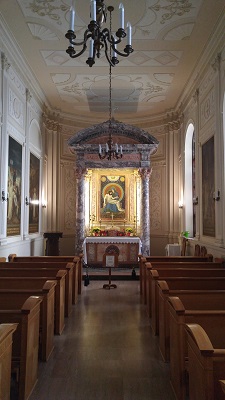
- Marytown’s rector published a letter which is distributed at the entrance to their chapel, explaining that their music program is being changed to incorporate more Gregorian Chant. A new music director with connections to Mundelein Seminary has been hired to implement this new focus. Marytown is also home to occasional Tridentine Masses, entirely appropriate for the main chapel and the perfectly proportioned and preserved side chapel [shown in photo below].
- Mundelein Seminary has (re)installed a High Altar with centrally-located tabernacle in the sanctuary of their main chapel. Mundelein hosts a number of Holy Masses in the Extraordinary Form each year, so there is a practical benefit to having this particular architectural feature restored.
- Mon. 01/04 7:00 PM: Low Mass at St. Josaphat (St. Elizabeth Ann Seton, Widow)
- Tue. 01/05 7:00 PM: Low Mass at Holy Name of Mary (St. Telesphorus, Pope & Martyr)
- Wed. 01/06 7:00 PM: High Mass at Our Lady Queen of Martyrs, Beverly Hills, Michigan (Epiphany of the Lord)
- Wed. 01/06 7:00 PM: High Mass at St. Joseph (Epiphany of the Lord)
- Fri. 01/08 7:00 PM: High Mass at St. Joseph (Feria After Epiphany)
- Tue. 01/10 2:00 PM: Solemn High Mass at St. Alphonsus, Windsor (The Holy Family) – First local Mass of Dom John Tonkin, CRNJ. Reception after Mass in the social hall.
Two amusing tweets from MBD
(1)[Hat tip to JM]
Michael B Dougherty @michaelbd 31 Dec 2015 @Blagojevism
I’m not a consistent anti-modernist. More of a cafeteria-anti-modernist.
(2)
Neil deGrasse Tyson @neiltyson
To all those who reckon time on the Gregorian Calendar - Happy New Year! (FYI: January 1 is astronomically insignificant.)
Michael B Dougherty @michaelbd Dec 31
So are all the atoms that we collectively call "Neil"
Tridentine Masses coming this week to metro Detroit and east Michigan
Tridentine Masses This Coming Week
-
Sunday
- Sun. 01/03 7:30 AM and 10:00 AM: Low Mass (Confessions 45 minutes before and after Masses) at St. Joseph's Church, Richmond [NB: See note at bottom of this post about SSPX sites.]* (Holy Name of Jesus - 2nd class)
- Sun. 01/03 8:00 and 10:30AM Low Mass (Confessions 1/2 hour before Mass: call beforehand) at St. Ann's Church, Livonia [NB: See note at bottom of this post about SSPX sites.]* (Holy Name of Jesus - 2nd class)
- Sun. 01/03 9:30 AM: High Mass at St. Josaphat, Detroit (Holy Name of Jesus - 2nd class)
- Sun. 01/03 9:30 AM: High Mass at Assumption Grotto, Detroit (Holy Name of Jesus - 2nd class)
- Sun. 01/03 9:45 AM: High Mass at OCLMA/Academy of the Sacred Heart, Bloomfield Hills (Holy Name of Jesus - 2nd class)
- Sun. 01/03 2:00 PM: High Mass at Holy Name of Mary, Canada (Holy Name of Jesus - 2nd class)
- Sun. 01/03 3:00 PM High Mass St. Matthew Catholic Church, Flint (Holy Name of Jesus - 2nd class)
Monday
- Mon. 01/04 7:30 AM: High or Low Mass (varies) at Assumption Grotto, Detroit (Feria of Christmastide - 4th class, or [USA] St. Elizabeth Ann Seton - 4th class)
- Mon. 01/04 8:00 AM: Low Mass (Confessions 8:30 AM to 9:30 AM) at St. Joseph's Church, Richmond [NB: See note at bottom of this post about SSPX sites.]* (Feria of Christmastide - 4th class, or [USA] St. Elizabeth Ann Seton - 4th class)
- Mon. 01/04 7:00 PM: Low Mass at St. Josaphat, Detroit (Feria of Christmastide - 4th class, or [USA] St. Elizabeth Ann Seton - 4th class)
- Mon. 01/04 7:00 PM: High Mass (usually) at Assumption Grotto, Detroit (Feria of Christmastide - 4th class, or [USA] St. Elizabeth Ann Seton - 4th class)
Tuesday
- Tue. 01/05 7:00 AM High or Low Mass (varies) at Assumption Grotto, Detroit (Feria of Christmastide - 4th class, or St. Telesphorus - 4th class)
- Tue. 01/05 8:00 AM: Low Mass (Confessions 8:30 AM to 9:30 AM) at St. Joseph's Church, Richmond [NB: See note at bottom of this post about SSPX sites.]* (Feria of Christmastide - 4th class, or St. Telesphorus - 4th class)
- Tue. 01/05 7:00 PM: Low Mass at Holy Name of Mary, Canada (Feria of Christmastide - 4th class, or St. Telesphorus - 4th class)
- Tue. 01/05 7:00 PM: Low Mass (usually) at Assumption Grotto, Detroit (Feria of Christmastide - 4th class, or St. Telesphorus - 4th class)
Wednesday
- Wed. 01/06 7:30 AM: High or Low Mass (varies) at Assumption Grotto, Detroit (Epiphany of the Lord - 1st class)
- Wed. 01/06 8:00 AM: Low Mass (Confessions 8:30 AM to 9:30 AM) at St. Joseph's Church, Richmond [NB: See note at bottom of this post about SSPX sites.]* (Epiphany of the Lord - 1st class)
- Wed. 01/06 7:00 PM: High Mass (usually) at Assumption Grotto, Detroit (Epiphany of the Lord - 1st class)
- Wed. 01/06 7:00 PM: High Mass at Our Lady Queen of Martyrs, Beverly Hills, Michigan (Epiphany of the Lord - 1st class)
- Wed. 01/06 7:00 PM: High Mass at St. Joseph, Detroit (Epiphany of the Lord - 1st class)
Thursday
- Thu. 01/07 7:30 AM: High or Low Mass (varies) at Assumption Grotto, Detroit (Feria after Epiphany - 4th class, or Jesus Christ the High Priest - 3rd class)
- Thu. 01/07 8:00 AM: Low Mass (Confessions 8:30 AM to 9:30 AM) at St. Joseph's Church, Richmond [NB: See note at bottom of this post about SSPX sites.]* (Feria after Epiphany - 4th class, or Jesus Christ the High Priest - 3rd class)
- Thu. 01/07 7:00 PM: Low Mass (usually) at Assumption Grotto, Detroit (Feria after Epiphany - 4th class, or Jesus Christ the High Priest - 3rd class)
Friday
- Fri. 01/08 7:30 AM: High or Low Mass (varies) at Assumption Grotto, Detroit (Feria after Epiphany - 4th class) [First Friday]
- Fri. 01/08 8:00 AM: Low Mass (Confessions 8:30 AM to 9:30 AM) at St. Joseph's Church, Richmond [NB: See note at bottom of this post about SSPX sites.]* (Feria after Epiphany - 4th class) [First Friday]
- Fri. 01/08 7:00 PM: Low Mass at St. Josaphat, Detroit (Feria after Epiphany - 4th class) [First Friday]
- Fri. 01/08 7:00 PM: Low Mass (usually) at Assumption Grotto, Detroit (Feria after Epiphany - 4th class) [First Friday]
- Thu. 01/08 7:00 PM: High Mass at St. Joseph, Detroit (Feria after Epiphany - 4th class) [First Friday]
Saturday
- Sat. 01/09 8:00 AM: Low Mass (Confessions 1/2 hour before Mass: call beforehand) at St. Ann's Church, Livonia [NB: See note at bottom of this post about SSPX sites.]* (Saturday of Our Lady - 4th class) [First Saturday]
- Sat. 01/09 8:00 AM: Low Mass (Confessions 8:30 AM to 9:30 AM) at St. Joseph's Church, Richmond [NB: See note at bottom of this post about SSPX sites.]* (Saturday of Our Lady - 4th class) [First Saturday]
- Sat. 01/09 7:30 AM: High or Low Mass (varies) at Assumption Grotto, Detroit (St. Stephen - 2nd class)
- Sat. 12/26 6:00 PM Tridentine Mass at SS. Cyril & Methodius Slovak Catholic Church, Sterling Heights (Saturday of Our Lady - 4th class) [First Saturday]
Sunday
- Sun. 01/10 7:30 AM and 10:00 AM: Low Mass (Confessions 45 minutes before and after Masses) at St. Joseph's Church, Richmond [NB: See note at bottom of this post about SSPX sites.]* (The Holy Family - 2nd class)
- Sun. 01/10 8:00 and 10:30AM Low Mass (Confessions 1/2 hour before Mass: call beforehand) at St. Ann's Church, Livonia [NB: See note at bottom of this post about SSPX sites.]* (The Holy Family - 2nd class)
- Sun. 01/10 9:30 AM: High Mass at St. Josaphat, Detroit (The Holy Family - 2nd class)
- Sun. 01/10 9:30 AM: High Mass at Assumption Grotto, Detroit (The Holy Family - 2nd class)
- Sun. 01/10 9:45 AM: High Mass at OCLMA/Academy of the Sacred Heart, Bloomfield Hills (The Holy Family - 2nd class)
- Sun. 01/10 2:00 PM: High Mass at St. Alphonsus Church, Windsor, Canada (The Holy Family - 2nd class)
- Sun. 01/10 3:00 PM High Mass St. Matthew Catholic Church, Flint (The Holy Family - 2nd class)
* NB: The SSPX chapels among those Mass sites listed above are posted here because the Holy Father has announced that "those who during the Holy Year of Mercy approach these priests of the Fraternity of St Pius X to celebrate the Sacrament of Reconciliation shall validly and licitly receive the absolution of their sins." These chapels are not listed among the approved parishes and worship sites on archdiocesan websites.

Saturday, January 02, 2016
"Social Gospel Über Alles"
 This is a long post to slog through; but, as almost always, Rod Dreher hits on the right questions and provokes the needed sorts of ruminations, here in "Social Gospel Über Alles" (The American Conservative, December 26, 2015).
As our underground correspondent, Guy Noir - Private Eye, said in a text containing the link sent from his iPhone (what, has he left off using carrier pigeons???):
Rod Dreher, Ross Douthat, Rorate Caeli, Amy Welborn, and a splash of Mularkey's bitters... An internet Catholic's roaming habits could be a lot worse, a lot... starting with the measured, reasoned morphine drip that CRUX supplies willing patients. Their "spirituality columnist," especially, is heterodox-to-Chisiter heinous. Anyway...
From Dreher, I think this is long but exactly right, and explains why Francis' "be good" -isms and dulling of doctrine may help Argentina but are damning for the larger Church in the West...
The Remarkable Woman Behind 'In the Bleak Midwinter'
Karen Swallow Prior, "The Remarkable Woman Behind 'In the Bleak Midwinter'" (TGC, December 16, 2015):
 Choirmasters consider it the world’s greatest Christmas carol. It has been recorded by musicians ranging from the Choir of King’s College to Annie Lennox to James Taylor. Originally
titled “A Christmas Carol,” the poem we know as “In the Bleak
Midwinter” by Christina Rossetti (1830–1894) was first published in 1872
by the American journal Scribner’s Monthly. It wasn’t set to music until 1906, 12 years after Rossetti’s death, when it appeared in The English Hymnal.
Choirmasters consider it the world’s greatest Christmas carol. It has been recorded by musicians ranging from the Choir of King’s College to Annie Lennox to James Taylor. Originally
titled “A Christmas Carol,” the poem we know as “In the Bleak
Midwinter” by Christina Rossetti (1830–1894) was first published in 1872
by the American journal Scribner’s Monthly. It wasn’t set to music until 1906, 12 years after Rossetti’s death, when it appeared in The English Hymnal.
Described by some critics as a “nun of art,” the never-married Rossetti was devoted to two seemingly opposing forces: deep Christian conviction and rich artistic sensibility. Both of these influences permeate “In the Bleak Midwinter”:
Plain words, echoed by resonant rhythms and sounds, serve as a foil to the brilliance of the poem’s theological insights. Even while universalizing the biblical narrative of Christ’s birth by transferring the scene at Bethlehem to a snowy Victorian Christmas, the poem remains steeped in Scripture. “Our God, heaven cannot hold him / Nor earth sustain” restate 1 Kings 8:27: “But will God really dwell on earth? The heavens, even the highest heaven, cannot contain you. How much less this temple I have built!” The vision foretold in Revelation 20:11 is repeated in the lines “Heaven and earth shall flee away / When he comes to reign.” Most significant is the biblical truth that the most important thing we can give to Christ is possessed by even the most impoverished soul.
Writing about Rossetti’s later poetry in the journal Religion and the Arts, scholar Chene Heady describes how Rossetti’s devotional verses “re-enchant a disenchanted world.” Within Rossetti’s Christian vision, formed by the liturgy of her Anglican tradition, “all existence is a long Advent.” Our earthly condition is “devoid of meaning,” Heady explains, and gains “significance only through . . . the eyes of faith.” Material objects, then, such as those that dominate the imagery of “In the Bleak Midwinter,” serve as symbols of spiritual reality. Thus Rossetti’s poems are like the parables of Jesus: “sufficiently complicated as to seem simple to the hearer who misses the point.”
The very restraint of “In the Bleak Midwinter” forces the poem’s
meaning to burst forth. The same can be said of the poet’s life, too.
Rossetti was born in England to Italian parents in a household immersed in the arts. Her father, an Italian emigrant, was a Dante scholar. Her two older brothers, Dante and William, helped form the famous arts community known as the Pre-Raphaelite Brotherhood, and Rossetti sat for some of their paintings. Schooled at home by her Anglican mother, Rossetti declined two offers of marriage due to doctrinal scruples and remained single her entire life. She devoted herself to her family and her faith, ministering to former prostitutes and working with the Society for Promoting Christian Knowledge, as well as nurturing a vibrant inner life as a poet.
Her brother described Rossetti, famously, as “replete with the spirit of self-postponement.” Yet like her American counterpart Emily Dickinson (1830–1886), Rossetti’s image as a retired, prudish spinster is belied by the intensity of her poetry. Paradoxically, as The Oxford Anthology of English Literature observes, Rossetti’s “curious literal-mindedness produces a wholly original kind of devotional poetry, astonishing historically because it gives the effect of being free from self-consciousness—and this later in the 19th century.” The volume identifies Rossetti as “superior to any other woman who wrote poetry in English before the 20th century” besides Dickinson.
Despite her apparent self-effacement, Rossetti seemed keenly aware of her sacrifice—overshadowed by her brothers, unmatched by any suitor, plagued by illness—yet chose contentment with her lot. Here are poignant words penned to her brother in 1888:
The paradox of Rossetti’s life is that her “spirit of self-postponement” produced some of the finest Christian poetry written—the gift of herself, given to her Savior and received by the world.
[Hat tip to JM\
Choirmasters consider it the world’s greatest Christmas carol. It has been recorded by musicians ranging from the Choir of King’s College to Annie Lennox to James Taylor. Originally
titled “A Christmas Carol,” the poem we know as “In the Bleak
Midwinter” by Christina Rossetti (1830–1894) was first published in 1872
by the American journal Scribner’s Monthly. It wasn’t set to music until 1906, 12 years after Rossetti’s death, when it appeared in The English Hymnal.Described by some critics as a “nun of art,” the never-married Rossetti was devoted to two seemingly opposing forces: deep Christian conviction and rich artistic sensibility. Both of these influences permeate “In the Bleak Midwinter”:
In the bleak midwinter
Frosty wind made moan,
Earth stood hard as iron,
Water like a stone:
Snow had fallen, snow on snow
Snow on snow,
In the bleak mid-winter,
Long ago.
Frosty wind made moan,
Earth stood hard as iron,
Water like a stone:
Snow had fallen, snow on snow
Snow on snow,
In the bleak mid-winter,
Long ago.
Our God, heaven cannot hold him
Nor earth sustain;
Heaven and earth shall flee away
When he comes to reign:
In the bleak mid-winter
A stable-place sufficed
The Lord God Almighty
Jesus Christ.
Nor earth sustain;
Heaven and earth shall flee away
When he comes to reign:
In the bleak mid-winter
A stable-place sufficed
The Lord God Almighty
Jesus Christ.
Enough for him, whom cherubim
Worship night and day,
A breastful of milk,
And a mangerful of hay:
Enough for him, whom angels
Fall down before,
The ox and ass and camel
Which adore.
Worship night and day,
A breastful of milk,
And a mangerful of hay:
Enough for him, whom angels
Fall down before,
The ox and ass and camel
Which adore.
Angels and archangels
May have gathered there,
Cherubim and seraphim
Thronged the air -
But only his mother
In her maiden bliss
Worshipped the beloved
With a kiss.
May have gathered there,
Cherubim and seraphim
Thronged the air -
But only his mother
In her maiden bliss
Worshipped the beloved
With a kiss.
What can I give him,
Poor as I am?
If I were a shepherd
I would bring a lamb;
If I were a wise man
I would do my part;
Yet what I can, I give him -
Give my heart.
Poor as I am?
If I were a shepherd
I would bring a lamb;
If I were a wise man
I would do my part;
Yet what I can, I give him -
Give my heart.
Paradoxical Simplicity
The stark language of the poem belies the intensity and complexity of its imagery and feeling. Indeed, beneath a deceptively simple surface, at the heart of the poem is a profound paradox. The juxtaposition of simple, earthly elements—wind, water, snow, hay—with the ineffability of the incarnation points toward the very crux of Christmas: might made humble, Word become flesh, God with us. In this poem, as in the body of Rossetti’s works, the material world of nature reveals transcendent spiritual reality. Hence the mother’s simple kiss is an act of worship of the one true God.Plain words, echoed by resonant rhythms and sounds, serve as a foil to the brilliance of the poem’s theological insights. Even while universalizing the biblical narrative of Christ’s birth by transferring the scene at Bethlehem to a snowy Victorian Christmas, the poem remains steeped in Scripture. “Our God, heaven cannot hold him / Nor earth sustain” restate 1 Kings 8:27: “But will God really dwell on earth? The heavens, even the highest heaven, cannot contain you. How much less this temple I have built!” The vision foretold in Revelation 20:11 is repeated in the lines “Heaven and earth shall flee away / When he comes to reign.” Most significant is the biblical truth that the most important thing we can give to Christ is possessed by even the most impoverished soul.
Writing about Rossetti’s later poetry in the journal Religion and the Arts, scholar Chene Heady describes how Rossetti’s devotional verses “re-enchant a disenchanted world.” Within Rossetti’s Christian vision, formed by the liturgy of her Anglican tradition, “all existence is a long Advent.” Our earthly condition is “devoid of meaning,” Heady explains, and gains “significance only through . . . the eyes of faith.” Material objects, then, such as those that dominate the imagery of “In the Bleak Midwinter,” serve as symbols of spiritual reality. Thus Rossetti’s poems are like the parables of Jesus: “sufficiently complicated as to seem simple to the hearer who misses the point.”
Spirit of Self-Postponement

Rossetti was born in England to Italian parents in a household immersed in the arts. Her father, an Italian emigrant, was a Dante scholar. Her two older brothers, Dante and William, helped form the famous arts community known as the Pre-Raphaelite Brotherhood, and Rossetti sat for some of their paintings. Schooled at home by her Anglican mother, Rossetti declined two offers of marriage due to doctrinal scruples and remained single her entire life. She devoted herself to her family and her faith, ministering to former prostitutes and working with the Society for Promoting Christian Knowledge, as well as nurturing a vibrant inner life as a poet.
Her brother described Rossetti, famously, as “replete with the spirit of self-postponement.” Yet like her American counterpart Emily Dickinson (1830–1886), Rossetti’s image as a retired, prudish spinster is belied by the intensity of her poetry. Paradoxically, as The Oxford Anthology of English Literature observes, Rossetti’s “curious literal-mindedness produces a wholly original kind of devotional poetry, astonishing historically because it gives the effect of being free from self-consciousness—and this later in the 19th century.” The volume identifies Rossetti as “superior to any other woman who wrote poetry in English before the 20th century” besides Dickinson.
Despite her apparent self-effacement, Rossetti seemed keenly aware of her sacrifice—overshadowed by her brothers, unmatched by any suitor, plagued by illness—yet chose contentment with her lot. Here are poignant words penned to her brother in 1888:
Beautiful, delightful, noble, memorable,
as is the world you and yours frequent, I yet am well content in my
shady crevice—which crevice enjoys the unique advantage of being to my
certain knowledge the place assigned me.
The paradox of Rossetti’s life is that her “spirit of self-postponement” produced some of the finest Christian poetry written—the gift of herself, given to her Savior and received by the world.
[Hat tip to JM\
"InterVarsity Seduced by Compartmentalized 'Justice'"
Derryck Green, "InterVarsity Seduced by Compartmentalized 'Justice'" (Juicy Ecumenism, December 31, 2015) - excerpt:
[Hat tip to JM]
During InterVarsity’s Urbana missions conference, Michelle Higgins, director of Faith for Justice, a Christian advocacy group — and herself a member of #BlackLivesMatter — lectured listening Christians about the need to be involved in the fight against racial injustice. Fighting against racial injustice, in addition to all forms of injustice, is a Christian obligation that’s firmly rooted in the mission of the church. The body of Christ is — and should be — the vessel of racial reconciliation, predicated on Christ having overcome all superficial forms of division and separation, including those based on racial and ethnic considerations.We Catholics, of course, have an infallible Magisterium. But how has that improved our performance the street level? Please tell me.
But for Higgins, or any Christian, to conflate the fight against racial injustice with supporting the agenda, intent, and behavior of #BlackLivesMatter is “chasing after the wind” — a fool’s errand that leads many sincere Christians astray. Christian leaders have a tremendous responsibility to be voices and examples of reason. Christian credibility is at stake. So it’s a cause for concern when Christians engage in negligent and questionable behavior. Here it involves using racial guilt to manipulate Christians into supporting a movement that perpetuates a secular social and political narrative that consists of lies and racial paranoia under the guise of fighting racial inequality.
During her speech, Higgins sought to religiously justify support of #BlackLivesMatter in a manner similar to the Christians and theologians that used Christianity to justify the black power movement of the past. Higgins said, “Black Lives Matter is not a mission of hate. It is not a mission to bring about incredible anti-Christian values and reforms to the world. Black Lives Matter is a movement on mission in the truth of God.”
That a Christian felt comfortable enough to say this with a straight face is disturbing. The fact that the audience was so embracing of her message, especially in light of the rhetoric and strategies used by #BlackLivesMatter activists is even more disturbing, reflecting poorly on Christians. The claim that #BlackLivesMatter is on ‘mission in the truth of God’ is about as true as the claim made at Michael Brown’s funeral — that he was “out spreading the word of Jesus Christ” before he was killed.
[Hat tip to JM]
How porn hurts
A class of seminarians and I were discussing the effects of pornography in an ethics class before Christmas, and a couple of my seminarians called my attention to a terrific website called "Fight the New Drug." Among other things, it discusses three ways in which porn can harm the addict: (1) physiological effects in the brain; (2) detrimental effects on personal relationships; and (3) negatives effects in communities and society generally. There's a lot more on the website. Check it out.
Friday, January 01, 2016
Happy New Year!

- عيد رأس السنة (Arabic)
- Честита Нова Година! (Bulgarian)
- Feliç Any Nou! (Catalan)
- San nin faailok! (Cantonese)
- 新年好 (Chinese)
- Sretna Nova Godina! (Croatian)
- Stastny Novy Rok (Czech)
- Godt nytår! (Danish)
- Gelukkig Nieuwjaar! (Dutch)
- Sal-e no mubarak! (Farsi)
- Onnellista uutta vuotta! (Finnish)
- Zalig Nieuw Jaar! (Flemish)
- Bonne année! (French)
- Ein Glückliches neues Jahr! (German)
- Blian nua faoi mhaise duit! (Gaelic)
- Ευτυχισμένο το Νέο Έτος (Greek)
- Shana tova! (Hebrew)
- नया साल मुबारक हो (Hindi)
- Selamat Tahun Baru (Indonesian)
- Felice Anno Nuovo! (Italian)
- 明けましておめでとう! (Japanese)
- 새해 복 많이 받으세요. (Korean)
- Bonum annum ingrediaris! (Latin)
- Linksmu Nauju Metu! (Lithuanian)
- Selamat Tahun baru! (Malayan)
- Kong He Xin Xi! (Mandarin)
- Godt Nytt År! (Norwegian)
- Szczęśliwego Nowego Roku! (Polish)
- Feliz Ano Novo! (Portuguese)
- La Multi Ani! (Romanian)
- С новым годом! (S Novym Godom! - Russian)
- Сретна Нова Година! (Serbian)
- Srechno Novo Leto! (Slovenian)
- Feliz Ano Nuevo! (Spanish)
- Masaganang Bagong taon! (Tagalog)
- Yeni Yiliniz Kutlu Olsun! (Turkish)
- Вітаю з Новим роком! (Ukrainian)
- Chúc mừng năm mới! (Vietnamese)
- Blwyddyn Newydd Dda! (Welsh)
Subscribe to:
Posts (Atom)