
Saturday, January 01, 2011
Papist Parody: Pope said I can have condom?
Related: Comic parody: "Larry King & Sarah Palin debating Pope's statement on condoms" [Advisory: indecent language].
[Hat tip to E.E. & D.R.]
Happy New Year!

- عيد رأس السنة (Arabic)
- Честита Нова Година! (Bulgarian)
- Feliç Any Nou! (Catalan)
- San nin faailok! (Cantonese)
- 新年好 (Chinese)
- Sretna Nova Godina! (Croatian)
- Stastny Novy Rok (Czech)
- Godt nytår! (Danish)
- Gelukkig Nieuwjaar! (Dutch)
- Sal-e no mubarak! (Farsi)
- Onnellista uutta vuotta! (Finnish)
- Zalig Nieuw Jaar! (Flemish)
- Bonne année! (French)
- Ein Gleuckliches neues Jahr! (German)
- Blian nua faoi mhaise duit! (Gaelic)
- Ευτυχισμένο το Νέο Έτος (Greek)
- Shana tova! (Hebrew)
- नया साल मुबारक हो (Hindi)
- Selamat Tahun Baru (Indonesian)
- Felice Anno Nuovo! (Italian)
- 明けましておめでとう! (Japanese)
- 새해 복 많이 받으세요. (Korean)
- Bonum annum ingrediaris! (Latin)
- Linksmu Nauju Metu! (Lithuanian)
- Selamat Tahun baru! (Malayan)
- Kong He Xin Xi! (Mandarin)
- Godt Nytt År! (Norwegian)
- Szczęśliwego Nowego Roku! (Polish)
- Feliz Ano Novo! (Portuguese)
- La Multi Ani! (Romanian)
- С новым годом! (S Novym Godom! - Russian)
- Сретна Нова Година! (Serbian)
- Srechno Novo Leto! (Slovenian)
- Feliz Ano Nuevo! (Spanish)
- Masaganang Bagong taon! (Tagalog)
- Yeni Yiliniz Kutlu Olsun! (Turkish)
- Вітаю з Новим роком! (Ukrainian)
- Chúc mừng năm mới! (Vietnamese)
- Blwyddyn Newydd Dda! (Welsh)
Film review: "Behind the Lines" (1997)
Based on the novel Regeneration by Pat Barker and true events, the film chronicles the meeting between a psychologist named Dr. William Rivers (Jonathan Pryce) and his patients, who include "a mute, amnesiac officer named Billy Prior (Jonny Lee Miller), as well as the emotionally depleted poet Wilfred Owen (Stuart Bunce) and another poet and war hero, Siegfried Sassoon (James Wilby). Unlike the others, Sassoon is not, in fact, suffering from any disorder but is being quietly punished for writing a pamphlet denouncing the war."
Christopher Blosser, "Cinema: 'Behind the Lines' (1997)" (Against the Grain, December 30, 2010).
Christopher Blosser, "Cinema: 'Behind the Lines' (1997)" (Against the Grain, December 30, 2010).
Friday, December 31, 2010
Pope at year's end: the future of world at stake
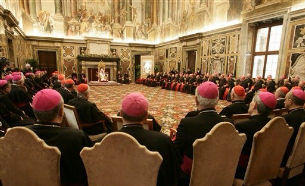 The recent Address of His Holiness Benedict XVI on the Occasion of Christmas Greetings to the Roman Curia (December 20, 2010) contained some astonishing remarks, embedded unobtrusively in this small and seemingly insignificant speech, remarks almost entirely overlooked in the mainstream media: "The very future of the world is at stake."
 The context of the Pope's remarks was the near total collapse in the western world of any moral consensus rooted in Christian worldview. The Pope declared: "... an eclipse of reason has taken place ... man no longer uses his intellect in search of God ... but is driven by his passions and desire for self-gratification." He began his comments by comparing the current state of affairs with the collapse of the Roman Empire. "The disintegration of the key principles of law and of the fundamental moral attitudes underpinning them burst open the dams which until that time had protected peaceful coexistence among peoples. The sun was setting over an entire world."
The pope also revisited the present pervasive blight of sexual depravity: "No pleasure is ever enough, and the excess of deceiving intoxication becomes a violence that tears whole regions apart – and all this in the name of a fatal misunderstanding of freedom which actually undermines man’s freedom and ultimately destroys it."
Related:
- Year's-end Jeremiad, "The Pope's Warning" (RealCatholicTV, December 28, 2010).
- Fr. Barron's comments on the wise words from Pope Benedict XVI (YouTube)
Summorum Pontificum on Vatican website available only in Hungarian & Latin
As noted in Fr. Z's blog (December 30, 2010), the Supreme Pontiff’s Motu Proprio Summorum Pontificum is still provided only in Latin and Hungarian on the Vatican website:
What does this do but provide a convenient excuse to those bishops who wish to ignore the Motu Proprio and do nothing to help the Holy Father implement his stated objectives in Summorum Pontificum and accompanying Letter to the Bishops.
Languages equally comprehensible to liberals.
Does this seem right to you?
This is an important document of a Pope’s pontificate.
Shouldn’t it be in the main languages in which the Holy See released documents including, say, English?
Do the people who run that website, or oversee those who do, not think the Holy Father’s documents are important?

Thursday, December 30, 2010
Fish on Friday: The One That Got Away

Still Life with Fish by Edouard Manet
By Michael P. Foley
One of the most recognizable markers of Catholic identity used to be the practice of abstaining from meat on Friday. A Protestant colleague of mine speaks admiringly of how in his youth he would hang out, Happy Days style, at a burger joint on Friday night. When the clock struck twelve, the Catholic teens who were there would let loose a cry that echoed through the parking lot: “Ham-burger!”
What those teenagers didn’t know was that they were honoring a discipline probably as old as Christianity itself. Abstaining on Friday from “flesh meat,” the meat of a warm-blooded animal, is potentially older than some books of the New Testament.1 Be it with fasting (having little or no food) or abstaining (refraining from food of a particular kind), the Church has always observed Friday with some sort of restriction on comestibles.
Broader Impact
Friday abstinence has also had a ripple effect going far beyond its primary aim of personal sanctification. Contrary to wild theories about medieval fishermen lobbying the Church to create Friday abstinence, it was Friday abstinence that helped create the medieval fishing industry.2 Professor Brian Fagan claims that the Church’s Friday discipline may have even led to the discovery of the New World, spurring Atlantic fishermen to push further westward in search of better waters and providing navigational precedents for Christopher Columbus.3 By pushing the borders of the known world, Friday abstinence not only put fishing on the map, it helped make the map itself. Friday and Lenten abstinence prompted medieval monasteries to pioneer new techniques in pisciculture, including artificial fish ponds and artificial fertilization.4 It was a Catholic nun who wrote the first fishing manual in English and a Catholic priest who invented the first spinning reel.5
Nor has only distant history been affected by this ancient custom. Restaurants typically have a Friday seafood special of the day or a soup du jour such as clam chowder because of the power that Catholics once wielded as a united front. Even titans of global uniformity like McDonald’s were forced to take notice. The Filet-o-Fish sandwich was added to its menus in 1962 after Louis Groen, owner of the chain’s Cincinnati franchises, noticed that his restaurants experienced a sharp drop in sales every Friday. Even today, of the 300 million Filets-o-Fish sold annually, 25% of those sales come from the forty days of Lent.

* * * * * * *So strong was the American association of Catholics with fish on Friday that “mackerel snapper” was once a common epithet for papists.
* * * * * * *
Of course, one of the curious things about all of these effects is that Catholics don’t have to eat fish on Fridays. This is a point impishly brought home in an essay by Fr. Leonard Feeney.7 “I am one of those moderately good Catholics,” Feeney writes, “in whom the persuasive power of Canon Law has not developed a taste for fish either on Friday or any other day, and stands no chance of doing so.”8 For Feeney, the reputation of Catholics as a queer sort of “Sixth Day Adventists” is a badge of honor to be worn in cheerful defiance of Protestant America.
Another mackerel snapper, renowned anthropologist Mary Douglas, agrees. Douglas sees in the rule of Friday abstinence “allegiance to a humble home in Ireland and to a glorious tradition in Rome.”9 These allegiances, she continues, are particularly important for a humiliated class. “At its lowest,” Douglas writes, Friday abstinence for a “bog Irishman” meant “what haggis and the pipes mean to Scots,” and at its most, “it means what abstaining from pork meant to the venerable Eleazar as narrated in 2 Maccabees.”10 One wonders if the Church in Ireland and America today, which in both countries is being humiliated by the savagery of the press and the corruption of some of its clergy, is not in need of a similar morale-boosting sign of allegiance.
Exceptions Curious and Quaint
Fr. Feeney also remarks: “if we dared tell non-Catholics the number of reasons which will legitimately permit us to eat meat on Friday, they would be scandalized.”11 There were numerous variations of the Friday rule based on local usage and the judgment of “intelligent and conscientious Christians.”12 Holy days such as Christmas trumped Friday abstinence, and Pope Pius XII, in order to relieve their overburdened refrigerators, allowed U.S. Catholics to eat meat the day after Thanksgiving. Special groups, such as travelers and soldiers, were occasionally exempted, and so were areas that either already had a seafood-rich diet or were smitten by epidemic or famine.
And sometimes whole peoples got a free pass. In 1089 Spanish counts were granted a dispensation from the Friday rule by Pope Urban II for their role in the Crusades; after the Battle of Lepanto in 1571, Pope St. Pius V extended the dispensation to the entire Spanish dominion, including her colonies in the New World. Mexico, for example, was not instructed by the Holy See to observe Friday abstinence until 1950, and the following year bishops in New Mexico and Texas informed their flock that this applied to them as well.13
And then there are the curious local substitutes. During Lent the people of Venezuela can eat capybaras, the world’s largest rodent, a fact that has inspired the following doggerel:
You’ll enjoy capybaras to eat;Writing about the year 1188, Giraldus Cambrensis remarks that in “Germany and the arctic regions,” beavers’ tails are eaten during times of fast by “great and religious persons” because of their resemblance to fish meat.14 This practice was carried to parts of the New World, especially Canada. Jesuit missionaries wrote to Rome to verify that the custom was permissible. Rome replied that not only were beavers allowable but so were most amphibious animals and even some species of wild duck.15
Venezuelans proclaim them a treat.
Those of Catholic bent
May consume them for Lent
If a fine rodent burger’s their meat.
... some Michiganders have the dubious privilege of dining on muskrat for their Friday and Lenten observances. ... the bishop added: “Anyone who could eat muskrat was doing penance worthy of the greatest of the saints.”
* * * * * * *
In the United States, some Michiganders have the dubious privilege of dining on muskrat for their Friday and Lenten observances. Several Catholic communities in the Wolverine State have claimed a dispensation to eat the aquatic rodent since the days of the French trappers. In 1987, Bishop Kenneth Povish of Lansing wrote that although such a permission could not be found in the Church’s records, the practice had been around for so long that it could continue as an “immemorial custom.” And there was another reason to allow it, the bishop added: “Anyone who could eat muskrat was doing penance worthy of the greatest of the saints.”16
The Law No One Knows
After Vatican II Pope Paul VI took up the question of Friday abstinence in his 1966 Apostolic Constitution Paenitimini. The document masterfully reaffirms the traditional theology of penance and abstinence, and it resolves a longstanding inconsistency about which feast days should supersede Friday abstinence.17 But Paenitimini also announces the Pope’s goal of reorganizing “penitential discipline with practices more suited to our times.”18 Even so, Friday abstinence was explicitly reaffirmed.19
In November of the same year, the U.S. bishops responded to the call for reorganization with a “Pastoral Statement on Penance and Abstinence.”20 Whereas American Catholics were hereby released from a strict obligation under pain of sin to keep Friday abstinence, the bishops emphasized that Friday was still a mandatory day of penance: indeed, they wrote eloquently of Friday as a mini-Lent in the same way that Sunday is a “weekly Easter.”21 And they made it clear: “We give first place to abstinence from flesh meat. We do so in the hope that the Catholic community will ordinarily continue to abstain from meat by free choice as formerly we did in obedience to Church law.”22 The 1983 Code of Canon Law would later codify this teaching by stating that: Friday is an obligatory day of penance and abstinence is the standard form of Friday penance, although other forms may be done instead.23

Clam Chowder Bread Bowl
* * * * * * *
Restaurants typically have a Friday seafood special of the day or a soupdu jour such as clam chowder because of the power that Catholics once wielded as a united front.
* * * * * * *
If this is the position of the Magisterium, then why has it failed so miserably, with the majority of the world’s Catholics ignorant of any obligation to do anything special on Friday? Certainly, the media’s mishandling of the 1966 news (which made glib remarks like “you won’t go to hell anymore for eating a hamburger on Friday” instead of reporting all the facts), the minimalist mindset of the faithful who were happy to be free of one less duty, and the failure of the clergy to catechize on the subject all played a part in the overnight disappearance of Friday abstinence.
But there may also be a more fundamental reason. The removal of a symbol, or in this case the removal of a law protecting a symbol, can give the impression that the reality to which the symbol points is likewise being rejected. “To take away one symbol that meant something,” notes Mary Douglas,
is no guarantee that the spirit of charity will flow in its place….We have seen that those who are responsible for ecclesiastical decisions are only too likely to have been made, by the manner of their education, insensitive to non-verbal signals and dull to their meaning. This is central to the difficulties of Christianity today. It is as if the liturgical signal boxes were manned by colour-blind signalmen.24And there are other complications. Paenitimini and Canon 1253, which allow an episcopal conference to designate other forms of penance such as works of charity for Friday, divorce for the first time in Church history Friday penance from food abstinence. Yet even this latitude is honored more in the breach than in the observance, for few episcopal conferences have made any decision about what form of Friday penance its flock may follow. The signalmen, it appears, have fallen asleep at the switch.
Confusion reigns even in the capitol of Christendom. When my father-in-law, who is a member of a pontifical academy, was invited to dine at the Vatican’s Casina Pio IV on a Friday night several years ago, he and the other guests were served horse meat!

* * * * * * *
Pope Pius XII, in order to relieve their overburdened refrigerators, allowed U.S. Catholics to eat meat the day after Thanksgiving.
* * * * * * *
Abstaining from the Alternatives
Regardless of the available options, there are at least seven reasons to keep the traditional sixth-day penance:
- It is corporate. Having everyone do his own form of penance lacks the marvelous unity of almost the entire Catholic world performing the same act on the same day. This is not only spiritually constructive, it is socially edifying, building up solidarity and deepening our awareness of joint membership in the mystical Body of Christ.
- It is ancient. A single practice unites all the living, but when it is ancient it also unites them to their forebears. If tradition is, as Chesterton put it, the democracy of the dead, then Friday abstinence is the veritable apple pie of Catholic life. In the words of the American bishops in 1966: We show “out of love for Christ Crucified…our solidarity with the generations of believers to whom this practice frequently became, especially in times of persecution and of great poverty, no mean evidence of fidelity to Christ and His Church.”25
- It is testimonial. Friday abstinence bears powerful witness to the distinctiveness of the Church. My Protestant friend whom I mentioned earlier knew little about Catholics when he was young, but he knew they stood for something when he watched his papist peers exercise self-discipline even away from the watchful eyes of their parents.
- Abstinence is efficacious. Ancient authors taught that abstinence from food and drink was useful in dampening “the ardor of lust.”26 Bodily passions are not bad per se, but left untrained they can become the occasion of sin. Trimming the body’s food intake, as modern studies have confirmed, can lower lustful proclivities.27
- Abstinence is appropriate. The Church still teaches that every human being is required to do penance by virtue of divine law (Can. 1249), and Friday abstinence is an especially appropriate way to do this. It was on a Friday in Eden that Adam and Eve transgressed the first law of abstinence.28 And, of course, it was on a Friday that our Lord was crucified in order to undo the effects of that transgression. It is therefore appropriate to make abstinence our Friday penance, in sober memory of the Fall and “in prayerful remembrance of the passion of Jesus Christ.”29
- Abstinence from meat is particularly appropriate. Catholicism ingeniously teaches both through presence and through absence. Usually, the Church employs physical signs to convey invisible realities; but sometimes, she temporarily withdraws something as a way of arresting our attention and heightening our awareness of what is missing.
Hence, the suppression of the Alleluia during Septuagesima and Lent effectively demonstrates that we are in exile from our true Home, where the angels sing Alleluia without ceasing. Veiling sacred images in church during Passiontide — when we would most expect to gaze upon a crucifix — paradoxically heightens our awe of Christ’s Passion. And prohibiting the sacrifice of the altar on Good Friday draws us in an inverted way to the sacrifice of the cross made that day.
Similarly, when we “make meager,” we withdraw from our table the flesh of an animal whose blood was shed for us on the day in which the Blood of the God-man was shed for us.30 The absence of the former paradoxically reminds us of the latter; not having a bloody victual backhandedly alerts us to the Bloody Victim. - It is Christ-like. Jesus Christ consumed nothing on Good Friday except the gall He tasted shortly before His death. With fasting or abstinence on the day of the Crucifixion, Catholics in some small way “suffer with Christ that they may one day be glorified with Him. This is the heart of the tradition of abstinence from meat on Friday.”31
How the Church can best recover its former Friday integrity remains an open question.32 In the meantime, there is ample reason to fulfill Paul VI’s and the American bishops’ 1966 wish that what was once done in obedience be now done by free choice. The weekly abstinence from flesh meat is rich in history and meaning, bringing us closer to God and to each other. Living the Catholic tradition, even on days of deprivation, is anything but a meager existence.
Postscript: Since Ireland has been a leitmotif in this article, it is fitting to add that in response to the horrific abuse scandals decimating the Catholic Church in that country, Pope Benedict XVI has asked its faithful to offer their Friday penance from now until Good Friday 2011 for God’s mercy.33 Those of us who owe our blood or our faith to the sons and daughters of St. Patrick might wish to do the same.
Notes
- The custom of fasting on Friday is mentioned in Didache 9, a book believed to have been written around A.D. 75. [back]
- Brian Fagan, Fish on Friday: Feasting, Fasting, and the Discovery of the New World (Basic Books, 2007), pp. 25ff. [back]
- Ibid. [back]
- Michael P. Foley, Why Do Catholics Eat Fish on Friday? (Palgrave Macmillan, 2005), p. 111. [back]
- See Foley, pp. 46, 69, and 109, resp. [back]
- Meagre/Meager, adj. and n.," Oxford English Dictionary, A.3. and B.2. [back]
- Leonard Feeney, S.J. "Fish on Friday," in Fish on Friday and Other Sketches (Sheed & Ward, 1934), pp. 3-16. [back]
- Ibid., p. 3. [back]
- Mary Douglas, Natural Symbols: Explorations in Cosmology (Routledge, 1996), p. 37. [back]
- Ibid., pp. 37-38. [back]
- Feeney, p. 6. [back]
- J.D. O'Neill, "Abstinence," Catholic Encyclopedia, 1907. [back]
- See "Friday Abstinence," in the Religion section of Time Magazine, June 18, 1951. [back]
- The Itinerary of Archbishop Baldwin through Wales, 2.3. [back]
- Daniel Wilson, "Early Notices of the Beaver in Europe and North America," in the Canadian Journal of Industry, Science, and Art (1849-1914), Vol. 4, p. 386. The scoter, for example, was consumed on Friday in parts of France (see Alexander Wilson and Charles Lucian Bonaparte, American Ornithology, Vol. 3 [Constable and Col, 1831], pp. 212-13). [back]
- Kristin Lukowski, "Muskrat love: A Lenten Friday delight for some Michiganders," CNS News, March 8, 2007. [back]
- Prior to Vatican II, only holy days of obligation suspended abstinence from flesh meat on Friday. The problem with this arrangement was that different nations had different days of obligation. The difficulty was resolved by giving all [first class] solemnities in the universal calendar priority over Friday penance. [back]
- III.C. [back]
- Chapter 3, II.2. [back]
- National Conference of Catholic Bishops, "Pastoral Statement on Penance and Abstinence," November 18, 1966. This is an outstanding document. [back]
- Ibid., 23. [back]
- Ibid., 24. [back]
- See Canons 1251-1253. [back]
- Douglas, p. 42. [back]
- "Pastoral Statement," 24a. [back]
- See Saint Jerome, Against Jovinian 2.6; Saint Thomas Aquinas, Summa Theologiae II-II.147.1. [back]
- Flesh meat, for instance, is high in zinc, which raises testosterone levels. For a summary of modern dietary research, see Theresa M. Shaw, Burden of the Flesh (Augsburg Fortress Publishers, 1998), pp. 126-27. [back]
- Adam and Eve sinned on the same day they were created when they ate the fruit from which they were commanded to abstain. Dante gives the First Couple about six hours in Paradise before they were expelled. [back]
- "Pastoral Statement," 23. [back]
- Cold-blooded animals such as fish and amphibians also "shed their blood for us" when we use them as food, but because of the similarity of our physiology to that of other warm-blooded animals, our symbolic association with the latter is greater. [back]
- "Pastoral Statement," 18. [back]
- For an interesting discussion on this, see Father John Zuhlsdorf's blog for April 23, 2009, at http://wdtprs.com/blog/2009/04/kicking-it-up-a-notch-our-catholic-identity-fr-z-rants/. [back]
- Pope Benedict XVI, "Pastoral Letter of the Holy Father Pope Benedict XVI to the Catholics of Ireland," no. 14, March 19, 2010. [back]
 (Palgrave Macmillan, 2005) and Wedding Rites: A Complete Guide to Traditional Vows, Music, Ceremonies, Blessings, and Interfaith Services(Eerdmans, 2008). Dr. Foley's article, "Fish on Friday: The One That Got Away," Latin Mass: The Journal of Catholic Culture and Tradition Vol. 19, No. 3 (Summer/Fall 2010), pp. 42-46, is reproduced here by kind permission of Latin Mass, 391 E. Virginia Terrace, Santa Paula, CA 93060, and the author.
[N.B. -- This post is permanently archived at "Fish on Friday: The One That Got Away" (Scripture and Catholic Tradition, December 30, 2010).]
Monday, December 27, 2010
"The right to bear arms ... and fill the freezer"
Fr. Zuhlsdorff, of all people, posted the following today:
Even if Admiral Yamamoto didn’t actually say this, it is nevertheless true. Se non è vero, è ben trovato:You cannot invade the mainland United States. There would be a rifle behind every blade of grass.I received this amusing piece via e-mail:The state of Wisconsin has gone an entire deer hunting season without someone getting killed. That’s great. There were over 600,000 hunters. Allow me to restate that number. Over the last two months, the eighth largest army in the world – more men under arms than Iran; more than France and Germany combined – deployed to the woods of a single American state to help keep the deer menace at bay. But that pales in comparison to the 750,000 who are in the woods of Pennsylvania this week. Michigan ‘s 700,000 hunters have now returned home. Toss in a quarter million hunters in West Virginia, and it is literally the case that the hunters of those four states alone would comprise the largest army in the world. America will forever be safe from foreign invasion of troops with that kind of home-grown firepower.
Hunting – it’s not just a way to fill the freezer. It’s a matter of national security!
Geography teacher in Spain sued by Moslem for mentioning ham in class
And Spanish ham -- the Jamón serrano they serve in tapas bars from Santiago de Compostela to Cadiz -- is almost as exquisite as Spanish flamenco in Andalusia.
One may offend public sensibilities by using a male pronoun instead of the now politically correct and grammatically hideous "they" or "them"; by eating pork rinds or mentioning "Jesus" in polite company; by quoting Leviticus 18:22 in public in Canada; and now ... by referring to HAM in Spain.
Plus ça change, plus c'est la même chose.
Sunday, December 26, 2010
Fallout over condom debate
Christopher Blosser, "Pope Benedict, Fr. Rhonheimer, Janet Smith and Stephen Long -- the 'Condom Conundrum' Continues" (The Benedict Blog, December 20, 2010).
[Note: While these participants in the debate seem to be all pretty much agreed on what the Holy Father was (and, just as importantly, was not) saying about condoms in his book, their own highly-nuanced discussion of the ethical issues goes well beyond the interpretation of the Pope's own words to a treatment of their own respective positions on condoms and contraception and their moral evaluation of the issues involved.]
[Hat tip to C.B.]
Update:
[Note: While these participants in the debate seem to be all pretty much agreed on what the Holy Father was (and, just as importantly, was not) saying about condoms in his book, their own highly-nuanced discussion of the ethical issues goes well beyond the interpretation of the Pope's own words to a treatment of their own respective positions on condoms and contraception and their moral evaluation of the issues involved.]
[Hat tip to C.B.]
Update:
"Papist Parody: Pope said I can have condom?" (Musings, January 1, 2011).
Detroit/Windsor Tridentine community: 2010 In Review
Tridentine Community News (December 26, 2010):
Another year has rushed by, and it is appropriate to reflect on the significant events that have taken place.[Comments? Please e-mail tridnews@stjosaphatchurch.org. Previous columns are available at www.stjosaphatchurch.org. This edition of Tridentine Community News, with minor editions, is from the St. Josaphat bulletin insert for December 26, 2010. Hat tip to A.B.]
The major happening in 2010 was, of course, the Latin Liturgy Association National Convention. People from across the English-speaking world traveled to Detroit to participate in the talks and special liturgies held at St. Joseph, St. Josaphat, St. Albertus, Assumption-Windsor, and Sweetest Heart of Mary. A bus tour of historic churches was held, which incidentally will be repeated at another event in 2011. Chicago Auxiliary Bishop Joseph Perry celebrated the first Solemn Pontifical Mass held in this region in over 40 years, attracting a congregation of over 400.
Our region gained two dedicated celebrants of the Extraordinary Form with the ordination in May of Fr. Patrick Bénéteau for the Diocese of London, and with Fr. Robert Marczewski of Orchard Lake’s Ss. Cyril & Methodius Seminary having learned to celebrate the Mass.
The Archdiocese of Detroit displayed its support for the Latin Mass tradition in the St. Josaphat cluster by appointing experienced Tridentine celebrant Fr. Paul Czarnota as pastor.
Numerous new altar servers have joined our teams at Assumption-Windsor and St. Josaphat. Several have expressed interest in a vocation to the priesthood. One of our longtime servers, Joe Tuskiewicz, entered Blessed John XXIII Seminary near Boston as a second-career seminarian for the Archdiocese of Detroit. Joe was recently instituted as an Acolyte, allowing him to serve as Subdeacon at Solemn High Tridentine Masses. Joe did this for the first time on Christmas Day at Assumption Church.
The first weekday Tridentine Mass in Windsor debuted at St. Theresa Church in January. When pastor Fr. John Johnson was transferred to a parish in Thamesville, the Mass quite logically moved to Assumption Church, home of the weekly Sunday Mass.
St. Paul on the Lake Church in Grosse Pointe Farms held its first Tridentine Mass in over 40 years, for a funeral. The beautifully restored church proved a perfect setting for the traditional liturgy.
The All Souls Day Masses held at the side altars and high altar of Windsor’s Assumption Church attracted a record attendance of over 350 souls to the Windsor Tridentine Mass.
The Diocese of London created the Assumption Heritage Trust Foundation, an entity to raise the funds for and administer the $9,800,000 restoration of Windsor’s Assumption Church. Tridentine Mass Community member Jason Grossi was named lead architect for the project.
Jason and Dr. Steven Ball discovered and restored an historic 18th century bell in the tower of Assumption Church. The original swinging mechanism of the larger, main bell was restored. The story of this discovery gained front page coverage in the Windsor Star newspaper and national CBC Television coverage.
Following upon the success of its quarterly Tridentine Masses, St. Albertus Church made the decision to double the frequency of those Masses to eight times per year in 2011.
Diocese of Lansing Bishop Earl Boyea established the Blessed John XXIII Community at Lansing’s St. Mary Cathedral. It is the first Tridentine Mass Community in our region that has been given the possibility of evolving into a full parish. Bishop Boyea also encouraged Ann Arbor’s Old St. Patrick Parish to commence regular Extraordinary Form Masses. His Excellency celebrated a Pontifical Low Mass at All Saints Church in Flint, after which he delivered a speech explaining his support for Summórum Pontíficum and his vision for establishing multiple strong Tridentine Mass Communities throughout his diocese.
Multiple weddings and baptisms have been held in the Extraordinary Form in our various churches. What was once a newsworthy event has become, thanks be to God, a common occurrence.
Tridentine Masses This Coming Week
Mon. 12/27 7:00 PM: High Mass at St. Josaphat (St. John, Apostle & Evangelist)
Tue. 12/28 7:00 PM: High Mass at both Assumption-Windsor and St. Josaphat (Holy Innocents)
Sat. 01/01 2:00 PM: High Mass at Assumption-Windsor (Octave of Christmas)
What makes good preaching?
I remember thinking about this question back when I was in graduate school and not yet a Catholic. I had heard hour-long sermons that seemed like ten minutes, and ten minute homilies that seemed like an hour; sermons so rich in content that one would take out a pad of paper and take notes, and sermons that were so forgettable one couldn't say what they were about five minutes afterward.
The first thing one has to ask is: What is a homily for? What is it's purpose? It's not primarily entertainment, although it helps if it's engaging. It's not primarily education, although it helps if it's edifying. It's not primarily therapy, although it helps if it's personally illuminating. It's not primarily moral exhortation, although it helps if it's morally challenging. A homily is the voice of the Good Shepherd telling us what we need to hear, not necessarily what we want to hear -- guiding us toward the safety of our heavenly fold.
A good homily builds a bridge from Jesus to ourselves. It bridges the historical chasm separating Palestine 2000 years ago and ourselves living where we are today in the 21st Century. It takes a theme or text from the Bible, like the story about the Prodigal Son, and draws an application. This is where the rubber meets to road. It has to engage us here and now in our own lives. We have to encounter the living God, Christ as our own Contemporary, and hear His call to repentance, to contrition, to acceptance of the Father's mercy, to holiness. This is what it means when a homily "touches" us.
Fr. John Ricardo is a priest from Our Lady of Good Council, a parish in Plymouth, MI, a suburb of Detroit. He is a good communicator, who makes good preaching look natural and easy. I wish we had more Catholic priests like him.
The first thing one has to ask is: What is a homily for? What is it's purpose? It's not primarily entertainment, although it helps if it's engaging. It's not primarily education, although it helps if it's edifying. It's not primarily therapy, although it helps if it's personally illuminating. It's not primarily moral exhortation, although it helps if it's morally challenging. A homily is the voice of the Good Shepherd telling us what we need to hear, not necessarily what we want to hear -- guiding us toward the safety of our heavenly fold.
A good homily builds a bridge from Jesus to ourselves. It bridges the historical chasm separating Palestine 2000 years ago and ourselves living where we are today in the 21st Century. It takes a theme or text from the Bible, like the story about the Prodigal Son, and draws an application. This is where the rubber meets to road. It has to engage us here and now in our own lives. We have to encounter the living God, Christ as our own Contemporary, and hear His call to repentance, to contrition, to acceptance of the Father's mercy, to holiness. This is what it means when a homily "touches" us.
Fr. John Ricardo is a priest from Our Lady of Good Council, a parish in Plymouth, MI, a suburb of Detroit. He is a good communicator, who makes good preaching look natural and easy. I wish we had more Catholic priests like him.
Saturday, December 25, 2010
A Christmas reflection
Glory to God in the highest and on earth peace, good will toward men.And it came to pass, as the angels were gone away from them into heaven, the shepherds said one to another,
Let us now go even unto Bethlehem, and see this thing which is come to pas, which the Lord hath made known unto us.
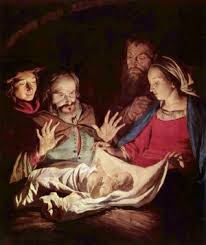 And they came with haste, and found Mary, and Joseph and the babe lying in a manger. And when they had seen it, they made known abroad the saying which was told them concerning this child. And all they that heard it wondered at those things which were told them by the shepherds. But Mary kept all these things, and pondered them in her heart. And the shepherds returned, glorifying and praising God for all the things that they had heard and seen, as it was told unto them. (The Gospel According to Luke, Chapter Two, Verses 13-20)
Here we are again, on the first day of the Christmas season. It has become something of a Christmas tradition for me to engage the following text from C.S. Lewis in connection with the above quoted Scriptures. The reason will be obvious.
Nearly every Christmas, it seems, NEWSWEEK or TIME or some television special will featre the "latest scholarship" concerning the "authenticity" of the Christmas story. The scholarly authorities cited are consistently and incorrigibly one-sided, usually including scholars like John Dominic Crossan who dissent from Church teaching, or more ostensibly mainline scholars like Raymond E. Brown (now deceased) who have been quite thoroughly corrupted by the Humean philosophical presuppositions of the historical-criticism of the biblical narrative. Three years ago we saw the Archbishop of Canterbury, Rowan Williams, call the Christmas story a 'legend' ("Archbishop says nativity 'a legend,'" London Telegraph, December 12, 2007). And this year I've notice that About.com, a site which Internet browsers frequent to learn "the facts" about this or that, has taken up this partisan skeptical slant in Austin Cline's article, "Nativity vs Gospels: Are the Gospels Reliable About Jesus' Birth?" (About.com), suggesting that all the key ingredients of the Nativity story in the Gospels were concocted fictions of various kinds.
The lack of critical circumspection in all of this would be amusing if it were not so destructive. The upshot is always the same: that the Gospel writers are unreliable and not to be trusted, and certainly not to be taken at face value. Just how ludicrous this all is, however, can be seen by anyone with a bit of intelligence and familiarity with literature, mythology, and history.
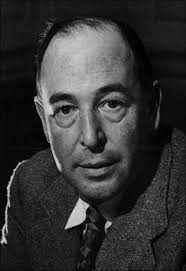 One of the best examples of a powerful antedote to this kind of foolishness -- and one I keep using because it is simple -- is a little essay by C.S. Lewis entitled "Modern Theology and Biblical Criticism," which is available in a collection of essays by Lewis entitled Christian Reflections (1967; reprinted by Eerdmans, 1994). The following are some excerpts from Lewis' essay, which begins on p. 152 and contains four objections (or "bleats") about modern New Testament scholarship:
1. [If a scholar] tells me that something in a Gospel is legend or romance, I want to know how many legends and romances he has read, how well his palate is trained in detecting them by the flavour...For further reading:
I have been reading poems, romances, vision-literature, legends, myths all my life. I know what they are like. I know that not one [of the stories in the Gospel of John, for example] is like this... Either this is reportage - though it may no doubt contain errors - pretty close up to the facts; nearly as close as Boswell. Or else, some unknown writer in the second century, without known predecessors or successors, suddenly anticipated the whole technique of modern, novelistic, realistic narrative...
2. All theology of the liberal type involves at some point - and often involves throughout - the claim that the real behaviour and purpose and teaching of Christ came very rapidly to be misunderstood and misrepresented by his followers, and has been recovered or exhumed only by modern scholars... The idea that any... writer should be opaque to those who lived in the same culture, spoke the same language, shared the same habitual imagery and unconscious assumptions, and yet be transparent to those who have none of these advantages, is in my opinion preposterous. There is an a priori improbability in it which almost no argument and no evidence could counterbalance.
3. Thirdly, I find in these theologians a constant use of the principle that the miraculous does not occur... This is a purely philosophical question. Scholars, as scholars, speak on it with no more authority than anyone else. The canon 'if miraculous, unhistorical' is one they bring to their study of the texts, not one they have learned from it. If one is speaking of authority, the united authority of all the Biblical critics in the world counts here for nothing.
4. My fourth bleat is my loudest and longest. Reviewers [of my own books, and of books by friends whose real history I knew] both friendly and hostile... will tell you what public events had directed the author's mind to this or that, what other authors influenced him, what his over-all intention was, what sort of audience he principally addressed, why - and when - he did everything... My impression is that in the whole of my experience not one of these guesses has on any one point been right; the method shows a record of 100 per cent failure.
The 'assured results of modern scholarship', as to the way in which an old book was written, are 'assured', we may conclude, only because those who knew the facts are dead and can't blow the gaff... The Biblical critics, whatever reconstructions they devise, can never be crudely proved wrong. St. Mark is dead. When they meet St. Peter there will be more pressing matters to discuss.
However... we are not fundamentalists... Of course we agree that passages almost verbally identical cannot be independent. It is as we glide away from this into reconstructions of a subtler and more ambitious kind that our faith in the method wavers... The sort of statement that arouses our deepest scepticism is the statement that something in a Gospel cannot be historical because it shows a theology or an ecclesiology too developed for so early a date...
Such are the reactions of one bleating layman... Once the layman was anxious to hide the fact that he believed so much less than the Vicar; he now tends to hide the fact that he believes so much more...
- C.S. Lewis, Christian Reflections,
- If you're interested in reading the relevant chapter from Lewis's book online, click on: "Modern Theology and Biblical Criticism"
- Pope Benedict XVI's 2010 Christmas message in full (The Telegraph, December 25, 2010).
- "Urbi et Orbi Message of His Holiness Pope Benedict XVI: Christmas 2007"
- Pope Benedict's Christmas Message to the Roman Curia, 2008
- Pope Benedict's Christmas Message: "I Once More Joyfully Proclaim Christ's Birth" (December 25, 2008)
- Pope Benedict's 2009 Christmas message, "God Is Important, by Far the Most Important Thing in Our Lives" (December 24, 2009) [delivered at the Christmas Vigil Mass in St. Peter's after being physically assaulted.
Thursday, December 23, 2010
Joe Tuskiewicz to serve as subdeacon at Windsor Christmas Mass
We announced on Dec. 14 that our own Joe Tuskiewicz, formerly of Sacred Heart Major Seminary, was installed to the Ministry of Acolyte at Blessed John XXIII Seminary in Weston, Massachusetts, on Dec. 8th. We also noted that according to the ruling of the Pontifical Commission Ecclésia Dei, this is the equivalent step in the Ordinary Form system to the Extraordinary Form’s ordination as Subdeacon.
For those interested, Joe's first Solemn High Mass as Subdeacon will be on Christmas Day at Assumption-Windsor at 2:00 PM. Fr. Peter will be the celebrant, and Fr. Patrick Beneteau will be Deacon.
For those interested, Joe's first Solemn High Mass as Subdeacon will be on Christmas Day at Assumption-Windsor at 2:00 PM. Fr. Peter will be the celebrant, and Fr. Patrick Beneteau will be Deacon.
Subscribe to:
Posts (Atom)