Tuesday, July 06, 2010

Pope on spiritual antithesis among Catholics

[I]n the decades that followed the Second Vatican Council, some have interpreted openness to the world not as a requirement of the missionary zeal of the Heart of Christ, but rather as a passage to secularization.... They were unconsciously caught up in the self-secularization of many ecclesial communities....

Today there is a new generation born into this secularized ecclesial context. Instead of showing openness and consensus, it sees the abyss of differences and opposition to the Magisterium of the Church growing ever wider, especially in the field of ethics. In this desert without God, the new generation feels a deep thirst for transcendence. (emphasis added)

Pope Benedict XVI
Ad Limina address to Bishops of Brazil
September 7, 2009

Monday, July 05, 2010

Crass insights

"Getting What You Want, Wanting What You Get: An Unbiased Study of Feminism" (Fred On Everything, June 29 2010):
I see where women, or college girls anyway, are honking and blowing most fierce about how they don’t like the way sex works nowadays. Yeah. It seems that the hook-up is in flower....

... But then came fem-lib. A torrent of really nasty dykes with politically-significant hairy armpits started yowling about how it wasn’t fair that men could cat around and women couldn’t. Then the Pill shifted the paradigm into high gear....

Which meant—Oh bliss!—that she had little excuse for saying No....
[Hat tip to J.S.]

Update: "Kreeft on feminism" (Musings, July 6, 2010).

Sunday, July 04, 2010

Question For Our Readers

Tridentine Community News (July 4, 2010):
The Church implemented a revised Latin Psalter (text of the Psalms) in 1945. Which Bible translation(s) are appropriate for use for this new Latin text which was in force between 1955-65? The Douay-Rheims does not reflect the meaning of the reworded Latin. What was the authoritative source of the English text?

There was – and will be shortly once again – a version of the Extraordinary Form Breviary with both Latin and English. It was published circa 1964; copies today are extremely scarce. Whatever English translation was used in this edition likely answers this question.

If any of our readers are aware of the answer to this question, please e-mail the address at the bottom of this page.

NPM Convention
Immediately preceding the July 16-18 Latin Liturgy Association Convention, the National Association of Pastoral Musicians will hold its Annual Convention, July 12-16, also here in Detroit. Based at Cobo Hall, the NPM Convention is the primary gathering of parish music ministers in North America. Points across the Catholic liturgical spectrum, from the modern to the traditional, are given attention. Those of our readers who are interested in musical topics outside of the Latin Mass world may wish to take a look at the NPM Convention schedule at www.npm.org and are invited to register for the conference.
[Comments? Please e-mail tridnews@stjosaphatchurch.org. Previous columns are available at www.stjosaphatchurch.org. This edition of Tridentine Community News, with minor editions, is from the St. Josaphat bulletin insert for July 4, 2010. Hat tip to A.B.]

Saturday, July 03, 2010

Reasons of the heart: the obstinacy of belief and unbelief

In answer to the question, "What if there is so much liberal scholarship simply because it is right?" a reader sent me a link to this article by S. M. Hutchens, "The Durability of the Gift" (Touchstone, July 2, 2010), who begins his article with a quote from Lutheran theologian, Carl Braaten:
The so-called new hermeneutic of Ebeling and Fuchs was a synthesis of recent historical-critical studies of the Bible, the theology of Rudolf Bultmann, and the history of modern hermeneutical reflections, from Schleiermacher to Wilhelm Dilthey, and Martin Heidegger. This new trend was being heralded as a lively new option that overcame the hiatus between the Barthian and Bultmannian schools of theology. I saw it as an inferior alternative to that of Wolfhart Pannenberg, so I gave an address at the American Theological Society in Chicago entitled, “How New is the New Hermeneutic?” I started out by saying that more important than whether the approach of Ebeling and Fuchs is new is whether it is true. Publishers are looking for a profit so they need to market their goods to people with “itching ears,” for whom relevance to the new is more preferable than faithfulness to the old. In fact, in my view the theologies that turn out to be the most relevant are those that intentionally eschew novelty in favor of renewing the faith “once for all delivered to the saints” (Jude 3b).
--Carl E. Braaten, Because of Christ: Memoirs of a Lutheran Pastor-Theologian. Grand Rapids: Eerdmans, 2010, p. 61.
Hutchens writes:
... The conclusion I am reaching is something like this: belief in the truth of the gospel creates in the mind a pre-existing interpretational matrix from which one cannot depart without conscious (conscious, that is, until the mind is intentionally dulled and fogged) knowledge that a departure has taken place, a knowledge that creates an intolerable burden on the conscience until it is “dealt with” in some way. This exculpatory dealing is known to be a sin, in fact, a departure from the faith with all that entails with regard to the apostasy of one’s own soul. For many, the deal is made, the pottage purchased, ambiguity substituted for faith, and the call of the fallen teacher goes out for his Master’s debtors, who accordingly buy their own damnation in his reduction of their accounts.

For others, the conscience cannot bear this, and they reject the temptation for the “faith once for all delivered” which they heard at their Mother’s knee....

The effect of the fundamental gospel’s matrix upon preaching and teaching is seen in evidence of belief that all must depend on a narrative that follows its pattern from ground-principles forward. The preacher may not believe everything that is in the Bible; he may have severe difficulties with certain traditional interpretations. But, believing the maternal creed, there are large tracts of it he believes to be true as surely and profoundly as he hopes for salvation. It is from those places he begins his narrative and attempts to develop it along lines that are true to the gospel, bringing in, as he begins to understand them and connect them to this line of thought, other passages of scripture he may once not have been able to believe, or which traditional interpretations made unpalatable, but now whose part in the whole he is beginning to understand--the whole of which is becoming more evident not as the restrictive canon it once appeared, but the appointed way forward into the unimaginable--the Narrow Way (shall we recognize it as the birth-canal?) of which the Lord spoke.
[Hat tip to J.M.]

Divine Do-Overs: The Secret of Recapitulation in the Traditional Calendar

By Michael P. Foley

Followers of the 1962 liturgical calendar may have noticed an odd pattern. There is a reading, theme, event, or saint that appears on a particular day. Then, later in the year, the same reading, theme, event, or saint reemerges, only not quite in the same manner. This can happen with both occasions in the same cycle, either the “Temporal Cycle” (comprising seasons such as Advent, Lent, etc.) or the “Sanctoral Cycle” (the rotation of saints’ feasts). Or, each event can occur in a different cycle.

For example: Palm Sunday, especially with the blessing and procession of palms, celebrates Christ’s Kingship, but there is also a Feast of Christ the King. Holy Thursday celebrates the gift of the Eucharist, but there is also a Feast of Corpus Christi. Good Friday commemorates the blood our Lord shed for us on the Cross as well as His pierced heart, but there is also a Feast of the Precious Blood, a Feast of the Holy Cross,1 and a Feast of the Sacred Heart. September 27 is the Feast of Saints Cosmas and Damien, but we also pray to these saints on Thursday of the Third Week of Lent.2 The Ember Wednesday of Advent focuses on the Annunciation, but there is also a feast for it on March 25.

One would think that since the traditional Missal has an annual cycle of readings (as opposed to the three-year cycle of the new lectionary), there would be a minimum of repetition in order to expose the faithful to as much variety as possible. But instead, we find a startlingly different strategy. What on earth is it?

Recapitulation

The answer to that question is the subject of this essay. What we see in the traditional calendar is an ingenious strategy of recapitulation. The concept of recapitulation has been a part of sacred tradition almost from the beginning: St. Irenaeus of Lyons (ca. 130) speaks of it,3 and so does St. Augustine, who uses it to describe the patterns in the Bible where certain things are said in such a way that it looks as if they are proceeding in chronological order or in the order of events, whereas the narrative is [really] secretly recalling prior things which had been overlooked.4

Augustine gives as an example the fact that Genesis first mentions the Lord God planting a garden of paradise and then states that He formed out of the ground “all manner of trees, fair to behold, and pleasant to eat of” (2:8-9). The second statement, that God grew trees, “recapitulates” the first by making explicit something that is not in the first statement, namely, the precise manner in which God planted the garden.

A similar dynamic is at play in the Church year. Every event in the life of Christ or in sacred history, as well as every mystery of the Christian faith, is too profound to be comprehended in a single sitting. There are too many facets, too many layers, to be taken in at once by our feeble intellects. Hence the Church often returns to the same thing she had celebrated earlier in the year but from a different perspective. She wishes to experience the mystery in a way in which she might not have been able to before. When the Church meditates on the Annunciation during Ember Wednesday of Advent, her thoughts are dominated by the impending celebration of the Nativity. But when she meditates on the Annunciation during Lady Day (March 25), she is freer to consider other dimensions of this great event: the mystery of the Incarnation, the role of the Holy Spirit, and most importantly, the fiat of the Blessed Virgin Mary.

Since several of these recapitulations occur during the summer, let us look at three of them now: Corpus Christi, the Precious Blood, and the Transfiguration.

Corpus Christi

Holy Thursday is essentially the original Feast of Corpus Christi (“Body of Christ”), the celebration of the institution of the Eucharist. Yet as a part of the sacred Triduum, Maundy Thursday is mixed with other considerations: the institution of the priesthood, the call to service dramatized by the washing of the feet, Judas’ betrayal of our Lord, the agony in the garden, etc.

Fittingly, the first person to see the need for an additional feast to honor the Blessed Sacrament is our Lord Himself. In the thirteenth century, a humble sixteen-year-old girl began having dreams of a bright moon marred by a small black spot. After years of seeing this perplexing vision, Jesus Christ appeared to her and revealed its meaning. The moon, He told her, represented the Church calendar, and the black spot the absence of a feast in honor of His Blessed Sacrament. That nun was St. Juliana, Prioress of Mont Cornillon (d. 1258) [pictured above], and the feast she was commissioned by our Lord to promote was that of Corpus Christi.

Even before its universal promotion in 1314, Corpus Christi was one of the grandest feasts of the Roman rite. By request of Pope Urban IV, the hymns, Mass propers, and Divine Office were composed or selected by St. Thomas Aquinas (d. 1274), whose teaching on the Real Presence was so profound that the figure of Jesus Christ once descended from a crucifix and declared to him, “Thou hast written well of me, Thomas.” The mastery with which Aquinas weaves together the scriptural, poetic, and theological texts of this feast amply corroborates this judgment.

One of the most conspicuous features of Corpus Christi is the procession after Mass, for which Holy Church grants a plenary indulgence (under the usual conditions) to all those who take part in it. This public profession of the Catholic teaching on the Real Presence, which was solemnly encouraged by the Council of Trent, was traditionally accompanied by ornate pageantry and much celebration. The streets would be elaborately decorated with garlands and images, and the procession would wind through the whole town.

While it is true that the Eucharist is both the Body and Blood of our Lord, and while the Collect for the feast states that we “venerate the sacred mysteries of [both Christ’s] Body and Blood,” the focus of Corpus Christi is predominantly on His Eucharistic Body. The reason for this has not so much to do with the sacrament per se, but the principle of recapitulation. When we consider the Host and the Precious Cup together, we think of the miracle of Transubstantiation, the Real Presence, and the great appropriateness of bread and wine as the matter of the sacrament, of how crushed grains and crushed grapes die to sustain us and rise again as a new creation.

But when we consider the Host rather than the Precious Cup, our minds are drawn to a different set of themes. We think of food for our souls, the Panis angelicus, the great spiritual nourishment prefigured by the manna from heaven and by the multiplication of the loaves. We also think incarnationally: Emmanuel, “God is with us,” was once among us veiled in a body and is now among veiled in the appearances of bread and wine. Finally, we think eschatologically, of how the Host, which makes present the Risen Christ, is a foreshadowing of the glorified bodies the elect will enjoy at the end of time. Hence, the Magnificat antiphon for Vespers on Corpus Christi speaks of the Body of Christ as the “pledge of our future glory.”

Precious Blood

On the other hand, when the Church thinks of the Precious Blood, she does not think primarily in terms of food or drink. For although we consume the Blood of our Lord at Holy Communion (even if we are receiving under the species of bread alone), the mention of His blood by itself invites us to meditate on four other topics.

The first is ablution and aspersion, washing and sprinkling. The flesh of the sacrificial lamb may have been eaten during the feast of Passover, but its blood was sprinkled on the doorposts, thereby averting the Angel of death. Similarly, St. Peter speaks of being sanctified for “the sprinkling of the Blood of Jesus Christ” (1 Pet. 1:2), while the Book of Revelation describes the Blood of the Lamb of God as washing the white robes of the saints (7:14; cf. 1:5).

Second, the red Blood that washes white also redeems, buying us back from the slave block of the devil. In the Epistle to the Hebrews we read that “neither by the blood of goats or of calves, but by His own blood [Christ] entered once into the Holies, having obtained eternal redemption” (Heb. 9:12).5 One of the earliest epithets for the Savior’s Blood in Church parlance is pretium redemptionis nostrae, the “price of our redemption.”

Third, we remember the Atonement, with its teaching on sin and propitiation. The Blood forcibly reminds us of our shared responsibility in spilling it and God’s mercy in accepting it as our reconciliation with Him. In the Book of Genesis, the blood of Abel “speaks” from the ground (4:10). What does it say? That Cain is guilty. Similarly, the Epistle to the Hebrews states that the Blood of Christ “speaks better” than Abel’s (12:24). What does it say? That we are guilty, but that we are also reconciled. Christ was wounded for our iniquities (Is. 53:5), but it is by these stripes that we are healed (I Pet. 2:24). Hence, God proposes His Son as “a propitiation, through faith in His blood…for the remission of former sins” (Rom. 3:25).

These awesome themes and more are explored on the Feast of the Most Precious Blood (July 1). The feast began in Spain in the sixteenth century and was promoted by St. Gaspar del Bufalo (d. 1837), founder of the Missionaries of the Most Precious Blood. When Pope Pius IX was exiled from Rome, one of his companions, Don Giovanni Merlini, third superior general of the Missionaries, suggested that he vow to extend the feast to the entire Church if he regained possession of the Papal States. But the Pope decided instead to extend the feast immediately to all Christendom on June 30, 1849. That same day, the French drove out the Italian nationalists who had captured Rome. Since June 30 was a Saturday before the first Sunday of July, Pius IX decreed on August 10 of that year that every first Sunday of July would be dedicated to the Most Precious Blood (this was later changed to July 1).6

In 1934, to commemorate the nineteenth centenary of our Lord’s death, Pope Pius XI raised the feast to the rank of a double of the first class (according to the pre-1960 system). The feast was also extolled shortly before Vatican II by Pope John XXIII in an excellent apostolic letter entitled, “On Promoting Devotion to the Most Precious Blood of our Lord Jesus Christ.”7 While purists laboring under the error of what Pope Pius XII called archeologism (the presumption that older means better) might sniff at this “recent” feast, John XXIII saw in it traces of God’s ongoing love for His Church. “The Church’s wonderful advances in liturgical piety match the progress of faith itself in penetrating divine truth,” he writes. “Within this development it is most heart-warming to observe how often in recent centuries this Holy See has openly approved and furthered” this devotion.8

Of course, our Lord’s Blood was considered earlier on Good Friday, but our hearts on that day were filled with such sorrow that it was difficult for us to appreciate Its magnificence. It is therefore appropriate that we recapitulate the theme, under a more triumphant banner. After noting that the Church has already celebrated Good Friday and Corpus Christi, Dom Guéranger asks, “How is it…that holy Church is now inviting all Christians to hail, in a particular manner, the stream of life ever gushing from the sacred fount?” His answer: “What else can this mean, but that the preceding solemnities have by no means exhausted the mystery?”9

The Transfiguration

Another feast that it is fitting to celebrate after the Triduum and Corpus Christi is that of the Transfiguration on August 6. As Pope Benedict XVI notes in his encyclical Sacramentum Caritatis, the Transubstantiation of bread and wine into Christ’s Body and Blood is not only a profound miracle in its own right, but it “introduces within creation the principle of a radical change, a sort of ‘nuclear fission’” that sets off a chain reaction which will ultimately culminate in the “transfiguration of the entire world, to the point where God will be all in all.”10 And one of the first hints of this cosmic transfiguration at the end of time is the personal transfiguration of our Lord, when His face shone as the sun and His garments became white as snow (cf. Matt. 17:2).

The Gospel reading for the Second Sunday of Lent is also of the Transfiguration. According to tradition, our Lord deigned to be transfigured before three Apostles — Peter, James, and John — in order to fortify them for the brutal and demoralizing spectacle of His forthcoming crucifixion11 (note that it is these same three Apostles that He wanted with Him in the Garden of Gethsemane). The Transfiguration was meant to give the Apostles a foretaste of the Resurrection in order to help them overcome the trauma of the Crucifixion. By the same logic, the Church wisely anticipates the glory of Easter during the penitential season of Lent by calling to mind the Transfiguration, as if to give the faithful a glimpse of the light at the end of the tunnel.

But Lent is not the time to savor the glory of Easter, and there is so much more to glean from the Transfiguration than a means of steeling one’s courage. How appropriate, then, that the Church recapitulates the event during the more jubilant Time after Pentecost. It is there that she can ruminate on at least three other aspects of this mystery:

First, as with Corpus Christ, she can consider our future glory. One of the Breviary hymns for the feast speaks of the event as a “sign of perennial glory.”12 As Peter the Venerable teaches, the Resurrection is already prefigured in the Transfiguration; and the Resurrection, needless to say, is a “sneak peek” at the amazing, luminous, space-and-time-defying bodies the elect will acquire on the Last Day.13

Second, she can reflect on the relationship between the two Testaments. When Jesus is transfigured, Moses and Elijah, representatives of the two main branches of the Old Testament (the Law and Prophets), accompany Him. The triptych of Moses, Elijah, and Jesus therefore represents the sum of biblical history. But eventually, Moses and Elijah disappear and only Jesus remains. The High Priest of the new Covenant is in continuity with the Old but is also greater than it.

Third, she can speculate on the “social” dimension of the transfiguration. What does it mean to say with the Pope that the world will be “transfigured”? What does it mean to have human living transfigured by the Catholic call to action,14 under the social kingship of our transfigured Lord? How should our lives, our social interactions, and our politics be transfigured in light of the “nuclear fission” of Christ’s Eucharistic Body? Interestingly, the date of the feast was chosen for a socio-political reason, to commemorate the Christian victory over the Turks at the Battle of Belgrade in July 1456, news of which reached the Pope’s ears on August 6.15

Why It Matters

Recapitulation in the calendar is valuable for at least two reasons. First, it “gets” us. That is, recapitulation ideally suits the way we grow in wisdom and love. It knows that physiologically we are monogastric, but mentally we are ruminants: we are creatures who, to borrow a colorful image from St. Augustine, need to call things up from the stomach of our mind in order to chew on them more. Recapitulation presupposes that because we see now through a glass darkly and know only in part, we need to circle around the same object several times, like a spy plane gathering intelligence. Returning to the same thing but in a new light deepens our experience and knowledge of that thing.

Second, it “gets” mystery. Recapitulation is not just a concession to the littleness of our minds, it is an acknowledgement of the greatness of the sacred. Realities such as those narrated in Scripture or defined by Catholic dogma or even instantiated in the life of a saint are too august to be captured by a single snapshot. They need to be revisited again and again from different camera angles. This is why there are different accounts of the Mosaic Law in the Old Testament and why there are four different Gospels rather than one “definitive” biography of our Lord. And it is why the traditional calendar recapitulates seemingly “redundant” elements.

Conclusion

There are instances of recapitulation in the 1970 calendar as well, but not as many. The Feast of Corpus Christi was changed to the Feast of the Body and Blood of Christ; and John XXIII’s beloved Feast of the Precious Blood was suppressed, leaving no day on which Christ’s Blood is exclusively adored. The three-year cycle of Biblical readings eliminates, two-thirds of the time, several of the pairings necessary for recapitulation, as does the fact that the new lectionary is not influenced by the station days, over 50% of which were cut from the new calendar.

Such a situation should increase our gratitude for the plentiful “divine do-overs” that we enjoy in the usus antiquior. The concept of recapitulation hearkens to the charming poetics of sacred Scripture and the classical theology of the Fathers and Doctors of the Church. But more than that, recapitulation affords us the opportunity to delve more deeply into the mysteries of our Faith, mysteries which we, God willing, shall one day behold with utter clarity. In this sense, the recapitulations of the year can help bring us just that much closer to the beatific vision.

Image credits
  1. The Vision of Saint Juliana of Mont Cornillon, by Philippe de Champaigne (1602–1674), courtesy of http://www.barber.org.uk/.
  2. The Transfiguration, by Pietro Perugino, courtesy of http://www.thinkingfaith.org/.
Notes
  1. And in the calendar before 1962, there were two feasts for the Cross: one on May 3 (dropped in 1960) and one on September 14. [back]

  2. We do so because the stational church for that day is Santi Cosma e Damiano. [back]

  3. Irenaeus uses it for Christ's summing up and redeeming all human experience (cf. Apostolic Preaching, 6). [back]

  4. On Christian Doctrine 3.36.52, translation mine. [back]

  5. See Ulrich F. Mueller, "Feast of the Most Precious Blood," in Catholic Encyclopedia, vol. 12 (NY: The Encyclopedia Press, 1913), p. 373. [back]

  6. June 30, 1960. [back]

  7. "On Promoting Devotion to the Most Precious Blood of our Lord Jesus Christ." [back]

  8. "On Promoting Devotion to the Most Precious Blood of our Lord Jesus Christ." [back]

  9. Dom Prosper Guéranger, The Liturgical Year, vol. 12, trans. Dom Laurence Shepherd (Great Falls, Montana: Bonaventure Publications, 2000), p. 386. [back]

  10. Sacramentum Caritatis, 11. [back]

  11. See Saint Thomas Aquinas, Summa Theologiae III.45.1. [back]

  12. The hymn is Quicumque Christum quaeritis, and the verse is Signum perennis gloriae. [back]

  13. Those bodies will possess the four gifts of impassibility, agility, subtlety, and clarity. [back]

  14. See Bernard J.F. Lonergan, S.J. Insight (San Francisco: Harper & Row, 1978), PP. 742-43. [back]

  15. As Pope Calixtus III later wrote: "if this fortress [at Belgrade] had been lost, the very existence of the entire Christian republic would have been in danger" (Letter to a Burgundian Bishop, http://www.ucalgary.ca/applied_history/tutor/endmiddle/bluedot/belgrade.html). [back]

Michael P. Foley, an associate professor of Patristics at Baylor University, is author of Why Do Catholics Eat Fish on Friday?: The Catholic Origin to Just About Everything (Palgrave Macmillan, 2005) and Wedding Rites: A Complete Guide to Traditional Vows, Music, Ceremonies, Blessings, and Interfaith Services(Eerdmans, 2008). Dr. Foley's article, "Divine Do-Overs: The Secred of Recapitulation in the Traditional Calendar," Latin Mass: The Journal of Catholic Culture and Tradition Vol. 19, No. 2 (Spring 2010), pp. 46-49, is reproduced here by kind permission of Latin Mass, 391 E. Virginia Terrace, Santa Paula, CA 93060, and the author.

[This post is permanently archived at "Divine Do-Overs: The Secret of Recapitulation in the Traditional Calendar" (Scripture and Catholic Tradition, July 3, 2010).]

Friday, July 02, 2010

4th of July weekend: pray for our nation

These days this can sound a bit like asking one to pray for the sinking Titanic. For anyone the least bit versed in history, it's hard not to become a trifle cynical -- so much is reminiscent of the bread and circuses and corruption in the declining years of the Roman Empire. And what is this we are celebrating -- National Dependence Day? As I said to a friend yesterday: Is it just me, or do you get the feeling that you're a helpless bystander watching the country get kidnapped by a consortium of liberals, lesbians, liars, and lunatics (or is that becoming redundant these days)?

Having said that, there is so much for which to be thankful about this land and nation of ours. We may be snuffing out nearly 3,700 lives of unborn Americans per day, but we've got great cable and satellite TV packages and home entertainment systems and i-phones. Damn. There I go being cynical again, when I had meant to say something really positive.

So what am I thankful for? I'm thankful for freedom of worship (even in the "extraordinary form"), freedom of speech (to say politically incorrect things without being hauled off to prison yet), freedom to travel (without being stopped and questioned for not sporting an Obama-Beiden bumper sticker, so far). I'm thankful for the natural beauty of our country, from the Grand Canyon in the Southwest to the Rockies in Colorado and the Outer Banks off the Southeast coast of North Carolina. I'm thankful for the historical institutions of the land -- religious, academic, and governmental -- that once made this country great and offer a glimmer hope that she may yet weather her contemporary crises. I'm thankful for the native goodness of so many Americans still, as Aleksandr Solzhenitsyn noted when he was first exiled to our shores from the former Soviet Union -- goodness which arose again, phoenix-like, immediately from the ashes of the fallen Twin Towers after the terrorist attacks of 9/11. I'm thankful for families that still look like families, for faithful marriages and healthy children, which give hope and strength to our social fabric. I'm thankful that no matter what lies in store for us as a nation, nothing that happens to us can separate us from the love of God, provided we place our trust in Him.

Thursday, July 01, 2010

The "ineffible weirdness" of deformed liturgy

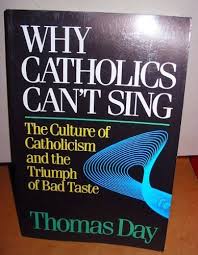
I liked Thomas Day's Why Catholics Can't Sing: The Culture of Catholicism and the Triumph of Bad Taste (New York: Crossroad, 1990) when it came out. I knew it would be entertaining, but I had no idea it would be so informative about why Catholic music and liturgy have developed the way they have in contemporary Catholicism. The book was well written, read easily and was obviously targeted at a broad audience; but it was also an education in things I did not then know about the history of the modern Church, like the various strands of Irish, Italian and German influence on liturgy in the American Church.

I recently happened across a sequel by the same author, entitled Where Have You Gone, Michelangelo: The Loss of Soul in Catholic Culture (New York: Crossroad, 1993). Dated, to be sure: that's almost two decades ago. But, to put things in perspective, my favorite college professor used to warn our class not to bother buying any book published within the last 50 years, since, he said, it hadn't yet garnered a sufficient track record to establish itself as a classic worthy of purchase. Hyperbole, of course. But he has a point. And the book looks to be a good read, perhaps a bit more playful, even, if no less serious, than his first.

Here's just a bit from his Preface to give you a taste. "This is one of the most important things to happen to the Catholic church in its entire history. You must experience it!" It sounded urgent, says the author, so he went along "to experience the experience."

The occasion, apparently sometime around the year 1980, was a Mass at a convention of a Catholic organization. Multitudes had descended upon a large cathedral for what was expected to be the sort of post-Vatican II phenomenon that would change the face of the church, if not the world, FOREVER. Multitudes eagerly awaited the experience.

Finally, music indicated that the liturgy had begun, he says, and for the next hour or more, he says he had the uncomfortable feeling that he was attending an illustrated lecture on the meaning of the word "decadent." It was like watching all his loved ones and friends disintegrate in front of him from a loathsome but unnamed disease:
Maybe it was the music: much strumming of guitars; one "contemporary" song sliding, like warm pudding, into another song of similar consistency. According to the printed Order of Service, nearly the entire liturgy would feature the songs of a famous group of "folk" musicians. Sung prayer, in other words, would also double as a demo-session, a little free advertising for the group.

Pain! Oh, the pain of listening to adolescent self-pity and self-importance in song! It would have been bearable if the congregation, caught up in the fervor of the music, had been carried along in its mighty sound, but very few people in the congregation were actually singing.
Looking for a distraction -- anything to take his mind off the group's slouching melodies, he began to look for relief in art, in the building's decorative features, which might be "read" as if they were an architectural prayerbook; which did not work too well, because the cathedral, a mountain of stone piled upon stone, "suggested a combination of a maximum security prison and a Victorian train station," though not utterly without charm. Finding that charm, however, was a little difficult since the building "had recently been subjected to extensive plastic surgery in an effort to make it look more youthful, more postconciliar." During the facelift, "the cathedral had lost some of its gingerbread ornamentation and statues that were too cloying for modern taste, but it had also lost some of its character."

His search for a prayer in architecture was interrupted, abruptly, by an amplified voice.
The presiding priest, holding a microphone now, began the Mass by telling us who he was and who the concelebrants and singers were and who we were and how wonderful it was that we had come. To soften us up even more, he made a little attempt at humor. (nobody even smiled.)

This kind of verbal intrusion, the opening warm-up monologue, is, of course, the modern post-Vatican II method for gathering Catholics together; it is supposed to make everyone feel at home -- but I am positive that the only thing everyone could feel was a rhetorical cattle-prod being shoved into the ribs. The man was forcing us to pay attention to him, and him alone. His warm-up remarks, which warmed up nobody, were really his way of establishing dominance.

A few minutes later there was a homily whose "style" seemed to blend logically with everything else. I shall never forget it.

Drifting from one off-the-top-of-his-head thought to another, the homilist sounded as if he were slipping into a coma. So many sentences ended with a pause and "y'know" that I started to count them. All of this semi-coherent mumbling was supposed to suggest his gift of intimacy and sincerity bestowed upon us, the grateful congregation; yet, at the same time, the intimacy and sincerity were also suggesting that the man had not really prepared his remarks.

It was not easy to discern exactly what the homilist was trying to say with the verbal fragments he was casually dribbling here and there, but a theme gradually emerged and it was this: "them" against "us." Out there in the world were "them," the people who just did not understand the revolution that had changed the Catholic church and the way it should worship after Vatican II. They were powerful, these reactionaries, but they would eventually be swept away. The Spirit was with "us," the authentic Christians of the post-Vatican II era, the only people who possess the true faith in Jesus Christ . . . "y'know."
Right then and there, at that very moment, he says, something forcibly struck him, something clicked ... or snapped:
I still spend a few of my waking hours trying to figure out why anybody with more than three functioning brain cells would put the label of greatness on something that was so embarrassingly shallow, why Catholic parishes by the thousands would try so hard to duplicate that same "atmosphere" of dense and banal immaturity . . . and why I reacted so badly, when I should have just walked out.

. . . I did not go to that cathedral with the idea that I should be reassured by traditional Catholicism expressing its conservatism, its orthodoxy, in traditional rituals. I certainly was not expecting to be uplifted with ceremonies, music, architecture, and preaching that were all glorious beyond description. I did, however, assume that, in a manner that an anthropologist would describe as a universal human phenomenon, I would be part of a collective, common prayer (an activity that comes in many different forms). Instead, I found myself in the middle of something very . . . weird, almost freakish, and it could not be explained away according to the ideologies of conservatism or liberalism. I realize that a High Anglican might find a Cherokee rain dance a trifle weird, just as a Presbyterian might put the same label on a Marionite Catholic liturgy from Lebanon. But the weirdness of that "experience" in a cathedral was something of an altogether different order, and I could not put my finger on it. What was the source of the problem?
The author says that his research for this book was part of his own personal quest to discover what had caused that feeling of being in the presence of "ineffable weirdness: something bizarre, neither fish nor fowl, weak, vaguely diseased." Whatever it was, he writes, "the weirdness had a life of its own and effectively blocked any encounter with theological messages that the ritual was trying to convey."

The author has no illusions about his audience:
Younger readers -- especially Catholics born after, let us say, 1960 -- are hereby forewarned. They may find it difficult to "imagine" whole sections of this book. Older Catholics will read a particular sentence and their minds might be flooded with memories (good and bad) of sights, sounds, and even smells. The younger Catholic will read the same sentence and comprehend only words printed on a page. One reason I wrote this book is to give younger Catholics a different perspective, so they could "imagine" a broader Catholic culture that most of them have never known.

Tuesday, June 29, 2010

Christopher West's sexy idea critiqued

A reader writes:
I think I have seen this before. Women whose husbands have cheated have watched friends insist there is no problem fidelity-wise in their marriage, only to be proven wrong. Or parents who insist their kids are towing the line when they are not.

When you have lived with problems, you have a keen eye for them. I thought of this with the latest item on Christopher West and the Theology of the Body (TOB). Don't get me wrong. He is not the prodigal, but the trusting parent. But just like I know where Biblical criticism of a sort leads, as a former Protestant, I know where this sex-up-front stuff leads. West was a little too wowed by the positive thrust of TOB to realize he was already preaching to shorts-wearing surfer dudes in Church. Sexual reticence? Not their problem!
In that vein, our reader refers us to Michael Liccione's post, "Dawn Eden on the Theology of the Body" (Sacramentum Vitae, June 24, 2010), based on Eden's recent master's thesis at "the Pontifical Faculty of the Immaculate Conception at the Dominican House of Studies" in Washington, DC: "Towards a 'Climate of Chastity': Bringing Catechesis on the Theology of the Body into the Hermeneutic of Continuity."

Several excerpts from Liccione's post:
Eden's most telling criticism is that West's explication of the TOB explicitly presents it as "revolutionary," in such a way as to constitute an actual rupture with the broad tradition of Church teaching. I'm convinced she's right about that. For example, she shows in almost painful detail how West's account of the pre-virtue of "continence," and the full virtue of "chastity" of which continence forms a part, is actually contrary to John Paul II's (largely Thomistic) meaning.

West also thinks that the TOB is revolutionary as an antidote to the sexual "repression" from which "generations of Catholics" have suffered. That may well have been true of many Catholics prior to Vatican II, but as Eden notes, it can hardly be said about the majority of Catholics since then....

... The difficulty is not with his general idea about the development of doctrine, but rather with his imperfect understanding of the TOB's content. West makes JP2 appear to say things contrary to the tradition of the Church, even though neither man intended that. But West's metaphor of the Church moving from childhood to adolescence on the matter of sexuality, though perhaps sloppily applied, can be understood to apply to the Church's understanding of the deposit rather than to the deposit itself.

Unfortunately, West does not concern himself with such subtleties. Worse, his vision of the TOB is blinkered in comparison with that of JP2 himself. The wider context of the Pope's voluminous output shows that he makes far more allowance for the role of redemptive suffering in marriage, including conjugal sexuality, than does West, who virtually ignores the issue in favor of arguing that our relationship with Christ is "always" mediated through "sexual desire" and "intercourse." The charge that he oversexualizes spirituality is justified. In fact, a healthy conjugal sexuality should be seen as a real symbol of God's relationship with his people, but that entails self-restraint at least as often as it entails intercourse.

Accordingly, Eden's most constructive suggestion is to urge that West's approach incorporate "Mystical Body theology" especially in the "experience of brokenness," about which West says very little. There has to be a via media between seeing sex primarily as a danger to the soul and seeing it as the preferred medium for our divinization in Christ. Sexual desire, intercourse, and continence, each in their proper circumstances and order, need to be seen as expressions of a married couple's mutual self-gift, i.e. their sacramental love.

The issues raised by the TOB require more profound meditation than West has given them. That kind of meditation has been seen hitherto only in a rather narrow academic circle of Catholics. Once Eden's thesis is re-written as a book aimed at a general audience, the meditation can spread in earnest.
[Hat tip to J.M.]

Science (again) confirms common sense

Simon Caldwell, "Abortion 'triples breast cancer risk': Fourth study finds terminations linked to disease" (Mail Online, June 24, 2010):
An abortion can triple a woman’s risk of developing breast cancer in later life, researchers say.

A team of scientists made the claim while carrying out research into how breastfeeding can protect women from developing the killer disease.

While concluding that breastfeeding offered significant protection from cancer, they also noted that the highest reported risk factor in developing the disease was abortion.

Which one is not in drag?


Breaking:

Report on possible effect of Vatican recognizing SSPX Masses

The report, prepared by Peter Karl T. Perkins, is posted under the title, "Preparing for the Third Anniversary of Summorum Pontificum: An ongoing worldwide report" (Rorate Caeli, June 28, 2010). Excerpts:
As the doctrinal talks with the S.S.P.X continue, many might wonder what effect a public recognition of Society Masses ... might have.

... In the past, it is likely that Rome did not recognize the ability of Society Masses to fulfill the Sunday obligation mainly because this might cause the faithful to abandon the New Mass in large numbers. It might have caused great division. ... Rome let time pass, during which most faithful came to accept, even if sometimes reluctantly, the New Mass. Then, starting in 1984, by a number of initiatives, Rome gradually ‘let out the rope’ to permit a return of the T.L.M. as an option. The result is that, today, there are far more regularized Latin Masses than there are Society Masses....

What we can estimate is the impact a recognition of Society Masses might have if done today, this year. Would this cause a grave crisis? Would there be an enormous exodus from the New Mass to the Society Masses, or even from regularised Traditional Latin Masses to Society Masses? I argue here that the effect of such a recognition would be small in the short term but very important in the longer term.... The main effect of creating a ‘free-ranging’ S.S.P.X is secondary; It would induce obstructive bishops gradually to allow their priests to offer the T.L.M. without being penalised for doing so .... No bishop wants to have his authority undermined.... Most bishops in Western countries are already allowing a few Traditional Latin Masses. They would quietly encourage a few more to keep the S.S.P.X at bay.
The report also list figures comparing the number of dioceses offering Traditional Latin Masses in 2005, when this pontificate began, and 2010:
  • France: 65, 78.
  • Italy: 15, 52.
  • Germany: 10, 23.
  • Spain: 3, 12.
  • Poland: 6, 14.
  • Portugal: 0, 1.
  • Austria: 5, 7.
  • Switzerland: 3, 4.
  • The Netherlands: 1, 3.
  • England: 9, 17.
  • Scotland: 2, 3.
  • Ireland: 4, 6.
  • Wales: 0, 1.
  • Philippines: 5, 5 (there was a substantial increase and then a fall back to 5).
  • Australia: 10, 11.
  • New Zealand: 2, 5.
  • USA: 112, 149.
  • Canada: 11, 15.
  • Mexico: 1, 4.
  • Brazil: 7, 21.
  • Argentina: 2, 2 (obstruction from Bergoglio and company).
  • Colombia: 1, 2.
  • Peru: 1, 2.
  • South Africa: 0, 1.
  • Gabon: 1, 2.
  • Nigeria: 1, 1.
  • Hungary: 1, 3.
  • Czech Republic: 1, 4.
  • Slovakia: 0, 1.
  • Ecuador: 0, 1.
  • Sweden: 0, 1.
The report ends with the notice: "Comparisions with S.S.P.X numbers to follow."

The dilemma for progressives in the Church sex scandals

An excellent post by Mike Liccione, "At least they're our perverts..." (Sacramentum Vitae, June 26, 2010) about what was reported about "the fall of the Belgian Church" by Alexandra Colen in The Brussels Journal (June 24, 2010):
In Belgium today [June 24], police searched the residence of the Archbishop of Mechelen-Brussels and the crypt of the Archbishop’s cathedral in Mechelen. They were looking for evidence of cover-ups in the ongoing investigation into widespread pedophilia practices within the Belgian church in the decades during which Cardinal Godfried Danneels was Archbishop. Danneels retired in January of this year.
Liccione comments:
The article proceeds to recount some of the lurid details, which the author was personally involved in discovering and protesting as a Catholic parent. Let the squeamish beware.

. . . The first kicker is how Cardinal Danneels was, himself, enabled to enable the problems for three decades. What makes it so astonishing is that, as the article makes clear, the problems were public knowledge for much of that time. So how did he get away with it?

Two reasons. For one, and as the MSM have made sure we know, the Vatican wasn't aggressive enough in disciplining evildoers. But the other reason is the MSM themselves. Danneels was a darling of both ecclesial and secular "progressives" throughout his 30-year reign. Since progressives dominate the MSM in Western Europe even more than here, the damning facts were reported only haltingly, and no drumbeat of outrage was sounded against Danneels or his minions.

. . . The other kicker in the Danneels case is the dilemma it poses for the conventional progressive wisdom. Popes rarely depose bishops, and the more prominent a bishop's see, the less likely he is to be deposed. That's probably how it should be. The pope is not the CEO of Catholic Church, Inc; he is chief bishop among his brother bishops. His exercise of jurisdiction over the Church universal must and does take due account of that. But amid the current agony of scandal, many progs will have none of it. They all want the Church to be less centralized when that would weaken Rome's doctrinal authority, but want her more centralized when that would help prevent things such as the sex-abuse-and-coverup scandal—except, of course, when the guy covering up is himself a progressive. Then we must remember collegiality.
[Hat tip to M.L.]

Monday, June 28, 2010

Beckett all over again?

Rachel Zoll, "Court lets Vatican-sex abuse lawsuit move forward" (Breibart, June 28, 2010):
A lawsuit against the Vatican that had been dismissed as a publicity stunt moved forward Monday when the U.S. Supreme Court refused to hear an appeal from the Holy See. The case represents a significant hurdle for what many believed to be a long-shot claim that the Vatican bears legal responsibility for molester priests.

The high court's decision not to stop the lawsuit means the clergy sex abuse case will go to trial in an Oregon district court.
The reader who send me the link comments:
It appears that [Benedict XVI] did not take up Obama on his "deal". Now the latter is allowing, probably funding, the attack for the RC's destruction in the US. Doubt me? Believe me, I would rather not see this mad game played out, but for Obama it is crucial. He must undermine churches so as to consolidate power to the state, and he hopes, himself. Why not start with the church that has had the most thrown at it over the last 15 years or son. Why not take down one of the elephants? Look out Baptists . . .
[Hat tip to S.K.]

Sunday, June 27, 2010

Yesss! There is hope after all!

Come this fall, the gifted, confident and serene young Mary Ann Marks, who delivered her Harvard commencement oration in Latin, will head to Ann Arbor, Michigan to try her vocation as a Dominican Sister of Mary, Mother of the Eucharist!!!

(The order operates several schools, one of which our daughter will be attending this fall, and several sisters from the order were recently interviewed by Oprah Winfrey on her show.)

[Hat tip to E.E.]

Update:
Here's a link to an article that explains a bit more about these annual Latin orations at Harvard commencement exercises: Sarah Sweeney, "Commence wonderment" (Harvard Gazette, May 26, 2010).

Beyond the New English Ordinary Form Missal: Other Issues With Approved Translations – Part 6

Tridentine Community News (June 27, 2010):
A Possible Meeting of the Minds

Our reader who favors modern Biblical translations argues that accuracy is essential, and so does the Holy See. No question can be raised there. However, the language of prayer surrounding the Extraordinary Form is hierarchical in nature. That is, in fact, one of the appealing aspects of the EF. Countless prayer books, many of which are being republished today, have a Douay-like ring to the ear. Fortunately, the two concepts are not mutually exclusive.

It would be possible to embark on an entirely new translation of the Bible that incorporates hierarchical language. This writer acknowledges that some of the sentence constructs in the Douay are hard on modern ears. We cannot expect to be frozen in time with the Douay forever, though it is pastorally understandable why Church authorities might want to leave things alone for a few years. Many of those who love the traditional liturgy of the Church don’t believe it is time for substantial changes to the Tridentine Mass any time soon. Excessive change in the liturgy of the Church has already presented many pastoral problems; a time of stability will heal wounds. A new translation with more traditional wording, however, could address all concerns.

Ordinary vs. Extraordinary Form Perspective
in the Official Books of the Church


There is one other issue to point out with regards to the successive English editions of the Church’s book of private prayer, the Manual of Indulgences: The current 2006 edition is written exclusively from the perspective of the Ordinary Form.

Language is used such as “the Solemnity of the Body and Blood of our Lord”. In the Extraordinary Form, there is no such thing as a “Solemnity”. The equivalent concept is a “First Class Feast”. Corpus Christi, however, may be celebrated as a First Class Feast on a Thursday, or as an “External Solemnity” (a transferred Feast . . . not the same thing as a “Solemnity”) on the next Sunday. In such a case, on what day would an indulgence attached to the Feast apply? Presumably to the day on which the Feast is celebrated, but what if it is celebrated twice at the same parish, once on the Thursday, and once on the Sunday? Could one earn the indulgence twice?

Similarly, occasional indulgences are granted to Feasts which only exist in the Ordinary Form. The first that comes to mind is “Divine Mercy Sunday”. While Divine Mercy Sunday devotions are often celebrated at Extraordinary Form Masses, the name of that Feast Day in the EF Calendar remains unchanged as “Low Sunday”. There is no “Feast of Divine Mercy” in the EF. Should not then the announcement of the indulgence for that day state that one can gain it on “the Feast of Divine Mercy” in the OF or on “Low Sunday” in the EF? In this post-Summórum Pontíficum world, it is incumbent upon Church leaders to consider such questions.

We point this out simply to suggest that there are differences between the Ordinary and Extraordinary Forms that may take years or decades to work out. Clarifications will be needed for questions that have not yet been pondered. While not strictly a matter of the vernacular, it is a subject which one discovers upon delving into the contents of prayer books and announcements.

Perhaps these are some of the areas in which our Holy Father hopes that the Ordinary Form and Extraordinary Form can inform one another. As issues concerning the vernacular, the liturgical Calendar, Holy Days, and certain assumptions in the Manual of Indulgences are considered, there can only be two long-term outcomes: Either the two Forms of the liturgy fuse in certain ways, or they separate in more clearly defined ways. They could proceed according to the Fiat-Chrysler model, in which certain new Chryslers may be built on Fiat platforms, and vice-versa; or they could follow the Warren Buffet model, where subsidiary companies operates independently.

English Bishops Take the Lead


It is encouraging to note that matters pertaining to the Extraordinary Form are starting to pop up on the radar screen of some National Bishops’ Conferences. The Bishops of England and Wales have long been at the forefront of EF-OF coexistence, having obtained the first Tridentine Mass Indult in 1971, barely two years after the promulgation of the Novus Ordo. Today, the Liturgy Office of the Bishops of England and Wales devotes a substantial portion of their web site, www.liturgyoffice.org.uk, to the Extraordinary Form. It is a model for other Bishops’ Conferences to emulate. While their conclusions on one particular subject, that of EF Holy Day transferrance to Sundays, are debatable, we must applaud the fact that they have given the matter consideration. It is refreshing to see both forms of the Roman Liturgy given attention on such a well-visited web site.

A Way Forward

The mainstreaming of the Extraordinary Form by the Motu Proprio Summórum Pontíficum has created a need for a new area of study, scholarship, and action in the Church: Starting with issues concerning the vernacular, and continuing through Calendar and Indulgence matters, there is a need to determine which practices should be brought closer in line between the EF and the OF, and which need to be separated but fleshed out. Perhaps there should be an EF-oriented Manual of Indulgences, employing hierarchical language, for example.

Though we cannot speak for any language other than English, it seems that for English-speaking lands, a body akin to ICEL, but with experience in, and sensitivity to, the customs of the Extraordinary Form, could be created to address some of these issues, in conjunction with the appropriate authorities from Rome. Unlike ICEL, the vernacular would not be its sole concern. Its leader and members should have acknowledged expertise in the Extraordinary Form. Royalties on English texts should not be charged, to give incentive for publication of the texts. And ideally, the body should be one of advocacy and not just regulation.
[Comments? Please e-mail tridnews@stjosaphatchurch.org. Previous columns are available at www.stjosaphatchurch.org. This edition of Tridentine Community News, with minor editions, is from the St. Josaphat bulletin insert for June 27, 2010. Hat tip to A.B.]