

Victor Davis Hanson, "The New World Map" (Town Hall, June 18, 2015):
Adolf Hitler started World War II by attacking Poland on September 1, 1939. Nazi Germany moved only after it had already remilitarized the Rhineland, absorbed Austria and dismantled Czechoslovakia. Before the outbreak of the war, Hitler's new Third Reich had created the largest German-speaking nation in European history.
Well before the attack on Pearl Harbor, the Imperial Japanese government had redrawn the map of Asia and the Pacific. Japan had occupied or annexed Indochina, Korea, Manchuria and Taiwan, in addition to swaths of coastal China. Attacking Hawaii, the Philippines, Hong Kong, Malaysia and Indonesia was merely the logical 1941 follow-up to more than a decade of Japanese aggression.
Fascist Italy, by the outbreak of World War II in Europe, had already been remaking the map of the Mediterranean region in imitation of ancient Rome. Strongman Benito Mussolini had annexed what is now Ethiopia, Albania and most of Libya. He promised Italians that the Mediterranean would soon be mare nostrum, "our sea."
All of these hegemonies had arisen without triggering a global war. Had Hitler, Mussolini and the Japanese just been satisfied and consolidated their winnings, there was no evidence that the tired Western democracies would ever have stopped them.
The contemporary world is starting to resemble the 1930s, and maps again must be redrawn.
The Islamic State plans to take Baghdad to make it the capital of a radical Sunni caliphate from what is left of Syria and Iraq.
Its enemy, theocratic Iran, is forging its own Shiite empire. Through its proxies, Iran now effectively runs much of Iraq, Lebanon, Syria and Yemen. When Tehran gets a nuclear bomb, it will urge on Shiite minorities to overthrow the Sunni monarchies in the rich, oil-exporting Persian Gulf nations.
Russian President Vladimir Putin thinks he can reconstitute the empire of the czars and the later Soviet Union. American "reset" diplomacy green-lighted his annexation of the Crimea and his occupation of areas of Ukraine. Should Putin wish to absorb Estonia or other Baltic States, NATO probably would not stop him.
A terrified Eastern Europe, which not that long ago was part of the old Soviet Warsaw Pact, is already making the necessary political concessions in hopes that the unpredictable Putin leaves them alone.

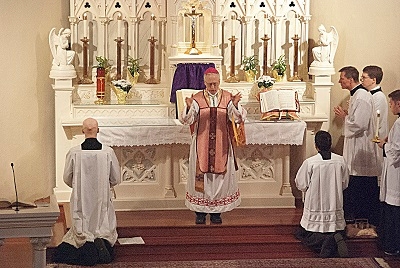
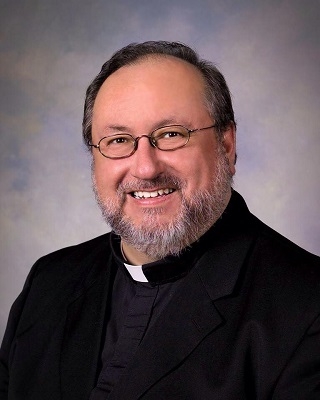 Many of our readers know Fr. Tim Ferguson from his days as a parishioner at St. Josaphat and in his former role as a Canon Lawyer for the Archdiocese of Detroit. He was recently ordained to the priesthood for the Diocese of Marquette, Michigan. His first Holy Mass after ordination was in the Extraordinary Form, with at least two metro Detroiters in attendance. Fr. Tim will return to St. Josaphat next Sunday, June 21, to celebrate the 9:30 AM Tridentine Mass. He has been assigned to St. Peter Cathedral in Marquette, which perhaps not so coincidentally was the site of Extraordinary Form Masses formerly celebrated by current Oakland County Latin Mass Association Chaplain and fellow Canon Lawyer Msgr. Ronald Browne.
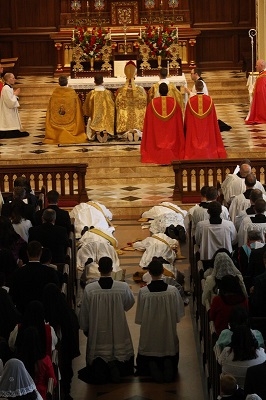 An astute reader reported some good news concerning the new Newman Center in Lincoln, Nebraska, a new church constructed in the traditional style which was featured in our May 31 column. The very day before, on May 30, 2015, the Newman Center hosted its first Holy Mass in the Extraordinary Form, an ordination Mass for the Priestly Fraternity of St. Peter. Bishop James Conley ordained six priests there, a most fitting choice considering that the previous site for FSSP ordinations, the Cathedral of the Diocese of Lincoln, has often been noted for being too modern architecturally for such ceremonies.
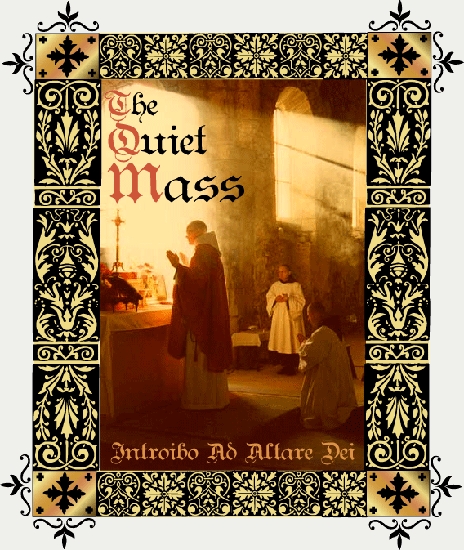

 Peter Kwasniewski, a professor of philosophy
and theology at Wyoming Catholic College, has written a wide-ranging
book consisting of articles, most of which originally appeared in The Latin Mass
magazine, that pin the many problems in the Catholic Church today —
indeed, over the past fifty years — on the state of the liturgy. In
question here is the Mass of the Latin Church, or Roman rite, whose
ancient liturgy was replaced in 1970 with a “new order of Mass,” or Novus Ordo Missae, which has weakened or even destroyed the sacred atmosphere or ethos that was long associated with Catholic worship.
Peter Kwasniewski, a professor of philosophy
and theology at Wyoming Catholic College, has written a wide-ranging
book consisting of articles, most of which originally appeared in The Latin Mass
magazine, that pin the many problems in the Catholic Church today —
indeed, over the past fifty years — on the state of the liturgy. In
question here is the Mass of the Latin Church, or Roman rite, whose
ancient liturgy was replaced in 1970 with a “new order of Mass,” or Novus Ordo Missae, which has weakened or even destroyed the sacred atmosphere or ethos that was long associated with Catholic worship.
 Only Alcuin Reid broke beyond this binary set of numbers, and he did so because he wanted to prevent a third figure from entering his set of 1s and 0s. At the local level, priests and some laity are increasingly interested in the genuine old rite, particularly in the un-Pianized Holy Week. This past year saw a proliferation in Holy Week celebrations according to older usages, celebrations wisely un-publicized by the faithful. The diocesan bishop is unlikely to care, but the district superior of the FSSP is.