
Wednesday, May 02, 2012
Funeral march for LCWR assembly in St. Louis
Well, sort of. You have to appreciate Fr. Z's sense of humor, which is ... well, at least as twisted as my own: "An idea for the upcoming LCWR assembly in St. Louis" (WDTPRS, May 2, 2012):
Tuesday, May 01, 2012
What makes a person FALL IN LOVE with the Mass?
 I remember reading about how Dietrich von Hildebrand, after his conversion, could be seen running down the streets of New York City, coat flapping in the wind, rushing so as not to be late to weekday Mass. He LOVED the Mass and could not abide the thought of missing one or arriving late.
It has been a while since I've encountered anyone so passionately in love with liturgy as that. Until I read this post today by the young and spirited "Once-a-Detroit-Girl-Always-a-Detroit-Girl" Ms. Allie, "I am in love ..." (All Things Christ, April 28, 2012):
Laudetur Iesus Christus![Hat tip to A.B.]
Friday of the Third Week of Easter/Saint Peter Canisius, Doctor of the Church (EF)
Here it is, 11:30 at night and I am lying in bed again but there is something different about me. Something wonderfully different. Something that cannot be amply described in words. Seriously.
I just got back from a wonderful evening at Saint Josaphat’s in Detroit, a beautiful Polish church in Detroit that I had never seen before in person but had seen many pictures. I was with a friend for a Mass put on [by] the Juventutem, which is a group of Catholic young adults (18-35) who have a particular love for the traditional Latin Mass (TLM). This was their inaugural Mass and social for the group that has been started in the metro-Detroit area and it was great.
I had not been to a TLM since 2009 so I had to get a quick refresher from a priest-friend who happened to be the celebrant of said Mass. I used to go when I was in college because there was a parish that had a TLM every Sunday at 12:30 so not only did we get to go to Latin Mass, but we also got to sleep in! Win-win situation much? Yea. I had gone a couple times after I graduated but it had been a while.
All of my memories of the TLM had been wonderful but I had never been to a Missa Cantata or a sung Mass aka High Mass. It was beautiful. It was ethereal. It was glorious.
If I could tell you, if I could describe to you how my spirit had been and has been lifted up by this experience, I would but I cannot put it into words.
As we walked into the quiet church (a pleasant change from the sometimes noisy state of my home parish before Mass), I put on my beloved mantilla and we found our seats. It was hard for me to *not* look around. I have studied the histories of many of the parishes in the city so for me to be physically present in one of those places connects me in a concrete way to the history of these places. There were so many things my eyes wanted to examine but luckily, one of the perks of wearing a veil is that you have blinders of sorts that remind you why you are wearing the veil, to honor and focus on the Lord.
I prayed Vespers on my iPod and made a silent pre-Mass meditation. In churches like Saint Josaphat’s, I have no problem making a meditation because one’s spirit is lifted up by one’s surroundings. This can be sadly lacking in some more modern churches that have this fixation on the horizontal plane (immanence) of existence as opposed to directing the human heart and soul to the vertical plane (transcendence) of eternity.
Then Mass began. The organ music made my heart smile. The Latin made my soul so happy. I knew the vast majority of the songs that the people could sing. And luckily, I have watched enough Masses from the Vatican to know the what the responses are chanted. Latin is sadly not used as often as it ought at my home parish so hearing Latin songs filled a void in my heart that can only be filled by hearing a beautifully sung Panis Angelicus or another song like that.
There is something about the TLM that affects me differently than the Novus Ordo (the Ordinary Form of the Roman Rite). No, I am not going to go off on a trad rant of sorts where I decry the Ordinary Form and praise unceasingly the Extraordinary Form.
But I must say that with this experience, my preference has been reinforced. I have a preference for the Extraordinary Form. While I don’t really get to go as often as I would like, when I can, I do go. All I care about otherwise is that the Mass is valid, licit, and it’s reverent.
Sure it can be an “acquired” taste and sure it can be an adjustment but, you know, it’s a new experience and you never know, you may just like it. I love it. My experience today reminded me of how very much I love it.
It took a bit to follow the rhythm but once I got my bearings things went smoothly.
Anyway, you’re probably wondering what the title of this post means.
Well, it has to do with the wonderful “feeling” that overcame me today during Mass, more specifically after receiving Communion.
My spirit had already been lifted so high by the beauty of the Mass but it was about to experience something all the more glorious.
As I knelt at the rail to receive Communion (and ignored that OCD tendency to fret about my veil) and waited for Him to come to me, my eyes wandered, I’ll admit it. But they fell on the crucifix over the tabernacle. Then, He was there. There is something about the prayer the priest says right before he gives you Communion that I love. It’s not just “The Body of Christ” which I find to be “lacking” (don’t you burn me at the stake, let me finish) in describing what it means. “Corpus Domini nostri Jesu Christi custodiat animam tuam in vitam aeternam. Amen.” = “May the Body of Our Lord Jesus Christ keep your soul unto life everlasting. Amen.” Here, we do not just hear what we receive, namely the Body of Christ, but we also come to know what He does for us by His offering His Body and Blood for us. I think this is more “complete” than just saying “Body of Christ.”
Well, I received Communion and waited a moment afterward (you don’t just dine and dash like some persons are apt to do in the Ordinary Form) and then walked back to my seat. A mantilla really helps one keep custody of the eyes.
I knelt and began to pray. I usually pray the Post-Communion/Mass Prayer of Saint Thomas Aquinas and while I do not have it memorized yet, I have the outline committed to memory. I got about halfway through when suddenly, my gaze was lifted up and my eyes kept going in and out of focus which was strange. And then I felt this overwhelming feeling of peace wash over me. Suddenly, all the pains, worries, and fears that had been plaguing my heart went away and were replaced by an indescribable joy. I could feel this interior smile of sorts that was beyond anything I had felt. I don’t know if I was smiling but my soul was and it was quite a wonderful feeling.
Then I realized it.
He had stolen my heart again.
And He does it so beautifully.
Throughout my discernment, I have heard Christ referred to as one who pursues and woos.
Does He ever.
No wonder He’s God.
And He is so generous. More than I deserve. He loves me so. He loves me individually and uniquely.
When I came back home from the convent, people told me (and they still do), “Allie, go find yourself a boyfriend.” or “Allie, you should date some more.” I just roll my eyes and ask, “Why would I do that when I already have someone?” Their response tends to be that of one who is not sated by what I say. But that does not matter.
It was at that moment that I knew. I did not belong to anyone but Him whom I had just received. And it filled me with peace and joy. There is still hope for me yet! Yay!
I tell you, once I get a car, I am going to TLM more often. I will still belong to my home parish but I will go to TLM. The added bonus is that I would get to wear my veil. Why don’t I wear it at the parish? Long story. Just trust that there is a reason. Those who know know. It’s not really a big deal. Not big enough to share here, at least.
Well, I have to get to bed. Mass in the morning. I am going to wish it was a TLM, just watch. I will probably hear the music in my head during Mass and I’ll probably get that wistful look on my face.
It was so wonderful today. So wonderful. I wish I could experience that always!
Have a great evening, everyone! -Allie
Monday, April 30, 2012
Prayer request
Please pray for the family of Pieter Vree, the editor of New Oxford Review. His wife just went into labor.
Sunday, April 29, 2012
Papal Support of “Praying the Rosary During Mass”

One of the most commonly-heard clichés about the Traditional Latin Mass is that it does not “actively” involve the faithful as much as the Ordinary Form. Newer readers of this column might be interested in reading our previous essays debunking this assertion, namely our March 19, 2006 column defining Active Participation according to the mind of the Church; and the four-part series of columns from August-September, 2009 showing that there are actually more responses for the faithful in the Extraordinary Form than in the Ordinary Form. Like all of our back columns, those are posted on our web site. [See "Active Participation in the Mass: A Statistical Study" - Part 1, Part 2, Part 3, and Part 4; and "Congregational Responses in the Low Mass" - Part 1, and Part 2.][Comments? Please e-mail tridnews@stjosaphatchurch.org. Previous columns are available at www.stjosaphatchurch.org. This edition of Tridentine Community News, with minor editions, is from the St. Josaphat bulletin insert for April 29, 2012. Hat tip to A.B.]
A particularly frequently-heard comment is that prior to Vatican II, some of the faithful were praying the Rosary during Mass. This is oft stated in the sort of scornful tone one might use to describe people texting during Mass, as though one should never even think of doing such a thing. It might therefore surprise some people to learn that in paragraph 108 of the 1947 encyclical Mediátor Dei, Pope Pius XII acknowledges the legitimacy of such devotions, in truly pastoral language. This author has even seen a combination missal-prayer book from that era with a foreword recommending personal devotional prayer during Mass, citing this papal document. Additionally, in 1883 Pope Leo XIII issued Suprémi Apostolátus Offício, a document establishing October as the Month of the Rosary. In it, and in an 1886 clarification, he asks that the Rosary be prayed [during October] while Mass is being said or while the Blessed Sacrament is exposed.
While most modern scholarship argues that “pray[ing] the Mass”, as Pope St. Pius X said, is a more complete ideal for the faithful, one cannot overlook the 1883 and 1947 papal endorsements, at least with regards to the Extraordinary Form. The subsequent document Mariális Cultus, from 1974, did recommend against praying the Rosary during Holy Mass, but rulings from that era strictly regarded the Ordinary Form. We thus present the section of Mediátor Dei which addresses the subject:105. Therefore, they are to be praised who, with the idea of getting the Christian people to take part more easily and more fruitfully in the Mass, strive to make them familiar with the “Roman Missal,” so that the faithful, united with the priest, may pray together in the very words and sentiments of the Church. They also are to be commended who strive to make the liturgy even in an external way a sacred act in which all who are present may share. This can be done in more than one way, when, for instance, the whole congregation, in accordance with the rules of the liturgy, either answer the priest in an orderly and fitting manner, or sing hymns suitable to the different parts of the Mass, or do both, or finally in high Masses when they answer the prayers of the minister of Jesus Christ and also sing the liturgical chant.Tridentine Masses This Coming Week
106. These methods of participation in the Mass are to be approved and recommended when they are in complete agreement with the precepts of the Church and the rubrics of the liturgy. Their chief aim is to foster and promote the people’s piety and intimate union with Christ and His visible minister and to arouse those internal sentiments and dispositions which should make our hearts become like to that of the High Priest of the New Testament. However, though they show also in an outward manner that the very nature of the sacrifice, as offered by the Mediator between God and men,[102] must be regarded as the act of the whole Mystical Body of Christ, still they are by no means necessary to constitute it a public act or to give it a social character. And besides, a “dialogue” Mass of this kind cannot replace the high Mass, which, as a matter of fact, though it should be offered with only the sacred ministers present, possesses its own special dignity due to the impressive character of its ritual and the magnificence of its ceremonies. The splendor and grandeur of a high Mass, however, are very much increased if, as the Church desires, the people are present in great numbers and with devotion.
107. It is to be observed, also, that they have strayed from the path of truth and right reason who, led away by false opinions, make so much of these accidentals as to presume to assert that without them the Mass cannot fulfill its appointed end.
108. Many of the faithful are unable to use the Roman missal even though it is written in the vernacular; nor are all capable of understanding correctly the liturgical rites and formulas. So varied and diverse are men's talents and characters that it is impossible for all to be moved and attracted to the same extent by community prayers, hymns and liturgical services. Moreover, the needs and inclinations of all are not the same, nor are they always constant in the same individual. Who, then, would say, on account of such a prejudice, that all these Christians cannot participate in the Mass nor share its fruits? On the contrary, they can adopt some other method which proves easier for certain people; for instance, they can lovingly meditate on the mysteries of Jesus Christ or perform other exercises of piety or recite prayers which, though they differ from the sacred rites, are still essentially in harmony with them. [Emphasis our own]
109. Wherefore We exhort you, Venerable Brethren, that each in his diocese or ecclesiastical jurisdiction supervise and regulate the manner and method in which the people take part in the liturgy, according to the rubrics of the missal and in keeping with the injunctions which the Sacred Congregation of Rites and the Code of canon law have published. Let everything be done with due order and dignity, and let no one, not even a priest, make use of the sacred edifices according to his whim to try out experiments. It is also Our wish that in each diocese an advisory committee to promote the liturgical apostolate should be established, similar to that which cares for sacred music and art, so that with your watchful guidance everything may be carefully carried out in accordance with the prescriptions of the Apostolic See.
Mon. 04/30 7:00 PM: Low Mass at St. Josaphat (St. Catherine of Siena, Virgin)
Tue. 05/01 7:00 PM: High Mass at both Assumption-Windsor and St. Josaphat (St. Joseph the Worker)
Saturday, April 28, 2012
"The revolution inside the Catholic Church was on the part of the clergy"
Catholic News Service offers this "Vatican Report" video featuring Fr. Joseph Kramer FSSP, parish priest of SS. Trinità dei Pellegrini (the personal parish for the Traditional Latin Mass in Rome), speaking on the prospects of Tradition in the Catholic Church:
Catholic News Service's companion piece to this video: New generation, old rite: the enduring appeal of Catholic tradition (CNS, April 27, 2012).
[Hat tip to Rorate Caeli]
Catholic News Service's companion piece to this video: New generation, old rite: the enduring appeal of Catholic tradition (CNS, April 27, 2012).
[Hat tip to Rorate Caeli]
Imagine: no Roe v Wade
As the nine justices of the Supreme Court are currently preparing their briefs for their decision later this year on the Affordable Care Act and Mandate of the Department of Health and Human Services, it may be felicitous to consider another possibly similar scenario involving Roe v Wade (1973).
Christopher Ferrara, current president and Chief Council of the American Catholic Lawyers Association, in his much-neglected but highly-illuminating book, The Church and the Libertarian (2010), offers "A Thought Experiment" in changing history: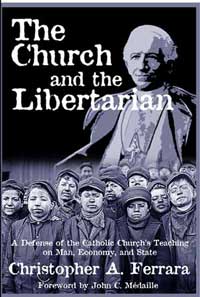
Related: Richard Aleman, "The Church and the Libertarian: A Review," The Distributist Review (March 14, 2011).
Christopher Ferrara, current president and Chief Council of the American Catholic Lawyers Association, in his much-neglected but highly-illuminating book, The Church and the Libertarian (2010), offers "A Thought Experiment" in changing history:
Let us suppose ... that tomorrow the five "conservative" Catholic justices of the United States Supreme Court (we will exclude Justic Sotomayor) come to their senses and join in a majority opinion overruling Roe v. Wade. Let us suppose that this opinion holds that the Fifth Amendment protection against the deprivation of life and liberty without due process of law, applied to the several States via the Fourteenth Amendment, extends to life in the womb. Let us suppose further that the opinion also holds that the Fourteenth Amendment itself, which provides that no State shall "deprive any person of life, liberty, or property, without due process of law; nor deny to any person within its jurisdiction the equal protection of the laws" applies to persons in utero. And let us suppose that in support of this conclusion the Court notes that feticide is already a crime in 37 states and that even federal law recognizes a child in utero as a legal victim if injured or killed during the commission of specified violent crimes. (This is a perfect indication of the insane moral incoherence of modern, post-Christian legal codes.) Finally, let us suppose that the five Catholid justices end their opinion with this astonishing declaration:Imagine! Unlike John Lennon's silly 1971 song by that title, which portrays a wistful fantasy Laputa-land with no relation to historical reality, Ferrara's imagined world is one tangibly connected to reality, history, tradition and legal precedent.The Constitution was not drafted and ratified in a moral or theological vacuum. The Framers lived in a society whose common law tradition still recognized the Law of God, and in particular the "divine positive law" of the Ten Commandments, as the ultimate source of human positive law. The classic commentaries of William Blackstone place this historical conclusion beyond serious dispute. The justices of this very Court take an oath to God, and we deliver our opinions while sitting beneath a frieze depicting Moses the Lawgiver holding the tablets containing the Commandments.What would happen upon the issuance of such an opinion? The mass media would of course erupt in an unprecedented storm of outrage. There would be calls for impeachment hearings to remove all five Catholic justices. But then, how could such hearing be conducted? What would be the impeachable offense -- that the five justices had violated their oaths to God by citing God's law in their opinion? Who in the Senate would be foolhardy enough to lead a prosecution of five sitting Supreme Court justices based on their adherence to God's law, supported moreover by references to history, tradition, an Saint Martin Luther King?
We recall here Dr. Martin Luther King's historic declaration in his "Letter from a Birmingham Jail" in the midst of the civil rights movement of the 1960s. "One has not only a legal but a moral responsibility to obey just laws. Conversely, one has a moral responsibility to disobey unjust laws. I would agree with St. Augustine that 'an unjust law is no law at all.'" For too long, the legal distortions created throughout the fabric of this nation by our unprecedented decision in Roe have placed conscientious Americans in the same position as Dr. King, writing from his jail cell. Indeed, Roe has given rise to a new civil rights movement and concomitant social turmoil that show no signs of abating nearly forty years after Roe divided this nation in a way not seen since the abolition movement that followed the everlasting embarrassment of our decision in Dred Scott v. Sanford, 60 U.S. (19 How.) 393 (1857).
But beyond a mere appeal to history, which provides the context for our textual interpretation, we hold today that the Consitution's morally freighted terms, "person," "life," and "liberty" cannot be considered apart from the same ultimate source of moral authority that Blackstone, our nation's common law tradition, and Dr. King had in view. As this Court observed in Zorach v. Clausen, 343 U.S. at 314, "We are a religious people whose institutions presuppose a Supreme Being." Men are creatures of that Supreme Being, bound by His law and accountable to Him for any human law that contravenes the natural law He has written on our hearts. Roe is such a human law. We overrule it today, not only in the name of our nation's history and tradition, but in the name of God.
Consider the galvanizing effect such a decision would have on a nation whose population is still overwhelmingly at least nominally Christian. Surely, in response to the liberal onslaught, conservative talk radio and TV would hail the justices as heroes, as would evangelical Christian leaders and even many members of the ordinarily craven United States Conference of Catholic Bishops. The Pope would hail the decision, emboldened by the courageous witness of the justices, and Catholics around the world would join the Pope. Even certain orthodox Jewish leaders who have long allied themselves with Christians on moral and social issues would lend support to the justices as they come under attack by the media jackals and Congress. And what could the President do? Order up a firing squad? Or would he not be reduced to denunciations having no legal effect on the life tenure of the five justices, getting no further than FDR when he tried to pack the Supreme Court in order to prevent it from declaring his New Deal programs unconstitutional? The justices would hold on to their seats and the "separation of powers" that was supposed to characterize the American Republic would receive a tremendous vindication.(Ferrara, pp. 271-273)
Related: Richard Aleman, "The Church and the Libertarian: A Review," The Distributist Review (March 14, 2011).
Brilliant! Congressman grills Sebelius on HHS Mandate
Posted April 26, 2012, this is one of those 'teachable' moments, for anyone willing to hear some simple facts, which may be more than we are able to assume for Secretary Sebelius.
The Culture War & the Catholic Church
By Tom Bethell
The contraception mandate and the furor surrounding it tell us just how much the culture is at odds with the Catholic Church today. Whereas other Christian communions have surrendered — Episcopalians, for example, who signed on to every detail of the sexual revolution, find themselves a dwindling force in American life — the war on Catholic doctrine has redoubled.
The phrase “culture war” as applied to the United States seems to have begun with Patrick J. Buchanan. It is a sign of our times that he was blamed for launching a war by noticing we were under attack. Those interested in the decline of the Church in America over the past fifty years should read his latest book, Suicide of a Superpower, particularly the chapter titled “The Crisis of Catholicism.”
In opening the Second Vatican Council, Pope John XXIII said, “We feel we must disagree with those prophets of gloom, who are always forecasting disaster, as though the end of the world were at hand.” Maybe not the end of the world, but fifty years on it’s clear that the period after Vatican II has been a disaster for the Church. The 58,000 U.S. Catholic priests in 1965 are down to 41,000 today. The 1,575 ordinations are down to 467 today. All this while the U.S. population grew by 60 percent. Mass attendance, then three in four Catholics, has fallen to one in four today.
The U.S. bishops, as the Church leaders in the fight against the contraception mandate, are hamstrung by a Church in decline. They are especially burdened by a legacy of failure — poor decisions and uncertain leadership — left behind by their immediate predecessors and, more often, of their own doing.
The Rev. Thomas Reese, S.J., a dissenting theologian, said of the present moment that “the bishops have lost a lot of their clout.” The oft-quoted Reese is right about that.
The contraception mandate and the furor surrounding it tell us just how much the culture is at odds with the Catholic Church today. Whereas other Christian communions have surrendered — Episcopalians, for example, who signed on to every detail of the sexual revolution, find themselves a dwindling force in American life — the war on Catholic doctrine has redoubled.
The phrase “culture war” as applied to the United States seems to have begun with Patrick J. Buchanan. It is a sign of our times that he was blamed for launching a war by noticing we were under attack. Those interested in the decline of the Church in America over the past fifty years should read his latest book, Suicide of a Superpower,
particularly the chapter titled “The Crisis of Catholicism.”In opening the Second Vatican Council, Pope John XXIII said, “We feel we must disagree with those prophets of gloom, who are always forecasting disaster, as though the end of the world were at hand.” Maybe not the end of the world, but fifty years on it’s clear that the period after Vatican II has been a disaster for the Church. The 58,000 U.S. Catholic priests in 1965 are down to 41,000 today. The 1,575 ordinations are down to 467 today. All this while the U.S. population grew by 60 percent. Mass attendance, then three in four Catholics, has fallen to one in four today.
The U.S. bishops, as the Church leaders in the fight against the contraception mandate, are hamstrung by a Church in decline. They are especially burdened by a legacy of failure — poor decisions and uncertain leadership — left behind by their immediate predecessors and, more often, of their own doing.
The Rev. Thomas Reese, S.J., a dissenting theologian, said of the present moment that “the bishops have lost a lot of their clout.” The oft-quoted Reese is right about that.
Friday, April 27, 2012
Voris outs scandal of sanctioned "gay masses"
Imagine Obama white
Throw in blue eyes, an Alabama accent, and light brown straight hair for good measure. Do you imagine he could get away with any of his disingenuous shenanigans in this election year if he were not a smooth-talkin' African-American Chicago-style politician? With the record he's making for himself -- from bankrupting the nation's treasury to threatening the Supreme Court -- he wouldn't stand a snowball's chance in hell.
Thursday, April 26, 2012
Political joke for the day
"Apparently, we're supposed to be more outraged by what Mitt Romney does with his money than by what Barack Obama does with ours."
Wednesday, April 25, 2012
Obama quietly signs bill banning protests against himself
NO JOKE!! For a few minutes, I thought this was a SPOOF! It's NOT! HR-347, signed into law last week under a media white out.
Mother Assumpta comments on the doctrinal assessment of the LCWR
 Sr. Maria Guadalupe, Principal of the burgeoning Spiritus Sanctus Academy (Plymouth), operated by the intrepid Dominican Sisters of Mary, Mother of the Eucharist, recently sent out the following notice to parents, faculty and staff:
Many of you may have heard news stories in recent days about the Congregation for the Doctrine of the Faith’s doctrinal assessment of the Leadership Conference of Women Religious (LCWR). There have been a wide range of reactions to this, and I thought I would share with you a brief piece written by Mother Assumpta [pictured left], for the National Catholic Register. You can find it at this link.Mother Mary Assumpta Long is superior of the Dominican Sisters of Mary, Mother of the Eucharist in Ann Arbor, Michigan.
Tuesday, April 24, 2012
Wow! MASS outside Planned Parenthood clinic!
"Denver priest 'pulls out the big guns': TLM outside Planned Parenthood" (WDTPRS, April 24, 2012).

Hey, just an ebullient thought ...
Hey, just an ebullient thought ...
Subscribe to:
Posts (Atom)