Tuesday, January 03, 2006

How do you change a subculture? Three cases

I solicit your reflections on the following questions, in which I am particularly interested in the respective roles of the Church and state -- the role of the Church in preserving and fostering the Gospel and the role of the state in protecting the legitimate rights of its citizens:

  1. How do you reform a morally reprobate sexual subculture within the Catholic priesthood while respecting the personal rights and dignity of individuals involved in the case?
  2. How do you reform a seditious educational subculture of religious dissent within Catholic colleges and universities while respecting the rights of students and scholars to free inquiry?
  3. How do you reform an illiberal utilitarian bias that has infected higher education, often with state complicity (e.g., defense contracts, mounting accreditation requirements for professional programs, etc.) while respecting academic freedom? Can the Church play a role in affiliated universities?
First case: How do you reform a morally reprobate sexual subculture within the Catholic priesthood while respecting the personal rights and dignity of individuals involved in the case?
This problem began, as I understand it, when those who should have been minding the shop let their guards down, perhaps most precipitously beginning back in the 60s. Bishops, priests, vocations directors, deans and rectors became lax and latitudinarian. The issue was broader than homosexuality. The sixties spawned a culture of sexual revolution, experimentation, and license. But insofar as homosexuality was part of the mix, the Church's distinction between the sinner and the sin were exploited to full effect to fuel such fantasies as the notion that as long as one wasn't involved in committing some heinous act like homosexual rape, one's homosexual inclinations (for which one presumably wasn't responsible) might be viewed as divine gifts to be embraced and celebrated.

Fast forward to the sex scandals that rocked the Catholic Church in the late 1990s and early 2000s. The mainstream media fastidiously avoided the term "homosexual" in reporting the scandal, panting the scandal as an issue of pedophile priests. There were exceptions, of course. Yet as case after case came to light, a landslide of evidence mounted of a subculture in the priesthood of homosexual activity involving teenage boys. According to the study conducted by the John Jay College of Criminal Justice in New York:
An overwhelming majority of the victims, 81 percent, were males.... A majority of the victims were post-pubescent .... The John Jay study said that pedophilia ... was a smaller part of the sex abuse problem. It said that 22 percent of the victims were under 10. It added that 51 percent were 11 to 14 years old and 27 percent were 15 to 17 years old. ("John Jay Study Reveals the Extent of Abuse Problem," AmericanCatholic.Org)

Yet the silence of denial on this point has been deafening. For example, in the video, Protecting Our Children, produced by The National Catholic Risk Retention Group, Inc., produced for the purpose of raising the awareness of diocesan volunteers and employees about the widespread problem of sexual abuse of minors in our society, only one of the four victims portrayed in the video was abused by a priest, and the victim was a girl. In other words, precisely zero percent of the abuse it portrays is actually representative of the scandal in the Church. (See "Protecting the Lavender Mafia" by Ken Skuba)

The question, then, is how can this abusive and malignant subculture be reformed or purged? What is the proper role of the government? What is the proper role of the Church? The government of the United States, for its side, has gone after the sex offenders where criminal prosecution has been warranted and possible, and I think several dioceses have cooperated with these criminal inquiries, at least as far as they have done so by making certain records and documention available to civil authorities. Yet on some level St. Paul's rebuke must also weigh in against the Corinthians who looked outside the household of faith to the civil courts of unbelievers for judgment (I Cor. 6:1-11), which probably attests to the reticence of some bishops about turning an ecclesial matter over to civil authorities. At present the Church is undertaking its Apostolic Visitation of American seminaries and houses of formation, and on November 9, 2005, the Vatican released its Instruction "On Priesthood and Those With Homosexual Tendencies," both of which aim to address the problem in question. What think ye?
Second case: How do you reform a seditious educational subculture of religious dissent within Catholic colleges and universities while respecting the rights of students and scholars to free inquiry?

There is little question that American Catholic colleges have significantly lost their Catholic identity over the past decades. One nominally Catholic institution would be about as examplary as another. I remember visiting Georgetown University a few years ago and being hardpressed to find a Catholic chapel anywhere. Peter Kreeft, Professor of Philosophy at Boston College, also a Jesuit institution, naturally likes to pick on Jesuit institutions, and says there are two kinds of Catholic schools -- those that are Jesuit, and those that are Christian. The undisputed flagship Catholic university of the United States, Notre Dame, has theologians on staff that regularly and loudly dissent from Church teaching in the media, and has also been in the news -- controversially -- for having hosted the Vagina Monologues and a gay/lesbian day on campus.

This drift toward dissent picked up momentum precipitously, I believe, in the late 1960s in response to Pope Paul VI's encyclical, Humanae Vitae (1968), defending the traditional Catholic teaching against contraception. The response of liberal Catholics, who had been led by liberal theologians and clerics to expect that Vatican accommodation to modern changes in contraceptive technologies was imminent, was open outrage. Charles Curran, a popular liberal professor of moral theology at the Catholic University of America in Washington, DC, formed a coalition of dissenters who took out a full-page ad in the New York Times expressing defiant rejection of Rome's instruction. Curran's case soon became a cause celebre and was championed by leftists, as it was derided by rightists. Curran himself was eventually dismissed from the Catholic University of America in 1986 after the Vatican declared him unfit to teach Catholic theology because of his heterodox positions on such social issues as contraception, homosexuality, and abortion (see William W. May's 1987 book, Vatican Authority and American Catholic Dissent: The Curran Case and Its Consequences, as well as Larry Witham's 1991 study, which has been greeted by nearly all sides as "fair,"Curran vs. Catholic University: A Study of Authority and Freedom in Conflict).

The Vatican response to the deterioration of Catholic identity at Catholic institutions of higher learning was the document, Ex Corde Ecclesiae (Apostolic Constitution of the Supreme Pontiff John Paul II on Catholic Universities), issued August 15, 1990. On the one hand, many if not most mainline universities continued to carry on with business as usual, settling for cosmetic changes at most and ignoring the more substantial demands of the document, mandating that professors of Catholic theology must profess theology that is in fact Catholic as understood by the Catholic Church and requiring Catholics who teach the theological disciplines in a Catholic university to have a mandatum granted by competent ecclesiastical authority (i.e., bishop).

On the other hand, others have responded more supportively. The Cardinal Newman Society, a national intercollegiate organization of more than 16,000 college leaders, educators, students, alumni and others dedicated to the renewal of Catholic identity at Catholic colleges and universities in the United States in keeping with the principles of Ex Corde Ecclesiae, has been surveying developments in Catholic higher education for some time. For example, it has noted cases of historically Catholic institutions that are no longer recognized by the Church as Catholic: "We know of four colleges that have are no longer recognized as Catholic by the bishops since Ex Corde Ecclesiae, the apostolic constitution on Catholic higher education, was issued in 1990: Marist College (NY), Marymount Manhattan College (NY), Nazareth College (NY) and Saint John Fisher College (NY). THESE ARE NOT CATHOLIC!" (Cardinal Newman Society, "Catholic Colleges"). More importantly, however, it has produced critiques of the curricula and course content and events conducted at colleges and universities that are still recognized as Catholic across the country, and the results are not encouraging. The following is a sampling:

Times and cultures, of course, change; which raises sticking points in identifying the institutional identity and mission of academic institutions. A case in point is one of England's most prestigious religious colleges, St. Philip's Sixth Form College in Birmingham, England, founded by Cardinal Newman and proudly counting J.R.R. Tolkien among its alumni. In October of 1992 The Times (Oct. 5, 1992) carried an article announcing a plan by the administration to turn the institution into a nonsectarian school on the ground that more than two-thirds of the students were now non-Catholic. In fact, as a result of an increased multicultural and non-Christian student population, the Lord's Prayer and Sign of the Cross have been "deemed inappropriate" at the college.

The problem raised by the trustees and dissenting parents, however, was that the terms of the college trust deed state that buildings are to be provided for "the performance of public worship according to the rites and ceremonies of the Roman Catholic religion" and that the college is to be operated "in accordance with the principles of the Roman Catholic faith" -- which seemed to leave no legal means of implementing the proposed changes. But the administration argued that the mitigating circumstances of a changed cultural climate now permitted it to redirect the original terms of the trust deed by way of the legal doctrine of "cy pres" (or "nearest equivalent"), alleging that the secular multiculturalism of the late 20th-century made a strictly Catholic education, as envisaged by the original grantors, unrealistic. Since "cy pres" applies only where it is impossible to carry out the purposes of the trust, and since benefactors who explicitly give their property for a defined purpose have an inviolable right to have their property used for that purpose if there is any reasonable way in which this can still be done, the relevant question is this: Does having a multicultural student body prevent St. Philip's, a traditionally Catholic college, from teaching its voluntarily enrolled students the Catholic Faith? To pose the question is to reveal its absurdity.

Some Catholic schools, of course, are pontifical institutions whose Vatican affiliation ties them ineluctably to the Catholic Church. Others have varying forms of governance, some being affiliated with religious orders, others with governance shared between administration and faculty under a board of trustees, offering considrably more fluidity. Catholic college presidents used invariably to be clerics. This is no longer so. Even trustees now may be Catholic or non-Catholic, often with little if any idea of what they, in principle, hold in trust.

It is hard, therefore, to generalize about the precise rights of faculty in terms of academic freedom in Catholic academic institutions across the board. Situations may vary legally from one school to another. What remains clear is that just as individual faculty members are entitled by the nature of their profession to free academic inquiry within the parameters specified by law and by the religious mandates of their academic institutions, so Catholic colleges and universities are entitled by the nature of their institutional purpose to mandate what instructional content is consistent with their religious mission. The leftist National Catholic Reporter (February 25, 2005), as part of a cover story about Vatican "repression" under the pontificate of John Paul II, compiled a list of 24 individuals censured worldwide by the Vatican during the past 26 years as "evidence" (The List) . Karl Keating, of the Catholic Answers apologetics organization, in his e-letter of March 9, 2005, comments on this list but draws the opposite conclusion: that the Vatican has been almost laughably lenient! Obviously, it is a question of perspective.

Again, what think ye?

Third case: How do you reform an illiberal utilitarian bias that has infected higher education, often with state complicity (e.g., defense contracts, mounting accreditation requirements for professional programs, etc.) while respecting academic freedom? Can the Church play a role in affiliated universities?

Most church-related liberal arts colleges and universities in the United States were founded in the mid-to-late nineteenth century, and the same is true of Catholic institutions. Most church-related colleges and universities were founded initially as institutions devoted to the professions of training clergy and teachers and, if they were co-ed or women's institutions, nurses. Again, Catholic institutions were not too different. They came to the new world with a long tradition of liberal arts education, which was embedded in the curricular assumptions of their institutions from the beginning. Add to that the emergent American ideal of a liberal arts education as something to which a greater part of the population aspired, and by the end of the Second World War, for better or worse, it was largely an expectation nearly all graduates from high school would go on to complete a liberal arts college degree.

What this meant, in practice, was generally a freshman and sophomore year devoted to a standardized core curriculum in the liberal arts (a bit of English, mathematics, natural science, history, social science, philosophy, economics, foreign language, etc.) and a junior and senior year devoted to a specialized major (in one of those disciplines). While the general expectation of a "college education" has not changed, the educational landscape has changed considerably over the last several decades, with the traditional core curriculum in the liberal arts being increasingly eroded under the pressure of professional programs (business, physical therapy, occupational therapy, exercise science, nursing, counseling, etc.). This encroachment of practical interests from the professional world has presented a challenge to the identity and traditional mission of liberal arts institutions.

I have elsewhere chronicled the crisis weathered by our own institution in recent years, and as yet I have my doubts that we are altogether out of the woods. See for example, "A Critical Look at the Proposed New Core Curriculum" (October 12, 2005) presented by the College of History, Philosophy, and Religion to a special called assembly of the faculty of Lenoir-Rhyne College last fall; "The LRC curriculum battle in the blogsphere" (August 26, 2005) ; and "Kurt Schmidt: Why are liberal arts classes being cut?" (September 05, 2005) . The critical question seems to come down to something like this: if we're going to call ourselves a liberal arts institution, then how can we allow ourselves to cut our liberal arts core down to an 8-hour puff core course? How could we justify charging the seventh highest tuition of any educational institution in North Carolina if a student could get the same education by going to a local community college?

But the issues go deeper still. Part of the meaning of the "liberal" in liberal arts has to do with the freedom of these theoretical pursuits from externally imposed practical, utilitarian ends. The value of the liberal arts does not lie academically in their utility. In fact, academically, they have no utilitarian value whatever. Their worth lies elsewhere, as ends worthy of being pursued for their own sake rather than for the sake of ulterior purposes that lay beyond. Academic freedom, therefore, lies precisely in the freedom of intellectual prusuits for their own sake, independent of, say, political or ideological purposes that might be served by the academy, which would otherwise subordinate those intellectual pursuits to a form of utilitarian servitude. But this is precisely what happens when academic institutions allow themselves and their policies to be shaped by federal subsidies, grants, and programs, and defense contracts for educational research.

Here, for example, is a Department of Defense announcment of a program in its University Research Initiative called "The Department of Defense (DoD) Fiscal Year 2005 Defense University Research Instrumentation Program (DURIP)":

The Department of Defense (DoD) announces the Fiscal Year 2005 Defense University Research Instrumentation Program (DURIP), a part of the University Research Initiative (URI). DURIP is designed to improve the capabilities of U.S. institutions of higher education (hereafter referred to as "universities") to conduct researchand to educate scientists and engineers in areas important to national defense, by providing funds for the acquisition of research equipment.

Clearly, a university whose curriculum has been subordinated to the practical utilitarian designs of a government's defense department has forfeited its academic freedom at least in this respect. To that extent it has cut itself off from the tradition of the liberal arts, whose arts were always understood to be "liberal" in the sense of being free of practical, utilitarian ends. The academy must be a place where ideas can be pursued and mulled over for their own sake.

Here it might be asked whether the Church cannot also serve to impose extrinsic utilitarian purposes upon the academy as well as the state; and I suppose this is possible. Yet I think one's haste to jump to this conclusion may lead him to overlook something singularly different about the case of the educational instution established by the Church. For here the mission of the Church is not extrinsically related to the purposes of education. The faithful Christian understands this. For him, the purposes of academic freedom are inherently -- not extrinsically -- subordinated to the purposes of love of God and service to the Church. That is the significance, most certainly, of the title of John Paul II's Apostolic Constitution, Ex Corde Ecclesiae -- that is, the educational instituion and its mission is envisioned as proceeding "from out of the heart of the Church." There is, in principle, no conflict here.

All of which raises a question I've pondered for some time: What role might the Church play in resisting the encroachments of these corrosive illiberal utilitarian pressures upon the liberal arts traditions of her colleges and universities? It seems to me the Church could with good reason exercise some clout in the defense of the liberal arts tradition. For one thing, like the liberal arts, the agenda of the Church
itself is not something that has a value that is calculable in practical utilitarian terms. The worship and love of God, whatever sublimated do ut des (I give to you in order that you give to me) utilitarian contractual motives it may be susceptible of, is ultimately a matter of useless self-transcendence, something worthy of undertaking as a good in and of itself. In this respect, the Church is on the same page as the liberal arts tradition in its view of what is ultimately worth doing: it is worth doing for its own sake, and not because it is extraneously useful. Furthermore, the Church in many cases has a proper avenue through her ties of affiliation with her academic instutions for exercising a rightful authority over their policies in view of their institutional mission.

Again, what think ye?

Following up on Christopher Derrick and G.K. Chesterton

I recently received a phone call from Mr. Peter Sheehan, senior reporter for the Long Island Catholic, who told me that had come across something I had posted exactly a year ago, "Can anyone help with data on relation of G.K. Chesterton to Christopher Derrick?" (January 3, 2005) , in which I had solicited information about the Catholic influence of either of these men on the other. Sheehan told me that he once had the privilege of interviewing Christopher Derrick. Among the many interesting things he shared with me, two helpful things stand out as helpful in terms of my original query: I learned from him (1) that Derrick is a cradle catholic, and (2) that the influence of Chesterton on Derrick was in all probability more by way of inspiration than by way of any direct personal influence.

My thanks to Mr. Sheehan for this help in filling in the details a bit more. Those interested may see Mr. Sheehan's recent article, "Always Winter and Never Christmas," at the Long Island Catholic website. What yet remains in question for me -- based on a sketchy recollection of something I read somewhere -- is whether Chesterton was converted through the influence of Derrick's grandfather or whether Derrick's father, perhaps, was converted through the influence of Chesterton -- something like that. If anybody has information to share, I should be pleased.

Monday, January 02, 2006

Strike against Iran imminent?

Jerusalem Post (Dec. 31, 2005; updated Jan. 1, 2006) : 'US planning strike against Iran' -- citing the German newspaper Der Tagesspiegel about NATO arrangements regarding the use of Turkish military bases.
Although Der Spiegel could not say that these plans were concrete, they did note that according to a January 2005 New Yorker report American forces had entered Iran in 2005 in order to mark possible targets for an aerial assault.
Come, Lord Jesus, and bring us what we cannot give ourselves: peace on earth!

New book

John H. O'Leary, of Zacches Press (not to be confused with Fr. Joseph O'Leary), has just sent me a copy of the latest from Zacchaeus Press, a new translation of Blessed Columba Marmion's Christ, the Life of the Soul. He writes: "This was a very popular book among lay Catholics back in the 1920s and 30s, and has a great deal to offer still, I think. Marmion goes very deep. We're hopeful that the book will find an audience in its newly translated form."

Our readers may be interested to know what some of our Popes have said about Marmion's work:
  • "An authentic treasury of spiritual truth" -- Pope John Paul II, speaking at Blessed Columba's Beatification Ceremony
  • The works of Marmion are "outstanding in the accuracy of their doctrine, the clarity of their style, and the depth and richness of their thought." -- Pope Pius XII (1939-1958)
  • "You have written a very beautiful book.... Read this -- it is the pure doctrine of the Church." -- Pope Benedict XV (1914-1922)
Fr. Benedict Groeschel describes the volume as an "invitation to laity, religious, and clergy to return to the pure waters of life and leave behind the murky creeks and polluted rivers that have engulfed us for much of the last half century," and Dom Raymond Thibaut says, of reading the book: "Always, at each of his pages, one is bathed in a spiritual atmosphere -- an atmosphere of prayer. Hence also light, security and peace."

Blessed Columba Marmion was born in Ireland and served for several years as a priest in Dublin before finding a vocation to the monastery. Eventually he became Abbot of Maredsous Abbey in Belgium and one of the foremost spiritual masters of the 20th century. His books have been translated into eleven languages and sold some 1.5 million copies. The back cover describes the work thus: "Firmly rooted in the Bible, the Liturgy, and the writings of the Saints and Doctors of the Church, Marmion explores every aspect of Catholic dogma -- with penetrating insight -- but his great emphasis is on the person o Christ, and the doctrine of Divine Adoption." Long out of print, this new crisp translation from the French original by Alan Bancroft is sure to please those that venture into the intricacies of this "how-to" guide to the Catholic spiritual life. The book, which is divided into two parts -- Book One: "The Divine Designs" and Book Two: "The Christian Life" -- comes with appendicies on Blessed Columba Marmion's Cause for Canonization, a chronology of his life, and introductory material from prior editions of this work.

"Incriminating" pics

Well, my friends, as much as we may enjoy our highbrow intellectual discussions, holiday gourmet dishes and foofoo drinks along with the best of our blue state friends, we want to let you in on a little family secret: unlike some people, we don't for a moment think that life is all about philosophy, theology, sushi, cheese fondue, fine wine, creme brule , or tiramisu, as fine as those things may be. ... Consider:
Pictured left is Christopher, webmaster of the Cardinal Ratzinger Fan Club and Pope Benedict XVI Fan Club websites, taking a few pre-Christmas practice shots before venturing into the Smoky Mountains with his brother Jonathan for some days of rugged backpacking adventure -- of course, after winning $20 dollars from his brothers in poker with losers doing shots of Jim Beam. Pictured below is Chris, center, with his brothers, Nathan (left), and Jon (right).We realize that this may scandalize and confirm the worst suspicions of some of our readers, and for that we unrepentantly offer no apology. Christopher flew down over Christmas to hook up with his brothers (Jon fron Tennessee and Nathan from Virginia) and enjoy some of the finer things the South has to offer, like unlicensed firearms, beer for breakfast, and the Southern Christmas Smoked Pork Barbecue Tour (indeed, my vegetarian and vegan chums, unlike Samuel Jackson, we dig on swine)! For a favorite local barbecue establishment, featuring all the barbecue (that's a noun in the South) and iced tea you could ever want, live blue grass music, and clogging, visit Sim's Country Bar-B-Que, Inc. Chris also recommends Ed Boudreaux's Bayou Bar-B-Que in Asheville. For a reliable guide to moon pies, visit MoonPie.Com, and don't forget about RC Cola and pork rinds. The only thing you've gotta avoid is the fake Japanese stuff called "authentic Japanese cuisine" down here, featuring candied carrots and "shrimp sauce." If you come visit, just remember to draw out your vowels and slip in the dipthongs, and you should be alright -- as long as you're not discovered. I remember seeing a T-shirt that sported a picture of a good-ol' boy saying to his dog, "Let's go bite some Yankees," and the dog replying, with wagging tail, "I'll bring the beer." For related family pics, check here.

The challenge of Islamic extremists

I just received an email from Christopher with a link to an article (Iran Focus) noting that "Iran's hard-line President Mahmoud Ahmadinejad who recently called for the destruction of Israel and termed the Holocaust a 'myth' has asked for a committee to be set up to prove that the massacre of some six million Jews in Nazi Germany never took place" (emphasis added). The the scary thing, as Chris noted, is that this guy is working on a nuclear weapons program.

In other news, the latest issue of Crisis magazine (December 2005) carries an article by Ronald J. Rychlak entitled "Hitler's Mufti: The Dark Legacy of Haj Amin Al-Husseini" (unfortunately not available online) in which Rychlak argues that while Pius XII wasn't the Nazi collaborator recent books have claimed him to have been, Hitler did have a strong religious ally -- the grand mufti of Jerusalem (see also in this connection David Dalin's recent book, The Myth of Hitler's Pope). While only a brief summary of Rychlak's article is available online for those of you who don't subscribe to Crisis, information about Hitler's Mufti and other Muslim collaborators is available through other sources. A recent issue of Columbia magazine, the Knights of Columbus periodical, carried a brief article on the subject. The Children of Truth website carries an extensive and incriminating photo gallery and discussion worth visiting, which may to be somewhat shocking to those unaquainted with this historical Nazi-Muslim marriage of convenience. Palestine Facts: British Mandate - Grand Mufti also offers a detailed discussion. First Things (August-September 2005) carries an article by David G. Dalin entitled "Hitler's Mufti." And Front Page Magazine (August 9, 2005) also carries an article by Rabbi David G. Dalin entitled "Hitler's Mufti, Not Hitler's Pope."

So it seems the fat is in the fire.

Sunday, January 01, 2006

A Happy Thought for a New Year

This painting by Georges de la Tour shows a young woman -- the Magdalene, I believe -- staring at a skull on her table. In the December 2005 issue of Crisis magazine, Tom Howard's column, Ashes to Ashes, carries a short reflection entitled "Halyards, Sheets, Shrouds, and Painters." Though sailors will know what the title is all about, it's not with those marine technicalities that he begins his reflection, but rather the painting by Georges de la Tour: "By our lights the whole thing is macabre. That lady is headed for trouble, and what she needs is some upbeat counseling." Something of this kind, at least, would be the pervasive response of many today. But Howard observes:
Anyone familiar with the 2,000 years of Catholic forms of meditation will, of course, wish to lay a hand on the sleeve of the scandalized viewer and try to explain things. One may rummage in vain through the pages of a thousand contemporary books and articles on self-actualization and good mental health and fail altogether to find a syllable recommending what, to the Magdalene and hosts of ardent Catholics, is the very avatar of sound, sensible, solid mental health and freedom.

What we have there, of course, is a momento mori: a reminder of death. The idea is not that we need to wallow in "grim, ungainly, ghastly, gaunt, and ominous" revels about "tombs and worms and tumbling to decay" (my thanks to Poe for that glorious, alliterative line-up, and to Hopkins for the worms). The idea, quite sensible and wholesome if you think about it for more than the most rushed moment, is that unless you have a fixed, stark, and robust notion of just what that lovely head of yours is going to look like one fine morning, the chances are that your life might fritter itself away, "distracted from distraction by distraction" (Eliot, Four Quartets).
There is more, of course, that establishes a thematic connection in Howard's meditation between Georges's painting and sailing -- halyards, sheets, shrouds, and painters -- but the upshot here is that, among the myriads of material things -- the stuff one acquires over the course of a lifetime -- one could do far worse than buy a cheap reproduction of old Georges's picture and mull it over.

A "happy" thought for a new year? Indeed. What is a "happy" thought? Have you ever wondered at how the word "happy" in English is related to cognates such as "happen," "mishap," "happenstance," "hapless," and the like? What is interesting is how the subject is passive in relation to the action in question. This is altogether wrongheaded when it comes to happiness, for it leads us to think that happiness is something that depends on external factors such as good luck, wealth, health, comfortable circumstances, etc. But even the Greeks (like Plato and Aristotle) knew that a happy life involved virtue, which involved our choices in the formation of our own character. In short, happiness involves a commitment to a cluster of values and virtues, which, in the Christian milieu mean a commitment to the realism of a life well-lived within the understanding of how our temporal life is lodged within the larger canopy of eternity. Apart from that understanding, all the "pursuit of happiness" one might muster in this life is a vain chasing after the wind.

My mother died 23 years ago. My father turns 89 this year. Vita brevis. Tempus fugit. Momento mori.

[Also see our post of November 12, 2004, entitled "Momento Mori," a reflection based on a visit to the crypt of the church, Sta Maria della Concezione, located at Via Vittorio Veneto 27 in Rome.]

Saturday, December 31, 2005

Happy New Year!

  • Gelukkig Nieuwjaar! (Dutch)
  • Ein Gleuckliches neues Jahr! (German)
  • Onnellista uutta vuotta! (Finnish)
  • Zalig Nieuw Jaar! (Flemish)
  • Bonne Annee! (French)
  • Blian nua faoi mhaise duit! (Gaelic)
  • Felice Anno Nuovo! (Italian)
  • Bonum annum ingrediaris! (Latin)
  • Linksmu Nauju Metu! (Lithuanian)
  • Szczesliwego Nowego Roku! (Polish)
  • Feliz Ano Novo! (Portuguese)
  • La Multi Ani! (Romanian)
  • S Novym Godom! (Russian)
  • Srechno Novo Leto! (Slovenian)
  • Feliz Ano Nuevo! (Spanish)
  • Blwyddyn Newydd Dda! (Welsh)
  • Shinnen omedeto goziamasu! (Japanese)
  • Selamat Tahun baru! (Malayan)
  • San nin faailok! (Cantonese)
  • Sal-e no mubarak! (Farsi)
  • Shana tova! (Hebrew)
  • Kong He Xin Xi! (Mandarin)
  • Manigong bagong taon! (Tagalog)
  • Yeni Yiliniz Kutlu Olsun! (Turkish)
  • Chuc Mung nam moi! (Vietnamese)

The Pope Fiction of "Pope Joan"

On Thursday, December 29th, CBS aired a program entitled "Uncovering the Story of Pope Joan." In the show, host Diane Sawyer presented the legend of Pope Joan (a mythical female imposter pope) in such a way that many, if not most, of the millions of viewers who saw the presentation could easily have been left with the impression that Joan may well have been a real person.

If you want the facts about the legend of Pope Joan, or if you know someone who may have been confused by the misinformation commonly associated with the "Pope Joan" myth, you may be interested in the easily accessible article, "Debunking the Persistent Myth of Pope Joan," by Catholic apologist, Patrick Madrid, or his treatment of this and other related questions in his book, Pope Fiction: Answers to Thirty Myths and Misconceptions About the Papacy (see also "Pope Fiction" 16-part EWTN television series, available on VHS video).

Friday, December 23, 2005

Christmas Reflections

And suddenly there was with the angel a multitude of the heavenly host, praising God, and saying,
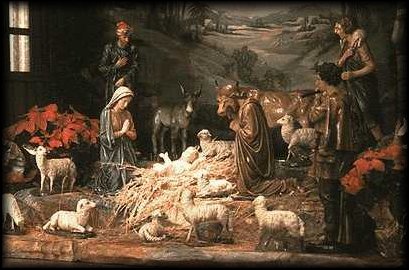
Glory to God in the highest and on earth peace, good will toward men.
And it came to pass, as the angels were gone away from them into heaven, the shepherds said one to another,

Let us now go even unto Bethlehem, and see this thing which is come to pas, which the Lord hath made known unto us.
And they came with haste, and found Mary, and Joseph and the babe lying in a manger. And when they had seen it, they made known abroad the saying which was told them concerning this child. And all they that heard it wondered at those things which were told them by the shepherds. But Mary kept all these things, and pondered them in her heart. And the shepherds returned, glorifying and praising God for all the things that they had heard and seen, as it was told unto them. (The Gospel According to Luke, Chapter Two, Verses 13-20)

Here we are again, at Christmas. Last year, I wrote the following:

Every Christmas, it seems, NEWSWEEK or TIME magazine will come out with an article featuring the "latest scholarship" concerning the "authenticity" of the Christmas story. The scholarly authorities cited are consistently and incorrigibly one-sided, usually including scholars like John Dominic Crossan who dissent from Church teaching, or more ostensibly mainline scholars like Raymond E. Brown (now deceased) who have been quite thoroughly corrupted by the Humean philosophical presuppositions of the historical-criticism of the biblical narrative. The upshot is always the conclusion, or at least the suggestion, that the Gospel writers are unreliable and not to be trusted, and certainly not to be taken at face value. Just how ludicrous this all is can be seen by almost anyone with a bit of intelligence and familiarity with literature, mythology, and history. One of the best examples of a powerful antedote to this kind of foolishness is a little essay by C.S. Lewis entitled "Modern Theology and Biblical Criticism," which is available in a collection of essays by Lewis entitled Christian Reflections [Amazon link] (1967; reprinted by Eerdmans, 1994). The following are some excerpts from Lewis' essay, which begins on p. 152 and contains four objections (or "bleats") about modern New Testament scholarship:

1. [If a scholar] tells me that something in a Gospel is legend or romance, I want to know how many legends and romances he has read, how well his palate is trained in detecting them by the flavour...

I have been reading poems, romances, vision-literature, legends, myths all my life. I know what they are like. I know that not one [of the stories in the Gospel of John, for example] is like this... Either this is reportage - though it may no doubt contain errors - pretty close up to the facts; nearly as close as Boswell. Or else, some unknown writer in the second century, without known predecessors or successors, suddenly anticipated the whole technique of modern, novelistic, realistic narrative...

2. All theology of the liberal type involves at some point - and often involves throughout - the claim that the real behaviour and purpose and teaching of Christ came very rapidly to be misunderstood and misrepresented by his followers, and has been recovered or exhumed only by modern scholars... The idea that any... writer should be opaque to those who lived in the same culture, spoke the same language, shared the same habitual imagery and unconscious assumptions, and yet be transparent to those who have none of these advantages, is in my opinion preposterous. There is an a priori improbability in it which almost no argument and no evidence could counterbalance.

3. Thirdly, I find in these theologians a constant use of the principle that the miraculous does not occur... This is a purely philosophical question. Scholars, as scholars, speak on it with no more authority than anyone else. The canon 'if miraculous, unhistorical' is one they bring to their study of the texts, not one they have learned from it. If one is speaking of authority, the united authority of all the Biblical critics in the world counts here for nothing.

4. My fourth bleat is my loudest and longest. Reviewers [of my own books, and of books by friends whose real history I knew] both friendly and hostile... will tell you what public events had directed the author's min to this or that, what other authors influenced him, what his over-all intention was, what sort of audience he principally addressed, why - and when - he did everything... My impression is that in the whole of my experience not one of these guesses has on any one point been right; the method shows a record of 100 per cent failure.

The 'assured results of modern scholarship', as to the way in which an old book was written, are 'assured', we may conclude, only because those who knew the facts are dead and can't blow the gaff... The Biblical critics, whatever reconstructions they devise, can never be crudely proved wrong. St. Mark is dead. When they meet St. Peter there will be more pressing matters to discuss.

However... we are not fundamentalists... Of course we agree that passages almost verbally identical cannot be independent. It is as we glide away from this into reconstructions of a subtler and more ambitious kind that our faith in the method wavers... The sort of statement that arouses our deepest scepticism is the statement that something in a Gospel cannot be historical because it shows a theology or an ecclesiology too developed for so early a date...

Such are the reactions of one bleating layman... Once the layman was anxious to hide the fact that he believed so much less than the Vicar; he now tends to hide the fact that he believes so much more...
For further reading:Merry Christmas everyone!

Advent to Christmas

Well, it's time to sign off for a while, my friends. I may be in tomorrow, yet for a few last things. But this Christmas Eve I have four of my five children home for the holidays -- yes, the HOLY DAYS -- and look forward to a gratifying time indeed. Only one son, himself married with children and working on completing a doctorate in patristics at Catholic University in Washington, DC, is expected not to show, and for good reason: he will be spending Christmas with his in-laws in Virginia, on leave from their work in Jordan. As for the rest, Chris will be flying down from Manhattan to meet up with his brother, Jon, in Knoxville today, then driving up together tomorrow. Nathan and his wife will be driving from Portsmouth, VA, tomorrow. And, of course, Hannah Cabrini is still very much at home with us, so that makes a family indeed! With Hannah still too young for midnight Mass, I expect we'll carry on our Swiss tradition of a Christmas Eve cheese fondue and take in the Christmas morning Mass. Amy, of course, is cooking up a storm while Hannah contents herself munching on bits of the Christmas tree.

Pope Benedict's epoch-making speech on Vatican II

"The End of the 'Post-Conciliar Church' - Day Two - THE EPOCH-MAKING SPEECH" declares Rorate Caeli (Dec. 23, 2005), giving some idea of the importance some Catholics are attaching to the Pope's recent speech. Elaborating, he comments:
The "mainstream Catholic press" in America ("conservative" as well as "liberal") does not seem to have realized the importance of the explosive speech that Pope Benedict gave yesterday (see here). With the exception of Sandro Magister's blog (in Italian), no Catholic news outlet or papal blog has highlighted the real focus of the speech."
An English translation is available online at Magister's blog where one reads the following: Pope Ratzinger Certifies the Council -- The Real One," at www.chiesa (December 23, 2005):

In his pre-Christmas address to the Roman curia, Benedict XVI demolishes the myth of Vatican II as a rupture and new beginning. He gives another name "reform," to the proper interpretation of the Council. And he explains why."
Benedict XVI has voiced his opinions on Vatican II formally on two occasions, says Magister: the first was on Thursday, December 8, the feast of the Immaculate Conception; the second was Thursday, December 22, during the traditional meeting between the pope and the Vatican curia for the exchange of Christmas greetings. The first, according to Magister, was the "overture." The address to the curia was "the main act."

In his homily on December 8, pope Joseph Ratzinger focused his attention on "the inner structure" of Vatican Council II, and the Marian aspect in understanding that stucture.
But in his address to the curia on December 22, Benedict XVI went to the heart of the most controversial question. He asked:

"Why has the reception of the Council been so difficult for such a great portion of the Church up until now?"

And he replied:

"The problems have arisen from a struggle between two conflicting forms of interpretation. One of these has caused confusion; the other, in a silent but increasingly visible way, has brought results, and continues to bring them."

He called the first form of interpretation "the hermeneutics of discontinuity and rupture." The second he called "the hermeneutics of reform."
He criticized the first of these at its very roots, while illustrating the reasons for and validity of the second, says Magister.

Pope Benedict's speech, "Two forms of interpretation have struggled with each other..." is carried in it's entirety by www.chiesa (scroll down for Benedict's speech).

Liturgical discontents have long known that the former Cardinal Ratzinger has on occasion described the Novus Ordo Missae as a "rupture" in liturgical tradition. What a genuine "reform" of the Traditional Latin Mass would mean remains to be seen. If the Eucharist is the source and summit of a Catholic's life, that would be, of course, only the beginning. The "reform" would need to embrace everything from catechesis to the priesthood to a renewed understanding of secular vocation in the life of the laity.

[Tip of the hat to James P. Caputo: Gratias tibi ago!]

Noonan: a Church that CAN, HAS, and SHOULD Change!

Here it is, from the Judge! Catholic moral teaching has changed, thus it can change, and therefore it will change. And it should be changed, so we can change it. Got it?
Thus begins Jim Taylor's brief skewering review of A Church That Can and Cannot Change, a new, trendy-lefty and predictably muddle-headed contribution to Catholic dissent by John T. Noonan, Jr.

In attempting to revive a case Taylor calls "as worn as an old lawyer's brief bag," Judge Noonan raises three issues whose recrudescence we've grown accustomed to seeing in the dissenter's customary bag of tricks: slavery, usury, and marriage. He tries to show (as others we're familiar with have tried to show in our comment boxes) that what was once acceptable or embraced by the Church is now held as intrinsically evil -- indeed, that some changes in moral teachings have occurred shows that any changes in these areas can occur. Like others drifting with the tide, Noonan has visited these topics before and continues to be, says Taylor, unpersuasive.

On the question of slavery, we find that Noonan misinterprets papal encyclicals and other Vatican documents; on the question of usery, we find that he conflates the meaning and nature of lending accepted by the Church today with that practiced in the Middle Ages; on the question of marriage, we find that he confuses the Church's sacramental teaching on marriage with the moral teaching on adultery. Like others we know, Noonan suggests that the Ordinary Magisterium might not be infallible: he suggests that the very practices of some popes (e.g., slave holding) constitute the teaching of doctrine. But making such a claim, he conflates the category of infallibility with impeccability, which he should know that no pope has ever claimed for himself. Not even the worst of the Borgia popes ever suggested that his notorious sins were Christian virtues promoted by the Church; and even the best popes frequented the confessional. Noonan wants to argue that the licitness of moral acts progresses "from practice to approval," so that we may conclude that if the faithful embrace an illicit act (say homosexual sodomy) with sufficient tenacity, the Church will eventually accept it.

"Noonan's real intent is to craft an argument. It is, roughly, this: Change is healthy, and the Church should abandon what is untenable; each age helps forge deeper understanding; though a revised doctrine may itself be wrong, we needent worry because people of the future will fix such problems...." Sound familiar?

Read Taylor's review in its entirety online HERE (scroll down to his review).

Wednesday, December 21, 2005

"Neocons" -- a definition

In the latest issue of New Oxford Review (December 2005), Dale Vree offers an extended definition of "neoconservative," or "neocon," in his editorial that may surprise many. It's not a theological definition. It's not even an ecclesiological definition. How he begins may throw you for a loop. He writes:
Authentic neocons descend from the Communist and socialist movements, with the most prominent leaders being Trotskyites (that is, ultra-Left Communists). When Stalin took over the Soviet Union, the Trotskyites were severely persecuted, and ultimately Trotsky himself was assassinated in Mexico. Stalin was a gentile (indeed, an ex-seminarian) and Trotsky was a Jew, and the divide between the Stalinists and Trotskyites pretty much followed the same divide (with significant exceptions, especially in the early years of the Soviet satellite states in Eastern Europe, before many of the Jews in those satellite states were purged from the Party, even executed).
You may be thinking: What's this bit of Soviet history got to do with anything? But in a very few dense paragraphs, Vree takes you to this:
As we said in our September Editorial: "Before Crisis and First Things were even founded, the NOR was contacted by a neocon foundation -- right out of the blue. The foundation wanted to give us money -- 'free' money. A fellow flew out from the East Coast and asked me (the Editor) to meet him for drinks in a San Francisco restaurant -- on him. Sure! (We were desperate for money.) He told me he would fund us regularly -- if we would support corporate capitalism and if we would support a militaristic U.S. foreign policy." What I didn't say was that the fellow was a Jewish neocon with no interest in Christianity or Catholicism, and I suspected he was interested in getting us to promote Jewish neocon interests (which he had every right to do). As we said in the September Editorial, I said "no," and that was the end of that. But the neocon foundations didn't give up. Michael Novak (very pro-Israel) founded Crisis -- then called Catholicism in Crisis -- and Fr. Neuhaus (also very pro-Israel) founded First Things, both with huge financial support from neocon foundations. So the neocons found a way to get Catholic and Christian magazines to front for their largely Jewish neocon interests (which, again, is their right). Do we exaggerate? No we don't. When the Catholic Church denounced the war on Iraq -- calling it an unjust war, a war of aggression -- both Crisis and First Things supported it.

Connecting the dots between early twentieth century Trotskyism and twenty-first century neoconservatism is a serious undertaking. But essentially, according to Vree, it was a process launched by Jewish Trotskyites reacting against the increasingly anti-Semitic policies of Stalin and the post WWII Soviet Union, which sided with Arabs against Israel and prevented Jews from emigrating to Israel. Many Jewish Trotskyites and other Jewish Leftists (though hardly all of them) became vehemently anti-Communist and increasingly conservative; and thus you had the advent of neocons like Irving Kristol, the Jewish ex-Trotskyite godfather of neoconservatism as we now know it. For Vree's historical synopsis that connects the dots from Trotsky to the coalition of dominated by National Review conservatives, Bush Administration operatives and politically conservative Catholics, read Vree's editorial in its entirety online: "What Is a Neoconservative? -- and Does It Matter?" New Oxford Review (December 2005), pp. 2-6. See what you make of it.

Additional references (courtesy of Christopher):

Introducing Rorate Caeli: New Catholic's new blog

Taking his blog name from the opening words of the Vulgate text of Isaiah 45:8 -- "Rorate coeli desuper et nubes pluant justum: aperiatur terra, et germinet Salvatorem" (Drop down dew, ye heavens, from above, and let the clouds rain the Just: let the earth be opened and bud forth a Savior.) -- New Catholic's new blog, Rorate Caeli, is based on a text -- according to the Catholic Encyclopedia -- that is used frequently both at Mass and in the traditional Divine Office during Advent, giving exquisite poetic expression to the longings of Patriarchs and Prophets, and symbolically of the Church, for the coming of the Messiah. As New Catholic describes in the opening post on his new blog, the words quoted above come from the "first words of the Mass (Introit) of the day in which [the weblog] was established, the Fourth Sunday of Advent. It truly is one of the most beautiful of all Introits in the Liturgical Year."

Of special interest to readers of this blog will be the recent posts on two very special papal documents, (1) Pope St. Pius X's Sacra Tridentina Synodus, which made it clear that Catholics could and should receive frequent Holy Communion, changing what was the ordinary habit of most Catholics to rarely Communion only rarely, which New Catholic discusses in his post entitled "A Glorious Centennial" (Tuesday, December 20, 2005); and (2) Pope Pius XII's Musicae Sacrae Disciplina, on Sacred Music, which is addressed in his post entitled "The Discipline of Sacred Music - 50 years later - I" (also on Tuesday, December 20, 2005).

Also of interest are the posts: (1) "Vatican II at 40 - The Pope who will correct Vatican II?" and (2) "Vatican II at 40 - Continuity - II."

For those unfamiliar with "New Catholic," he is a relatively new convert to the Catholic Faith (one year), credits his conversion in signifiant measure to the influence of the Traditional Latin Mass, of which he is a stalwart proponent, and has a profound devotion to the Blessed Mother.

Welcome to the wonderful world of blogging and endless cut-throat competition for no pay, no respect, and the mixed blessing of dissident Irish commentators!