Wednesday, August 09, 2017

Against the new optimism ...


Michel Houellebecq, prophet without religion

Rod Dreher, "Against The New Optimism" (American Conservative, July 31, 2017):
Oliver Burkeman has a long-read piece in The Guardian about whether or not life is getting better or worse. It is mostly a defense of the claims by the “New Optimists” that pessimism is grounded on willful blindness to the spectacular material improvements modernity has brought us. But it’s not entirely a defense. Excerpt:
The argument that we should be feeling happier than we are because life on the planet as a whole is getting better, on average, also misunderstands a fundamental truth about how happiness works: our judgments of the world result from making specific comparisons that feel relevant to us, not on adopting what David Runciman refers to as “the view from outer space”. If people in your small American town are far less economically secure than they were in living memory, or if you’re a young British person facing the prospect that you might never own a home, it’s not particularly consoling to be told that more and more Chinese people are entering the middle classes. At book readings in the US midwest, Ridley recalls, audience members frequently questioned his optimism on the grounds that their own lives didn’t seem to be on an upward trajectory. “They’d say, ‘You keep saying the world’s getting better, but it doesn’t feel like that round here.’ And I would say, ‘Yes, but this isn’t the whole world! Are you not even a little bit cheered by the fact that really poor Africans are getting a bit less poor?’” There is a sense in which this is a fair point. But there’s another sense in which it’s a completely irrelevant one.

At its heart, the New Optimism is an ideological argument: broadly speaking, its proponents are advocates for the power of free markets, and they intend their sunny picture of humanity’s recent past and imminent future to vindicate their politics. This is a perfectly legitimate political argument to make – but it’s still a political argument, not a straightforward, neutral reliance on objective facts. The claim that we are living in a golden age, and that our dominant mood of pessimism is unwarranted, is not an antidote to the Age of the Take, but a Take like any other – and it makes just as much sense to adopt the opposite view. “What I dislike,” Runciman says, “is this assumption that if you push back against their argument, what you’re saying is that all these things are not worth valuing … For people to feel deeply uneasy about the world we inhabit now, despite all these indicators pointing up, seems to me reasonable, given the relative instability of the evidence of this progress, and the [unpredictability] that overhangs it. Everything really is pretty fragile.”
This seems right to me. Read more >>
[Hat tip to JM]

Puts things in perspective ...

​Joni Eareckson Tada, "Reflections on the 50th Anniversary of My Diving Accident" (TGC, July 30, 2017):
Recently I was at my desk writing to Tommy, a 17-year-old boy who just broke his neck body surfing off the Jersey shore. He’s now a quadriplegic. He will live the rest of his life in a wheelchair without use of his hands or legs. When it comes to life-altering injuries, quadriplegia is catastrophic.

Halfway through my letter describing several hurdles Tommy should expect in rehab, I stopped. I felt utterly overwhelmed, thinking of all that lies ahead for him. I’ve been there. And even though half a century has passed, I can still taste the anguish. Hot, silent tears began streaming, and I choked out a prayer, Oh God, how will Tommy do it? How will he ever make it? Have mercy; help him find you!

... Like Tommy, I was once the 17-year-old who retched at the thought of living life without a working body. I hated my paralysis so much I would drive my power wheelchair into walls, repeatedly banging them until they cracked. Early on, I found dark companions who helped me numb my depression with scotch-and-cola. I just wanted to disappear. I wanted to die.

What a difference time makes—as well as prayer, heaven-minded friends, and deep study of God’s Word. All combined, I began to see there are more important things in life than walking and having use of your hands. It sounds incredible, but I really would rather be in this wheelchair knowing Jesus as I do than be on my feet without him [emphasis added]. But whenever I try to explain it, I hardly know where to begin....

Ten words have set the course for my life: God permits what he hates to accomplish what he loves.
Read more >> This gets pretty deep.

What we did on our summer vacation

This summer four of us made a 'grand tour' of Europe and the UK. I had a couple of invitations to visit friends across the Atlantic, and at a colleague's suggestion, Hannah and I took along two members of the Peters family and split hotel costs. It was a remarkably congenial arrangement. Robert Peters has spent several previous summers in European countries learning various languages, and this summer he was brushing up his Italian in Rome while looking into lodging accommodations for doctoral studies at the Augustinianum Institute next year; so, being sufficiently fluent in Italian, he served as our 'Cicerone,' or guide, while in Rome, ordering our meals in restaurants, etc. His sister, Theresa has studied Arabic and noticed when we arrived in Malta she understood many of the words in Maltese, since the language is largely a combination of Italian and Arabic. All-in-all, it was a terrific arrangement, and we couldn't have asked for better traveling companions. (Pictures of all of us are linked in the descriptions of our time in Rome and at Harlaxton Manor in the UK below.)

Poverty of spirit: different Papal styles


In his Vicars of Christ: A History of the Popes(Arcadia: Tumblar House, 2014), 380-90, Charles Coulombe makes the following insightful observation about the difference in 'style' between Benedict XVI and Francis:
The generation of westerners of which [Francis] is a part was marked -- in Church, State, and indeed, in every field -- by what can only be called a sort of "personalization" of authority. That is to say, that the traditional division in perception between an office and the current holder of that office -- which allowed people of wildly differing, sometimes even opposed, views to collaborate out of shared respect for the office under whose direction they functioned -- has been blurred or even obliterated. Such folk, when in authority, tend to downgrade or do away with traditional symbols of their office while emphasizing their own personalities in pursuit of some nebulous "authenticity." So it is that morning dress and uniforms disappear from presidential inauguration and legislatives openings, and royals love to appear in casual wear. The difficulty with such an approach is that it tends to weaken respect for the office in the eyes of its subjects, who in turn begin to believe that their loyalty to it is dependent purely on their personal feelings for the occupant of the moment. Seeing the problems this had created, Benedict XVI began to restore the symbolic side of the Papacy, for all that formalism and display ran extremely counter to his nature. But it is not an issue that one of Francis's generation could be expected to understand -- quite the contrary.... Despite the lack of tiara noted earlier, piece by piece [Pope Benedict] restored bits of the papal wardrobe that his immediate predecessors had discarted: the fur-lined mozzetta, the camauro, the fanon, and -- most annoying to some -- the traditional red shoes, symbolizing the fact that as Pope he walked in the footsteps of the martyrs.
Commenting on this passage, Prof. Peter A. Kwasniewski writes about Benedict:
This humble Bavarian who shied away from the limelight saw that it was necessary to elevate and accentuate the sacramental iconicity of the pontiff in order to move beyond the cult of personality inadvertently started by John XXIII and vastly augmented in the charismatic athlete, actor, poet, and playwright of John Paul II. With Pope Francis, we see a return both of the cult of personality and of the false conception of poverty, this time applied not only to liturgy but also to doctrine itself.
By "poverty of doctrine," Kwasniewski explains, "I refer to the superficiality, messiness, ambiguities, contradictions, and unclarity of this pope's teaching, in contrast to the rich truthfulness of those of his predecessors who take seriously the Lord's command to 'let what you say be simply 'yes' or 'no' (Mt 5:37); cf. 2 Cor. 1:17-19, Jas. 5:12. (Peter A. Kwasniewski, "True Poverty of Spirit in the Splendor of Worship," The Latin Mass: The Journal of Catholic Culture and Tradition, Vol. 26, No. 2 (Summer 2017), p. 14.

Wednesday, August 02, 2017

Sunday, July 30, 2017

Tridentine Community News - Fr. Jake van Assche to Celebrate First Missa Cantata at Old St. Mary’s this Friday, August 4; Pontifical Missa Cantatas No Longer Allowed; Local TLM schedule


"I will go in unto the Altar of God
To God, Who giveth joy to my youth"

Tridentine Community News by Alex Begin (July 30, 2017):
July 30, 2017 – Eighth Sunday After Pentecost

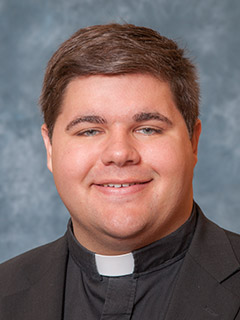
Fr. Jake van Assche to Celebrate First Missa Cantata at Old St. Mary’s this Friday, August 4


Long-time readers may recall that Fr. Jake van Assche has served as Subdeacon at Solemn High Masses for the St. Benedict Tridentine Community prior to his ordination to the sacred priesthood. Since ordination, he has celebrated Low Masses at St. Michael Church in Pontiac during Lent. Fr. Jake became interested in the Extraordinary Form when it began to be offered at his family’s parish, St. Stephen in New Boston, in 2008.

This Friday, August 4, Fr. Jake will celebrate his first High Mass at Old St. Mary’s. This is a homecoming of sorts for Fr. Jake, as he has received spiritual direction from one of the priests at Old St. Mary’s. We hope you can join us in thanking Fr. Jake for his willingness to offer the Traditional Mass.

Pontifical Missa Cantatas No Longer Allowed

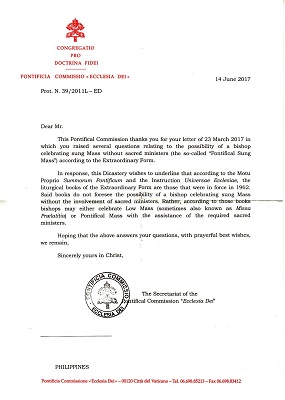
In response to an inquiry from a Tridentine Mass choir from the Philippines, the Vatican’s Pontifical Commission Ecclésia Dei has ruled that it is no longer permissible for a bishop to celebrate a Missa Cantata, that is, a sung Mass without the additional clergy and ceremonies that constitute a Pontifical Solemn Mass.


In 1962, the only options for a bishop were to celebrate Pontifical Low Masses or Pontifical Solemn Masses. The Pontifical Missa Cantata was authorized in 1964 in the document Inter Oecuménici, likely because even at that time it was becoming increasingly challenging to assemble the trained clerical entourage necessary to support a Pontifical Solemn Mass. In light of the fact that this document included instructions paving the way for the 1965 transitional missal, the PCED must believe that it did not strictly pertain to the liturgy of 1962, thus the permission given in it is not valid. While that viewpoint is understandable, the PCED has been given the authority to amend the 1962 rubrics when beneficial. For example, the PCED ruled that laymen who have been installed as an Acolyte may fill the role of Subdeacon at a Solemn High Mass. This is a logical adaptation to the needs of our time, when truly ordained Subdeacons are only found in the priestly communities that are granted use of the preconciliar rites of ordination. That makes it all the more puzzling why the PCED would not see a similar benefit to the faithful in permitting the Pontifical Missa Cantata. Furthermore, it is odd to think that a bishop – who has the fulness of Holy Orders – might have less faculties than a priest.

This writer has substantial experience organizing Pontifical Masses in our region. The few local bishops who have consented to celebrate the Traditional Mass, Bishop Earl Boyea in Lansing, Auxiliary Bishop Donald Hanchon in Detroit, retired Bishop Eugene LaRocque in Windsor, and retired Auxiliary Bishop Francis Reiss in Detroit, have all celebrated Pontifical Missa Cantatas. That has been challenging enough to arrange. None of them has the interest to learn the Pontifical Solemn Mass.

This writer has also been involved in organizing or serving three Pontifical Solemn Masses: 1) A Pontifical Solemn Mass at the Faldstool for the 2010 Latin Liturgy Association Convention at St. Josaphat Church with Auxiliary Bishop Joseph Perry of Chicago, 2) A Pontifical Solemn Mass at the Throne at All Saints Church in Flint in 2005 with then-Ordinary Bishop Carl Mengeling, and 3) A Pontifical Solemn Mass at the Faldstool for the 2006 C.I.E.L. Conference in Oxford, England. All three required an outside Master of Ceremonies to oversee the complex rubrics, an experienced Assistant Priest to attend to the bishop, and extensive server rehearsals to prepare for the unfamiliar and elaborate ceremonies. The rarity and complexity of the rubrics place the Pontifical Solemn Mass outside the competence of even our most experienced local clergy and servers. A Pontifical Missa Cantata, however, is an organic development for our modern era that allows our bishops to offer the Traditional Mass in a solemn but not discouragingly difficult manner. We must not intimidate those whom we wish to involve in the Extraordinary Form.

Our next local Pontifical Mass – Bishop Hanchon’s Mass before Confirmation on October 1 at the OCLMA/Academy of the Sacred Heart – will thus be a Pontifical Low Mass. We will, of course, make it the highest of Low Masses, with hymns and motets sung by the choir. There will, however, be nothing sung by the celebrant, no Aspérges, and no sung Ordinary or Propers.

Tridentine Masses This Coming Week
  • Mon. 07/31 7:00 PM: Low Mass at St. Josaphat (St. Ignatius Loyola, Confessor)
  • Tue. 08/01 7:00 PM: High Requiem Mass at Holy Name of Mary, Windsor (Daily Mass for the Dead) – Fr. Joe Tuskiewicz will celebrate a memorial Requiem Mass for his mother, Virginia Tuskiewicz
  • Fri. 08/04 7:00 PM: High Mass at Old St. Mary’s (St. Dominic, Confessor) – Celebrant: Fr. Jake van Assche. Devotions to the Sacred Heart before Mass. Reception in the second floor parish hall after Mass.
  • Sat. 08/05 8:30 AM: Low Mass at Miles Christi (Dedication of the Basilica of St. Mary Major)
[Comments? Please e-mail tridnews@detroitlatinmass.org. Previous columns are available at http://www.detroitlatinmass.org. This edition of Tridentine Community News, with minor editions, is from the St. Albertus (Detroit), Academy of the Sacred Heart (Bloomfield Hills), and St. Alphonsus and Holy Name of Mary Churches (Windsor) bulletin inserts for July 30, 2017. Hat tip to Alex Begin, author of the column.]

Tridentine Masses coming this week to metro Detroit and east Michigan


Tridentine Masses This Coming Week

Sunday


Monday


Tuesday


Wednesday


Thursday


Friday


Saturday


* NB: The SSPX chapels among those Mass sites listed above are posted here because the Holy Father has announced that "those who during the Holy Year of Mercy approach these priests of the Fraternity of St Pius X to celebrate the Sacrament of Reconciliation shall validly and licitly receive the absolution of their sins," and subsequently extended this privilege beyond the Year of Mercy. These chapels are not listed among the approved parishes and worship sites on archdiocesan websites.

Saturday, July 29, 2017

Blog issue resolved!

After many attempts at unsuccessfully trying to resolve the blog problem, our good friend Alex Begin immediately identified the problem as the background image, which was taking forever to load. I'm still not sure what changes Google made to it's Blogger program that triggered this sudden slow down; but the issue is resolved. The background is now a simple white, but the blog loads immediately and will allow continued posts. So Deo Gratias. Thanks also to Christopher Blosser for his many related tips, which helped perfect the new format.

Saturday, July 22, 2017

The Russians have hacked by blog!!!

I'm not sure what's wrong, but one of my readers notified me that my blog is on the fritz. My son Christopher who knows a lot about these things is working with me to resolve the problem. In the meantime, one wag suggested that it must be the Russians. I'm inclined to agree. Perhaps it was Putin himself. In collusion with Trump. After all, that's about all the Democratic Media have been saying for the last six months, is it not? It's the Russians! It's the Russians! We can overlook the 'indiscretions' of Clinton that compromised national security, involved multiple violations of constitutional law, and got innocent people killed, but there's sure to be a Russian plot behind all this. Think I'll hire a Grand Inquisitor. Or a Special Prosecutor.

New studies: 'responsible contraception' doesn't prevent pregnancy or abortion in more than half of cases

Slippery slope from non-Catholic to non-Christian 'saints'?

Peter Crenshaw, "Pope Francis Opens Door to Non-Catholic Saints" (Remnant, July 12, 2017).

Comment by Guy Noir - Private Eye: "Does anyone really think there will be a long gap between the emergence of protestant Saints and the emergence of non-Christian ones? There's the rub!"

Google, Marshall McLuhan, and Catholicism

Google makes a point of ignoring the birthdays of traditional celebrities of the western tradition. It wouldn't be caught dead celebrating the feast days of Catholic saints. Instead, it makes a point of celebrating the 'feast days' of offbeat, marginalized figures, non-whites, often women, often unknown, sometimes of dubious distinction. This isn't a bad thing as such, except insofar as it leads to ignorance about meritorious figures in the traditional western canon of celebrities. It is most certainly, however, a very politically correct thing.

When Google chose the Canadian pioneer of media theory, Marshall McLuhan, as its 'saint' for the day (his birthday was July 21, 1911), I have little reason to believe that they had in mind feting this Canadian professor for having converted from agnosticism to the Catholic Faith. Here are the delicious facts, however, lifted directly from Wikipedia:
While studying the trivium at Cambridge, he took the first steps toward his eventual conversion to Roman Catholicism in 1937, founded on his reading of G. K. Chesterton. In 1935, he wrote to his mother: "[H]ad I not encountered Chesterton, I would have remained agnostic for many years at least." At the end of March 1937, McLuhan completed what was a slow but total conversion process, when he was formally received into the Roman Catholic Church. After consulting a minister, his father accepted the decision to convert. His mother, however, felt that his conversion would hurt his career and was inconsolable. McLuhan was devout throughout his life, but his religion remained a private matter. He had a lifelong interest in the number three (e.g., the trivium, the Trinity) and sometimes said that the Virgin Mary provided intellectual guidance for him. For the rest of his career, he taught in Roman Catholic institutions of higher education. From 1937 to 1944, he taught English at Saint Louis University (with an interruption from 1939–40 when he returned to Cambridge). There he taught courses on Shakespeare and tutored and befriended Walter J. Ong, S.J. (1912–2003), who went on to write his Ph.D. dissertation on a topic that McLuhan had called to his attention, and who also became a well-known authority on communication and technology.
Who was it that said "even a blind pig can find an acorn once in a while"?

The Marcello Pera interview: a political interpretation of Pope Francis

President of the Italian Senate Marcello Pera is a classical liberal Catholic and friend of the former Pope Benedict XVI, with whom he co-authored a book: Without Roots: The West, Relativism, Christianity, Islam. Here he is interviewed by Corrado Ocone (Il Mattino, July 9, 2017), translated by Rorate Caeli in "THE ULTIMATE INTERVIEW to Understand all About Pope Francis: Marcello Pera, Italian politician and close Ratzinger friend" (Rorate Caeli, July 14, 2017).

Spadaro and Figueroa in La Civiltà Cattolica: Eeeek! The FUNDAMENTALISTS are coming!!!

But wait! Do they even know what a 'Fundamentalist' is? Of course not! And here is Frank J. Sheed to prove it in "Reading is Fundamental!" (July 21, 2017).

[Hat tip to JM]

Wednesday, July 19, 2017

Home safe

Thanks to those of you who offered a Hail Mary (or more) for our safety during our three weeks of travel. We are home again, safe and sound; and as wonderful as other places may be that one may visit over the course of vacation travels, coming home is always wonderful.

I will post a brief resume of our travels with some personal impressions in the next few days.

Thanks again!

Pertinaciously yours,
PP