Wheaton College, perhaps the nation's premier four-year Evangelical liberal arts college, was delighted to have assistant professor Joshua Hochschild teach students about medieval philosopher Thomas Aquinas, one of Roman Catholicism's foremost thinkers.
But when the popular teacher converted to Catholicism, the prestigious evangelical college reacted differently. It fired him.
Read Daniel Golden's January 7, 2006, article in the Wallstreet Journal, "A Test of Faith."
[Hat tip to Sean Fagan]

Monday, January 09, 2006
Ireneaus & Tertullian and the "Rule of Faith"
An Anglican acquaintance is exploring Catholicism and inquiring into what was meant by the "Rule of Faith" as taught by Ireneaus and Tertullian. He is attempting to determine specifically what relevance this might have in defining what is (or what should be considered) authoritative for Christians today. He is reading Jaroslav Pelikan's The Emergence of the Catholic Tradition (100 - 600), but is interested in learning what the best Catholic books on Ireneaus and Tertullian and their views of the "Rule of Faith" in the early Church Suggestions?
Friday, January 06, 2006
Krehbiel's badly needed bucket of cold-water-realism
In the January 2006 issue of Crisis magazine, Greg Krehbiel, who writes the Crowhill Weblog, has a guest column entitled, somewhat doubtfully, "Why I'm Still Catholic" (p. 61). I have a great deal of respect for Krehbiel, who is a friend of mine, and a fellow Catholic convert. I first encountered Krehbiel when he was still a Presbyterian working through the theological claims of the Catholic Church. He was a member of the Orthodox Presbyterian Church which has the largest number of Ph.D.'s per capita of any denomination in the world and is affiliated with Westminster Theological Seminary in Philadelphia. It will come as no surprise, then, that his Christianity had a bit of an intellectual cast. Like other converts from the Presbyterian or Reformed tradition, he was meticulous in the way he went about researching Catholicism. Some of his work I actually found helpful in my own pilgrimage into Church. The quality of his analysis can be seen in his review of Protestant apologist, Keith Mathison's book, The Shape of Sola Scriptura (LINK). Still, Krehbiel took his good time coming into the Church. To some of us, he seemed to drag his feet. I presume he was only covering his bases, leaving no stone unturned, taking his meticulous time. The story of his journey to Catholicism - Krehbiel came to Catholicism by way of Lutheranism - can be found on the Catholic Answers website: "A 'Convert Me' Sign on My Head."
One thing I've always appreciated about Krehbiel is that, like Louis Bouyer and Tom Howard, he continues to appreciate his Protestant roots even after having moved beyond them. He exhibits none of the ebullient triumphalism or reactionary knee-jerk negativity towards his erstwhile Protestant brethren. Krehbiel even goes a bit farther than Bouyer and Howard: after being invited aboard the Ark of Salvation, he has little hesitation in expressing his disgust at how bad things smell onboard. And thus he begins this article, "Why I'm Still Catholic," with a scathing laundry list of things he detests about now being a Catholic:
One thing I've always appreciated about Krehbiel is that, like Louis Bouyer and Tom Howard, he continues to appreciate his Protestant roots even after having moved beyond them. He exhibits none of the ebullient triumphalism or reactionary knee-jerk negativity towards his erstwhile Protestant brethren. Krehbiel even goes a bit farther than Bouyer and Howard: after being invited aboard the Ark of Salvation, he has little hesitation in expressing his disgust at how bad things smell onboard. And thus he begins this article, "Why I'm Still Catholic," with a scathing laundry list of things he detests about now being a Catholic:
I'm not one of those cheerleading Catholic converts. On the contrary, I often feel like a man who has spent many years on a difficult quest to join the Arthurian round table only to find a bunch of sissies I velvet playing Chutes and Ladders.Comments like that, he admits, encourage Protestant friends to invite him back. Indeed, he further concedes, the appeal has its merits. "I have a lot of respect for Protestantism," he says:
I miss the reverence and beauty of the Lutheran liturgy, the hymns, kneeling at the communion rail. I miss the sense of fellowship and community -- even simple things like hanging up your coat as if you intend to stay a while. I miss Sunday school after worship and the biblical literacy of most Protestants. Moreover, I'm just not terribly pleased with Catholicism. The mediocrity of the bishops is almost proverbial. The Bible "translation" read at Mass is atrocious. Typical Catholic music sounds like something from Barney and Friends. The Eucharist can seem like a fast-food assembly line, and the traditional style of a Catholic homily doesn't appeal to me, even when it's done well.Well, then, one's curiosity does begin to rise: why is Krehbiel still Catholic? Despite all these grievances, he says, he can't see himself leaving the Catholic Church for a number of reasons, which he presents in his article in classic top-ten style. Some key excerpts:
10. My spiritual journey has had a certain logic to it ... like a climb up the church ladder. To go back wouldn't make any sense.[For Krehbiel's complete unedited article, pick up the latest copy of Crisis magazine (January 2006) and find it on p. 61, or, hopefully, the editors will post it online in the near future at www.crisismagazine.com]
9. Becoming a Protestant would throw me back into that self-selective church thing. Which communion would I choose? ... When you're Catholic you're just Catholic. It's peaceful.
8. As a Protestant I was always having to explain things to friends and acquaintances. Some lunatic Presbyterian denomination would ordain a gay sea lion and somebody at the office would ask, "You're a Presbyterian, aren't you?" ... Not that Catholics don't do and say weird things, but there's an understanding that the Catholic Church is so big and so old and so full of both saints and sinners that individual Catholics aren't held accountable.
7. When I first became Catholic, I had this extraordinary feeling of continuity with the Church through the ages. I realized that I was in the church of St. Patrick and St. Thomas. Protestant groups broke away, and the tie has been severed to some extent.
6. There's an amazing amount of freedom in the Catholic Church. As a Protestant you self-identify with a narrow theological and cultural group. As a Catholic you might be an albino assassin or a "we are the church" fanatic, or just the guy who gets dragged to Mass by his mother-in-law....
5. Catholics have fewer bizarre hang-ups -- about Holloween or beer or evolution. Protestants talk about "Christian liberty," but Catholics live it.
4. With the cetainty of faith, I can say that we'll never have priestesses in the Roman Catholic Church.
3. The sacrament of penance is a wonderful thing.
2. While God is free to extend His grace beyond His promises, when I receive the Catholic Eucharist I know it's valid.
1. The Roman Catholic Church is the Church Christ founded. Period.
Thursday, January 05, 2006
Alec Guinness & Catholic conversion
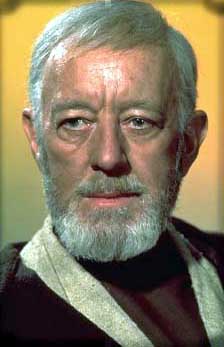 On the recommendation of my friend, Donegan Smith, himself a retired Hollywood actor and Catholic convert, I've been reading Piers Paul Read's Alec Guinness: The Authorized Autobiography
 . The book lets one into the deeply private side of Alec Guinness's life. Guinness traveled in a circle of friends that included Catholic writers such as Graham Greene and Evelyn Waugh. At one time, he visited Asheville, North Carolina, and I'm sure spent time in the Basilica of St. Lawrence there, as well as the Biltmore House, before traveling on his way to New Orleans.
As Fr. O'Leary will tell you, he also inhabited a world of actors famed for its society of homosexuals, the OUDS, among them Peter Glenville, Robert Flemyng, Terence Rattigan and presided over John Gielgud who, in 1932, was elected president of the organization. Guinness, too, was tormented by homosexual inclinations. But the difference between himself and those who embrace a lifestyle of open defiance of Church teaching is plain. Guinness sought reconciliation with God, found a priest, became a Catholic and took on the discipline of confession and amendment of life:
There were to be found then, as there are now, confessors who take a lenient view of sexual sins. A close friend of Alec's in the later years of his life, Quentin Stevenson -- a homosexual and once a Catholic -- describes 'the sort of Farm Street talk: "oh, you shouldn't have gone to confession there, you should have gone to Farm Street because Fr. So-and-so is sweet about that sort of thing" ... The very people who go on about how wonderful it is being a Catholic because of the Church's authority will, ten minutes later, tell you about the private arrangements they have made with God.' In Catholic parlance, absolution - the forgiveness of a penitent's sins by a priest, acting on the authority of Christ who had told his disciples that those whose sins they forgave were forgiven -- depended not just on an Act of Contrition made before the priest in the confessional, but also on a 'firm purpose of amendment' -- a determination not to commit the sin again. (pp. 277-278)I was interested in noting how often Piers Paul Read cited the work of the excellent Catholic biographer, Joseph Pearce. "No one," wrote Pearce in Literary Converts: Spiritual Inspiration in an Age of Unbelief
, "has been able to describe a conversion in terms which are objectively appropriate. As in the language of mystics, analogies which give only a shadow of the substance have been used." Here, too, such analogies and shadows must suffice. Why did Alec become a Catholic?:Alec became a Catholic because he accepted that the Roman Catholic Church was the Church founded by Jesus Christ, the Second Person of a Trinitarian God. But long before Alec's formal 'reconciliation' he had been living the life of a Catholic more conscious than most Roman Catholics that the Church was a community of the living and the dead. He prayed to Mary, the Mother of God, said the Rosary, and conversed with his favourite Catholic saints, calling for their intercession in the greatest and smallest of causes -- a votive candle lit so that Matthew might walk again, or a request to St. Anthony of Padua to loosen the nuts on a wheel.After Alec's own conversion, his gentleness with his wife is beyond touching. He insisted that any decision about Catholicism must be hers alone:
But Alec also felt that he had had a direct experience of God Himself, and of God's grace; and in the final analysis this was the point of departure of his conversion. 'I think most ... human beings have that once in their lives,' he wrote to Merula [his wife] from Los Angeles:...in greatly varying degrees of course. And of course it's the most supreme, happy, and important moment of life. I believe it is ... God giving each man and woman, according to their capacity, a glimpse of his promise to them, an impression of what eternity could mean, a glimpse of their adoption as Sons of God, and by its withdrawal a realisation of what the Fall of Man means. We are all left with a feeling of exhiliration and yet at the same time, hand in hand with its happiness, a sadness that we are unlikely to encounter it again in this life. It's a golden carrot held up to donkeys -- who could be gods ... (pp. 281-282)
I can't help you my love. All I can suggest is three things (1) whether you feel as I'm sure you do that Christ was true in his claims and is God (2) whether you are satisfied that the claims of the Catholic Church are reasonably justified. And then (3) -- probably more difficult for you than for me, as it's a question of temperament to start with -- whether in a Catholic Church you feel a sense of worship. For me this last grows. I find it less and less a difficulty -- in fact none really -- except through my own fidgetiness and distraction and general crossness with people and things -- but I accept absolutely now and with no effort that I am in the actual presence of God on the altar. There have been very few days this year when I haven't paid a visit -- even if only for three minutes -- to a church, merely to kneel and be astonished at the humility of God. (p. 296, emphasis added)One marvels here at these words. Remarkable indeed. Some time in December of 1956, Merula resolved her doubts and was received into the Roman Catholic Church. She told Alec, reports Read, only when she and Matthew joined him in Ceylon, "where the three celebrated their first Christmas together in the same church."
Later, when Alec visited the United States, he was distressed by aspects of American Catholicism. After Mass at the Jesuit-run Boston College on one occasion, he wrote:
I felt obliged to complain to one of them, a good friend of mine, of how Mass was said at the St. Francis Xavier chapel. Seven minutes flat from the opening of Mass until the end of the Gospel and nine minutes from the beginning of the Credo to the end!... The sign of the cross was reduced to a hurried scratching of the stomach and the 'elevations' were soblasphemously hurried that I thought there might easily be an accident. O dear oh dear oh dear. And why why why? I found it very disturbing. I wrote an angry note to the priest in charge and then tore it up as useless as well as uncharitable. (p. 358)Both Alec and Merula remained remarkably loyal to the Church although both were subject to tests of their faith and suffered from the radical changes that came about in the Roman Catholic Church as a result of the Second Vatican Council:
The most evident change following Vatican II was to the liturgy, and one of the greatest trials for those like Alec and Merula who had joined a church with a Latin Mass was suddenly to find it said in an English of great triteness and banality. The officiating priest, who had mysteriously re-enacted the sacrifice of Christ upon the Cross with his back to the congregation, now facedhis parishioners from the other side of a table like a jovial scout-master serving orangeade and cupcakes in a village hall. The age-old plain-chant, or the melodious hymns of the pre-Conciliar church, were replaced by commonplace ditties or African dirges.Alec, too, like Waugh, continued to go to Mass, but suffered from the liturgical changes: "Latin was far from my strong point at school," he wrote in My Name Escapes Me
Two of Alec's Catholic friends reacted to these changes in different ways. Graham Greene managed to bend to this wind of change: his novel, A Burnt-Out Case
Evelyn Waugh, whose Augustinian Catholicism had so appealed to Alec, was at first optimistic that the Church would weather the storm.... Later, however, Waugh's optimism evaporated. 'A year in which the process of transforming the liturgy has followed a planned course,' he wrote in his diary on Easter Day, 1965:Protests avail nothing ... More than the aesthetic changes which rob the Church of poetry, mystery and dignity, there are suggested changes in Faith and morals which alarm me. A kind of anti-clericalism is abroad which seeks to reduce the priest's unique sacramental position. The Mass is written of as a 'social meal' in which the 'people of God' perform the consecration. Pray God I will never apostatize but I can only now go to church as an act of duty and obedience ... (p. 562)
, "and yet I miss its sonority in the essential and unchanging parts of the mass." Again: "I do think the Gloria in English is a mess in its present translation," he complained to Dame Felicitas. "It seems to me everything is back to front in the new mass." More than twenty years later, in 1987, after going to Mass at St. Laurence's in Petersfield on the Feast of Corpus Christi, he wrote:My spirits sink so low I can hardly bring myself to the Communion rail. All my fault I know -- but my whole being winces at the congregation intoning introits, etc. in dull English, slowly and badly -- and the reading of the Epistle in a plummy voice, ill phrased and muddled, is a mortification I don't think I can stand any longer. (p. 563)(Note, however, that he still had the Communion rail!) One of my favorite remarks by Alec Guinness about post-Conciliar liturgical innovations is that found in Pearce's book, Literary Converts: Spiritual Inspiration in an Age of Unbelief
:Much water has flown under the Tiber's bridges, carrying away splendor and mystery from Rome since the Pontificate of Pius XII.... [T]he banalities and translations which have ousted the sonerous Latin and Greek are of a supermarket quality which is quite unacceptable. Hand shaking and embarrassed smiles or smirks have replaced the older courtesies: kneeling is out, queuing is in, and the general tone is like BBC radio broadcast for tiny tots....Nevertheless, despite such sentiments, Alec and his wife remained devoted Catholics the rest of their lives. In the last chapter of his last book, A Positively Final Appearance: A Journal: 1996-1998
, Alec wrote:If I have one regret (leaving aside a thousand failings as a person, husband, grandfather, great-grandfather and friend -- and my lazy, slapdash, selfish attitude as an actor) it would be that I didn't take the decision to become a Catholic in my early twenties. That would have sorted out a lot of my life and sweetened it. (p. 560)Alec Guinness, whose Academy Award winning acting career spanned almost 70 years between stage and screen and encompassed 67 works of film, died on August 5th, 2000, after an extended illness. Guinness, whose memorable roles ranged from Shakespeare to "Star Wars", was 86 years old. Requiescat in pace.
Related: David Thomas, "Sorry Alec, I couldn't let you off the hook" (The Telegraph, October 7, 2003).
Navarre Pentateuch back in stock
 Coming to you live from the powerhouse Opus Dei-run University of Navarre in Pamplona, Spain, the Navarre Bible is among the most coveted Bible study tools in the world. Hey, I remember first running into Protestant Evangelical students enthusiastically promoting their copies of the Navarre New Testament books at L'Abri Fellowship in Switzerland back in the 1970s! And now the Opus Dei-affiliated Scepter Publishers has this portion of the Navarre Bible, the Pentateuch, back in stock.
This volume of the Navarre Bible can help make the first five books of the Old Testament a vital part of your spiritual reading and practical growth in the Christian life. It contains the full English and Latin texts of these books, along with extensive and faithfully Catholic commentaries. Like other volumes in the world-renowned Navarre Bible series, these commentaries draw on Church documents, the exegesis of Fathers and Doctors of the Church, and the works of contemporary spiritual writers, particularly St. Josemaria Escriva, who initiated the Navarre Bible project.
You can order your copy direct from Scepter Publishers online for $39.95 plus S&H, ... or you can try to be the first person to beat the rush to Amazon.Com
to get the single remaining spanking brand new Amazon Marketplace copy being sold for $32.33 plus S&H (as of 1/5/06 11:21am).
Wednesday, January 04, 2006
The "Third Case"
Note: This is a continuation of "How do you change a subculture? Three cases" (January 3, 2006). I'm posting the Third Case separately, since posting all three together became too long. Again, I'm soliciting your considered reflections on the question of the roles of the Church and state in thse questions.
Third case: How do you reform an illiberal utilitarian bias that has infected higher education, often with state complicity (e.g., defense contracts, mounting accreditation requirements for professional programs, etc.) while respecting academic freedom? Can the Church play a role in affiliated universities?
Third case: How do you reform an illiberal utilitarian bias that has infected higher education, often with state complicity (e.g., defense contracts, mounting accreditation requirements for professional programs, etc.) while respecting academic freedom? Can the Church play a role in affiliated universities?
Most church-related liberal arts colleges and universities in the United States were founded in the mid-to-late nineteenth century, and the same is true of Catholic institutions. Most church-related colleges and universities were founded initially as institutions devoted to the professions of training clergy and teachers and, if they were co-ed or women's institutions, nurses. Again, Catholic institutions were not too different. They came to the new world with a long tradition of liberal arts education, which was embedded in the curricular assumptions of their institutions from the beginning. Add to that the emergent American ideal of a liberal arts education as something to which a greater part of the population aspired, and by the end of the Second World War, for better or worse, it was largely an expectation nearly all graduates from high school would go on to complete a liberal arts college degree.
What this meant, in practice, was generally a freshman and sophomore year devoted to a standardized core curriculum in the liberal arts (a bit of English, mathematics, natural science, history, social science, philosophy, economics, foreign language, etc.) and a junior and senior year devoted to a specialized major (in one of those disciplines). While the general expectation of a "college education" has not changed, the educational landscape has changed considerably over the last several decades, with the traditional core curriculum in the liberal arts being increasingly eroded under the pressure of professional programs (business, physical therapy, occupational therapy, exercise science, nursing, counseling, etc.). This encroachment of practical interests from the professional world has presented a challenge to the identity and traditional mission of liberal arts institutions.
I have elsewhere chronicled the crisis weathered by our own institution in recent years, and as yet I have my doubts that we are altogether out of the woods. See for example, "A Critical Look at the Proposed New Core Curriculum" (October 12, 2005) presented by the College of History, Philosophy, and Religion to a special called assembly of the faculty of Lenoir-Rhyne College last fall; "The LRC curriculum battle in the blogsphere" (August 26, 2005) ; "Kurt Schmidt: Why are liberal arts classes being cut?" (September 05, 2005); and "Bowling for Lenoir-Rhyne: A New Michael Moore Movie, or the New Liberal Arts Curriculum?" The critical question seems to come down to something like this: if we're going to call ourselves a liberal arts institution, then how can we allow ourselves to cut our liberal arts core down to an 8-hour puff core course? How could we justify charging the seventh highest tuition of any educational institution in North Carolina if a student could get the same education by going to a local community college?
But the issues go deeper still. Part of the meaning of the "liberal" in liberal arts has to do with the freedom of these theoretical pursuits from externally imposed practical, utilitarian ends. The value of the liberal arts does not lie academically in their utility. In fact, academically, they have no utilitarian value whatever. Their worth lies elsewhere, as ends worthy of being pursued for their own sake rather than for the sake of ulterior purposes that lay beyond. Academic freedom, therefore, lies precisely in the freedom of intellectual prusuits for their own sake, independent of, say, political or ideological purposes that might be served by the academy, which would otherwise subordinate those intellectual pursuits to a form of utilitarian servitude. But this is precisely what happens when academic institutions allow themselves and their policies to be shaped by federal subsidies, grants, and programs, and defense contracts for educational research.
Here, for example, is a Department of Defense announcment of a program in its University Research Initiative called "The Department of Defense (DoD) Fiscal Year 2005 Defense University Research Instrumentation Program (DURIP)":
The Department of Defense (DoD) announces the Fiscal Year 2005 Defense University Research Instrumentation Program (DURIP), a part of the University Research Initiative (URI). DURIP is designed to improve the capabilities of U.S. institutions of higher education (hereafter referred to as "universities") to conduct researchand to educate scientists and engineers in areas important to national defense, by providing funds for the acquisition of research equipment.Clearly, a university whose curriculum has been subordinated to the practical utilitarian designs of a government's defense department has forfeited its academic freedom at least in this respect. To that extent it has cut itself off from the tradition of the liberal arts, whose arts were always understood to be "liberal" in the sense of being free of practical, utilitarian ends. The academy must be a place where ideas can be pursued and mulled over for their own sake.
Here it might be asked whether the Church cannot also serve to impose extrinsic utilitarian purposes upon the academy as well as the state; and I suppose this is possible. Yet I think one's haste to jump to this conclusion may lead him to overlook something singularly different about the case of the educational instution established by the Church. For here the mission of the Church is not extrinsically related to the purposes of education. The faithful Christian understands this. For him, the purposes of academic freedom are inherently -- not extrinsically -- subordinated to the purposes of love of God and service to the Church. That is the significance, most certainly, of the title of John Paul II's Apostolic Constitution, Ex Corde Ecclesiae -- that is, the educational instituion and its mission is envisioned as proceeding "from out of the heart of the Church." There is, in principle, no conflict here.
All of which raises a question I've pondered for some time: What role might the Church play in resisting the encroachments of these corrosive illiberal utilitarian pressures upon the liberal arts traditions of her colleges and universities? It seems to me the Church could with good reason exercise some clout in the defense of the liberal arts tradition. For one thing, like the liberal arts, the agenda of the Church itself is not something that has a value that is calculable in practical utilitarian terms. The worship and love of God, whatever sublimated do ut des (I give to you in order that you give to me) utilitarian contractual motives it may be susceptible of, is ultimately a matter of useless self-transcendence, something worthy of undertaking as a good in and of itself. In this respect, the Church is on the same page as the liberal arts tradition in its view of what is ultimately worth doing: it is worth doing for its own sake, and not because it is extraneously useful. Furthermore, the Church in many cases has a proper avenue through her ties of affiliation with her academic instutions for exercising a rightful authority over their policies in view of their institutional mission.
Again, what think ye?
The "Second Case"
Note: This is a continuation of "How do you change a subculture? Three cases" (January 3, 2006). I'm posting the Second Case separately below, since posting all three together became too long. Again, I'm soliciting your considered reflections on the question of the roles of Church and state on these questions, if you're interested in offering comments.
Second case: How do you reform a seditious educational subculture of religious dissent within Catholic colleges and universities while respecting the rights of students and scholars to free inquiry?
Second case: How do you reform a seditious educational subculture of religious dissent within Catholic colleges and universities while respecting the rights of students and scholars to free inquiry?
There is little question that American Catholic colleges have significantly lost their Catholic identity over the past decades. One nominally Catholic institution would be about as examplary as another. I remember visiting Georgetown University a few years ago and being hardpressed to find a Catholic chapel anywhere. Peter Kreeft, Professor of Philosophy at Boston College, also a Jesuit institution, naturally likes to pick on Jesuit institutions, and says there are two kinds of Catholic schools -- those that are Jesuit, and those that are Christian. The undisputed flagship Catholic university of the United States, Notre Dame, has theologians on staff that regularly and loudly dissent from Church teaching in the media, and has also been in the news -- controversially -- for having hosted the Vagina Monologues and a gay/lesbian day on campus.
This drift toward dissent picked up momentum precipitously, I believe, in the late 1960s in response to Pope Paul VI's encyclical, Humanae Vitae (1968), defending the traditional Catholic teaching against contraception. The response of liberal Catholics, who had been led by liberal theologians and clerics to expect that Vatican accommodation to modern changes in contraceptive technologies was imminent, was open outrage. Charles Curran, a popular liberal professor of moral theology at the Catholic University of America in Washington, DC, formed a coalition of dissenters who took out a full-page ad in the New York Times expressing defiant rejection of Rome's instruction. Curran's case soon became a cause celebre and was championed by leftists, as it was derided by rightists. Curran himself was eventually dismissed from the Catholic University of America in 1986 after the Vatican declared him unfit to teach Catholic theology because of his heterodox positions on such social issues as contraception, homosexuality, and abortion (see William W. May's 1987 book, Vatican Authority and American Catholic Dissent: The Curran Case and Its Consequences, as well as Larry Witham's 1991 study, which has been greeted by nearly all sides as "fair,"Curran vs. Catholic University: A Study of Authority and Freedom in Conflict).
The Vatican response to the deterioration of Catholic identity at Catholic institutions of higher learning was the document, Ex Corde Ecclesiae (Apostolic Constitution of the Supreme Pontiff John Paul II on Catholic Universities), issued August 15, 1990. On the one hand, many if not most mainline universities continued to carry on with business as usual, settling for cosmetic changes at most and ignoring the more substantial demands of the document, mandating that professors of Catholic theology must profess theology that is in fact Catholic as understood by the Catholic Church and requiring Catholics who teach the theological disciplines in a Catholic university to have a mandatum granted by competent ecclesiastical authority (i.e., bishop).
On the other hand, others have responded more supportively. The Cardinal Newman Society, a national intercollegiate organization of more than 16,000 college leaders, educators, students, alumni and others dedicated to the renewal of Catholic identity at Catholic colleges and universities in the United States in keeping with the principles of Ex Corde Ecclesiae, has been surveying developments in Catholic higher education for some time. For example, it has noted cases of historically Catholic institutions that are no longer recognized by the Church as Catholic: "We know of four colleges that have are no longer recognized as Catholic by the bishops since Ex Corde Ecclesiae, the apostolic constitution on Catholic higher education, was issued in 1990: Marist College (NY), Marymount Manhattan College (NY), Nazareth College (NY) and Saint John Fisher College (NY). THESE ARE NOT CATHOLIC!" (Cardinal Newman Society, "Catholic Colleges"). More importantly, however, it has produced critiques of the curricula and course content and events conducted at colleges and universities that are still recognized as Catholic across the country, and the results are not encouraging. The following is a sampling:
- CNS Special Report: "Students Losing Faith at Catholic Colleges" Catholic World Report (March 2003)
- "Culture of Death on Catholic Campuses: A Five-Year Report" (April 2004)
- "18 Catholic Colleges Defy Bishops, Honor Public Dissidents" (May 2005)
- "Teaching Euthanasia" Crisis magazine (June 2005), by CNS President, Patrick Reilly
- "Catholic University Professors Helped to Pave the Way for Terri Schiavo's Death," Crisis magazine (2005), by CNS President, Patrick Reilly
Times and cultures, of course, change; which raises sticking points in identifying the institutional identity and mission of academic institutions. A case in point is one of England's most prestigious religious colleges, St. Philip's Sixth Form College in Birmingham, England, founded by Cardinal Newman and proudly counting J.R.R. Tolkien among its alumni. In October of 1992 The Times (Oct. 5, 1992) carried an article announcing a plan by the administration to turn the institution into a nonsectarian school on the ground that more than two-thirds of the students were now non-Catholic. In fact, as a result of an increased multicultural and non-Christian student population, the Lord's Prayer and Sign of the Cross have been "deemed inappropriate" at the college.
The problem raised by the trustees and dissenting parents, however, was that the terms of the college trust deed state that buildings are to be provided for "the performance of public worship according to the rites and ceremonies of the Roman Catholic religion" and that the college is to be operated "in accordance with the principles of the Roman Catholic faith" -- which seemed to leave no legal means of implementing the proposed changes. But the administration argued that the mitigating circumstances of a changed cultural climate now permitted it to redirect the original terms of the trust deed by way of the legal doctrine of "cy pres" (or "nearest equivalent"), alleging that the secular multiculturalism of the late 20th-century made a strictly Catholic education, as envisaged by the original grantors, unrealistic. Since "cy pres" applies only where it is impossible to carry out the purposes of the trust, and since benefactors who explicitly give their property for a defined purpose have an inviolable right to have their property used for that purpose if there is any reasonable way in which this can still be done, the relevant question is this: Does having a multicultural student body prevent St. Philip's, a traditionally Catholic college, from teaching its voluntarily enrolled students the Catholic Faith? To pose the question is to reveal its absurdity.
Some Catholic schools, of course, are pontifical institutions whose Vatican affiliation ties them ineluctably to the Catholic Church. Others have varying forms of governance, some being affiliated with religious orders, others with governance shared between administration and faculty under a board of trustees, offering considrably more fluidity. Catholic college presidents used invariably to be clerics. This is no longer so. Even trustees now may be Catholic or non-Catholic, often with little if any idea of what they, in principle, hold in trust.
It is hard, therefore, to generalize about the precise rights of faculty in terms of academic freedom in Catholic academic institutions across the board. Situations may vary legally from one school to another. What remains clear is that just as individual faculty members are entitled by the nature of their profession to free academic inquiry within the parameters specified by law and by the religious mandates of their academic institutions, so Catholic colleges and universities are entitled by the nature of their institutional purpose to mandate what instructional content is consistent with their religious mission. The leftist National Catholic Reporter (February 25, 2005), as part of a cover story about Vatican "repression" under the pontificate of John Paul II, compiled a list of 24 individuals censured worldwide by the Vatican during the past 26 years as "evidence" (The List) . Karl Keating, of the Catholic Answers apologetics organization, in his e-letter of March 9, 2005, comments on this list but draws the opposite conclusion: that the Vatican has been almost laughably lenient! Obviously, it is a question of perspective.
Again, what think ye?
Rev. Joseph Owens, C.S.S.R., Requiescat in pace
 In the latest issues of the Fellowship of Catholic Scholars Quarterly (Winter 2005), p. 54, was posted an obituary for Father Joseph Owens, C.S.S.R., the famous student of Etienne Gilson at the Pontifical Institute for Medieval Studies in Toronto, and a magisterial scholar in his own right. Given the respect I have for Owens's work, and the tradition of Gilson which he represents, I can't let the occasion pass without notice.
On the Pontifical Institute for Medieval Studies website, is posted the following fascinating remembrance by Edward Synan (I offer here only an excerpt):
Among the memories of graduate students from my time at the Pontifical institute of Mediaeval Studies and the University of Toronto, none is more vivid than is that of the defense made by Joseph Owens, CSsR, of his dissertation for the Institute doctorate. His erudition had long been the object of awe-struck rumor on the campus; with that ceremony it ceased to be rumor and became attested fact. Owens faced a board of examiners calculated to strike awe in any student. To name only those who spoke that day for philosophy, Etienne Gilson and Anton C. Pegis were members of his jury. Awe, however, ran in the opposite direction. This formidable board voted Owens his doctorate summa cum laude and the world of learning has been confirming that judgement ever since. The dissertation Owens defended has merited publication in three revisions and [many] printings. ... [Edward Synan, "Preface," Graceful Reason: Essays in Ancient and Medieval Philosophy Presented to Joseph Owens, CSsR on the Occasion of His Seventy-Fifth Birthday and the Fiftieth Anniversary of His Ordination, ed. Lloyd P. Gerson, Papers in Mediaeval Studies 4 (Toronto: Pontifical Institute of Mediaeval Studies, 1983)]Fr. Owens died at the Providence Health Centre, Toronto, on Sunday, October 30, 2005, in his 98th year and the 77th year of his Religious Life. Father Owens was ordained in 1933. Born in Saint John, New Brunswick on April 17, 1908, son of Louis Owens and Josephine Quinn, Fr. Joseph is survived by two nieces, Anne (David) Cole and Katherine (Ralph) Furness, as well as by his nephews, Bryson (Jacqueline) Eldridge, William (Trina) Eldridge, Robert Eldridge and Gerard (Susan) Eldridge. He served in parishes in Saskatchewan and British Columbia and completed graduate studies in Toronto at the Pontifical Institute of Medieval Studies. He then taught philosophy to the younger members of his Community, until he received his Licentiate in Medieval Studies in 1946. Thereafter, he continued his studies at the Institute while also lecturing in philosophy in Redemptorist houses of study. In 1951 he received his Doctorate in Medieval Studies summa cum laude from the Institute and became a professor of philosophy at the Pontifical Institute in 1954. He taught and wrote extensively in medieval philosophy, particularly on the philosophy of St. Thomas Aquinas, focusing especially on metaphysics, epistemology, ethics, and the philosophy of the human person. Fr. Owens wrote nine philosophy books and nearly a hundred and fifty articles and forty book reviews during his lifetime as a scholar. In 1973, having passed the usual retirement age, he continued to publish and teach part-time for another twenty-five years.
Tuesday, January 03, 2006
How do you change a subculture? Three cases
I solicit your reflections on the following questions, in which I am particularly interested in the respective roles of the Church and state -- the role of the Church in preserving and fostering the Gospel and the role of the state in protecting the legitimate rights of its citizens:
- How do you reform a morally reprobate sexual subculture within the Catholic priesthood while respecting the personal rights and dignity of individuals involved in the case?
- How do you reform a seditious educational subculture of religious dissent within Catholic colleges and universities while respecting the rights of students and scholars to free inquiry?
- How do you reform an illiberal utilitarian bias that has infected higher education, often with state complicity (e.g., defense contracts, mounting accreditation requirements for professional programs, etc.) while respecting academic freedom? Can the Church play a role in affiliated universities?
This problem began, as I understand it, when those who should have been minding the shop let their guards down, perhaps most precipitously beginning back in the 60s. Bishops, priests, vocations directors, deans and rectors became lax and latitudinarian. The issue was broader than homosexuality. The sixties spawned a culture of sexual revolution, experimentation, and license. But insofar as homosexuality was part of the mix, the Church's distinction between the sinner and the sin were exploited to full effect to fuel such fantasies as the notion that as long as one wasn't involved in committing some heinous act like homosexual rape, one's homosexual inclinations (for which one presumably wasn't responsible) might be viewed as divine gifts to be embraced and celebrated.Second case: How do you reform a seditious educational subculture of religious dissent within Catholic colleges and universities while respecting the rights of students and scholars to free inquiry?
Fast forward to the sex scandals that rocked the Catholic Church in the late 1990s and early 2000s. The mainstream media fastidiously avoided the term "homosexual" in reporting the scandal, panting the scandal as an issue of pedophile priests. There were exceptions, of course. Yet as case after case came to light, a landslide of evidence mounted of a subculture in the priesthood of homosexual activity involving teenage boys. According to the study conducted by the John Jay College of Criminal Justice in New York:An overwhelming majority of the victims, 81 percent, were males.... A majority of the victims were post-pubescent .... The John Jay study said that pedophilia ... was a smaller part of the sex abuse problem. It said that 22 percent of the victims were under 10. It added that 51 percent were 11 to 14 years old and 27 percent were 15 to 17 years old. ("John Jay Study Reveals the Extent of Abuse Problem," AmericanCatholic.Org)Yet the silence of denial on this point has been deafening. For example, in the video, Protecting Our Children, produced by The National Catholic Risk Retention Group, Inc., produced for the purpose of raising the awareness of diocesan volunteers and employees about the widespread problem of sexual abuse of minors in our society, only one of the four victims portrayed in the video was abused by a priest, and the victim was a girl. In other words, precisely zero percent of the abuse it portrays is actually representative of the scandal in the Church. (See "Protecting the Lavender Mafia" by Ken Skuba)
The question, then, is how can this abusive and malignant subculture be reformed or purged? What is the proper role of the government? What is the proper role of the Church? The government of the United States, for its side, has gone after the sex offenders where criminal prosecution has been warranted and possible, and I think several dioceses have cooperated with these criminal inquiries, at least as far as they have done so by making certain records and documention available to civil authorities. Yet on some level St. Paul's rebuke must also weigh in against the Corinthians who looked outside the household of faith to the civil courts of unbelievers for judgment (I Cor. 6:1-11), which probably attests to the reticence of some bishops about turning an ecclesial matter over to civil authorities. At present the Church is undertaking its Apostolic Visitation of American seminaries and houses of formation, and on November 9, 2005, the Vatican released its Instruction "On Priesthood and Those With Homosexual Tendencies," both of which aim to address the problem in question. What think ye?
Third case: How do you reform an illiberal utilitarian bias that has infected higher education, often with state complicity (e.g., defense contracts, mounting accreditation requirements for professional programs, etc.) while respecting academic freedom? Can the Church play a role in affiliated universities?There is little question that American Catholic colleges have significantly lost their Catholic identity over the past decades. One nominally Catholic institution would be about as examplary as another. I remember visiting Georgetown University a few years ago and being hardpressed to find a Catholic chapel anywhere. Peter Kreeft, Professor of Philosophy at Boston College, also a Jesuit institution, naturally likes to pick on Jesuit institutions, and says there are two kinds of Catholic schools -- those that are Jesuit, and those that are Christian. The undisputed flagship Catholic university of the United States, Notre Dame, has theologians on staff that regularly and loudly dissent from Church teaching in the media, and has also been in the news -- controversially -- for having hosted the Vagina Monologues and a gay/lesbian day on campus.
This drift toward dissent picked up momentum precipitously, I believe, in the late 1960s in response to Pope Paul VI's encyclical, Humanae Vitae (1968), defending the traditional Catholic teaching against contraception. The response of liberal Catholics, who had been led by liberal theologians and clerics to expect that Vatican accommodation to modern changes in contraceptive technologies was imminent, was open outrage. Charles Curran, a popular liberal professor of moral theology at the Catholic University of America in Washington, DC, formed a coalition of dissenters who took out a full-page ad in the New York Times expressing defiant rejection of Rome's instruction. Curran's case soon became a cause celebre and was championed by leftists, as it was derided by rightists. Curran himself was eventually dismissed from the Catholic University of America in 1986 after the Vatican declared him unfit to teach Catholic theology because of his heterodox positions on such social issues as contraception, homosexuality, and abortion (see William W. May's 1987 book, Vatican Authority and American Catholic Dissent: The Curran Case and Its Consequences, as well as Larry Witham's 1991 study, which has been greeted by nearly all sides as "fair,"Curran vs. Catholic University: A Study of Authority and Freedom in Conflict).
The Vatican response to the deterioration of Catholic identity at Catholic institutions of higher learning was the document, Ex Corde Ecclesiae (Apostolic Constitution of the Supreme Pontiff John Paul II on Catholic Universities), issued August 15, 1990. On the one hand, many if not most mainline universities continued to carry on with business as usual, settling for cosmetic changes at most and ignoring the more substantial demands of the document, mandating that professors of Catholic theology must profess theology that is in fact Catholic as understood by the Catholic Church and requiring Catholics who teach the theological disciplines in a Catholic university to have a mandatum granted by competent ecclesiastical authority (i.e., bishop).
On the other hand, others have responded more supportively. The Cardinal Newman Society, a national intercollegiate organization of more than 16,000 college leaders, educators, students, alumni and others dedicated to the renewal of Catholic identity at Catholic colleges and universities in the United States in keeping with the principles of Ex Corde Ecclesiae, has been surveying developments in Catholic higher education for some time. For example, it has noted cases of historically Catholic institutions that are no longer recognized by the Church as Catholic: "We know of four colleges that have are no longer recognized as Catholic by the bishops since Ex Corde Ecclesiae, the apostolic constitution on Catholic higher education, was issued in 1990: Marist College (NY), Marymount Manhattan College (NY), Nazareth College (NY) and Saint John Fisher College (NY). THESE ARE NOT CATHOLIC!" (Cardinal Newman Society, "Catholic Colleges"). More importantly, however, it has produced critiques of the curricula and course content and events conducted at colleges and universities that are still recognized as Catholic across the country, and the results are not encouraging. The following is a sampling:
- CNS Special Report: "Students Losing Faith at Catholic Colleges" Catholic World Report (March 2003)
- "Culture of Death on Catholic Campuses: A Five-Year Report" (April 2004)
- "18 Catholic Colleges Defy Bishops, Honor Public Dissidents" (May 2005)
- "Teaching Euthanasia" Crisis magazine (June 2005), by CNS President, Patrick Reilly
- "Catholic University Professors Helped to Pave the Way for Terri Schiavo's Death," Crisis magazine (2005), by CNS President, Patrick Reilly
Times and cultures, of course, change; which raises sticking points in identifying the institutional identity and mission of academic institutions. A case in point is one of England's most prestigious religious colleges, St. Philip's Sixth Form College in Birmingham, England, founded by Cardinal Newman and proudly counting J.R.R. Tolkien among its alumni. In October of 1992 The Times (Oct. 5, 1992) carried an article announcing a plan by the administration to turn the institution into a nonsectarian school on the ground that more than two-thirds of the students were now non-Catholic. In fact, as a result of an increased multicultural and non-Christian student population, the Lord's Prayer and Sign of the Cross have been "deemed inappropriate" at the college.
The problem raised by the trustees and dissenting parents, however, was that the terms of the college trust deed state that buildings are to be provided for "the performance of public worship according to the rites and ceremonies of the Roman Catholic religion" and that the college is to be operated "in accordance with the principles of the Roman Catholic faith" -- which seemed to leave no legal means of implementing the proposed changes. But the administration argued that the mitigating circumstances of a changed cultural climate now permitted it to redirect the original terms of the trust deed by way of the legal doctrine of "cy pres" (or "nearest equivalent"), alleging that the secular multiculturalism of the late 20th-century made a strictly Catholic education, as envisaged by the original grantors, unrealistic. Since "cy pres" applies only where it is impossible to carry out the purposes of the trust, and since benefactors who explicitly give their property for a defined purpose have an inviolable right to have their property used for that purpose if there is any reasonable way in which this can still be done, the relevant question is this: Does having a multicultural student body prevent St. Philip's, a traditionally Catholic college, from teaching its voluntarily enrolled students the Catholic Faith? To pose the question is to reveal its absurdity.
Some Catholic schools, of course, are pontifical institutions whose Vatican affiliation ties them ineluctably to the Catholic Church. Others have varying forms of governance, some being affiliated with religious orders, others with governance shared between administration and faculty under a board of trustees, offering considrably more fluidity. Catholic college presidents used invariably to be clerics. This is no longer so. Even trustees now may be Catholic or non-Catholic, often with little if any idea of what they, in principle, hold in trust.
It is hard, therefore, to generalize about the precise rights of faculty in terms of academic freedom in Catholic academic institutions across the board. Situations may vary legally from one school to another. What remains clear is that just as individual faculty members are entitled by the nature of their profession to free academic inquiry within the parameters specified by law and by the religious mandates of their academic institutions, so Catholic colleges and universities are entitled by the nature of their institutional purpose to mandate what instructional content is consistent with their religious mission. The leftist National Catholic Reporter (February 25, 2005), as part of a cover story about Vatican "repression" under the pontificate of John Paul II, compiled a list of 24 individuals censured worldwide by the Vatican during the past 26 years as "evidence" (The List) . Karl Keating, of the Catholic Answers apologetics organization, in his e-letter of March 9, 2005, comments on this list but draws the opposite conclusion: that the Vatican has been almost laughably lenient! Obviously, it is a question of perspective.
Again, what think ye?
Most church-related liberal arts colleges and universities in the United States were founded in the mid-to-late nineteenth century, and the same is true of Catholic institutions. Most church-related colleges and universities were founded initially as institutions devoted to the professions of training clergy and teachers and, if they were co-ed or women's institutions, nurses. Again, Catholic institutions were not too different. They came to the new world with a long tradition of liberal arts education, which was embedded in the curricular assumptions of their institutions from the beginning. Add to that the emergent American ideal of a liberal arts education as something to which a greater part of the population aspired, and by the end of the Second World War, for better or worse, it was largely an expectation nearly all graduates from high school would go on to complete a liberal arts college degree.
What this meant, in practice, was generally a freshman and sophomore year devoted to a standardized core curriculum in the liberal arts (a bit of English, mathematics, natural science, history, social science, philosophy, economics, foreign language, etc.) and a junior and senior year devoted to a specialized major (in one of those disciplines). While the general expectation of a "college education" has not changed, the educational landscape has changed considerably over the last several decades, with the traditional core curriculum in the liberal arts being increasingly eroded under the pressure of professional programs (business, physical therapy, occupational therapy, exercise science, nursing, counseling, etc.). This encroachment of practical interests from the professional world has presented a challenge to the identity and traditional mission of liberal arts institutions.
I have elsewhere chronicled the crisis weathered by our own institution in recent years, and as yet I have my doubts that we are altogether out of the woods. See for example, "A Critical Look at the Proposed New Core Curriculum" (October 12, 2005) presented by the College of History, Philosophy, and Religion to a special called assembly of the faculty of Lenoir-Rhyne College last fall; "The LRC curriculum battle in the blogsphere" (August 26, 2005) ; and "Kurt Schmidt: Why are liberal arts classes being cut?" (September 05, 2005) . The critical question seems to come down to something like this: if we're going to call ourselves a liberal arts institution, then how can we allow ourselves to cut our liberal arts core down to an 8-hour puff core course? How could we justify charging the seventh highest tuition of any educational institution in North Carolina if a student could get the same education by going to a local community college?
But the issues go deeper still. Part of the meaning of the "liberal" in liberal arts has to do with the freedom of these theoretical pursuits from externally imposed practical, utilitarian ends. The value of the liberal arts does not lie academically in their utility. In fact, academically, they have no utilitarian value whatever. Their worth lies elsewhere, as ends worthy of being pursued for their own sake rather than for the sake of ulterior purposes that lay beyond. Academic freedom, therefore, lies precisely in the freedom of intellectual prusuits for their own sake, independent of, say, political or ideological purposes that might be served by the academy, which would otherwise subordinate those intellectual pursuits to a form of utilitarian servitude. But this is precisely what happens when academic institutions allow themselves and their policies to be shaped by federal subsidies, grants, and programs, and defense contracts for educational research.
Here, for example, is a Department of Defense announcment of a program in its University Research Initiative called "The Department of Defense (DoD) Fiscal Year 2005 Defense University Research Instrumentation Program (DURIP)":
The Department of Defense (DoD) announces the Fiscal Year 2005 Defense University Research Instrumentation Program (DURIP), a part of the University Research Initiative (URI). DURIP is designed to improve the capabilities of U.S. institutions of higher education (hereafter referred to as "universities") to conduct researchand to educate scientists and engineers in areas important to national defense, by providing funds for the acquisition of research equipment.Clearly, a university whose curriculum has been subordinated to the practical utilitarian designs of a government's defense department has forfeited its academic freedom at least in this respect. To that extent it has cut itself off from the tradition of the liberal arts, whose arts were always understood to be "liberal" in the sense of being free of practical, utilitarian ends. The academy must be a place where ideas can be pursued and mulled over for their own sake.
Here it might be asked whether the Church cannot also serve to impose extrinsic utilitarian purposes upon the academy as well as the state; and I suppose this is possible. Yet I think one's haste to jump to this conclusion may lead him to overlook something singularly different about the case of the educational instution established by the Church. For here the mission of the Church is not extrinsically related to the purposes of education. The faithful Christian understands this. For him, the purposes of academic freedom are inherently -- not extrinsically -- subordinated to the purposes of love of God and service to the Church. That is the significance, most certainly, of the title of John Paul II's Apostolic Constitution, Ex Corde Ecclesiae -- that is, the educational instituion and its mission is envisioned as proceeding "from out of the heart of the Church." There is, in principle, no conflict here.
All of which raises a question I've pondered for some time: What role might the Church play in resisting the encroachments of these corrosive illiberal utilitarian pressures upon the liberal arts traditions of her colleges and universities? It seems to me the Church could with good reason exercise some clout in the defense of the liberal arts tradition. For one thing, like the liberal arts, the agenda of the Church
itself is not something that has a value that is calculable in practical utilitarian terms. The worship and love of God, whatever sublimated do ut des (I give to you in order that you give to me) utilitarian contractual motives it may be susceptible of, is ultimately a matter of useless self-transcendence, something worthy of undertaking as a good in and of itself. In this respect, the Church is on the same page as the liberal arts tradition in its view of what is ultimately worth doing: it is worth doing for its own sake, and not because it is extraneously useful. Furthermore, the Church in many cases has a proper avenue through her ties of affiliation with her academic instutions for exercising a rightful authority over their policies in view of their institutional mission.Again, what think ye?
Following up on Christopher Derrick and G.K. Chesterton
I recently received a phone call from Mr. Peter Sheehan, senior reporter for the Long Island Catholic, who told me that had come across something I had posted exactly a year ago, "Can anyone help with data on relation of G.K. Chesterton to Christopher Derrick?" (January 3, 2005) , in which I had solicited information about the Catholic influence of either of these men on the other. Sheehan told me that he once had the privilege of interviewing Christopher Derrick. Among the many interesting things he shared with me, two helpful things stand out as helpful in terms of my original query: I learned from him (1) that Derrick is a cradle catholic, and (2) that the influence of Chesterton on Derrick was in all probability more by way of inspiration than by way of any direct personal influence.
My thanks to Mr. Sheehan for this help in filling in the details a bit more. Those interested may see Mr. Sheehan's recent article, "Always Winter and Never Christmas," at the Long Island Catholic website. What yet remains in question for me -- based on a sketchy recollection of something I read somewhere -- is whether Chesterton was converted through the influence of Derrick's grandfather or whether Derrick's father, perhaps, was converted through the influence of Chesterton -- something like that. If anybody has information to share, I should be pleased.
My thanks to Mr. Sheehan for this help in filling in the details a bit more. Those interested may see Mr. Sheehan's recent article, "Always Winter and Never Christmas," at the Long Island Catholic website. What yet remains in question for me -- based on a sketchy recollection of something I read somewhere -- is whether Chesterton was converted through the influence of Derrick's grandfather or whether Derrick's father, perhaps, was converted through the influence of Chesterton -- something like that. If anybody has information to share, I should be pleased.
Monday, January 02, 2006
Strike against Iran imminent?
Jerusalem Post (Dec. 31, 2005; updated Jan. 1, 2006) : 'US planning strike against Iran' -- citing the German newspaper Der Tagesspiegel about NATO arrangements regarding the use of Turkish military bases.
Although Der Spiegel could not say that these plans were concrete, they did note that according to a January 2005 New Yorker report American forces had entered Iran in 2005 in order to mark possible targets for an aerial assault.Come, Lord Jesus, and bring us what we cannot give ourselves: peace on earth!
New book
 John H. O'Leary, of Zacches Press (not to be confused with Fr. Joseph O'Leary), has just sent me a copy of the latest from Zacchaeus Press, a new translation of Blessed Columba Marmion's Christ, the Life of the Soul. He writes: "This was a very popular book among lay Catholics back in the 1920s and 30s, and has a great deal to offer still, I think. Marmion goes very deep. We're hopeful that the book will find an audience in its newly translated form."
Our readers may be interested to know what some of our Popes have said about Marmion's work:
- "An authentic treasury of spiritual truth" -- Pope John Paul II, speaking at Blessed Columba's Beatification Ceremony
- The works of Marmion are "outstanding in the accuracy of their doctrine, the clarity of their style, and the depth and richness of their thought." -- Pope Pius XII (1939-1958)
- "You have written a very beautiful book.... Read this -- it is the pure doctrine of the Church." -- Pope Benedict XV (1914-1922)
Blessed Columba Marmion was born in Ireland and served for several years as a priest in Dublin before finding a vocation to the monastery. Eventually he became Abbot of Maredsous Abbey in Belgium and one of the foremost spiritual masters of the 20th century. His books have been translated into eleven languages and sold some 1.5 million copies. The back cover describes the work thus: "Firmly rooted in the Bible, the Liturgy, and the writings of the Saints and Doctors of the Church, Marmion explores every aspect of Catholic dogma -- with penetrating insight -- but his great emphasis is on the person o Christ, and the doctrine of Divine Adoption." Long out of print, this new crisp translation from the French original by Alan Bancroft is sure to please those that venture into the intricacies of this "how-to" guide to the Catholic spiritual life. The book, which is divided into two parts -- Book One: "The Divine Designs" and Book Two: "The Christian Life" -- comes with appendicies on Blessed Columba Marmion's Cause for Canonization, a chronology of his life, and introductory material from prior editions of this work.
"Incriminating" pics
Well, my friends, as much as we may enjoy our highbrow intellectual discussions, holiday gourmet dishes and foofoo drinks along with the best of our blue state friends, we want to let you in on a little family secret: unlike some people, we don't for a moment think that life is all about philosophy, theology, sushi, cheese fondue, fine wine, creme brule , or tiramisu, as fine as those things may be. ... Consider:
 Pictured left is Christopher, webmaster of the Cardinal Ratzinger Fan Club and Pope Benedict XVI Fan Club websites, taking a few pre-Christmas practice shots before venturing into the Smoky Mountains with his brother Jonathan for some days of rugged backpacking adventure -- of course, after winning $20 dollars from his brothers in poker with losers doing shots of Jim Beam. Pictured below is Chris, center, with his brothers, Nathan (left), and Jon (right).
 We realize that this may scandalize and confirm the worst suspicions of some of our readers, and for that we unrepentantly offer no apology. Christopher flew down over Christmas to hook up with his brothers (Jon fron Tennessee and Nathan from Virginia) and enjoy some of the finer things the South has to offer, like unlicensed firearms, beer for breakfast, and the Southern Christmas Smoked Pork Barbecue Tour (indeed, my vegetarian and vegan chums, unlike Samuel Jackson, we dig on swine)!
 For a favorite local barbecue establishment, featuring all the barbecue (that's a noun in the South) and iced tea you could ever want, live blue grass music, and clogging, visit Sim's Country Bar-B-Que, Inc. Chris also recommends Ed Boudreaux's Bayou Bar-B-Que in Asheville. For a reliable guide to moon pies, visit MoonPie.Com, and don't forget about RC Cola and pork rinds. The only thing you've gotta avoid is the fake Japanese stuff called "authentic Japanese cuisine" down here, featuring candied carrots and "shrimp sauce." If you come visit, just remember to draw out your vowels and slip in the dipthongs, and you should be alright -- as long as you're not discovered. I remember seeing a T-shirt that sported a picture of a good-ol' boy saying to his dog, "Let's go bite some Yankees," and the dog replying, with wagging tail, "I'll bring the beer." For related family pics, check here.
Pictured left is Christopher, webmaster of the Cardinal Ratzinger Fan Club and Pope Benedict XVI Fan Club websites, taking a few pre-Christmas practice shots before venturing into the Smoky Mountains with his brother Jonathan for some days of rugged backpacking adventure -- of course, after winning $20 dollars from his brothers in poker with losers doing shots of Jim Beam. Pictured below is Chris, center, with his brothers, Nathan (left), and Jon (right).We realize that this may scandalize and confirm the worst suspicions of some of our readers, and for that we unrepentantly offer no apology. Christopher flew down over Christmas to hook up with his brothers (Jon fron Tennessee and Nathan from Virginia) and enjoy some of the finer things the South has to offer, like unlicensed firearms, beer for breakfast, and the Southern Christmas Smoked Pork Barbecue Tour (indeed, my vegetarian and vegan chums, unlike Samuel Jackson, we dig on swine)! For a favorite local barbecue establishment, featuring all the barbecue (that's a noun in the South) and iced tea you could ever want, live blue grass music, and clogging, visit Sim's Country Bar-B-Que, Inc. Chris also recommends Ed Boudreaux's Bayou Bar-B-Que in Asheville. For a reliable guide to moon pies, visit MoonPie.Com, and don't forget about RC Cola and pork rinds. The only thing you've gotta avoid is the fake Japanese stuff called "authentic Japanese cuisine" down here, featuring candied carrots and "shrimp sauce." If you come visit, just remember to draw out your vowels and slip in the dipthongs, and you should be alright -- as long as you're not discovered. I remember seeing a T-shirt that sported a picture of a good-ol' boy saying to his dog, "Let's go bite some Yankees," and the dog replying, with wagging tail, "I'll bring the beer." For related family pics, check here.
The challenge of Islamic extremists
 I just received an email from Christopher with a link to an article (Iran Focus) noting that "Iran's hard-line President Mahmoud Ahmadinejad who recently called for the destruction of Israel and termed the Holocaust a 'myth' has asked for a committee to be set up to prove that the massacre of some six million Jews in Nazi Germany never took place" (emphasis added). The the scary thing, as Chris noted, is that this guy is working on a nuclear weapons program.
In other news, the latest issue of Crisis magazine (December 2005) carries an article by Ronald J. Rychlak entitled "Hitler's Mufti: The Dark Legacy of Haj Amin Al-Husseini" (unfortunately not available online) in which Rychlak argues that while Pius XII wasn't the Nazi collaborator recent books have claimed him to have been,
 Hitler did have a strong religious ally -- the grand mufti of Jerusalem (see also in this connection David Dalin's recent book, The Myth of Hitler's Pope). While only a brief summary of Rychlak's article is available online for those of you who don't subscribe to Crisis, information about Hitler's Mufti and other Muslim collaborators is available through other sources. A recent issue of Columbia magazine, the Knights of Columbus periodical, carried a brief article on the subject. The Children of Truth website carries an extensive and incriminating photo gallery and discussion worth visiting, which may to be somewhat shocking to those unaquainted with this historical Nazi-Muslim marriage of convenience. Palestine Facts: British Mandate - Grand Mufti also offers a detailed discussion. First Things (August-September 2005) carries an article by David G. Dalin entitled "Hitler's Mufti." And Front Page Magazine (August 9, 2005) also carries an article by Rabbi David G. Dalin entitled "Hitler's Mufti, Not Hitler's Pope."
So it seems the fat is in the fire.
Sunday, January 01, 2006
A Happy Thought for a New Year
 This painting by Georges de la Tour shows a young woman -- the Magdalene, I believe -- staring at a skull on her table. In the December 2005 issue of Crisis magazine, Tom Howard's column, Ashes to Ashes, carries a short reflection entitled "Halyards, Sheets, Shrouds, and Painters." Though sailors will know what the title is all about, it's not with those marine technicalities that he begins his reflection, but rather the painting by Georges de la Tour: "By our lights the whole thing is macabre. That lady is headed for trouble, and what she needs is some upbeat counseling." Something of this kind, at least, would be the pervasive response of many today. But Howard observes:
Anyone familiar with the 2,000 years of Catholic forms of meditation will, of course, wish to lay a hand on the sleeve of the scandalized viewer and try to explain things. One may rummage in vain through the pages of a thousand contemporary books and articles on self-actualization and good mental health and fail altogether to find a syllable recommending what, to the Magdalene and hosts of ardent Catholics, is the very avatar of sound, sensible, solid mental health and freedom.There is more, of course, that establishes a thematic connection in Howard's meditation between Georges's painting and sailing -- halyards, sheets, shrouds, and painters -- but the upshot here is that, among the myriads of material things -- the stuff one acquires over the course of a lifetime -- one could do far worse than buy a cheap reproduction of old Georges's picture and mull it over.
What we have there, of course, is a momento mori: a reminder of death. The idea is not that we need to wallow in "grim, ungainly, ghastly, gaunt, and ominous" revels about "tombs and worms and tumbling to decay" (my thanks to Poe for that glorious, alliterative line-up, and to Hopkins for the worms). The idea, quite sensible and wholesome if you think about it for more than the most rushed moment, is that unless you have a fixed, stark, and robust notion of just what that lovely head of yours is going to look like one fine morning, the chances are that your life might fritter itself away, "distracted from distraction by distraction" (Eliot, Four Quartets).
A "happy" thought for a new year? Indeed. What is a "happy" thought? Have you ever wondered at how the word "happy" in English is related to cognates such as "happen," "mishap," "happenstance," "hapless," and the like? What is interesting is how the subject is passive in relation to the action in question. This is altogether wrongheaded when it comes to happiness, for it leads us to think that happiness is something that depends on external factors such as good luck, wealth, health, comfortable circumstances, etc. But even the Greeks (like Plato and Aristotle) knew that a happy life involved virtue, which involved our choices in the formation of our own character. In short, happiness involves a commitment to a cluster of values and virtues, which, in the Christian milieu mean a commitment to the realism of a life well-lived within the understanding of how our temporal life is lodged within the larger canopy of eternity. Apart from that understanding, all the "pursuit of happiness" one might muster in this life is a vain chasing after the wind.
My mother died 23 years ago. My father turns 89 this year. Vita brevis. Tempus fugit. Momento mori.
[Also see our post of November 12, 2004, entitled "Momento Mori," a reflection based on a visit to the crypt of the church, Sta Maria della Concezione, located at Via Vittorio Veneto 27 in Rome.]
Subscribe to:
Posts (Atom)