Saturday, June 03, 2017

“No Enemies to the Left” [pas d’ennemis à gauche] — Still!

By Kenneth D. Whitehead

In July-August 2001, Kenneth D. Whitehead, R.I.P., a former U.S. Assistant Secretary of Education, was a writer living in Falls Church, Virginia, and a Contributing Editor of the NOR. His latest book was One, Holy, Catholic, and Apostolic: The Early Church Was the Catholic Church (Ignatius, 2000).

Ed. Note: Throughout 2017, in commemoration of our fortieth year of publication, we are featuring one article per issue from the NOR’s past. This article originally appeared in our July-August 2001 issue (volume LXVIII, number 7) and is presented here unabridged. Copyright © 2001.

Ideological slogans might not always seem to be very important. Sometimes, however, they can reveal basic and persistent mindsets. This is the case with the slogan that originated in the French Revolution, “No enemies to the Left.” Students of European politics will recognize that this slogan has persisted, and that the ideas behind it still apply to today’s politics.

In his 1928 classic, The French Revolution: A Monarchist History, Pierre Gaxotte describes the inexorable logic of revolutionary “progress”:
The revolutionary period was characterized by allowing successive avant-garde parties or factions to take political power while riots and disturbances in the streets dictated the actual government policies that were adopted. Against the royal court and the privileged classes, the members of the National Assembly appealed to the turbulent sectors of the capital. Even while privately deploring the excesses committed from July 13 on, they closed their eyes to them because they wanted to hold in reserve the power of the clubs and of the streets. Thus they became prisoners of the alliance they had made; they became prisoners of the formula “no enemies to the left” (pas d’ennemis à gauche).
The relative moderates initially responsible for getting the Estates General convoked in order to deal with the financial crisis of the French monarchy were very soon shunted aside by the more radical elements, who quickly resorted to extra-legal means to convert the Estates General into a National Assembly. These revolutionaries in the Assembly soon fell from power, however, giving way to yet more radical elements. Each successive party or faction that came to power faced the same ongoing, volatile revolutionary situation.

Continuing agitation in the country at large, but especially in Paris, kept the streets, the press, the factions, and the clubs in constant ferment. What was taken to be public opinion marched relentlessly forward. Yesterday’s impossible, unthinkable measure became today’s “idea whose time has come”; yesterday’s progressive Assembly member became today’s reactionary, if not traitor to the cause. The revolutionary mechanism ground mercilessly on.

Gaxotte correctly identifies one of the reasons why the more radical revolutionary elements were repeatedly able to displace the successively outmoded “progressives”: In a revolutionary climate, where events are thought to be leading ineluctably to human “liberation,” a “better world,” and the perfecting of the human condition, the more radical forces not only exhibit more consistency and determination toward attaining these ends, they also come to occupy the perceived moral high ground — they are the ones who appear truly dedicated to the cause, and thereby usually gain at least short-term popular support. Meanwhile, those who are more moderate and potentially more reasonable become awed or intimidated by the zeal of the zealots and tend to yield to them.

If, by definition, the Revolution is going to usher in freedom, eliminate oppression and injustice, and create a better world, then those who are more committed, energetic, and intolerant of any kind of compromise with injustice and oppression acquire a considerable psychological and moral advantage — while those who are or have become more lukewarm about the cause, or who, at the very least, have become concerned about their jobs or careers, can no longer effectively oppose the zealots and the true believers.

It is true that power relationships and the abilities and opportunities of individuals, as well as a host of other factors, play important roles in how a particular revolutionary situation develops; but if the whole aim of the Revolution is to clear away the obstacles on the road to human liberation, progress, and a better world, then those least deterred by moral or other considerations in the face of the obstacles encountered will be out in front of others who might have second thoughts, or even scruples, or who are otherwise deterred by various obstacles.

These are among the reasons why, in a revolutionary situation, there are “no enemies to the Left.” For it is the Left, after all, that by definition represents where the Revolution is supposed to go.
Friday, June 02, 2017

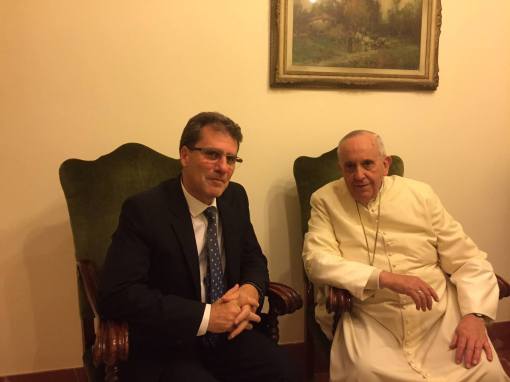
"Pope Francis never ceases to amaze"


Alessandro Zangrando, Culture and Arts editor for the Venice desk of the national newspaper Corriere della Sera and Rome Correspondent for The Latin Mass magazine, writes:
Pope Francis never ceases to amaze. For readers in Argentina he has created a new weekly edition of L'Osservatore Romano. As director he has named Marcelo Figueroa, the Argentine Protestant pastor of the Presbyterian Church and director for twenty-five years of the Argentine Bible Society. Figueroa is a longtime friend of Bergoglio, who accompanied him on the famous trip to Lund, Sweden, for the celebration of the five hundredth anniversary of the Lutheran Reformation. [Source: The Latin Mass: The Journal of Catholic Culture and Tradition, Vol. 26, No. 1 (Winter/Spring 2017), p. 5]

"Pope Francis, pray for us"???


Commenting on Confitebor's observations about the shameless papalotry represented by this pewter cross in a Catholic religious store -- a cross bearing the image of the Holy Father and the words, "Pope Francis, pray for us" -- Guy Noir - Private Eye, now our mid-Atlantic Piedmont correspondent, declared:
If every recent pope ends up canonized, what should we expect?

The cult of the saints becomes "cult like," encouraging veneration of people that ought to go to God's Son.

I used to think canonizations were exercises in papal infallibility. That confidence has been completely eroded. The modern Church has pushed its credibility on this score past the breaking point, with John Paul II himself, sadly, leading the way via removing the Devil's Advocate. Another example of how the Church's leaders do not seem overly keen to protect its enduring credibility in an age of disbelief. I just don't get it. Sanctity should not need overly aggressive PR hacks.

Prayer request

Please kindly pray for Hannah Cabrini, our daughter, who is scheduled to be confirmed at the Cathedral this Sunday, June 4, at the Mass of the Holy Spirit. She has chosen the Confirmation name of "Perpetua."

Tridentine Masses coming the week of June 4 to metro Detroit and east Michigan


Tridentine Masses This Coming Week

Sunday


Monday


Tuesday


Wednesday


Thursday


Friday


Saturday


* NB: The SSPX chapels among those Mass sites listed above are posted here because the Holy Father has announced that "those who during the Holy Year of Mercy approach these priests of the Fraternity of St Pius X to celebrate the Sacrament of Reconciliation shall validly and licitly receive the absolution of their sins," and subsequently extended this privilege beyond the Year of Mercy. These chapels are not listed among the approved parishes and worship sites on archdiocesan websites.

Sunday, May 28, 2017

Tridentine Masses coming this week to metro Detroit and east Michigan


Tridentine Masses This Coming Week

Sunday


Monday


Tuesday


Wednesday


Thursday


Friday


Saturday


* NB: The SSPX chapels among those Mass sites listed above are posted here because the Holy Father has announced that "those who during the Holy Year of Mercy approach these priests of the Fraternity of St Pius X to celebrate the Sacrament of Reconciliation shall validly and licitly receive the absolution of their sins," and subsequently extended this privilege beyond the Year of Mercy. These chapels are not listed among the approved parishes and worship sites on archdiocesan websites.

Tridentine Community News - Fr. Peter Hrystyk to be Named Archpriest; Rites of the Catholic Church; The many church constuction projects of McCrery Architects; TLM Mass schedule


"I will go in unto the Altar of God
To God, Who giveth joy to my youth"

Tridentine Community News by Alex Begin (May 28, 2017):
May 28, 2017 - Sunday After the Ascension

Fr. Peter Hrytsyk to be Named Archpriest


On Sunday, June 11 at 10:00 AM at Ss. Vladimir & Olga Church in Windsor, Toronto Ukrainian Eparchy Bishop Stephen Chmilar will formally elevate Fr. Peter Hrytsyk to the title of Archpriest. Roughly analogous to the Latin Rite title of Monsignor, the Ukrainian Rite title of Archpriest is given in recognition of a distinguished career of service to the Church. Besides being Chaplain of the St. Benedict Tridentine Community, Fr. Peter has long been Associate Pastor of Ss. Vladimir & Olga, as well as a Vice Principal serving the Windsor & Essex County Catholic District School Board at a number of schools.

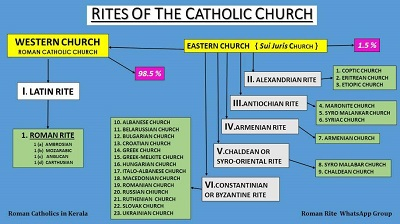
Rites of the Catholic Church

While we are on the subject of the Ukrainian Catholic Church, one of the Eastern Rites in union with Rome, it may interest you to examine the below graphic, which illustrates the structure of the Western and Eastern branches of the Catholic Church.


The Many Church Construction Projects of McCrery Architects

Much of the publicity about new churches being constructed in a traditional style rightly goes to prolific architect and Notre Dame professor Duncan Stroik. But there is only so much work one man and one firm can do, and as demand for traditionally-outfitted churches grows, it is only natural that an increasing number of architectural firms enter the fray. One firm that has been quietly building a reputation in this field is McCrery Architects of Washington, DC, led by architect James McCrery. Two of their latest projects are particularly encouraging:

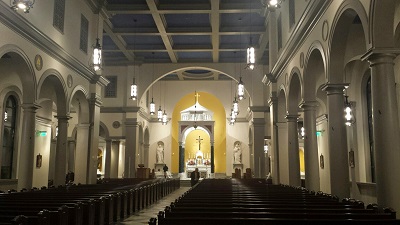
St. Mary, Help of Christians in Aiken, South Carolina, a parish which offers the Extraordinary Form, in 2015 dedicated a new, ornate church built in a classical style, with a baldacchino over their main altar. Interestingly, they also retained their original, historic church along with its separate Adoration Chapel. [Photo below by Fr. Gaurav Shroff]


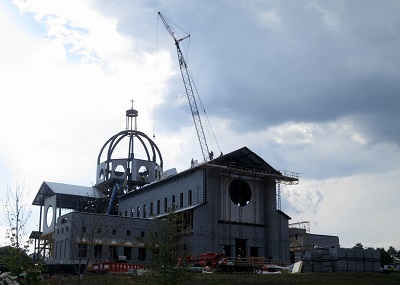
The new Sacred Heart Cathedral in Knoxville, Tennessee, is a similar grand design, with completion expected in 2018. [Wikipedia photo by Nheyob] Notably this parish does not offer the Latin Mass, yet they clearly value traditional design. There are many interesting drawings of these and other church projects on McCrery’s web site: www.mccreryarchitects.com


We commend McCrery and the parishes commissioning these edifices for their commitment to elevating the faith of the people through classic, inspiring designs. If your friends lament the banality of the new churches they see, tell them that beautiful designs are indeed coming back into prominence, one project at a time.

Tridentine Masses This Coming Week
  • Mon. 05/29 7:00 PM: Low Mass at St. Josaphat (St. Mary Magdalen of Pazzi, Virgin)
  • Tue. 05/30 7:00 PM: Low Mass at Holy Name of Mary, Windsor (St. Felix I, Pope & Martyr)
  • Fri. 06/02 7:00 PM: High Mass at Old St. Mary’s (Ss. Marcellinus, Peter, & Erasmus, Martyrs) – Celebrant: Msgr. Ronald Browne. Choir will sing William Byrd’s Mass for Four Voices. Devotions to the Sacred Heart before Mass. Reception follows Mass in the parish hall.
  • Sat. 06/03 8:30 AM: Low Mass at Miles Christi (Vigil of Pentecost)
  • Sun. 06/04: No Mass at OCLMA/Academy of the Sacred Heart
[Comments? Please e-mail tridnews@detroitlatinmass.org. Previous columns are available at http://www.detroitlatinmass.org. This edition of Tridentine Community News, with minor editions, is from the St. Albertus (Detroit), Academy of the Sacred Heart (Bloomfield Hills), and St. Alphonsus and Holy Name of Mary Churches (Windsor) bulletin inserts for May 28, 2017. Hat tip to Alex Begin, author of the column.]

Saturday, May 27, 2017

Fr. Hunwicke on why Pope Francis is not a heretic

Some interesting reasoning here. [Advisory: Rules ##7-9]

Essentially, Fr. John Hunwicke seems to be suggesting that, whatever the material content of the Holy Father's locutions, they lack sufficient theological sobriety and propositional restraint to rise to the level of formal heresy. Here's the first of four posts he has on the topic: "Is the Pope a heretic? (1)" (Fr. Hunwicke's Mutual Enrichment, May 18, 2017):
To this question there can only be one answer: NO. And NO means, as Mrs Brexiteer May might put it, NO. Pope Bergoglio has NEVER, to my knowledge, formally enunciated doctrines which are unambiguously heretical. The claim one sometimes hears, to the effect that he has formally, as if from his chair, made doctrinal assertions which the Church has formally defined as heretical, is NONSENSE. When such assertions tip over further, into the idea that he has ceased to be pope because of his alleged errors, the mistake is even more grievously EVIL because it runs the risk of detaching souls for whom Christ died from the Ark of Salvation, from the One Fold of the Redeemer.

One easy reason for being confident that the Sovereign Pontiff has not formally taught heresy is the simple fact, confirmed pretty well every time he opens his mouth, that he despises theology and holds doctrine in not-even-barely-concealed contempt. To be a heretic, or, more precisely, to be a formal heretic, it is in practical terms necessary to operate within the respectable constraints of propositional discourse. The fact that Bergoglio does not do this is proved by the fact, written large over this whole pontificate, that nobody ever quite seems to be sure what he means. The DUBIA which the four Cardinals put forward provide a good example of this. Four men of erudition (not to mention seniority) thought they needed to ask the Bishop of Rome what he meant. His tardiness, so far, in exercising the Petrine Ministry of Confirming his Brethren demonstrates his resolute determination not to be tied down by propositions. I do not believe that it is possible to convict such a man, operating such a policy, of being a formal heretic. Those who wish to do this are walking up quite the wrong garden path. And I will argue that they are guilty of a genre-error.

Further parts will follow. No comments will be enabled until they are all finished.
Here are the subsequent posts: Part 2; Part 3; Part 4. In Part 4 he concludes: "Is this a dangerous pontificate? Not nearly as much as panicky people fearfully imagine. Come off it! And cheer up! The ease with which Pope Francis and his associated ideologues, while studiously "not changing doctrine", in fact over-ride and ignore the Magisterium of his predecessors, will make it pitifully easy for his successors to dump his 'teaching' with only the most perfunctory of formalities, and then to restore the simple lucidities of the Tradition handed down through the Apostles, the Deposit of Faith.... Just hold tight whenever the roller-coaster seems to be going dangerously fast, and remember that her Immaculate Heart will prevail. This is Fatima Year!"

[Hat tip to L.S.]

Friday, May 26, 2017

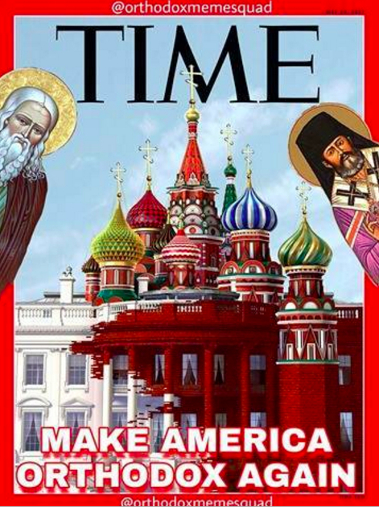
Mainline media plagiarizes Mad magazine: "Dear Time editors: The Kremlin is not a church. Dear CNN politicos: Churches are not mosques"


As Guy Noir - Private Eye observed recently: "Remember when big news weeklies had religion reporters of the caliber of Kenneth Woodward? Instead of twenty-somethings who have never worked a day outside of media in their lives?

"I do, vaguely. It was a time now shrouded in mists, a time when the phrase when 'biased news' was heard but a phrase like 'fake news' would have been laughed at... I have an MA in Journalism. At this juncture in history I view it as pretty much worthless. SAD!"

He then referred to this: Terry Mattingly's "Dear Time editors: The Kremlin is not a church. Dear CNN politicos: Churches are not mosques" (GetReligion, May 18, 2017).

When an Oxford Don goes rogue and comes out in support of traditional marriage and family values

I understand Oxford Don Richard Swinburne created quite a stir when he addressed the Midwest meeting of the Society of Christian Philosophers last fall. "The difficulty," according to The Editors of First Things, was that in the course of exploring these topics, Swinburne characterized homosexuality as a “disability” and a condition that, while sometimes “to a considerable extent reversible,” in many instances is “incurable,” given the present state of medical research.

The Editors continue:
Given the current state of public life and the stringency of academic moral codes in favor of diversity and tolerance, it will be no surprise to our readers that the president of the Society of Christian Philosophers, Michael Rea, subsequently expressed his “regret regarding the hurt caused by” Swinburne’s paper, suggesting that Swinburne’s ideas were inconsistent with the Society’s “values of diversity and inclusion.”

Rea’s message has triggered a reaction on the other side. So far the situation has been commented on by Joseph Shaw, Edward Feser, and Rod Dreher, along with eighty-seven philosophers who signed a letter of protest against the principles implied in Rea’s apology. We at First Things were curious about the paper that prompted all the to-do, and so we asked Professor Swinburne whether he would be willing to let us make his paper available. He has generously agreed.

You can read it here [PDF download].
Here is a video of Swinburne's live presentation:

Tuesday, May 23, 2017

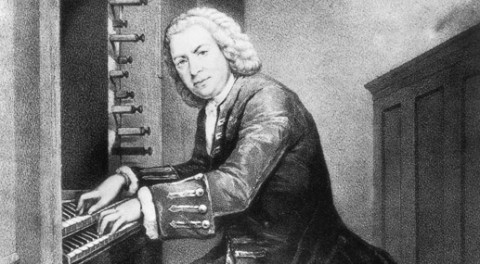
"What makes Bach so successful among the Japanese?"


Uwe Siemon-Netto, "J. S. Bach in Japan" (First Things, June 2000). What an amazing article! Here are a few teasers ...
Twenty-five years ago when there was still a Communist East Germany, I interviewed several boys from Leipzig’s Thomanerchor, the choir once led by Johann Sebastian Bach. Many of those children came from atheistic homes. “Is it possible to sing Bach without faith?” I asked them. “Probably not,” they replied, “but we do have faith. Bach has worked as a missionary among all of us.” During a recent journey to Japan I discovered that 250 years after his death Bach is now playing a key role in evangelizing that country, one of the most secularized nations in the developed world....

... “In their frenetic pursuit of production, speculation, and consumption,” Repp said, “the older Japanese have provided their offspring exclusively with materialistic values. But the youngsters are yearning for something more. The result is an enormous gap between the generations; they are no longer able to communicate with one another.”

... ”What people need in this situation is hope in the Christian sense of the word, but hope is an alien idea here,” says the renowned organist Masaaki Suzuki, founder and conductor of the Bach Collegium Japan. He is the driving force behind the “Bach boom” sweeping Japan during its current period of spiritual impoverishment. “Our language does not even have an appropriate word for hope,” Suzuki says. “We either use ibo, meaning desire, or nozomi, which describes something unattainable.” After every one of the Bach Collegium’s performances Suzuki is crowded on the podium by non-Christian members of the audience who wish to talk to him about topics that are normally taboo in Japanese society—death, for example. “And then they inevitably ask me to explain to them what ‘hope’ means to Christians.” ...

Japan’s Bach boom does, however, have one baffling aspect: how is it possible that melodies and rhythms from eighteenth-century Germany should please people of an entirely alien culture thousands of miles to the east? Tokyo musicologists have come up with an astonishing answer: Bach’s appeal to today’s Japanese is directly linked to a Spaniard’s first attempt to evangelize their ancestors 450 years ago.

... Believers were crucified, burned at the stake, tortured to death, or hanged upside-down over cesspools to intensify their suffering. Few Japanese were aware of this sinister aspect of their history until last year, when the Tobu art gallery in Tokyo commemorated the 450th anniversary of Francis Xaviér’s arrival with a massive exhibition spread over three floors.

The enormous crowds filing through this show were horrified by the cruelties its images portrayed. But there was one thing they did not learn at the Tobu Gallery: Western music managed to survive the persecution. The Jesuits had introduced Gregorian chant to Japan and built organs from bamboo pipes.... By the time Christianity was totally outlawed in Japan in the early seventeenth century, elements of Gregorian chant had infiltrated Japan’s traditional folk music. That influence remained strong enough to help Johann Sebastian Bach’s music sweep across the island nation more than four centuries later.

This explains the amazing success of Bach’s collected works, which were published by Sogakukan, a Tokyo company, to commemorate the 250th anniversary of the composer’s death. This collection of fifteen volumes, including 156 CDs accompanied by books with the original lyrics in German and Latin plus their Japanese translations, cost a staggering $3,000 each. Within weeks the first edition of five thousand copies was sold out.

The collection’s editor, Tesuo O’Hara, described himself as one of Christianity’s sympathizers, though not a believer. He could have fooled me. “What makes Bach so successful among the Japanese?” I asked him. O’Hara replied, “Bach gives us hope when we are afraid; he gives us courage when we despair; he comforts us when we are tired; he makes us pray when we are sad; and he makes us sing when we are full of joy.”
[Hat tip E. Echeverria]

Saturday, May 20, 2017

"What, then, remains of Luther?"

In the early part of the twentieth century there were prominent Protestant theologians like Reinhold Seeberg of Berlin and Wilhelm Braun of Heidelberg who lamented the bitter fruits of the Reformation. Fr. Joseph Husselein, S.J., writing in "What, Then, Remains of Luther?" in America, Vol. IX, No. 14 (July 12, 1913), p. 320, suggests that nowhere is this Protestant chagrin over the bitter fruit of the Reformation more faithfully reflected than in an article written by the Protestant theologian Braun for Evangelische Kirchenzeitung, March 30, 1913. Braun, upon reading the historical and theological exposés of Luther by Father Heinrich Denifle, O.P. [photo below left], in Luther und Luthertum and by Fr. Hartmann Grisar, S.J., in Luther, asked "What, then remains of Luther?" After candidly admitting the superior facilities possessed by the Dominican and Jesuit authors over Protestant theologians and historians in the field of Luther research (p. 169), Braun draws up the following remarkable summary of his impressions:
The reading of Grisar should afford food for reflection to us Evangelical theologians. With strips cut from our own skin the Catholic author has pieced together his 'Luther.' How small the Reformer has become according to the Luther studies of our own Protestant investigators! How his merits have shrivelled up! We believed that we owed to him the spirit of toleration and liberty of conscience. Not in the least! We recognized in his translation of the Bible a masterpiece stamped with the impress of originality -- we may be happy now if it is not plainly called a 'plagiarism'! ... Looking upon the 'results' of their work thus gathered together, we cannot help asking the question: What, then, remains of Luther?
Considering the bitter legacy of the Reformation -- a Christendom shattered into a thousand pieces -- these eminent Protestant scholars considered that it would be more appropriate for Protestants, rather than celebrate the fourth centenary of Luther's Ninety-Five Theses, should do penance in sack-cloth and ashes. But then, that was a century ago.

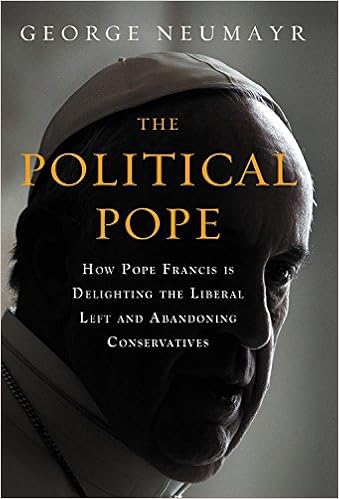
Book: The Political Pope, by George Heumayr


This is more about the politics of the Holy Father than his theology, though some might beg to differ; but it's a book that's catching quite a bit of attention. It's by George Neumayr, who is contributing editor to and former executive editor of the conservative American Spectator.

Maike Hickson recently published "An Interview with George Neumayr, Author of The Political Pope" (OnePeterFive, May 6, 2017).

Saturday, May 06, 2017

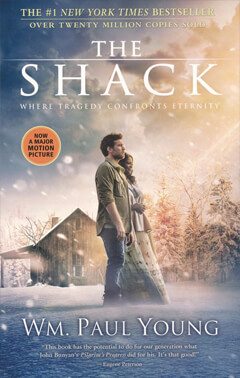
"Shack" Theology


Gavin Ortlund, "The god of William Paul Young" (TGC, April 28, 2017):
Paul Young’s The Shack has sold 20 million copies, inspired a major motion picture, and generated a lot of spiritual reflection and conversation. Some have appreciated its depiction of faith and suffering. Others have been uncomfortable with its theological eccentricities. More than a few have used the “h word” to describe it (heresy). But the fact that The Shack (and Young’s other books) are novels has made it difficult to know exactly how to place them.

Now, with the publication of his first non-fiction work, Lies We Believe About God, Young gives a more propositional, concrete expression of his beliefs. Although this book casts itself as tentative and conversational (20–21), it definitely advocates theological positions, often quite energetically. Its 28 chapters are each devoted to exposing a “lie” we believe about God, and expounding the corresponding opposite truth.

Unfortunately, the theology espoused in this book represents a wide and unambiguous deviation from orthodox Christian views. I mean no personal animus to the author in saying this, nor do I question his intentions. But the reason categories like “orthodoxy” and “heresy” arose in church history is because Christians have maintained there are right and wrong ways to think about God, and that pointing out the difference matters. When a book departs from historic, mainstream Christianity, it’s important to make the differences clear. Read more >>
Our underground correspondent, Guy Noir - Private Eye, who called our attention to this review asks whether this represents where a portion of modern Catholicism in America and Europe is positioning itself under the rhetoric of Pope Francis. They could never officially condone it, he says, but they don't need to: "Non-condemnation or equivocation is its own endorsement in these knee-jerk, social media times. Dissent non-condemned becomes a legit option. And those voicing concern become uptight haters."

Friday, May 05, 2017

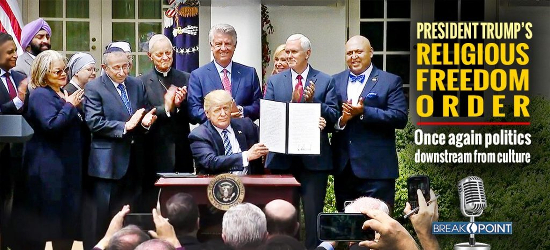
Trump's Religious Freedom Order: "Woefully inadequate"


John Stonestreet and Roberto Rivera, "BreakPoint: President Trump's Religious Freedom Order" (BreakPoint, May 5, 2017):
President Trump’s long-anticipated order on religious freedom reminds us that salvation won’t come on Air Force One.

Yesterday, on the National Day of Prayer, President Trump signed an executive order on religious liberty.

Unfortunately, though it was a “first step,” it was a small one, an order Ryan Anderson of the Heritage Foundation called “woefully inadequate.”

Now, let me be clear: there are things in the order worth praising. The president said that “No American should be forced to choose between the dictates of the federal government and the tenets of their faith.”

I couldn’t agree more. And I’m thankful that at least so far this administration, unlike the last one, isn’t forcing that choice on Americans. Still, protecting religious freedom requires more than just noble sentiments. And here is where the executive order disappoints. After directing the federal government to “vigorously enforce Federal law’s robust protections for religious freedom,” the measures set forth in the order are, well, less than vigorous.

The order instructs the Secretaries of the Treasury, Labor, and HHS to “consider amending existing regulations” to address “conscience-based objections” to the HHS mandate.

Words like “consider” aren’t exactly a guarantee that anything will change. As Ryan Anderson told The Atlantic, the “regulatory relief” promised to groups like the Little Sisters of the Poor may very well amount to, “Well, you have to do it, because [the Supreme Court] told you to do it,” but, it “doesn’t move the ball” on religious liberty.

Nor does the emphasis on the Johnson Amendment, which prohibits churches and other charitable organizations from endorsing political candidates.

First, the Johnson Amendment is bad law, but it’s rarely, if ever, enforced. So the order effectively tells the IRS to continue doing what it is already doing. Second, the inability to endorse candidates from the pulpit on Sunday isn’t the problem with religious freedom in this country. The problem is the increasing inability of Christians and other people of religious conviction to practice their faith Monday through Saturday.

Yesterday’s events suggest that, as I said after the election, the incoming administration has offered us a reprieve on religious freedom, but not a champion. Or as Chuck Colson often put it, salvation doesn’t arrive on Air Force One.

So, with or without the executive order we really wanted, we have to know this: The case for religious freedom must be made both in our churches and over our backyard fences. Even had we gotten the executive order many of us had hoped for, it would have been, at best a temporary help.

Why? Because our cultural understanding of religious freedom is currently not strong enough to offer or to sustain a long-term political solution. Like the understanding of marriage was lost in the cultural imagination way before Obergefell, so the understanding of religious freedom has been lost in the culture. Many are just frankly ignorant about what the free exercise of religion means and why our founders thought it so important.

For most Americans, religious freedom means the ability to “attend the church of your choice.” The logical corollary of this would be, “what happens in church stays in church.”

Of course, if Christians took that idea seriously, there would be a lot fewer religious hospitals, soup kitchens, homeless shelters, etc. Government can’t even begin to fill the vacuum left should these institutions be forced out of business.

Americans must be reminded that believers ought not be made to choose between obeying their conscience and serving their neighbor. And it would help if Christians understood this better. In too many churches, being a Christian is about how God can make your life better, not how you can work with God to make the invisible kingdom visible.

This is where the battle for religious freedom will be fought, and either won or lost, no matter who sits in the Oval Office.