Sunday, April 17, 2016

Tridentine Community News - Books: How to Avoid Purgatory; All About the Angels; 1st Communions at OCLMA; TLM Masses this week,


"I will go in unto the Altar of God
To God, Who giveth joy to my youth"

Tridentine Community News by Alex Begin (April 17, 2016):
April 17, 2016 – Third Sunday After Easter

Book Review: How to Avoid Purgatory

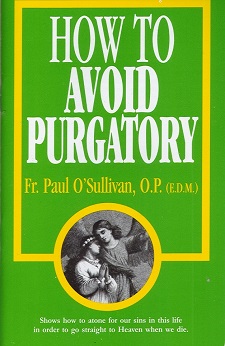
Altar server about town James Murphy brought to our attention two books written by the same author, Fr. Paul Sullivan, OP, and republished by TAN Books.


The first, How to Avoid Purgatory, is a small and brief book (39 pages), which first explains the reasons why souls are sent to Purgatory, then provides several means to escape being sent there. In addition to the usual methods one hears, namely regular Confession, Holy Communion, seeking to gain Indulgences, and offering up penances and suffering, Fr. Sullivan recommends explicitly asking God for the grace to avoid Purgatory. Being a Dominican, he also suggests joining the Third Order of St. Dominic, today commonly called the Lay Dominicans, because of the order’s history of devotion to the Holy Souls. He also argues that those who have a devotion to helping the Souls in Purgatory during their lifetime are likely to be shown mercy by God with regards to their own obligations after death.

This reviewer struggles with one aspect of the book: How many of us can honestly say that we don’t deserve at least some time in Purgatory? It’s fine to say that we want to avoid it, but are our souls truly pure enough to merit immediate admission to heaven? The Church gives us the means to do so, even via some exceptional privileges, such as the Apostolic Pardon which can be given by a priest to a person near death, so perhaps it’s not so presumptuous a grace to desire after all.

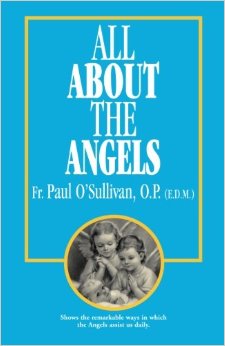
Book Review: All About the Angels


The second book, All About the Angels, is a lengthier work at 131 pages. It is a fascinating introduction to the work of the Angels among mankind. Fr. Sullivan’s stated objective in writing the book was to foster Catholics’ love for and devotion to their “best friends”, the Angels who defend and support us. Though the book was originally published in 1945, even then the author felt the Church was not doing a satisfactory job of informing the faithful about the presence and actions of the Angels.

He expounds upon the ubiquity and supreme intelligence of the Angels:
Millions and millions of angels fill the Heavens, ministering unto God, but millions and millions of angels are also here on earth, ministering unto us. They are in our midst, around us, about us, everywhere….Were it not for their ever-vigilant protection, the history of the world would be far different, far more calamitous than it has been.
Much of the book is taken up with documenting apparitions of Angels to Saints, kings, and others, in the Bible and throughout history. The author makes the point that Angels are enormously grateful for any appreciation we show them in return, presumably because they are accustomed to being ignored. They welcome prayers and petitions for help, especially our Guardian Angels. Fr. Sullivan proposes the following brief prayer as a sign of gratitude:
Dearest Angels here present, I honor and love you and give thanks to God for all the glory He has given you.
The author recommends that we periodically offer Masses, Rosaries, and Communions to thank and console the Angels. God permitted St. Gertrude to see how grateful the Angels were after she once offered her Holy Communion in honor of the nine choirs of Angels. Fr. Sullivan cautions the reader, however, that Angels cannot help people who are in a state of mortal sin.

Fr. Sullivan maintains that Angels are the ones responsible for the seemingly miraculously saves we occasionally experience from disasters large and small. Angels are also the ones who help Martyrs suffer torture with acceptance, even joy. The Angels provide the supernatural strength the Martyrs require to resist the extreme pain they might otherwise experience.

The fascinating anecdotes and logically deduced advice given in this book make it a highly recommended read. One wonders why the Angels, who are such key intercessors for us, are not mentioned more frequently in homilies, articles, and other educational materials.

First Communions at OCLMA

First Holy Communions will be held for the Oakland County Latin Mass Association at the 9:45 AM Mass on Sunday, May 1 at the Academy of the Sacred Heart Chapel in Bloomfield Hills, Michigan. The faithful may gain a Plenary Indulgence by being present for a First Communion ceremony, under the usual conditions of Confession within 20 days, reception of Holy Communion, prayer for the Holy Father’s intentions, and freedom from attachment to sin. A reception will follow the Mass.

Tridentine Masses This Coming Week
  • Mon. 04/18 7:00 PM: Low Mass at St. Josaphat (Feria)
  • Tue. 04/19 7:00 PM: Low Mass at Holy Name of Mary (Votive Mass for the Unity of the Church)
[Comments? Please e-mail tridnews@detroitlatinmass.org. Previous columns are available at http://www.detroitlatinmass.org. This edition of Tridentine Community News, with minor editions, is from the St. Albertus (Detroit), Academy of the Sacred Heart (Bloomfield Hills), and St. Alphonsus and Holy Name of Mary Churches (Windsor) bulletin inserts for April 17, 2016. Hat tip to Alex Begin, author of the column.]

Tridentine Masses coming this week to metro Detroit and east Michigan


Tridentine Masses This Coming Week
* NB: The SSPX chapels among those Mass sites listed above are posted here because the Holy Father has announced that "those who during the Holy Year of Mercy approach these priests of the Fraternity of St Pius X to celebrate the Sacrament of Reconciliation shall validly and licitly receive the absolution of their sins." These chapels are not listed among the approved parishes and worship sites on archdiocesan websites.

**NB: [Update: All St. Joseph's Church Masses have been re-located to St. Josaphat, Detroit, until further notice, due to structural renovations.]


Saturday, April 16, 2016

Lucifer: Dare we hope that none be saved?

Hmmmm ...

Skojec: Pope's projected persona doesn't reflect his autocratic style of governance

[Advisory: Rules 7-9]

Steve Skojec, "The Dictator of the Vatican" (FP, April 8, 2016):
There is hardly anyone in the world by now who is unfamiliar with the affable, down-to-earth, conspicuously humble persona projected by Pope Francis. His style of governance, however, is a far cry from this carefully cultivated public image. Influenced by the Peronist ideology of his native Argentina, he rules the Roman Catholic Church with the idiosyncratic passions, and disciplined commitment to an agenda, of a true ideologue. And Amoris Laetitia, Francis’s 260-page, nearly 60,000-word, post-synodal apostolic exhortation on marriage and family, which was at long last released on Friday, is the clearest example yet.
Read more >>

[Hat tip to Greg Beckwith]

Friday, April 15, 2016

Amoris Laetitia: Evelyn Waugh would have to re-write Brideshead

Considering the perpetual motion spin machine that Catholic media has now become, Guy Noir imagines an open letter to Fr. Barron beginning like this:
Dear Fr. Barron:

Inquiring Protestants want to know ...


"Evelyn Waugh Would Have to Re-Write Brideshead" (Old Life, April 13, 2016):
Phil Lawler wonders about the pastoral implications of Pope Francis’ pastoral advice in Amoris Laetitia....

... Now notice what happens to priests in these parishes when they meet a couple that has been re-married ... Now imagine the real life (fictional couple) of Rex Mottram and Julia Marchmain ...

... Evelyn Waugh knew that the Church of England had changed (even when dogma hadn’t). Do Roman Catholic apologists think Waugh wouldn’t notice this?

Entertainment Tonight: "It's a new time" ...

Coming to you courtesy of Guy Noir - Private Eye ...

Jackson McHenry, "The Rolling Stones Perform in Cuba for the First Time" (Vulture, March 26, 2016):


The Strolling Bones, who recently performed in Cuba

"This is a new time," Mick Jagger told the crowd...

Indeed. In other recent news:
  • White House appoints first gay Army secretary
  • Lands End honors Gloria Steinem
  • Pope Emeritus' confirms official abandonment of basic Catholic missionary impulse
  • Beyonce performs anti-police number at NFL Superbowl
  • Republican debaters join Democrats in focusing on best ways to increase federal spending
  • Vatican floods bones of St. Peter burial site with environmental light show
  • US Post Office unveils postages stamps featuring Marge Simpson and Harry Potter

Head of USCCB media arm shows his true colors

Christine Niles, "Head of Bishops' New Outfit Resigns Amid Controversy" (Church Militant, April 14, 2016). No kidding ... He was finally asked to step down from CNS after it became public knowledge that he was promoting an LGBT agenda on social media. Michael Hichborn of the Lepanto Institute first broke the story.


[Hat tip to JM]

Welcoming converts and reverts to a hijacked church

How is it possible? It's certainly tough. Anne Roth Muggeridge, in Desolate City, even admits to times when she and others felt inclined to discourage inquirers from seeking church membership, simply because of all the confusion. When you're read enough to see that many of the practices and beliefs encountered in typical suburban parishes are simply not Catholic, the task is even more daunting. What to do ...

In this one-and-a-half minute free video clip, Michael Voris brings an uncomfortably clear focus to the issue.

Converts or reverts undergo a life-changing experience and seize upon the nearest suburban 'Church of Nice' parish as a God-sent answer, completely oblivious to the fact that the parish is riddled with abuses. Then someone comes along and points out that this isn't the way things are supposed to be. You're asking people to make, first, a psychological jump from a way of viewing the world that was completely un-Christian to a new Christian worldview; and then you're asking them to make another jump because this new Christian life in the local AmChurch parish is also filled with errors. This is asking a lot of a person psychologically; and as Michael Voris suggests, it is fraught with dangers.

Thursday, April 14, 2016

Monica M. Miller examines the fallout from 'Zikagate'

Monica Migliorino Miller, "A Virus, a Crisis" (New Oxford Review, April 2016)

Monica Migliorino Miller, a Professor of Theology, earned a Doctorate in Theology from Marquette University. She is the Director of Citizens for a Pro-Life Society and the author of Abandoned: The Untold Story of the Abortion Wars (St. Benedict Press, 2012) and, more recently, The Authority of Women in the Catholic Church (Emmaus Road Publishing, 2015).  

The headline in The New York Times said it all: “[Pope] Francis Says Contraception Can Be Used to Slow Zika” (Feb. 19). Who in the history of Christianity would have thought that we would ever see a headline claiming that a sitting Pope has contradicted Church teaching? So, what exactly did the Pope say? Here is an English transcript of Francis’s exchange with a Spanish reporter, in its entirety, provided by the Catholic News Agency (Feb. 18), that took place during the Pope’s hour-long press conference on his return flight from Ciudad Juarez, Mexico, to Rome:
Paloma García Ovejero: Holy Father, for several weeks there’s been a lot of concern in many Latin American countries but also in Europe regarding the Zika virus. The greatest risk would be for pregnant women [who are potentially at risk of delivering children with a defect of the brain called microcephaly]. There is anguish. Some authorities have proposed abortion, or else avoiding pregnancy. As regards avoiding pregnancy, on this issue, can the Church take into consideration the concept of “the lesser of two evils”?
Pope Francis: Abortion is not the lesser of two evils. It is a crime. It is to throw someone out in order to save another. That’s what the Mafia does. It is a crime, an absolute evil. On the “lesser evil,” avoiding pregnancy, we are speaking in terms of the conflict between the fifth and sixth commandment. Paul VI, a great man, in a difficult situation in Africa, permitted nuns to use contraceptives in cases of rape.
Don’t confuse the evil of avoiding pregnancy by itself, with abortion. Abortion is not a theological problem; it is a human problem; it is a medical problem. You kill one person to save another, in the best-case scenario. Or to live comfortably, no? It’s against the Hippocratic Oath doctors must take. It is an evil in and of itself, but it is not a religious evil in the beginning. No, it’s a human evil. Then obviously, as with every human evil, each killing is condemned.
On the other hand, avoiding pregnancy is not an absolute evil. In certain cases, as in this one, or in the one I mentioned of Bl. Paul VI, it was clear. I would also urge doctors to do their utmost to find vaccines against these two mosquitoes that carry this disease. This needs to be worked on.
Francis’s comments on abortion are arguably the strongest of any pontiff. He compared the killing of the unborn to, of all things, Mafia tactics (“to throw someone out in order to save another”), and he called abortion a “crime” and an “absolute evil.” His stance is clear and unequivocal.

Unfortunately, the Pope’s strong condemnation of abortion has been almost completely overlooked due to his confused and equivocal statements regarding contraception. It is clear that Francis has the ability to speak plainly in defense of Church teachings, at least when his convictions regarding those teachings are heartfelt. Yet on the subject of contraceptive use in crisis situations, Francis made statements that lead one to conclude that he believes such use is morally licit, contrary to Catholic moral doctrine. Let us examine his exchange with the Spanish reporter.

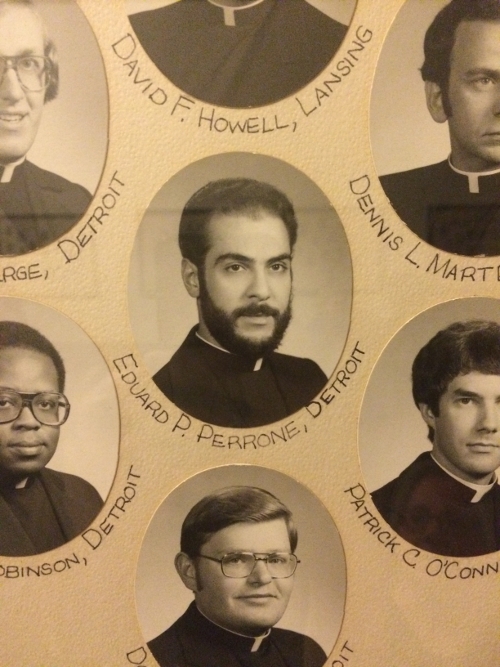
Fr. Eduard Perrone: past and present

I have heard some suggest that if this were today, he could pass for one of our Chaldean seminarians!


Fr. Eduard P. Perrone, ordained for the Archdiocese of Detroit in 1978


Rev. Eduard Perrone in 2011, and as he is today, the pastor of Assumption Grotto Church

Bishops who simply watch from the sidelines

So suggests Phil Lawler in his article, "In Georgia's religious-freedom debate, Catholic bishops sit on the sidelines" (CatholicCulture.org, April 7, 2016).

"And how did the Catholic bishops of Georgia respond to this disgraceful claim that the Christian faith is a form of bigotry? Archbishop Wilton Gregory of Atlanta and Bishop Gregory Hartmayer of Savannah announced blandly: 'Gov. Nathan Deal has announced his intention to veto H.B. 757 and the debate will, thus, continue.'”

Ugh. How lame. He won't even take sides in a fight where the other guy is trying to kill him?

Then there's this from a fellow college professor in another part of the country:
At the ... socially conservative college where I teach, after years of stonewalling, the administration has finally approved the charter of an LGBT student group. The school also sponsors the National Black Ministers Conference, one at which Obama spoke when he was campaigning. Sense the strange cultural cross currents? Anyway, kids are thrilled, and last night I walked across campus behind a couple of young ladies holding hands. In an advertising class I supervise, Target asked to sponsor a competition for ad design in which the students conceptualize and develop a campaign celebrating the chain's pro-LGBT stance. New world. But why should I or anyone blink or twitch, when "everyone knows the Church's teaching." (And no one believes in mortal sin any more than they understand String Theory).

Where are we now in terms of 'Building a Civilization of Love'?
Here's the kind of bishop we need:


And here's the kind of bishops we don't need:

"Bad papal eggs"

Joseph Martin, "Bad Papal Eggs" (Imprimatur, April 13, 20106):
The ever irenic Fr. Geo. Rutler breaks an egg or two... [referring to George Rutler's "The Curate’s Egg: A Reflection on Amoris Laetitia" (Crisis, April 13, 2016), which follows]:
There was a Victorian member of the Royal Academy who boasted that his paintings were the best because they were the biggest. More perceptively, Cicero and Pascal and Madame Recamier and Mark Twain made opposite apologies: each had written a long letter because they did not have the time to write a short one. Not only is verbosity indicative of muddled thinking, it is the rhetorical indulgence of the modern age. The documents of the Second Vatican Council are wordier than the extant records of all the other ecumenical councils combined. The recent apostolic exhortation, Amoris Laetitia, is nearly two-thirds the length of all the Vatican II promulgations.

The literary quality of Amoris Laetitia does not challenge the claim that the Authorized Version, or King James’s Bible, is the only successful work of art composed by a committee.In his encyclical celebrating Pope Gregory I, Iacunda Sane, Pope Pius X makes a point of the way that great pope’s clarity of thought issued in the beauty of his Latinity. That thought also posed no contradiction between truth and mercy: “It will certainly be the part of prudence to proceed gradually in laying down the truth, when one has to do with men completely strangers to us and completely separated from God. ‘Before using the steel, let the wounds be felt with a light hand,’ as Gregory said (Registr. v. 44 [18] ad Joannem episcop.).


Bishop: “I’m afraid you’ve got a bad egg, Mr. Jones.” Curate: “Oh, no, my Lord, I assure you that parts of it are excellent.” (From the November 9, 1895 issue of Punch, illustrated by George du Maurier.)

But even this carefulness would sink to mere prudence of the flesh, were it proposed as the rule of constant and everyday action…” (n. 26).Much, perhaps too much, has already been said about this apostolic exhortation, often revealing as much about the commentators as their commentaries. It is true that there are parts of it that are eloquent, but most of them are quotations of God and Saint Paul. The Word does have a way with words, and the charity of the Apostle gave him the tongue of an angel. In contrast, there are a lot of gongs clanging and cymbals clashing in the contradictions and redundancies of much of the exhortation’s diction.

Parts like the affirmation of Humanae Vitae settle the text in the sacred tradition, but there is also the muddled treatment of moral culpability that almost nods to the neuralgic interpretation of the “fundamental option” theory rejected by St. John Paul II (Veritatis Splendor, nn.65, 67). This had been addressed earlier by a formal declaration of the Holy See: A person’s moral disposition “can be completely changed by particular acts, especially when, as often happens, these have been prepared for by previous more superficial acts. Whatever the case, it is wrong to say that particular acts are not enough to constitute a mortal sin” (Persona Humana, December 29, 1975, No. 10).

A lack of clarity in the text might endorse the conceit already expounded in some media interviews, which says contrition is not a necessary element in petitioning for mercy. Any parish priest should wonder at the description of the confessional as a torture chamber. While it is only human when conflicted by guilt and uncertainty to approach the Sacrament of Reconciliation with trepidation, the radiance of that sacrament is inestimable in the life of the typical priest and penitent alike, and the agony of many souls and of the Church in our day can be traced in great measure to neglect of the gracious confessional. Speaking only of my own parish, in my confessional is a picture of the Prodigal Son and not the Grand Inquisitor. Dramaturgic references like that to torture are straw horses, and a straw horse is the rhetorical device of a weak argument. It was characteristic of the aforementioned Pope Gregory the Great, a systematic thinker, that he abstained from mocking his opponents, and did not advertise humility. By grace, God can help all of us emulate that to some modest extent so long as we submit to the realities of revealed and natural law.

In describing natural law, it is fascinating that the Catechism cites Cicero of pagan Rome, the same Cicero who did not have time to write a short letter (and the Robert Harris novel Dictator about him is worth reading): “For there is a true law: right reason. It is in conformity with nature, is diffused among all men, and is immutable and eternal; its orders summon to duty; its prohibitions turn away from offense… To replace it with a contrary law is a sacrilege; failure to apply even one of its provisions is forbidden; no one can abrogate it entirely” (n. 1956). Cicero’s own domestic life was not unblemished, but neither was the marital fidelity of that other orator Martin Luther King, Jr., who is quoted in the exhortation, but the principle, if not the practice, obtains.

As usual, Douthat is outstanding: 'Defense of Catholic Marriage'


Ross Douthat, "A Defense of Catholic Marriage" (New York Times, April 11, 2016).

[Hat tip to JM]

Sunday, April 10, 2016

Although this should go without saying ...

As Canonist Ed Peters points out, "The law before 'Amoris' is the law after" (In the Light of the Law, April 10, 2016):
Holy Communion is to be withheld from divorced-and-remarried Catholics in virtue of Canon 915 which, as has been explained countless times, does not require Catholic ministers to read the souls of would-be communicants, but rather, directs ministers to withhold holy Communion from those who, as an external and observable matter, “obstinately persevere in manifest grave sin”. The Catechism of the Catholic Church 2384 describes civil remarriage after divorce as “public and permanent adultery” (something obviously gravely sinful), so, if Francis had wanted to authorize the administration of holy Communion to divorced-and-remarried Catholics (and he did not want to repudiate CCC 2384, 1650, etc.) he would have had to have wrought a change in the law contained in Canon 915.
Read more >>

Tridentine Community News - Retired Bishop celebrates TLM exclusively; Jackson Tridentine choir YouTube channel; bowing head as sign of reverence; EWTN Live with Extraordinary Faith rescheduled; TLM schedule this week


"I will go in unto the Altar of God
To God, Who giveth joy to my youth"

Tridentine Community News by Alex Begin (April 10, 2016):
April 10, 2016 – Second Sunday After Easter

Retired Bishop Celebrates Tridentine Mass Exclusively

Exclusively In the April 6, 2016 edition of The Vortex on www.churchmilitant.com, retired Bishop René Gracida of Corpus Christi, Texas makes the surprising statement at 3:35 in the video that he now celebrates the Extraordinary Form exclusively, because of deficiencies he has come to perceive in the Ordinary Form. While several bishops in North America are regular celebrants of the Extraordinary Form, this is the first known instance of one eschewing the Ordinary Form entirely. Of course His Excellency’s being retired frees him from the duties that would otherwise make taking such a stance impossible.
Bishop Gracida has led a fascinating life, having been among other things a Benedictine monk, an architect, a cattle rancher, and a pilot. He published an autobiography which explains all of these ventures: An Ordinary’s Not So Ordinary Life, available on Amazon.com: http://www.amazon.com/dp/1502787253.

Jackson Tridentine Choir YouTube Channel Yet another impressive development from the Tridentine Mass community at Our Lady Star of the Sea Church in Jackson, Michigan: Their choir has begun to post recordings on YouTube, under the channel name, St. Mary Star of the Sea Schola. This choir consists of approximately 10 voices, many of whom are professional choir directors from the Jackson area. It has quickly developed into one of the most proficient Latin Mass choirs in Michigan. Listen to their recordings here: https://www.youtube.com/channel/UCqGIY_YdShIiGgQe8WOKUHw

Bowing the Head as a Sign of Reverence

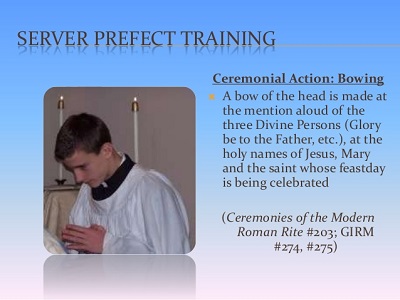
This past Tuesday, April 5, Arturo Ortiz of the Walking in the Desert blog published an interesting article about the tradition of bowing one’s head at the mention of certain holy names. Before we get in to the specifics, it is worth mentioning the difference between rubric and custom: What is defined by rubric is mandatory. What is a matter of local or regional custom falls into the category of pious but optional action. The article points out that not only in the Extraordinary Form, but also in the Ordinary Form of Holy Mass, it is the rubric that the celebrant bow his head at: 1) Each instance when all three members of the Holy Trinity are mentioned together, such as during the Glória Patri; 2) When our Lord’s Name, Jesus, is said [bow toward the altar crucifix in the EF]; 3) When our Lady’s name is said [bow toward the altar missal in the EF]; and 4) When the name of the Saint of the day is said [bow toward the altar missal in the EF]. It is the custom for altar servers and those in the congregation to do the same.


It is also a laudable custom that the faithful make a bow of the head when our Lord’s Name is heard or said is daily life. Such a habit fosters a devotion to the Most Holy Name. The article asserts that the Second Council of Lyons, in 1274 A.D., actually elevated this practice to a law of the Church, though today it would be hard to argue that it is more than a custom.

A touching story from another article is included in this blog post, in which a writer explains his father’s habit of bowing when holy names were mentioned. That writer also revealed a simple, but most pious practice: When his father heard the Lord’s Name said in vain in daily conversation, he would quietly make the Sign of the Cross over his heart and whisper, “Have mercy on us.” This simple action changed the incident from one of potential blasphemy to one of supplication. Would that we all had such heartfelt devotion ourselves.

The full article may be read here: http://walkinginthedesert.com/2016/04/05/bowing-at-holy-names-at-mass-and-elsewhere/

EWTN Live with Extraordinary Faith Rescheduled

EWTN has rescheduled the episode of EWTN Live which will feature Extraordinary Faith host and Tridentine Community News editor Alex Begin for Wednesday, May 4 at 8:00 PM. It will also be re-run on Thursday, May 5 at 1:00 AM and 9:00 AM, and Sunday, May 8 at 4:00 AM. It will also be viewable on-demand for several weeks thereafter on the EWTN Live web page, on Roku, and on the EWTN Android and iOS apps.

Tridentine Masses This Coming Week
  • Mon. 04/11 7:00 PM: Low Mass at St. Josaphat (St. Leo the Great, Pope, Confessor, & Doctor)
  • Tue. 04/12 7:00 PM: High Requiem Mass at Holy Name of Mary (Daily Mass for the Dead)
  • Sat. 04/16 11:00 AM: High Mass at Ss. Cyril & Methodius Seminary Shrine Chapel, Orchard Lake (Saturday of Our Lady)
[Comments? Please e-mail tridnews@detroitlatinmass.org. Previous columns are available at http://www.detroitlatinmass.org. This edition of Tridentine Community News, with minor editions, is from the St. Albertus (Detroit), Academy of the Sacred Heart (Bloomfield Hills), and St. Alphonsus and Holy Name of Mary Churches (Windsor) bulletin inserts for April 10, 2016. Hat tip to Alex Begin, author of the column.]