More in depth: "The truth about natural family planning" (Mic'D UP)

Friday, September 06, 2013
Prayer and fasting for Syria
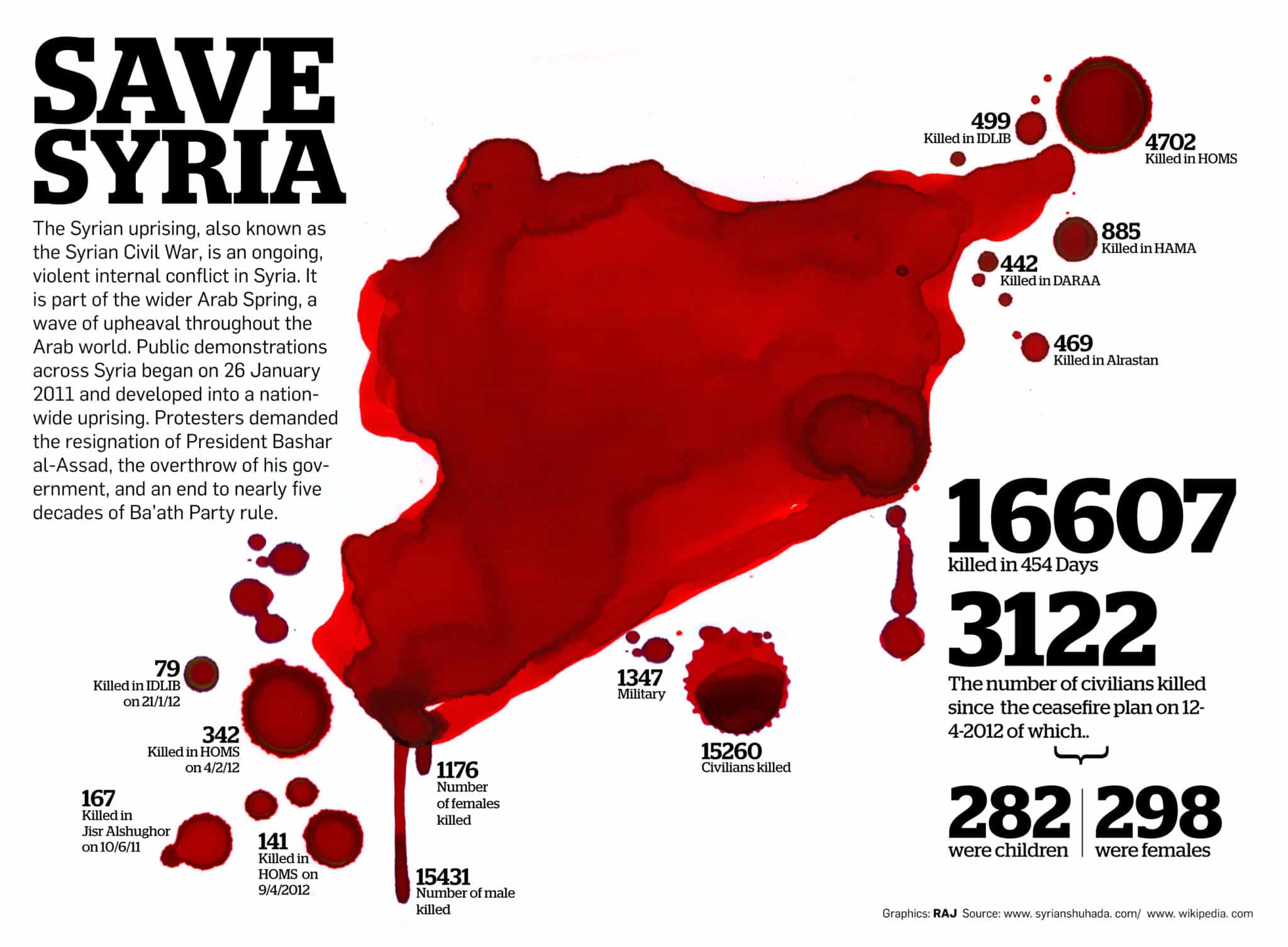
Save Syria offers some statistics worth noting.
This morning, I received this email reminding me about "Syria Saturday: Fasting Ideas for the Pope's Day of Penance" (Taylor Marshall, September 6, 2013). "Syria Saturday. Pope Francis has asked all Catholics and all Christians and other people of good will to dedicate Saturday (Sept 7, 2013) as a day of prayer and fasting for peace in Syria." The Holy Father did not give specific instructions about this, but Dr. Marshall offers some suggestions, classifying them as Hard, Medium, Easy. Read more >>
This morning, I received this email reminding me about "Syria Saturday: Fasting Ideas for the Pope's Day of Penance" (Taylor Marshall, September 6, 2013). "Syria Saturday. Pope Francis has asked all Catholics and all Christians and other people of good will to dedicate Saturday (Sept 7, 2013) as a day of prayer and fasting for peace in Syria." The Holy Father did not give specific instructions about this, but Dr. Marshall offers some suggestions, classifying them as Hard, Medium, Easy. Read more >>
Thursday, September 05, 2013
"If you meddle with the Mass, the Papacy will collapse"
An editorial from Radicati nella Fede, (via Adfero at Rorate Caeli, September 2, 2013):
A large part of so-called “conservative” Catholicism is committing a very serious error: in order to save what remains of the Catholic presence in the world, to render the mission of the Church stronger in secularized society, and faced with the moral weariness of many ecclesial sectors, it is making an effort to increase Catholic pride, by focusing totally on the Pope. Moreover, it is handling this attention on the Pope in exactly the same way as the newspapers, television and internet sites, who are extolling the humanity of the Pontiff, underlining with pride the popular interest in his person. They are behaving in the exact same way as the world devoid of faith or not concerned with faith, with their descriptions of oceanic gatherings around the Vicar of Christ, of his impressive gestures and the controversial choices that he seems to be making.
No, it is not from the Pope that we need to start in order to save our Catholic life: in fact, not from the Pope at all, but from the Holy Mass, from the Holy Eucharist.
So that we can explain ourselves, we turn to one of the most important spiritual authors of the of the last century, Dom Chautard, Abbot of Sept-Fons.
"Homosexualists destroy another Christian business"
"Todd's American Dispatch: Christian bakery closes after LGBT threats, protests" (Fox News, September 3, 2013). All in the name of "tolerance" and "non-judgmentalism" and opposition to "discrimination" and "bigotry," of course. (Remember what I've always said about "totalitarian democracy"? It's well on the way.)
Nouvelle theologies, the Pope, & Liberation theology
This morning we received this: Fr. Z, "Pope Francis and Liberation Theology" (WDTPRS, September 5, 2013), which Fr. Z warns may lead some readers to have "a spittle-flecked nutty and start dashing around screaming that the Pope is a Marxist" (I'm not making this up) -- sent so us from our exasperated undercover investigator, Guy Noir, who added this:
"Unless my historical theology is off, it is only in the last 50 years that theologies/theologians are condemned as unCatholic, and later rehabilitated. Criticisms that Catholicism is now more often defined by identification with the person of the Pope than with the office Tradition seem correct.[Hat tip to JM]
"Of course, unless someone was already known as quite Conservative, would you expect anything else from the Jesuit Latin hemisphere, honestly?
"Makes one feel like CDF verdicts are rather trifles. What did the Pope say, don't let those slaps on the wrists derail you, or some such?"
Wednesday, September 04, 2013
"Santo Subito -- American Author Calls for His Own Sainthood, Now"
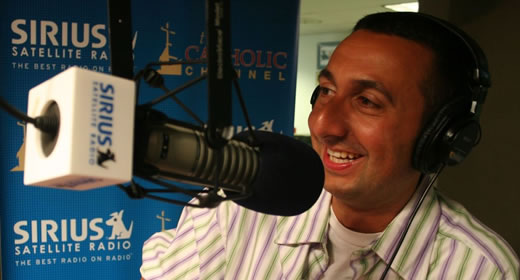
Kevin Wandra, "Santo Subito -- American Author Calls for His Own Sainthood, Now" (CNW, Sept. 4, 2013):
ATLANTA -- Widely known for his wit and humor as the host of "The Catholic Guy" on SiriusXM Radio, Lino Rulli believes that, like Pope John Paul II, his own Cause for Canonization should be addressed by Pope Francis immediately.
If Rulli has his way, he will be canonized on Divine Mercy Sunday, which, allegedly, is when Blessed Pope John Paul II and Pope John XXIII will be canonized in Rome. (The official announcement will be Sept. 30.) Rulli provides evidence for his Cause (and yours) in his latest book, SAINT: Why I Should Be Canonized Right Way, released this week from Servant Books....
And people accuse Latin Massers of being a bit weird?
Consider Adrienne von Speyr ...

Maureen Mullarkey, "Idolatry of Devout Ideas" (First Things, September 3, 2013) - excerpts:
The name of Hans Urs von Balthasar has become a kind of a code word among Catholics. Like the password to a speakeasy, it signals membership in a confidential circle on sequestered ground. Nonmembers have to tread carefully. Signs to “Keep Off the Grass” are everywhere. The lawn is beautifully kept.[Hat tip to JM]
At the risk of tripping over those staked warnings, I have to admit a high degree of nonplussment over the writings of Adrienne von Speyr and Balthasar’s drive to promote them. I spent the summer with Balthasar’s First Glance at Adrienne von Speyr, her Book of All Saints, her Confession, and The World of Prayer, each with an introduction by Balthasar. A curious phenomenon, von Speyr. Curiouser still is the aura of mimicry—Simone Weil speeds to mind—and nineteenth century spiritualism that accompanies her story. Equally nonplussing is the hagiographic obscurantism that marks Balthasar’s presentation of his protégée and alter ego....
... The impression of something insalubrious, askew, hovers over what is proffered as mystical insight. It is impossible to close Book of All Saints—which includes Balthasar’s verbal prompts to Adrienne in her visionary state—without gratitude that the Church does not require assent to private visions. The sensus fidelium is granted latitude for good reason. Credulity does faith no service. And skepticism, too, can be a gift of the Spirit. An astringent grace.
A hyper-suggestible female susceptible to the ascendent will of an authoritative male is the classic stuff of the literature of parapsychology. In this instance, it is also an invitation to consider the power of theology to seduce and the ways of an eminent theologian to mesmerize. At the same time, it beckons a glance at the corresponding fascination of a theologian with a living mirror of—and prod to—his own transformative ambitions.
Tuesday, September 03, 2013
"Seminarian Class Assignment"
From our undercover agent we keep on retainer in a dark northeaster city that knows how to keep its secrets, Guy Noir, Private Eye, comes this (slightly edited) missive:
Seminarian Class Assignment:[Hat tip to JM]
Read the following link: "Tampa church evicts Scout troop over decisions on gays" (Tampa Tribune, August 29, 2013).
Discussion Question:
Can any Catholic Leaders be described as 'conservative' in the sense of the word that would make one think they would support the congregation under fire in this article? How does this relate to the Question of Religious Liberty?
"The Liberal Protestant Future of Catholic Dissent"
by Tom Piatak, "The Liberal Protestant Future of Catholic Dissent" (Crisis, August 13, 2013):
Related: "Austrian 'Called to Disobedience' founder to be hosted by Fr. Bechard at Saints Simon and Jude in Metro Detroit" (Musings, June 18, 2013).
One of the many memorable scenes in David Lean’s Doctor Zhivago features Zhivago’s family fleeing the ugliness and brutality of Moscow after the Bolshevik Revolution for the tranquility of the family’s country estate in Varykino. Upon reaching the estate after an arduous journey, Zhivago’s father-in-law, Alexander Gromeko, finds the main house boarded up, with a notice affixed to the door. After reading the notice, he cannot contain his exasperation: “A body, styling itself the Yuriatin Committee of Revolutionary Justice, has expropriated my house. In the name of the people. Very well. I’m one of the people, too!”[Hat tip to JM[
I know how Gromeko felt. I recently attended a lecture at the Cleveland City Club by Helmut Schuller, a dissident Austrian priest who just finished touring the United States to promote his plan to dramatically refashion the Catholic Church so that it is more in line with Schuller’s opinions. Schuller claims to be acting in the name of “the People of God,” a phrase he repeated many times in Cleveland. As a baptized Catholic, I’m one of the People of God, too. But I no more gave Schuller authority to speak in my name than Gromeko gave the Bolsheviks authority to steal his house. And despite fawning coverage from such venues as The New York Times, NPR, Reuters, and the National Catholic Reporter, most of Schuller’s speeches were attended by crowds of no more than a few hundred, or less than the number who attend Mass each Sunday at a typical suburban parish. Read more >>
Related: "Austrian 'Called to Disobedience' founder to be hosted by Fr. Bechard at Saints Simon and Jude in Metro Detroit" (Musings, June 18, 2013).

Monday, September 02, 2013
Duelling musical traditions
As Fr. Z says: You decide, discuss, all of you who have the "courage to enter the song"!
[Hat tip to GM, via Fr. Z]
Sunday, September 01, 2013
Blessed Sacrament Cathedral Mass Report
Tridentine Community News (September 1, 2013):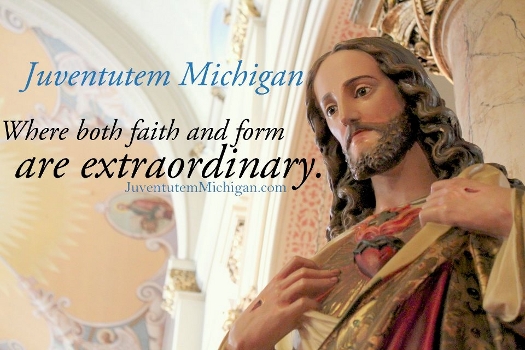
History was made this past Friday, August 30, as the first Tridentine Mass in over 40 years was offered at Detroit’s Blessed Sacrament Cathedral. Auxiliary Bishop Donald Hanchon celebrated his first Mass in the Extraordinary Form, assisted by Juventútem Michigan Clerical Guide Fr. Lee Acervo. His Excellency remarked afterwards at how pleasantly surprised he was to see so many young people interested in the historic liturgy.
Assisting in choir were several well-known local celebrants of the Extraordinary Form, including Fr. Peter Hrytsyk, who provided parts of the vestment set used for the Mass, Fr. Mark Borkowski, Msgr. Ronald Browne, and Fr. David Bechill. Music was provided by an impressive group of singers gathered for this Mass, under the direction of Joe Balistreri [who took the above photo]. Special thanks to Diane Begin for the many days spent creating the altar frontal [cloth] that lent a traditional appearance to the modern freestanding altar.
Sacred Heart Major Seminary to Offer Training on the Extraordinary Form
On the heels of the Cathedral Mass comes word that Detroit’s Sacred Heart Seminary will host a training symposium on the Extraordinary Form October 10-13, to be provided by priests from the Society of St. John Cantius in Chicago. Third and fourth year Theology seminarians and priests of the Archdiocese of Detroit are invited to participate. We congratulate Sacred Heart Seminary for taking this first, important step in exposing the Classic Liturgy to interested future and current clergy.
For those who cannot spare the time or money for a multi-day symposium, priest and deacon training by members of the Windsor Latin Mass Community is available at no charge to all clergy of the Archdiocese of Detroit, the Diocese of London, and the Diocese of Lansing. Bishop Hanchon, for example, availed himself of this local resource to prepare for this past Friday’s Mass. Interested clergy can e-mail the below address for details.
Reminder: First Saturday Masses Debut This Saturday
We invite our readers to attend St. Hyacinth Church’s new First Saturday Tridentine Low Masses. Five First Saturday Masses have been scheduled, beginning with this Saturday, September 7 at 9:00 AM. Confessions will be available before Mass, and the Rosary will be prayed. The celebrant for the first Mass will be Fr. David Bechill.
Episcopal Vicar Fr. James Roche to Celebrate Mass on September 15
On Sunday, September 15, Episcopal Vicar of Windsor Fr. James Roche will be the guest celebrant of the 2:00 PM Tridentine Mass at Assumption Church. Fr. Roche will make the formal proclamation of establishment of the St. Benedict Tridentine Catholic Community on behalf of Bishop Fabbro. A reception will follow Mass in the social hall under Rosary Chapel. As this column has many times made mention, Fr. Roche has been a great friend to the Latin Mass over the years, assisting quietly behind the scenes on matters major and minor.
The Tridentine Mass: An Egalitarian Liturgy
In our ongoing effort to set the record straight on misconceptions regarding the Tridentine Mass, today we present a quote from Pope Emeritus Benedict / then-Cardinal Ratzinger’s Spirit of the Liturgy:“The turning of the priest toward the people has turned the community into a self-enclosed circle. In its outward form, it no longer opens out on what lies ahead and above, but is locked into itself. The common turning toward the East was not a ‘celebration toward the wall’; it did not mean that the priest ‘had his back to the people’: the priest himself was not regarded as so important. For just as the congregation in the synagogue looked together toward Jerusalem, so in the Christian Liturgy the congregation looked together ‘toward the Lord’.”Our Holy Father Emeritus makes an interesting point which suggests a possible promotional angle for the Classic Liturgy: In this age when democratic and egalitarian ideals are trumpeted, one could talk about the Traditional Latin Mass as a form of worship of Almighty God in which the prayers and orientation of priest and congregation are uniquely in unison. All face God at the altar; everyone’s prayer, and not the celebrant per se, is the focus.
Tridentine Masses This Coming Week
- Mon. 09/02 7:00 PM: Low Mass at St. Josaphat (St. Stephen of Hungary, King & Confessor)
- Tue. 09/03 7:00 PM: Low Mass at Assumption-Windsor (St. Pius X, Pope & Confessor)
- Wed. 09/04 12:00 Noon: High Mass at Shrine of Our Lady of Consolation, Carey, Ohio (Votive Mass of Our Lady of Consolation) – For bus tour registration, call (248) 250-6005
- Fri. 09/06 7:00 PM: Low Mass at St. Josaphat (Votive Mass of the Sacred Heart of Jesus) – First Friday
- Sat. 09/07 9:00 AM: Low Mass at St. Hyacinth, Detroit (Immaculate Heart of Mary) – First Saturday Mass with Confessions and Devotions
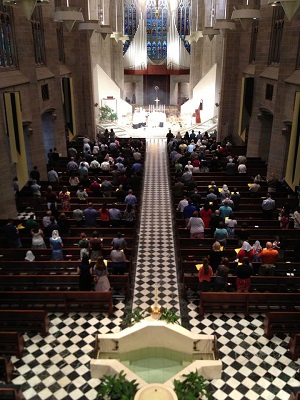
Book review: Michael Gillespie's The Theological Origins of Modernity

 My son, Christopher, just sent me an email today from New York where he lives, in which he relates (I'm quoting by permission):
I finished [Michael Allen] Gillespie's The Theological Origins of ModernityFrom his blog review, Against the Grain, Christopher quotes the fundamental thesis of Gillespie from the book:
He turns the conventional reading of the Enlightenment (as reason overcoming religion) on its head by explaining how the humanism of Petrarch, the free-will debate between Luther and Erasmus, the scientific forays of Francis Bacon, the epistemological debate between Descarte and Hobbes, were all motivated by an underlying wrestling with the questions posed by nominalism, which dismantled the rational God-and-universe of scholasticism and introduced (by the Franciscans) a fideistic God-of-pure-will born of their concern that anything less than such would jeopardize God's omnipotence -- subsequent intellectual history is in Gillespie's reading a grappling with the questions of free will and divine determinism; Protestantism involved at its core fidiestic, denying of free will will in order to preserve God's absolute power. However, this in turn culminated in an ambivalence about salvation. If God simply wills whom to save, human action then has no real merit or significance (Luther's "sin boldly"). Gillespie's chapter on the Erasmus-Luther was among the most interesting in bringing this out. Also fascinating was his discussion of Descartes and Hobbes -- the latter usually depicted as an atheist and his philosophy as chiefly political -- as sincerely religious, and revealing the underlying metaphysical concerns behind his thought. And so Gillespie says, even in modern times, we are bequeathed with a similar wrestling with modernity's political ambitions to increasing freedom and the inability to reconcile this with science's inherent determinist worldview. Likewise, in the post-9/11/ confrontation with Islam (which makes a brief appearance at the end) we are again confronted with the pure will and absolutism of Islam which sees the West's assertion of "individual autonomy" / free will as a challenge to God's omnipotence, for whom our only response is obedience.
...the apparent rejection or disappearance of religion and theology in fact conceals the continuing relevance of theological issues and commitments for the modern age. Viewed from this perspective, the process of secularization or disenchantment that has come to be seen as identical with modernity was in fact something different than it seemed, not the crushing victory of reason over infamy, to use Voltaire’s famous term, not the long drawn out death of God that Nietzsche proclaimed, and not the evermore distant withdrawal of the deus absconditus Heidegger points to, but the gradual transference of divine attributes to human beings (an infinite human will), the natural world (universal mechanical causality), social forces (the general will, the hidden hand), and history (the idea of progress, dialectical development, the cunning of reason)....Christopher cites Lee Trepanier's concise summary of the intellectual path Gillespie takes to demonstrate his thesis (University Bookman), delving into the thought of Petrarch and the significance of the debates between Luther and Erasmus, Descartes and Hobbes as they grappled with the theologic implications of nominalism.
That the deemphasis, disappearance, and death of God should bring about a change in our understanding of man and nature is hardly surprising. Modernity ... originates out of a series of attempts to construct a coherent metaphysic specialis on a nominalist foundation, to reconstitute something like the comprehensive summalogical account of scholastic realism. The successful completion of this project was rendered problematic by the real ontological differences between an infinite (and radically omnipotent) God and his finite creation (including both man and nature).
Apart from finding the last chapter "a bit rushed and inconclusive" (the post-9/11 spectre of Islam makes a cursory appearance at the end, but isn't adequately elaborated), he calls Gillespie's revisionist intellectual history of modernity and "immensely informative" and "provocative challenge to the conventional, secular reading of history." Sounds interesting. Read more on Christopher's blog >>
Dr. Taylor Marshall: FREE e-book on Mary Mediatrix of all Graces & tips on praying the Family Rosary
Another FREE e-book by Dr. Taylor Marshall HERE (the pdf is HERE).
It's only 16 pages, but covers: (1) tips for praying the Family Rosary, (2) the theology of Marian Mediation, and (3) the theology of Consecration to Mary.
Here is an excerpt of the Twelve Tips for Praying the Family Rosary Daily, which offers an example of the practical dimension of the book:
Some good thoughts here. Hat tip to Dr. Taylor.
It's only 16 pages, but covers: (1) tips for praying the Family Rosary, (2) the theology of Marian Mediation, and (3) the theology of Consecration to Mary.
Here is an excerpt of the Twelve Tips for Praying the Family Rosary Daily, which offers an example of the practical dimension of the book:
- Pray using alternation (The father prays first half of Our Father and everyone else prays second half - same goes for Hail Mary and Glory be).
- Pray the Rosary after dinner but right before bed - this means homework needs to be finished before dinner. Homework kills the Rosary if you don't stay on top of it. You'll also need to say goodbye to watching prime time television - since this is the ideal window of praying together as a family.
- Pray the Holy Rosary always at the same place at the exact same time. Devotions become strong - even invincible - by constant custom and habit.
- Pray the Rosary in a special room and set up a little altar with a Bible on it, candles, a statue or image, holy water, or a relic.
- Dim the lights and light the candles when you begin. If you let the little ones light the candles - they will love it. Kids love fire. Make this a "special time" different from other times. We even burn incense on our domestic altar on feast days. (You can do this easily by placing a little metal screen over a votive candle and then by placing a few grains of incense on the screen. It's fast and easy. This way you don't have use charcoal.)
- Maybe begin with a hymn or Bible reading to slow things down and set the tone.
- The father sets the example. I recommend that the father kneel for the whole Rosary. This communicates importance and solemnity to the Rosary. Children attach importance to what dad does, e.g. mowing lawn, going to work, driving the "dad car," etc.
- Make it a rule that the child who prays all the responses and volunteers to lead a mystery (10 beads) gets to stay up 10 minutes more than everyone that night - at our house this means you get to watch baseball or have a book read to you. This may be the most important tip. Kids under 7 or 8 need this sort of incentive. If you tell a 6 year old, pray the Rosary so that you receive grace and sanctity - they don't get it. If you say, pray the Rosary so that you can stay up and read a book with me - they'll hit their knees and pray like angels.
- The one who gets to stay up also gets to blow out the candle at the end. This gives another incentive to pray the prayers - especially for the younger ones. For some reason, blowing out the candle is a really big deal to younger children. (Kids love fire!!!). You'd be amazed how a four year old will attempt to stay still if he can only place a grain of incense on a flame or blow out a candle. (Did I mention that kids love fire?)
- End with invoking everyone's patron saint (your children's names, confirmation names, and other patrons). E.g. "Saint Thomas: pray for us. Saint Jude: pray for us. Saint Anne: pray for us." Always finish with St Joseph and then Holy Mary Mother of God. Then say "Sacred Heart of Jesus: have mercy on us," three times. If you're shooting for the plenary indulgence, make sure to pray an Our Father and Hail Mary for the Pope.
- If family Rosary is new, start with one decade for a week. Then go to three for a week. Then go to five decades on the third week. Then don't ever stop.
- After the daily Rosary is established in your home, have each child announce a mystery and pray the whole decade. This gives them confidence in praying and makes it natural. Plus, they'll learn to memorize all the mysteries of the Holy Rosary - which means they will have memorized the biblical account of Christ's life, death, and glory! This is why the Rosary is called "the Bible on beads."
Some good thoughts here. Hat tip to Dr. Taylor.
Catholic descendant of Charles Darwin
From Ed West (Catholic Herald, UK, June 13, 2013) via Laura Keynes , "I’m a Direct Descendant of Darwin ... and a Catholic"
(Strange Notions):
"Are you related to the economist?” people sometimes ask when they see my surname. I explain that, yes, John Maynard Keynes is my great-great-uncle—his brother Geoffrey married Margaret Darwin, my great-grandmother. “So you’re related to Darwin too?” Yes, he’s my great-great-great grandfather. Eyes might fall on the cross around my neck: “And you’re a Christian?” Yes, a Catholic. “How does a Darwin end up Catholic?”[Hat tip to Dr. E. Echeverria]
The question genuinely seems to puzzle people. After all, Darwin ushered in a new era of doubt with his theory of evolution, and the Bloomsbury Group, of which Keynes was a part, influenced modern attitudes to feminism and sexuality. How can I be a product of this culture, and yet Catholic? The implication is that simple exposure to my ancestors’ life work should have shaken me out of my backwards error.
I’m a product of what Noel Annan called “the intellectual aristocracy”, the web of kinship uniting British intellectuals over the 18th to 20th centuries....
Subscribe to:
Posts (Atom)