Sunday, January 27, 2013

Tridentine Masses at the March for Life


"I will go in unto the Altar of God
To God, Who giveth joy to my youth"

Tridentine Community News (January 27, 2013):
With each passing year, the Extraordinary Form takes on an increasingly prominent role during the annual March for Life in Washington, DC. This is a logical and welcome development, given the long track record of participation in the March for Life by members of Extraordinary Form communities from across North America.

This year, the March took place this past Friday, January 25. We are aware of at least three Extraordinary Form Masses being held, all at St. Mary Mother of God Church. St. Mary’s is the longtime home of the Tridentine Mass in Washington; prominent attendees include Pat Buchanan and Supreme Court Justice Antonin Scalia.

At 7:00 AM there was a Low Mass.

At 8:00 AM, the Paulus Institute organized a Missa Cantata honoring Nellie Gray, the recently deceased founder of the March for Life. Ms. Gray was a regular at St. Mary’s Tridentine Mass.


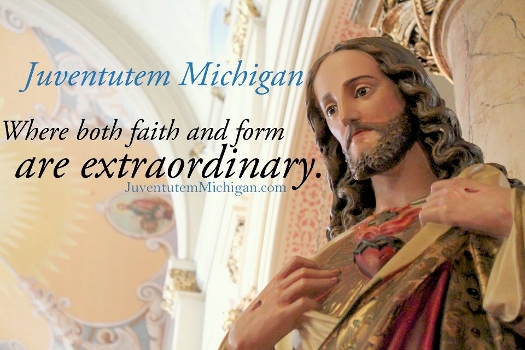
Our region was represented in a big way: At 6:00 PM, the intrepid Paul Schultz of Juventútem Michigan organized a Pontifical Solemn Mass celebrated by Chicago Auxiliary Bishop Joseph Perry. Our very own Wassim Sarweh was the organist and led the Gregorian Chant. Pictures of the Mass were just starting to be posted at press time; the above panoramic photo taken by Fr. Z for his blog www.wdtprs.com depicts a standing-room only congregation. Well done, Paul and Wassim!

Vatican to Issue Document with Norms for Celebrating Mass in the Ordinary Form

On January 16, the Zenit news agency reported that the Congregation for Divine Worship will be issuing a “Manual to Help Priests Celebrate Mass”, with an intended publication date this summer. While this document is clearly aimed at celebrations of the Ordinary Form of Holy Mass, it is noteworthy for stressing continuity with elements of the Extraordinary Form.

Cardinal Antonio Cañizares, the Prefect of the CDW, was quoted as criticizing “showmanship” in the celebration of Sacred Liturgy. He said that Mass does not need to be celebrated facing the people and mentioned the option of the priest facing [liturgical] East at the altar, citing the example of Pope Benedict XVI celebrating the Ordinary Form ad oriéntem in the Sistine Chapel. His Eminence also critiqued the relegation of the tabernacle to a side altar or side chapel.

A full and fascinating report on this forthcoming document is available at: http://www.zenit.org/article-36355?l=english

University of Windsor Campus Ministry to Visit Assumption’s Tridentine Mass

On Tuesday, February 12, the University of Windsor Catholic Campus Ministry is hosting a “Tridentine Mass Experience”, in which students will be taken to Assumption Church’s Tuesday 7:00 PM Tridentine Mass. That evening the Mass will be a High Mass, to expose the students to a full sung liturgy. All are invited to attend the Mass; our guests may well appreciate guidance through the Mass from experienced Latin Mass-goers.

Following the Mass there will be a discussion for students about the Extraordinary Form at Assumption University, on the south side of the parking lot from Assumption Church. Thanks are due to campus minister Fr. Chris Valka, CSB for organizing this event and for designing a beautiful advertising poster featuring a photo of a Solemn High Mass. Campus Ministry is a major enterprise at the University of Windsor, with numerous events, an active social media presence, and a Sunday evening campus Mass that attracts up to 600 people.

Blessing of Throats Next Sunday

After Holy Mass next Sunday, February 3 at Assumption-Windsor and Holy Redeemer, blessing of throats for the Feast of St. Blaise will be held. The candles used for the blessing, as well as throats, will be blessed using the Traditional Roman Ritual.

Tridentine Masses This Coming Week
  • Mon. 01/28 7:00 PM: Low Mass at St. Josaphat (St. Peter Nolasco, Confessor)
  • Tue. 01/29 7:00 PM: Low Mass at Assumption-Windsor (St. Francis de Sales, Bishop, Confessor, & Doctor)
  • Sat. 02/02 11:00 AM: High Mass at Ss. Peter & Paul (west side), Detroit (Purification of the B.V.M., with Candlemas procession)
  • Sun. 02/03 2:00 PM: High Mass at Holy Redeemer (Sexagésima Sunday)
[Comments? Please e-mail tridnews@detroitlatinmass.org. Previous columns are available at http://www.detroitlatinmass.org. This edition of Tridentine Community News, with minor editions, is from the St. Josaphat (Detroit) and Assumption (Windsor) bulletin inserts for January 27, 2013. Hat tip to A.B., author of the column.]

Saturday, January 26, 2013

Septuagesima Sunday

"Septuagesima Sunday" ...
... is the name for the ninth Sunday before Easter, the third before Ash Wednesday. The term is sometimes applied also to the period that begins on this day and ends on Shrove Tuesday [Fat Tuesday, Mardi Gras], the day before Ash Wednesday, when Lent begins. This period is also known as the pre-Lenten season or Shrovetide. The other two Sundays in this period of the liturgical year are called Sexagesima and Quinquagesima, the latter sometimes also called Shrove Sunday. The earliest date on which Septuagesima Sunday can occur is January 18 (Easter falling on March 22 in a non-leap year) and the latest is February 22 (Easter falling on April 25 in a leap year).
See Catholic Encyclopedia article here.

Tuesday, January 22, 2013

Anniversary of 40 yrs. of open season on baby killing

... and Robert George says he's "moderately pro-choice"!!

In remembrance of National Right To Life Day, celebrated every January 22nd on the annual anniversary of the Supreme Court decision legalizing abortion, Roe vs. Wade (1973), and in honor of the tens thousands of protesters who annually drive to Washington, D.C., to march from the Washington Monument to the Supreme Court, lobby senators, and get themselves ignored by the media in favor of the eight or nine abortion-rights activists who manage to come out and get themselves interviewed on national television, it seemed only decent and proper to come up with a "thought for the day" of some kind before stepping on the bus for D.C. tomorrow morning. Accordingly, I've retrieved from my files the following quotation from Princeton professor, Robert P. George:

I am personally opposed to killing abortionists. However, inasmuch as my personal opposition to this practice is rooted in sectarian (Catholic) religious belief in the sanctity of human life, I am unwilling to impose it on others who may, as a matter of conscience, take a different view. Of course, I am entirely in favor of policies aimed at removing the root causes of violence against abortionists. Indeed, I would go as far as supporting mandatory one-week waiting periods, and even non-judgmental counseling, for people who are contemplating the choice of killing an abortionist. I believe in policies that reduce the urgent need some people feel to kill abortionists while, at the same time, respecting the rights of conscience of my fellow citizens who believe that the killing of abortionists is sometimes a tragic necessity--not a good, but a lesser evil. In short, I am moderately "pro-choice."

[Legal disclaimer: Dr. Robert P. George is George McCormick Professor of Jurisprudence at Princeton University, a graduate of Harvard Law School, and earned his doctorate in philosophy of law at Oxford University. Just in case anyone is wondering, the foregoing statement by him is not intended to be taken at face value, but as a parody and reductio ad absurdum refutation of the fallacious reasoning employed pervasively by proponents of a "pro-choice" position favoring "abortion rights." I offer this explanation not to insult your intelligence, but only because I have learned to cover my bases: given our times, there is no telling who might mistakenly and foolishly think we're endorsing the killing of abortionists. We're not. We're pro-life!]

Sunday, January 20, 2013

"My Initial Doubts about the Latin Mass"

A reader called my attention this post, hands down one of the best introductions to the Extraordinary Form of the Mass I've seen, and called it "Sesame Street and the Apian Way" (you'll see why).

But Dr. Taylor Marshall, calls his post, "My Initial Doubts about the Latin Mass" (Canterbury Tales, January 8, 2013); and the following is his article:

Then Cardinal Ratzinger Celebrating the Latin Mass

By now it's no secret that I attend the Latin Mass and that I am the Chancellor of a College that offers the Latin Mass seven days a week - Fisher More College. However, I've not always been partial to the Latin Mass. For a few years after my conversion to the Catholic Faith, I was cautiously curious about the the "old Mass." I perceived it as exotic, antiquarian, and even as a dangerous. Although I had some esteem for the "old liturgies," I was not convinced of the merits of the Latin Mass and the culture, which for better or worse, surrounds it.

* * * * * * *

"The Latin Mass is like beer. You have to drink it in
a few times to like it."


* * * * * * *


My wife and I starting taking our family to the Latin Mass around Feast of the Ascension of 2010. Before we made this move, however, I had some serious misgivings about the Latin Mass, which we also call the Extraordinary Form of the Roman Rite. Our concerns were some of the common concerns that others still have and voice regularly. I cannot speak for everyone, but I'd like to go through my own personal misgivings about the Latin Mass and then explain how I overcame them, or, to be blunt, learned to live with them.

What caused our family to make the move?

"Disinviting God to the Inauguration"


How jolly decent of them! How discreet and diplomatic!! God would be such an embarrassment, after all. Where would you seat Him? Could the hide Him in the back row?


The left demands an inaugural event without the Bible or prayers. Check out George Neumayr's ripping article in the American Spectator (January 16, 2013).

[Hat tip to J.M.]

Extraordinary Community News


"I will go in unto the Altar of God
To God, Who giveth joy to my youth"

Tridentine Community News (January 20, 2013):
Recommended Books

From time to time we bring to the attention of our readers some books that may be of interest.

The Baronius Press Breviary


The long-anticipated three-volume Breviary from Baronius Press is finally shipping, albeit in fits and starts as demand continues to exceed supply. Derived from the 1963 Collegeville Breviary, this is the first comprehensive Latin/English Breviary to be published for the Extraordinary Form Divine Office in 50 years.

A copy of the booklet Learning the Traditional Breviary is included with each order, to help those users who are new to the Divine Office to understand and pray it.

On the plus side, there is no more up-to-date, more comprehensive, more thoroughly proofread Breviary available from anyone else. For those intending to pray the official Latin text of the Divine Office, this edition is the best one available today.

Some readers may be disappointed to discover that the Confraternity translation of the Bible was used. The majority of hand missals and other liturgical books in English employ the Douay-Rheims translation of Sacred Scripture. The former lacks the “thee and thou” formality of the latter. However, this is a small gripe as Article 32 of the May, 2011 Vatican document Univérsæ Ecclésiæ clarifies that the Extraordinary Form Breviary may not be prayed in the vernacular by those obliged to pray the Divine Office. The English is a reference, not a liturgical text. Laypeople who pray the Divine Office by choice rather than by obligation may arguably pray the vernacular side, but equally arguably, that would be crossing the boundaries of what the Church understands to constitute the official EF Divine Office.

The Knox Bible

A reader who happens to be a biblical scholar suggested that we point out another new offering from Baronius Press: their new reprint of the Knox Bible. Comprised of a translation from the Latin Vulgate by Msgr. Ronald Knox of the New Testament, completed in 1945, and the Old Testament, completed in 1950, the Knox Bible is best known as the source of the English translations of the readings and Propers in Masses in England from the mid 1960s through the early 1970s. Certain Latin-English hand missals for the Tridentine Mass printed in England such as the recently reprinted Layman’s Missal take their translations of Sacred Scripture from the Knox Bible. Some find the Knox Bible more accessible than the Douay-Rheims, while others critique the “dynamic equivalence” philosophy used in its translations. It is certainly a translation worthy of study.

The Raccolta


On several occasions this column has mentioned the USCCB’s 2006 edition of the Manual of Indulgences and the official Latin text on which it is based, the 2004 Enchíridion Indulgentiárum published by Libreria Editrice Vaticana. It is important for readers to understand that there is no distinction between Ordinary and Extraordinary Forms with regards to the list of prayers and acts which are enriched by Holy Mother Church with Indulgences. That being said, readers may still be interested in perusing the pre-Vatican II edition of the same book, Loreto Publications reprint of the 1957 edition of The Raccolta. While the statements of which prayers earn indulgences are no longer valid, the prayers themselves are a solid, meritorious collection. The Raccolta is a little less reader-friendly than The Blessed Sacrament Prayerbook or Blessed Be God, two popular reprinted collections of traditional prayers and devotions, but its presentation of the Latin original text of many of the prayers alongside the English is welcome and convenient.

St. Hyacinth Mass

The next Tridentine High Mass at Detroit’s St. Hyacinth Church will be held on Sunday, February 10 at 1:00 PM. The celebrant will be Fr. Pieter van Rooyen.

Tridentine Masses This Coming Week
  • Mon. 01/21 7:00 PM: Low Mass at St. Josaphat (St. Agnes, Virgin & Martyr)
  • Tue. 01/22 7:00 PM: Low Mass at Assumption-Windsor (Ss. Vincent & Anastasius, Martyrs)
[Comments? Please e-mail tridnews@detroitlatinmass.org. Previous columns are available at http://www.detroitlatinmass.org. This edition of Tridentine Community News, with minor editions, is from the St. Josaphat (Detroit) and Assumption (Windsor) bulletin inserts for January 20, 2013. Hat tip to A.B., author of the column.]

Saturday, January 19, 2013

Altar boys: meant to be icons of reverence, pointing us to Christ


Related: "And they don't even charge admission!" (Musings, January 18, 2009) -- This is a post on what I like about the prescribed gestures of the priest and servers in the Mass of the Traditional Latin Rite -- even a Low Mass, such as that which I describe here. Every gesture conspires, not to distract, but to draw one's attention to Christ Crucified and Glorified.

Just look at the posture of the servers below! They are saying the Confíteor during the Prayers at the Foot of the Altar. Where do you see anything like that in our Novus Ordo liturgies? We should! The example from the video above looks like an ad orientem Novus Ordo liturgy.


Reverence should be embodied! If our outward comportment suggests a casual bonhomie and indifference to the Presence of Christ the King in our midst, why should we be surprised at the attitudes we encounter among Catholics these days?

[Hat tip to Fr. Z.]

Msgr. Trapp on how to start a life of prayer


This is good advice, not only for the agnostic or cradle Catholic (hopefully those are not synonymous these days!) who has never before thought about how to pray, but for the person trying for the first time to make a Holy Hour in front of our Lord in the Blessed Sacrament.

The prayers we learn as children and even as adults from Mother Church are the bread and butter of our prayer life. But our prayers must also be animated by a trusting confidence in our Heavenly Father such as Jesus assumed when He taught His disciples to pray, beginning with the words, "Abba," "Father."

The key to the sacramental view that suffuses the Catholic perspective is the meeting of flesh with spirit, the outer with the inner, words and faith. One's "experience" of God must never come untethered from the prayers of the Church, particularly in corporate liturgical prayer; but neither must the words we utter become detached from a personal trust.

"And without faith it is impossible to please him. For whoever would draw near to God must believe that he exists and that He rewards those who seek Him." (Heb. 11:6)

Hilarious: "After the third kid, people stop congratulating you"


[Hat tip to John Lajiness via FB]

SSPX update: Di Noia sends letter to fraternity priests

... via Menzingen (Rorate Caeli, January 18, 2013).

Update: Rorate Caeli reports (January 21, 2023 -- European time) that Jean-Marie Guénois, religious correspondent for French daily Le Figaro, made public today the full text of the letter sent by the Vice-President of the Pontifical Commission Ecclesia Dei, Abp. Di Noia, to the Superior General of the Society of Saint Pius X, Bp. Fellay, and all the priests of the Society. The full French text (a translation of an originally English document) of the lengthy appeal is published on the Rorate website here.

Abp. Schneider: Dignitatis Humanae is a fall-back position

The position on religious liberty of the Vatican II document is "understandable," though ultimately not viable:


[Hat tip to Rorate Caeli]

Friday, January 18, 2013

Chicago Bus Tour Report


"I will go in unto the Altar of God
To God, Who giveth joy to my youth"

Tridentine Community News (January 13, 2013):
For the second year in a row, the Christmas week bus tour of historic churches in Chicago was an inspiration to all who participated. Every church toured was architecturally suited for hosting the Tridentine Mass, and in fact, two of them did!


Immaculate Conception Chapel, Mundelein Seminary

As expected, the liturgical highlight of the trip was the Tridentine High Mass at the glorious St. Mary of the Angels Church, photos of which have appeared in earlier editions of this column. Vespers was offered at the modest, modern Residence Chapel at Mundelein Seminary. A Tridentine Low Mass was offered on Friday morning at the left side altar in Mundelein’s main Immaculate Conception Chapel (above photo by Kyle Lee).

Additional architectural highlights included Marytown’s main chapel (pictured at left) and Sorrowful Mother Chapel; the art deco-ish Queen of All Saints Basilica (see below, first photo); St. Hyacinth Basilica; and of course St. John Cantius Church.

A particularly impressive site was Our Lady of Sorrows Basilica (see below, middle photo), a cavernous church with a barrel-vaulted ceiling best known as the site of the black-and-white video of a Solemn High Mass narrated by Archbishop Fulton Sheen. Our Lady of Sorrows sports an enormous High Altar, seemingly even wider than the one at Detroit’s St. Albertus Church, along with an incredible thirteen Side Altars. Two of those Side Altars are sizable ones against the left and right transept walls, almost as large as the High Altar; the others are contained in individual, themed chapels intended for the celebration of private Masses (see below, last photo).


Queen of All Saints Basilica


Our Lady of Sorrows Basilica


Side chapels inside Our Lady of Sorrows Basilica

If you would like to see some of these remarkable edifices yourself, set aside the week between Christmas and New Year’s for the 2013 edition of this tour.

Tridentine Masses This Coming Week
  • Mon. 01/14 7:00 PM: Low Mass at St. Josaphat (St. Hilary, Bishop, Confessor, & Doctor)
  • Tue. 01/15 7:00 PM: Low Mass at Assumption-Windsor (St. Paul the First Hermit)
  • Sat. 01/19 Noon: High Mass at St. Albertus (Wedding of Rich Kowalewski & Iwona Kur – All are invited)
  • Sun. 01/20 Noon: High Mass at St. Albertus (Second Sunday After Epiphany)
[Comments? Please e-mail tridnews@detroitlatinmass.org. Previous columns are available at http://www.detroitlatinmass.org. This edition of Tridentine Community News, with minor editions, is from the St. Josaphat (Detroit) and Assumption (Windsor) bulletin inserts for January 13, 2013. Hat tip to A.B., author of the column.]

Thursday, January 17, 2013

Lethal weapons: Guns, Cars, and Uterine Currettes


Kudos to Matt Drudge!

It is a sad fact that, on average, about 80 Americans are killed each day in the Unites States by means of guns. It is sadder still that, on average, about 135 people are killed each day in automobile accidents. It is an altogether abominable fact that, on average, about 3,500 Americans are killed each day by trained technicians under government protection in tax-funded abortuaries -- and nobody even blinks.

There has been a lot of fevered hype about guns. I have heard no discussion of Uterine Currettes, Syringes with Spinal Needles, Forceps, Vacuum Aspirators, or Dubois' Embryotomy Decapitating Scissors -- the deadly instruments of abortion (reader advisory: graphic video).

And then, of course, there's this:


In memory of the countless victims of the holocaust . . .
Whoever saves one life ... saves the world entire.

Sunday, January 13, 2013

The Prescience of Pope Pius XII


"I am worried by the Blessed Virgin's messages to Lucy of Fatima. This persistence of Mary about the dangers which menace the Church is a divine warning against the suicide of altering the Faith, in her liturgy, her theology and her soul....

"I hear all around me innovators who wish to dismantle the Sacred Chapel, destroy the universal flame of the Church, reject her ornaments and make her feel remorse for her historical past.

"A day will come when the civilized world will deny its God, when the Church will doubt as Peter doubted. She will be tempted to believe that man has become God. In our churches, Christians will search in vain for the red lamp where God awaits them, like Mary Magdalene weeping before the empty tomb, they will ask, 'Where have they taken Him?'"

(1931 declaration by E. Cardinal Pacelli, quoted in the book, Pie XII devant l'histoire[Paris: Editions Robert Laffont, 1972], pp. 52-53, by Msgr. Georges Roche).

"Some of the culture vultures out there might want to read the Alypius incident"

A reader writes:
I have always had a thing for pop culture, but as I get older I am far more suspect of the merit of such an interest. A recent book out called Popolegtics (http://www.amazon.com/Popologetics-Popular-Culture-Christian-Perspective/dp/1596383895) received quite a lot of hype, and academics yearning to maintain connectedness and relevance with youth love such stuff. I know, I have too. The youth thing, though, is tenuous at best: one of the best parts of Amerio's Iota Unum dissects Paul VIs pandering to youth (harsh, but what else do you call this reaction to contemporary culture that remains a legacy within Catholicism from the Vatcian II era we are still stuck with?).

The impulse now seems more double-edged than ever, given the evolutionary arc of Youth Culture, as Carl Trueman here suggests. He continues to arrest me with his good insights, even if he does also recommend Diarmid MacCulloch (I posted a comment lamenting that over at IgnatiusScoop).

See this...

http://www.reformation21.org/blog/2013/01/proust-paglia-and-exit-wounds.php
What we see has the power to shape our souls in powerful, unconscious ways; and when that sight is pornographic, whether of a sexual or violent kind, it shapes them for ill. Augustine realised this and exposed it brilliantly in his account of how his friend Alypius was taken unwillingly to see the gladiatorial games. Alypius kept his eyes closed until one of the combatants suffered a terrible blow. The crowd roared. Alypius opened his eyes. And from that moment on he was hooked on the games far more than the friends who had dragged him there in the first place. The pornographic sight of the violence had reshaped his soul.

As a postscript, it might be that some of the culture vultures out there might want to read the Alypius incident before they line up to see the latest Tarantino offering, with all of its no doubt beautifully choreographed blood and artistically presented gore. Is there a Christian perspective on such? Yes. It says that thirty years from now you may not remember the individual moments when you told your wife or your children or your parents that you love them, or any of those random acts of kindness of which you were the agent or the recipient. You certainly will not recall the sermon you heard last Sunday. But you will probably remember the exit wounds, every last splash of them.
[Hat tip to J.M.]