China is set to overtake the U.S. in manufacturing this coming year. Peter Marsh writes, in "US manufacturing crown slips" (Financial Times, June 20, 2010): "The US remained the world’s biggest manufacturing nation by output last year, but is poised to relinquish this slot in 2011 to China – thus ending a 110-year run as the number one country in factory production." The figures come from a league table being published on Monday by IHS Global Insight, a US-based economics consultancy.
As Vladimir Lenin said in 1922: “The capitalists will sell us the rope with which we will hang them.” Or, as Lev Navrozov says, "China Provides Rope for U.S. to Hang Itself" (Newsmax.com).
Remember when "Made in China" meant crap? I can even remember when "Made in Japan" meant crap. Then one began seeing brand names like Sony, Nikkon, Honda, Toshiba, Mitsubishi, etc. Yet now the Japanese are laying off thousands. I just bought a first-class wireless modem from AT&T. The fine print read, of course, "Made in China." Is it possible to buy something that is NOT made in China anymore, besides a local microbrew? Before long, the United States may become China's BANANA REPUBLIC. Just imagine! Mao and Chou must be laughing in their graves.

Sunday, June 20, 2010
Beyond the New English Ordinary Form Missal: Other Issues With Approved Translations – Part 5
Tridentine Community News (June 20, 2010):
English in Non-Liturgical Prayers for the Laity:[Comments? Please e-mail tridnews@stjosaphatchurch.org. Previous columns are available at www.stjosaphatchurch.org. This edition of Tridentine Community News, with minor editions, is from the St. Josaphat bulletin insert for June 20, 2010. Hat tip to A.B.]
The Manual of Indulgences
Arguably the most official book of prayers for the lay Catholic is the Enchirídion Indulgentiárum. As the Latin edition is updated, corresponding English editions are produced. Unlike the Extraordinary Form Missal and Ritual, however, the pre-Vatican II Book of Indulgences is no longer an actively sanctioned edition. While the prayers it contains continue to be meritorious in their own right, the indulgences attached to them are no longer in force. The rules for Indulgences changed in 1968, and the list of specifically indulgenced prayers was shortened considerably. Still, it is instructive to compare the translations of prayers which have survived throughout successive editions. Note that while the English name for the Book of Indulgences has changed over time, the purpose remains the same.
As an example, let us compare the Prayer at the Beginning of the Day. First we present the most recent pre-Vatican II English version from 1957’s The Raccolta, reflecting the 1950 Latin edition:Lord God Almighty, who hast safely brought us to the beginning of this day, defend us in the same by thy mighty power, that this day we may fall into no sin, but that all our words may so proceed, and all our thoughts and actions may be so directed as to do always that which is just in Thy sight. Through Christ our Lord. Amen.The 1991 Handbook of Indulgences reflected the 1986 Latin edition. This book made extensive use of modern English, as one can see:Almighty God, you have given us this day: strengthen us with your power and keep us from falling into sin, so that whatever we say or think or do may be in your service and for the sake of your kingdom. We ask this through Christ our Lord. Amen.The 2006 Manual of Indulgences mirrors the 1999 Latin edition. Published by the U.S. Conference of Catholic Bishops, some of its prayers return to more traditional wording. Like the forthcoming English Ordinary Form Missal, it is a more literal translation of the Latin which restores subtlety and detail to the text. A few of the prayers, though not this one, even restore us of the hierarchical pronouns Thee and Thou:Lord, God Almighty, you have brought us safely to the beginning of this day. Defend us today by your mighty power, that we may not fall into any sin, but that all our words may so proceed and all our thoughts and actions be so directed, as to be always just in your sight. Through Christ our Lord. Amen.A quandary arises with all three of the editions of the book: In many instances, the actual text of the prayer is not published, but rather only a mention of its name. For example, the 1991 Handbook prints the entire Te Deum in (modern) English, while the 2006 Manual only mentions that recitation of the Te Deum gains an Indulgence. Like the 2006 book, The Raccolta only names the Te Deum. It is not clear whether a vernacular recitation of the Te Deum qualified for an indulgence pre-Vatican II. The recently reprinted 1925 prayer book Blessed Be God contains a Douay-Rheims-ish English Te Deum, so presumably it was not unheard of to recite that prayer in English. Which English version is authorized for use nowadays? Logic would suggest the most recent one, from 1991. But what if one does not possess the now-obsolete 1991 Handbook? If the authorized vernacular text is hard to come by, what version should one use?
Some may contend that these are issues of scrupulosity. Yet codified prayer must have a specified form. Conceivably, translations of the Te Deum could evolve that depart substantially from the original Latin text. At what point do they become improper to use? At what point might they no longer actually qualify to gain the attached indulgence?
It would make sense to have a more complete Manual of Indulgences, with the complete Latin text of prayers on the left, and the complete, authorized English text of prayers on the right. If we have to rely on the “most recent” translations to determine what is the authorized English form, we could be stuck with Elizabethan English from the Raccolta for one prayer, adjacent to very casual English from the 1991 Handbook for the next prayer. It’s enough to move one to pray the Latin forms – a fine idea, by the way – except even the original Latin Enchirídion Indulgentiárum suffers from the problem of only naming certain prayers, and not printing them out.
The recitation of prayers should not be a puzzle requiring juggling various books, one of which specifies the prayers, and another of which contains their contents. It’s one thing for a hand missal to specify that for a certain weekday Mass, one should use the Mass from page X along with the Epistle from page Y; this is understandable given that hand missals must be thick books. The 2006 Manual, however, is a relatively thin publication. Adding the actual prayer contents would not significantly thicken it. While this is not an issue strictly pertaining to the vernacular, the current English book has done little to improve convenient usage.
Note the difference between our desire for standard English in the Manual of Indulgences and our previous argument supporting varying translations of the Orations of the Extraordinary Form Mass: Holy Mass can only be said in Latin. There need not be an authorized English translation of the Collects, as there is no opportunity to use those English translations liturgically. English is used solely to help the worshipper follow along with the Mass. With regards to the Manual of Indulgences, however, the form of the vernacular prayer does matter, as one is permitted to pray the vernacular to earn the indulgence. While not “liturgical” per se, these are private prayers with names and forms. Public devotions employ some of them. Take, for example, the Salve Regína: with the possible exception of thee/you, the prayer has a definitive form, allowing it to be prayed essentially unchanged by any congregation.
Saturday, June 19, 2010
Funny if it weren't so downright painful ...
"Laura Ingraham Has Some Fun with SC Dem Candidate Alvin Greene" (Breibart.tv, June 18, 2010).
Fear and Loathing in Trans-Tea-Party-Mania
Here's an email I received recently from a reader (a friend with history and theology degrees from a grad school in Wisconsin). Whether you agree with the ideas or not, you've got to love these raw, free-flowing, shoot-from-the hip reflections. This one is on politics, sparked by a banal interview with Sen. Ben Nelson (D-Neb.) entitled "Sen. Nelson: Obama May Not Have Constitutional Authority, But He Has Moral Authority" (Breitbart.tv, June 18, 2010). Commenting on the interview, our reader writes:
The very real and immediate dangerous sense of moral v. legitimate authority.Then, as an addendum:
Tea Parties vary from region to region. I'm not a member of any of the Parties, and can relate to some local SC groups that espouse standing by the constitution, but there are revisionists out there. Perhaps even in Nebraska, Nelson being less than a footnote trying to cash in on those members. This was a political move, one of emotion, not a statement of authority alone (as a senator).
The greater debate and even real fight remains in what right v. what is right. These principles can merge and fade from each other depending on emotion, philosophic bearings, theological bearings. What we witness is the early percolation of, God forbid, a civil war--YES being demonstrated between the Tea Partiers. The extreme Left (not Partiers) are perpetual commies and anarchists. They will be of no account during such a fight, but are a threat as people become weakened. They enjoy filling easy gaps and will impose their will when people are certainly (not probably) weak. Note and brief aside: Have you wondered why Obama Inc., will not make serious effort to save the Gulf from as much disaster as possible? Because it is not in their interest to. They want the citizens to be reduced to not demands but begging the government to save the area and thus themselves. They await a populace ready for slavery.
And so Nelson stands in emotive qualities, desperate to be in collusion with a philosophically oriented group(s). How can we know? As the saying goes, "How does one know a politician is lying?"--"His lips are moving". He's a desperate man trying to be needed by a constituency. He is on the verge of being completely irrelevant or being a fellow apparatchik of Obama's Amerika. The die is cast.
As for the Tea Parties, their variation divides them but also identifies them as societal phenomena that appear to be at least philosophically-based. They are not and cannot stand as one. They are philosophically moved by regional needs followed by, sometimes closely, emotional impulse. Many are conservative or even Republican. They are the groups bent on constitutionalism. The tenet here is every man--more American philosophy of humanity. Many others are liberal in the 19th century sense (as my former political science professor would call it). They are more readily identified with the examples given in the article posted on your blog. They seek to stand up for the little guy, whether infant or retiree. The tenet here is all men--more Franco-European philosophy of humanity.
And so, will the Constitution stand? What will survive--every man OR all men? What will overcome--in what right OR what is right?
By the way, the two spectra of the Tea Parties are NOT ever completely reconcilable. Their sense of democracy/representative republic/human rights are incompatible. It is exactly---NOT IN PART--but exactly (okay minus the riding bootsies) the 19th century difference between the understanding of freedom in the US as opposed to the varying interpretations in Europe. See Theodore Roosevelt's concepts on this. He has essays on what it is to be a man, good citizenship, good living--these fall line for line in with American values. The European values are found from French revolutionaries to Marx. They ultimately exclude the value of the individual--some in very short order.[Hat tip to S.K.]
Nail, meet hammer
Christopher Orlet's aptly titled "Matrimonial Gore" (American Spectator, June 18, 2010) is well worth a read. Here are choice excerpts:
[Hat tip to J.M., including for the header.]
Apparently a lot of Americans were surprised ("saddened," "depressed" -- New Republic) by news that Al and Tipper Gore were, after 40 years of marriage, parting company. Everywhere neurotic married couples asked: "If the Gores can't make it, who can?"Read the whole thing. Well written.
Well, how about the Clintons? Even the Eliot Spitzers were still together, last time we checked. Many political marriages have weathered far worse. Think about the odd White House dynamic of FDR, his mistress Lucy Mercer, his wife Eleanor and her wife Lorena Hickok. Go back far enough and you find some perfectly awful political marriages that endured, but none worse than the Lincolns'. Mary Todd once spat in the face of the secretary of state. (Are you taking notes, Michelle?) After one of Mrs. Lincoln's hissy fits, the long-suffering Abe shrugged it off, saying, "It does her lots of good and it doesn't hurt me a bit."
In my grandparents' day marriage meant something.... Common folk were obliged to pledge their troth, for better or worse, till death do we part, and like it.
If things got really bad, the wife was expected to discretely poison her husband and then quietly shut herself up in her big Victorian house for the rest of her life. The townsfolk would tactfully turn a blank eye, figuring he doubtless deserved it, and for the next few months husbands could be expected to mind their Ps and Qs.
... Even the Gores' email announcement of their separation was boring, meaningless and phony, much like the Gores themselves, calling it a "mutual and mutually supportive decision that we have made together following a process of long and careful consideration."
This attitude of Me Generation egotism and goofy pop psychology was perfectly captured in an interview with Stephanie Coontz, author of Marriage: A History. She told NPR that the Gores' divorce shouldn't be viewed as a failure, but as a "success" and a "celebration of life." I wonder what Dr. Coontz thinks of the recession. "A celebration of government intervention!" The oil leak? "A celebration of blowout prevention technology!"
[Hat tip to J.M., including for the header.]
Beyond the New English Ordinary Form Missal: Other Issues With Approved Translations – Part 4
Tridentine Community News (June 13, 2010):
English in the Roman Ritual[Comments? Please e-mail tridnews@stjosaphatchurch.org. Previous columns are available at www.stjosaphatchurch.org. This edition of Tridentine Community News, with minor editions, is from the St. Josaphat bulletin insert for June 13, 2010. Hat tip to A.B.]
Some of the first efforts at establishing standard English translations for pre-Vatican II ceremonies related to the Rituále Románum, the book of Sacraments and Blessings. The Roman Ritual is the complement to the Missále Románum (the altar missal), and is used for everything from Baptism to Marriage to blessing Rosaries. In 1954, the U.S. bishops published the Colléctio Rítuum, an abridged version of the Ritual containing the most frequently used prayers and ceremonies. A revised Colléctio was published in 1961, and that is the book which is technically in force today for the Extraordinary Form. The 1961 edition granted the priest the option to say certain portions of some ceremonies in English.
The 1950 Weller edition of the complete 1925 Rituále Románum has been reprinted by PCP Books. The New Sanctuary Manual, a subset of the 1961 Colléctio Rítuum, has been reprinted by Roman Catholic Books. A comparison of the two is rather interesting.
The Weller Ritual provides English translations for the entire contents of the book. Latin is on the left page, English on the right. This English, however, was provided only for study purposes. At the time of publication, it was not permissible to use the vernacular for any portion of the rites. Thus, the English contained therein cannot be considered “official” and must not be used liturgically because of later permissions.
In contrast, The New Sanctuary Manual is very clear: English is provided alongside the Latin only when it is permissible (but optional) to use the vernacular. That English text is the official version to be used.
Fortunately or unfortunately, depending on your point of view, the 1961 English is noticeably more casual language that what Weller contains. Let us compare, for example, the prayer at the conclusion of the Rite of Marriage:
From the Weller Ritual:Look down, we beseech thee, O Lord, upon these servants of thine, and graciously assist with thy care the institution thou didst ordain for the propagation of the human race; so that they who are bound together by thy authority may attain to perfection by thy help. Through Christ our Lord.From The New Sanctuary Manual:We beg you, Lord, to look on these your servants, and graciously to uphold the institution of marriage established by you for the continuation of the human race, so that they who have been joined together by your authority may remain faithful together by your help. Through Christ our Lord.Interestingly, despite its more Douay Rheims-ish sounding text, the Weller version does not capitalize the Divine pronouns. In fairness, the issue of capitalization is a complex one, to be discussed at a later date.
As of today, the complete 1961 Colléctio Rítuum has not yet been reprinted. Used books are scarce. The best option available in print, The New Sanctuary Manual, is puzzlingly incomplete: For instance, it omits one of the most frequently used prayers, the Blessing of All Things, used to bless objects for which there is no specific blessing formula.
The Weller Ritual provides the Blessing of All Things, along with an English translation. However, unless a priest happens to possess an actual 1961 Colléctio, it is impossible to tell if one may use the vernacular for this blessing. An old copy of the 1961 book Rites, Blessings, and Prayers, which is a more complete version of the Colléctio, contains only Latin for this blessing, which tells us that English is not permissible.
What is a priest supposed to do if he does not have access to the complete 1961 Colléctio Rítuum? Can he use the English in the Weller Ritual? No, he cannot. First, Weller does not indicate which portions of a given rite may be said in the vernacular, since it predates those permissions. Second, Weller’s English translation is not official. Thus, if a priest does not possess a 1961 Ritual, prudence dictates that he use Latin for the entire ceremony.
The longer term solution is for the 1961 Colléctio to be reprinted, and possibly updated as we have suggested in earlier columns. One useful aspect of the Weller Ritual is that it includes the rubrics in English on the right-side pages. The New Sanctuary Manual and Rites, Blessings, and Prayers contain only the Latin rubrics, which can be quite confusing when a priest is called upon to perform an unfamiliar ceremony.
Indeed, the absence of vernacular rubrics is why, in charity, we must grant some leeway to priests who are new to traditional rites. Imagine if you were judged harshly the first time you played a certain sport, cooked a meal, or drove a car. Now imagine if the instructions you had been given were not in your native tongue. Ecclésia supplet – the Church assures the validity of a Sacrament in most cases of accidental errors.
At the same time, we live in an era in which priests need to learn the “new” traditional Ritual. Many seminaries are not yet including training for the Extraordinary Form in their curricula, thus learning tools need to be created for independent study, a key one of which is the publication of rubrics in the vernacular.
In summary: An updated assemblage of blessings, rubrics in English, and a complete Ritual incorporating approved vernacular where it is allowed would be useful, indeed. The linguistic style should be similar to the existing prayers. This is the kind of organic development of the Church’s liturgical books that it seems Pope Benedict XVI has in mind for the Extraordinary Form.
The temptation to remake the Faith in our own image
Judges 17:6 "In those days there was no king in Israel, but every man did that which was right in his own eyes."Carl Olson, "The temptation is great to take the matter into our own hands, to transform the priesthood..." (Ignatius Insight Scoop, June 18, 2010):
Proverbs 14:12 "There is a way which seemeth right unto a man, but the end thereof are the ways of death."
The Holy Father, at the June 11th question-and-answer session he held with priests at the prayer vigil in St. Peter's Square, in response to a question from a priest about how to encourage vocations to the priesthood:[Hat tip to J.M.]What to do? The temptation is great to take the matter into our own hands, to transform the priesthood -- the sacrament of Christ, being chosen by him -- into a normal profession, into a job that has its hours, and for the rest of the time one belongs to oneself, thus rendering it, as any other vocation, accessible and easy. But this is a temptation, which does not resolve the problem. It makes me think of the story of Saul, the king of Israel, who before the battle against the Philistines waits for Samuel for the necessary sacrifice to God. And when Samuel does not come at that very moment, he carries out the sacrifice himself, though he was not a priest (cf. 1 Samuel 13); he thus thinks of resolving the problem, which of course he does not resolve, because he takes into his own hands what he cannot do, he makes himself God, or almost so, and it cannot be expected that things will really go in God's way. Thus, we also, if we only carried out a profession like others, giving up the sacredness, the novelty, the difference of the sacrament that only God gives, which can only come from his vocation and not from our "doing," we won't resolve anything. So much more must we -- as the Lord invites us -- pray to God, knock at the door, at the heart of God, so that he will give us vocations; pray with great insistence, with great determination, with great conviction, also because God does not close himself to an insistent, permanent, trusting prayer, even if he lets one do, wait, like Saul, beyond the times that we had foreseen.Read the entire piece on ZENIT. Benedict's remark: "The temptation is great to take the matter into our own hands, to transform the priesthood..." can just as well and meaningfully be applied to marriage, fidelity, and much else. "The temptation is great to take the matter into our own hands, to transform the institution and sacrament of marriage, to transform sexuality, to transform [fill in the blank]." The temptation to sublimate Church teaching and remake it in our fallen image, according to what is comfortable and convenient for us, has always been around, but there is in modernity a willful utilitarianism and a sense of technocratic arrogance that is a bit breathtaking in both its hubris and shallowness.
This, it seems to me, is the first point: to encourage the faithful to have this humility, this trust, this courage to pray with insistence for vocations, to knock at the heart of God so that he will give us priests. Beyond this, I would mention perhaps three points. The first: each one of us should do everything possible to live our priesthood in such a way that it is convincing, in such a way that young men can say: This is a true vocation, I can live like this, thus one can do an essential thing for the world. I think none of us would have become a priest if he did not know convincing priests in which the fire of the love of God burned. Hence, this is the first point: Let us seek to be convincing priests ourselves.
The second point is that we must invite, as I already said, others to the initiative of prayer, to have this humility, this trust of speaking with God with force, with determination. The third point: to have the courage to speak with young men if they think that God is calling them, because often a human word is necessary to open the hearing to the divine vocation; to speak with young men and above all to help them find a vital context in which they can live. Today's world is such that it almost seems to exclude the maturing of a priestly vocation; young people need environments in which the faith is lived, in which the beauty of the faith appears, in which it appears that this is a model of life, "the" model of life, and hence to help them find movements, or the parish -- the community in the parish -- or other contexts where they really are surrounded by faith, by the love of God, and can then be open so that the vocation of God will come and help them. On the other hand, we thank the Lord for all the seminarians of our time, for young priests, and we pray. [Emphasis added]
Here is a very good, recent example of this sort of thinking, from someone who, first, puts all of the responsibility for the spiritual rectitude and (not so) well-being of his family on "cardinals and bishops" (uh, whatever happened to parents being the primary catechists of their children?), and, secondly, thinks that transforming the priesthood is The Answer:It's long past time to accept that God made women and men equal. It's time to ask ourselves: if Jesus was standing physically among us right now, would he say women cannot be priests? Would he say priests can never marry? Would he come out of Sunday Mass feeling refreshed and stimulated by a homily that inspired and challenged him? Would he have an open mind to this suggestion: Allow single young men and women to become priests for a fixed period, say five to ten years, after which they could decide to stay on or leave to follow a different vocation.This man's children are no longer practicing the Catholic Faith, and he thinks the problem is that the Church is too demanding, too strict, too behind the times. He apparently overlooks the fact that if he teaches his children, through word or deed, that they really bear no responsibility for the state of their soul, then they will act accordingly. As a friend wrote to me, after reading the piece in question: "And I should pray that his heroically virtuous children, who are entirely blameless, are some day honored for having their steadfast refusal to join such an obviously flawed Church, filled with naive, incompetent and irrelevant male clergy. I mean, if dad is so correct here, why should they come back?" Yes, why?
Friday, June 18, 2010
Is the Tea Party a 'Social Justice' Movement?
Timothy Dalrymple, "Is the Tea Party a 'Social Justice' Movement?" (Patheos, June 16, 2010).
[Hat tip to J.M.]
[Hat tip to J.M.]
Pretty funny: "Brother Fairy" and "Fr. Randy"
Damian Thompson, "Catholic priest blogger's latest comic creation: a traditionalist 'fairy'" (Telegraph.co.uk, June 11, 2010).
[Hat tip to J.M.]
[Hat tip to J.M.]
Back again after short technical absence
My modem crashed and died last Friday, and I've just finished successfully installing the new one, which arrived yesterday by UPS and took a couple of days to install since I don't use any of the standard operating systems. In any case, it's good to be back, and I apologize for any inconvenience in moderating comments.
Saturday, June 12, 2010
April 11, 2009: the day God laughed
 I always get a nice lift from this YouTube clip of that most unlikely talent, Susan Magdalane Boyle, turning the tables on her judges when she first appeared as a contestant on the reality TV program, Britain's Got Talent, on April 11, 2009, singing "I Dreamed a Dream" from Les Misérables. You can see the judges and members of the audience rolling their eyes in disdain as she walks on stage and begins answering the judges' questions in the brief preliminary interview. Truth be told, she looks the part of a born loser. Then, out of the mouth of this homely matron, God brings forth voice and song such as nobody expects. There is a moment of stunned silence, then the entire audience explodes in applause. God laughs. If we had any sense at all, we should weep.
Boyle still lives in the family home, a four-bedroom council house, with her 10-year-old cat, Pebbles. Her father died in the 1990s, and her siblings had left home. Boyle never married, and she dedicated herself to care for her ageing mother until she died in 2007 at the age of 91. Boyle has a reputation for modesty and propriety, admitting during her first appearance on Britain's Got Talent that she had "never been married, never been kissed". A neighbour reported that when Bridget Boyle died, her daughter "wouldn't come out for three or four days or answer the door or phone."Her first album, Susan Boyle: I Dreamed a Dream,
Boyle is Catholic and sang in her church choir at herchurch in Blackburn, West Lothian, Scotland. Boyle remains active as a volunteer at her church, visiting elderly members of the congregation in their homes.["Susan Boyle," Wikipedia]
 was released in November 2009 and debuted as the number one best-selling CD on charts around the globe.
Suicide in foreign policy
The unraveling foreign policy of the current administration could have been scripted, chapter-by-chapter, from James Burnham's Suicide of the West: An Essay on the Meaning and Destiny of Liberalism (1964; rpt. Regnery Publishing, 1985).
David P. Goldman, in "The Morality of Self-Interest" (First Things, May, 2010), writes:
(1964; rpt. Regnery Publishing, 1985).David P. Goldman, in "The Morality of Self-Interest" (First Things, May, 2010), writes:
The value of Augustinian realism might be more easily seen in its absence. In the tenure of two administrations, our foreign policy has passed from adolescence -- the Wilsonian fancy that America could remake the world in its own image -- to senile renunciation of world leadership, without ever having passed through maturity. Instead of the uncertain meticulous work of containing failed states, nurturing prospective allies, and deterring prospective enemies, Washington has swung from a utopian effort to fix the world, to a baffling pretense that the world somehow will fix itself if only America leaves it alone. The result is a self-inflicted wound to America's world standing -- to the anguish of our allies and the undisguised contempt of our adversaries.There is a great deal more in this article worth reading on the concept of Augustinian realism, and how this differs from other versions of "realism" in foreign policy. What is inevitably highlighted is something like the attitude of liberalism Burnham must have had in mind -- a confident self-congratulatory smugness that if all right-thinking (liberal) administrations would simply implement policies in keeping with the religious ideals secular Western Enlightenment (and, what is the same, really, Postmodern) values, then everyone will start being nice to us and to everyone else in the New World Order. (Another cold one with them chips, Lutheran?)
... President Obama's doctrine is the self-liquidation of American influence -- an uprecedented and, on reflection, astonishing position for an American leader.
American foreign policy baffles the rest of the world. Look, for example, at the damage to America's world position during March and April of this year. First came the Obama administration's staged quarrel with Israel over a routine zoning decision for homes in northeastern Jerusalem, which is a neighborhood where Arabs had never lived and an area which every proposal for the division of Jerusalem has assigned to the Israeli side. Over thirty years, American administrations have avoided making an issue of Israel's claim to an undivided Jerusalem; Obama broke with that precedent in a staged crisis. The White House threatened Israel with an imposed solution, something no previous administration had undertaken, and threatened to demand that Israel abandon nuclear weapons.
Then came the United States' cosmetic nuclear-arms reduction agreement with Russia, after canceling the Bush administration's promise to base antimissiel systems in Poland and the Czech Republic. On receiving this diplomatic reward, Russia staged a coup in Kyrgyzstan that erased the American-sponsored "Tulip Revolution" of 2005 and left the air resupply of American forces in Afghanistan subject to Russian good will. There were valid objections to the Bush proposal, but Obama removed it without exacting anything in return from Russia, and he did so in a way that undercut the position of American allies.
And then, in a third blunder, the president indicated that he might not prevent Iran from acquiring nuclear arms, when he told a television interviewer, "The history of the Iranian regime, like the North Koreans regime, is that, you know, you apply international pressure on these countries, sometimes they choose to change behavior, sometimes they don't." To the extent that America's desultory efforts to impose sanctions on Iran had credibility, Obama lost it the moment he began to speak.
Thursday, June 10, 2010
Prince Charles: "Follow Islamic way to save the world"
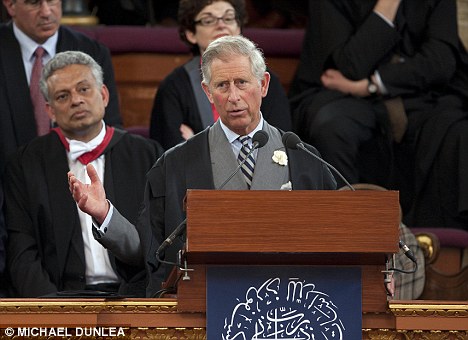
Rebecca English, "'Follow the Islamic way to save the world,' Prince Charles urges environmentalists" (Mail Online, June 10, 2010): "Prince Charles yesterday urged the world to follow Islamic 'spiritual principles' in order to protect the environment.... Charles, who is a practising Christian and will become the head of the Church of England when he succeeds to the throne, spoke in depth about his own study of the Koran which, he said, tells its followers that there is 'no separation between man and nature' and says we must always live within our environment's limits.
The prince was speaking to an audience of scholars at the Oxford Centre for Islamic Studies - which attempts to encourage a better understanding of the culture and civilisation of the religion."
Monday, June 07, 2010
A bit of national inspiration ...
While Obama does his damnest to prevent a window for freedom in the Mideast, Europe, Central America and East Asia, a former marine 'stuns crowd' at Georgia Tea Party event with an inspiring surprise.
[Hat tip to S.K.]
[Hat tip to S.K.]
Hamas not interested in humanitarian aid?
According to CNN:
Israel has attempted to deliver humanitarian aid from an international flotilla to Gaza, but Hamas -- which controls the territory -- has refused to accept the cargo, the Israel Defense Forces said Wednesday.See also "Who cares about Gazans? Not the flotilla!" (TEOZ, June 4,2010). Jordan, Saudi Arabia, Egypt and even Syria, by contrast, are cooperating with Israel to distribute humanitarian aide to Gaza. The politicization of aid by the flotilla is clarified by a recent report in Der Spiegel.
Palestinian sources confirmed that trucks that arrived from Israel at the Rafah terminal at the Israel-Gaza border were barred from delivering the aid.
Ra'ed Fatooh, in charge of the crossings, and Jamal Khudari, head of a committee against the Gaza blockade, said Israel must release all flotilla detainees and that it will be accepted in the territory only by the Free Gaza Movement people who organized the flotilla.
Subscribe to:
Posts (Atom)