


Is there a reason why the people whom President Obama wants to run his government (Napolitano and Kagan, left) share an uncanny resemblance to Elton John (two photos on right)?

Here richly, with ridiculous display,
The Politician's corpse was laid away.
While all of his acquaintance sneered and slanged
I wept: for I had longed to see him hanged.("Epitaph on the Politician Himself")
From quiet homes and first beginning,
Out to the undiscovered ends,
There's nothing worth the wear of winning,
But laughter and the love of friends.
(Verses (1910) "Dedicatory Ode")
May all good fellows that here agree
Drink Audit Ale in heaven with me,
And may all my enemies go to hell!
Noel! Noel! Noel! Noel!
May all my enemies go to hell!
Noel! Noel!(Drinking Song for Christmas from The Four Men)
Now the faith is old and the Devil bold
Exceedingly bold indeed.
And the masses of doubt that are floating about
Would smother a mortal creed.
But we that sit in a sturdy youth
And still can drink strong ale
Let us put it away to infallible truth
That always shall prevail.
And thank the Lord
For the temporal sword
And howling heretics too.
And all good things
Our Christendom brings
But especially barley brew!(The Pelagian Drinking Song)
The world is full of double beds
And most delightful maidenheads,
Which being so, there’s no excuse
For sodomy or self-abuse.("The world is full of double beds")
Heroic Poem in Praise of Wine
To exalt, enthrone, establish and defend,
To welcome home mankind's mysterious friend
Wine, true begetter of all arts that be;
Wine, privilege of the completely free;
Wine the recorder; wine the sagely strong;
Wine, bright avenger of sly-dealing wrong,
Awake, Ausonian Muse, and sing the vineyard song!
By thee do seers the inward light discern;
By thee the statue lives, the Gods return.
When the ephemeral vision's lure is past
All, all, must face their Passion at the last.
So touch my dying lip: so bridge that deep:
So pledge my waking from the gift of sleep,
And, sacramental, raise me the Divine:
Strong brother in God and last companion, Wine.
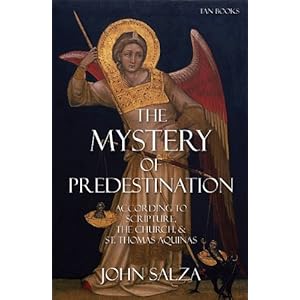
 Well, it's not quite that, but John Salza's The Mystery of Predestination: According to Scripture, the Church, and St Thomas Aquinas (Saint Benedict Press & Tan Books and Publishers, 2010) is about the clearest introduction you'll find to one of the most impossibly difficult subjects in theology. Here the publisher's summary:
How can an all-loving God choose some people for eternal salvation while permitting others to fall away? Doesn't God offer the same amount of saving grace to everyone? Isn't predestination a Protestant doctrine? In The Mystery of Predestination , author and apologist John Salza, seeks to answer these questions, and others, about that most ineffable and confounding of Christian beliefs: that God chooses to infallibly direct certain people to salvation but not others. Drawing deeply upon Scripture, Sacred Tradition, and the writings of St. Thomas Aquinas, Salza says that a proper Catholic understanding of the doctrine of predestination is interconnected with two other central mysteries: the ability of mankind to choose freely to accept or reject God's saving grace, and the inability of mankind to accept God's grace without first being moved by His grace from within. By holding these truths always before us we can see how God may predestine His elect to heaven but never desire that anyone go to hell. We can also achieve a new clarity and depth of insight into a profound Christian truth: God is the primary mover in salvation. It is He who chooses, seeks, and saves us. Meticulously researched and written in a scholarly yet accessible style, The Mystery of Predestination is perfect for the serious Catholic who is confused by Bible verses or Magisterial statements in favor of predestination (and never hears about it in Sunday sermons), or who wants to defend Catholic truth against Calvinist error, and is seeking clear, traditional, and Thomistic answers. Or, indeed, for any thoughtful Christian who wants to come to terms with what the Bible teaches about the fundamental truths of our salvation.The author is clearly well acquainted with not only the Biblical literature and Catholic theological tradition, but also with the Lutheran and Calvinist Protestant traditions that take issue, at points, with the Catholic position. This little book is a good place to start for anyone interested in the age-old problem and the debates surrounding it.
(cited by Lamont), less than one-fifth of the American population at the time of the American Revolution claimed church membership. The rate rose to more than one-third in the mid-nineteenth century and to more than one-half today. This is what they refer to as the "churching of America." The claim is that the "free competition" of religions made the average church more effective at getting members, which led to an increased rise in church attendance throughout the nineteenth and twentieth centuries in the U.S., in contrast to Europe, where church attendance has steadily dwindled.The market model predicts that that societies in which one religion has a monopoly will be religiously lax. But societies as varied as the Byzantine Empire, sixteenth-century Spain, Tibet under the Dalai Lama, Malta until the late twentieth-century, and many Islamic countries throughout history were not lacking in religious fervor. In general, prior to the American Revolution, free markets in religion were scarce or nonexistent, but religiously fervent societies, while not universal, were not uncommon.Furthermore, Lamont points out, Reginald Bibby has shown, in his books Fragmented Gods: The Poverty and Potential of Religion in Canada
Nor is it true that a free market in religion always leads to increased religiosity. Most areas of Western Europe have not had an established church for over a hundred years. The religiosity of these lands was significantly higher when they did possess established churches, and the removal of establishment has not produced any of the positive effects that the free-market component of the rational-choice school predicts.
(1987), Unknown Gods: The Ongoing Story of Religion in Canada(1993), and Restless Gods: The Renaissance of Religion in Canada(2003) that the Canadian experience furnishes especially clear evidence against the universal efficacy of a free market in religion.Such a free market has existed in Canada since the British conquest in 1759, and, until the post-World War II period, Canadian religious observance seemed to confirm the free-market model. As recently as 1956, Canadians were considerably more religious than Americans, with an average claimed weekly church-attendance rate of 61 percent. After 1956, however, the rate of reported weekly church attendance in Canada fell below the American rate and has now stabilized at about 25 percent.... The drop in religious observance in Canada did not happen as a result of the existence of an established religion. As Bibby has found, the fall resulted largely from Canadian's continuing to have some attachment to a religion but ceasing to practice it.The reason for the failure of the free-market model to explain religious practice in Western Europe and Canada, suggests Lamont, most likely stems from the fact that, for such a model to apply, "people have to think of a religious commitment as analogous to a purchasing decision, and to think of different religions as analogous to competing sellers of goods." While such thinking may apply to a large portion of American society, it is not universal. "Belonging to a particular religion often has been thought of as analogous to (or part of) membership in a family or an ethnic group, neither of which can be chosen or renounced," writes Lamont.
Because of the long-term exchange relations that religious organizations require, people are forever paying the costs in the here and now while most of the rewards are to be realized elsewhere and later. As a result, humans are prone to backslide, to get behind on their payments.... Thus, other things being equal, people will always be in favor of a modest reduction in their costs. In this fashion, humans begin to bargain with their churches for lower tension and fewer sacrifices. They usually succeed, both because it is those with the most influence -- the clergy and the leading laity -- who most desire to lower the level of sacrifice and because each reduction seems so small and engenders widespread approval.This lowering of standards has the immediate effect of pleasing people, but the long-term effect of driving them away. Finke and Stark's analysis offers a compelling supply-side model that explains why mainstream Protestant churches that make negligible demands of their members have declining memberships, while more demanding evangelical or Pentecostal churches continue to grow. In contrast to the free-market model, their supply-side model fits all the data, not only that of the American experience.
The post-conciliar changes (and, to a debated extent, the conciliar documents themselves) tried to erase, as far as possible, the many distinctions between Catholics and non-Catholics. This involved the abandonment of strict rules and distinctive dress for clergy and religious, the replacement of a distinctive liturgy by one that resembled Protestant worship, the legitimation of dissent on moral teaching, and the downplaying of strict Catholic doctrine in religious instruction. According to rational-choice theory, these were the best possible steps that could have been taken to diminish European Catholicism, and this prediction has been confirmed by events. The most vigorous religious movement in Europe today is extremist Islam -- a form of religion whose success is also predicted by rational-choice theory.Fink and Stark comment on the devastating effect this abandonment of demands and distinctiveness by the Catholic Church particularly had on priests and nuns: "... many of the most distinctive aspects of Catholic liturgy, theology, and practice, abandoned by the Council, turned out to have been crucial for generating and sustaining vocations, especially vocations sufficient to meet the high costs of Catholic religious life." They predict that "no longer in tension with the surrounding culture, the church will generate less commitment from its membership and will gradually fail to compete with a new generation of upstart sects."
Muslims, whose extremism is increasing, are doing the right thing, as are Hasidic Jews and Protestants who preserve their otherworldy doctrines and strict standards. Liberal Protestant denominations generally seem not to be salvageable: It is easier for believers who seek stricter standards to move to another church than it is to try to reimpose such standards on a resistant institution. Benedict XVI has made some movement toward a revival of Catholic distinctiveness by encouraging traditionalism, but the rational-choice theory does not predict that this will cause a general revival within the Church.Talk about food for thought! Your thoughts?
What will be necessary for such a revival is for strict standards to be required, not just permitted. This, however, would be antithetical to the pope's approach, which focuses on gentle persuasion. On a brighter note, Benedict's attempts to clarify the teachings of the Second Vatican Council open possibilities. In the decades since the council, its teachings have been widely understood as mandating an abandonment of Catholic distinctiveness and virtual surrender to the modern secular world. What is needed now, in contrast, is an interpretation of council teachings that upholds traditional Catholic distinctiveness. If such an interpretation is not vigorously enforced as well as promulgated, howver, no Catholic revival is to be expected. Instead, the pressures of secularism and competing religions will continue to erode Catholic membership. This is what the supply-side analysis predicts, and its predictions cannot be faulted so far. In short, if the Catholic Church is to thrive, a revival of zeal and reimposition of doctrine within it is urgently necessary.
Next LLA Convention Planning Meeting Scheduled[Comments? Please e-mail tridnews@stjosaphatchurch.org. Previous columns are available at www.stjosaphatchurch.org. This edition of Tridentine Community News, with minor editions, is from the St. Josaphat bulletin insert for May 2, 2010. Hat tip to A.B.]On Sunday, May 23 after St. Josaphat’s Tridentine Mass, (at approximately 11:00 AM), the next meeting will be held for volunteers for the July 16-18 Latin Liturgy Association National Convention. This meeting will again be held in the St. Josaphat Parish Hall, and refreshments will be served. Progress since our last meeting has included:
The flyer and registration form will be mailed out to LLA members this week. Single sheet and glossy postcard versions of the flyer will be created for bulletin board posting and local mailings.
- A full roster of speakers has been lined up. An organ recital has been added to the schedule.
- The Marriott Ren Cen has been chosen as the host hotel because of its willingness to give our attendees a special rate that makes it more attractive than other local hotels in less desirable locations.
- A four-page color flyer has been designed. It prints on 11 x 17” paper which folds in two, to create four 8.5 x 11” pages. The flyer includes the preliminary convention schedule, information about the Bus Tour, photos of the host churches, directions, and hotel information. Thanks to Jason Grossi for his design talents. (Online PDF link)
- A registration form has been designed, with various incentive discounts for clergy, seminarians, LLA members, and those who register by May 31. The form fits inside the flyer. (Online PDF link)
Our immediate challenge is to distribute these flyers to as many logical locations as possible, via mailings and drop-offs. We also need to discuss Bus Tour logistics, include who will serve as advance-men along the route. Between now and the meeting, we will be asking volunteers to place ads in various other media, and pursue other advertising and promotional opportunities.
Bus Tour Taking Shape
Those of our readers privileged to know Frank Greenia are aware that he is a walking encyclopedia of local church knowledge. From stained glass windows to statues to the names of former pastors, Frank knows Detroit’s historic churches like virtually no one else. It is only logical that Frank head up the Historic Church Bus Tour that is scheduled for Friday, July 16. The tour is so far expected to include:
Old St. Mary’s: This historically German church in Greektown is one of the best-preserved in the area. It has long been the home of a Novus Ordo Latin Mass and is known for its music program.
Holy Family: Currently clustered with Old St. Mary’s, Holy Family is an Italian / Sicilian parish that is known for having had essentially only (Novus Ordo) Latin Masses on its published schedule, ever. Only in unusual circumstances has Mass been celebrated in the vernacular, or versus pópulum. It’s all Latin, all ad oriéntem, all the time.
Transfiguration: This parish near Six Mile and Mound has a beautiful interior largely consisting of gold mosaics, reminiscent of an Eastern Rite church.
Holy Redeemer: A well-preserved church known for being the home of a large Hispanic community as well as the site of the filming of the movie The Rosary Murders.
Ste. Anne: Detroit’s oldest parish is located at the foot of the Ambassador Bridge. Like its sister parish, Assumption, at the other end of the bridge, Ste. Anne is administered by the Basilian Fathers. Michigan pioneer Fr. Gabriel Richard’s tomb is located in a chapel adjacent to the main church.
St. Francis d’Assisi: The west side of Detroit has its own Polish church cluster analogous to St. Josaphat’s. St. Francis is an immaculately preserved edifice whose extensive use of tiny light bulbs makes St. Josaphat look like a piker in comparison.
St. Florian: Hamtramck’s largest and most prominent church is the work of famed architect Ralph Adams Cram. It features an elaborate reredos (panel behind the high altar) and marble Communion Rail.
Shrine of the Little Flower: Many of us have visited Shrine, but few are aware of the various devotional chapels, unique architectural design elements, and nooks and crannies in this elaborate complex. A tour guide will show us the lesser-known areas of this historic church-in-the-round.
Discussions are pending with three other churches, as additions or substitutes: Special events such as a funeral may require last-minute changes to the itinerary. We are particularly hopeful that St. Aloysius can be included, as that church has perhaps the most unique design in the region.
The tour will include lunch at one of the churches; which one will depend upon how many sign up for the tour. The day will conclude with an optional visit to Windsor’s Assumption Church, where Vespers and Benediction will be held in the Extraordinary Form. Those who wish to go to Canada will need to have one of the following: a Passport, an Enhanced Driver’s License (the quickest and least expensive option), a Passport Card, or a Nexus Card. Apply for one of these as soon as possible so that you can join us.
DC Mass A Success As Expected
Tulsa Bishop Edward Slattery stepped in for Cardinal Castrillón Hoyos at the last minute to celebrate the Pontifical Mass last Saturday, April 24 at Washington, DC’s Basilica of the National Shrine of the Immaculate Conception. The church, which seats 4,000, was filled. EWTN broadcast the Mass and may make it available on DVD. Along with the 1996 landmark Pontifical Mass at New York’s St. Patrick Cathedral, this Mass is sure to break down barriers for further major event Extraordinary Form Masses to be celebrated in the future.

 the Lord, whom he encountered every dawn in prayer.
Evelyn Waugh described his masterpiece Brideshead Revisited as a story about "the operation of divine grace on a diverse but closely connected group of characters." Yesterday, I had the profoundly moving experience of witnessing the operation of grace on a particular person and a diverse group of people who were connected to each other through him. That person, Hadley Arkes, the Edward Ney Professor of Jurisprudence and American Institutions at Amherst College, was received into the Catholic Church in a beautiful ceremony in the chapel of the Catholic Information Center in Washington, D.C. Enveloped in the love of his many friends and admirers, Hadley was baptized, confirmed, and received his first communion.[Hat tip to E.E.]
Hadley is an outstanding political philosopher and constitutional theorist who has dedicated much of his professional life to defending the dignity and rights of the child in the womb. In remarks after the service yesterday, he explained that his faith in Christ had come through the Church. The Church's moral witness, especially on the sanctity of human life and on marriage and sexual morality---a witness that has in our time made the Church a "sign of contradiction" to the most powerful and influential elements of the elite sector of contemporary western culture---persuaded him that the Church is, despite the failings of so many of its members and leaders, fundamentally "a truth-teaching institution." In teachings that many find to be impediments, Hadley found decisive evidence that the Church is, indeed, what she claims to be.
Speaking of his Jewish identity, Hadley said that he neither would nor could ever leave the Jewish people. His entry into the Church was for him, he stated, a fulfillment of his Jewish faith, and in no way a repudiation of it. Invoking the testimony and authority of the late Cardinal Lustiger of Paris, he declared that he was and would always remain a Jew, though a Jew who, like the earliest Christians, had come to accept Jesus as "the Christ, the Son of the living God."
Hadley's sponsor was Michael Novak, who read aloud some charming verses he had composed for the occasion. The other speakers were Daniel Robinson of the Philosophy Faculty at Oxford University, Michael Uhlmann of the Political Science Department at Claremont Graduate School, David Forte of the Cleveland State University Law School, and your humble correspondent. The chapel was overflowing with people who had come from all over the country. The spirit of joy was extraordinary. Part of the reason for that, I believe, is that every person in the room had become a better Christian as a result of Hadley's friendship, long before Hadley himself entered the Church. More than a few people credited Hadley for their own conversions (or reversions). Like G.K. Chesterton, he spent years leading others into the Church before he walked through the door himself.
This American Spectator column from a decade back deals with a spate of church desecration. But, from the perspective of 2010, what most struck me upon rereading was the small aside that a ski-masked gang storming a cathedral at prayer, hurling used condoms at worshippers, desecrating paintings with bloody tampons, attempting to smash the tabernacle and lighting up a burning cross at the entrance doesn't qualify, under Quebec law, as a "hate crime". As Constable Sylvie Latour explains below, the "hate" law cannot be used against people who "in good faith" attempt "to establish by argument an opinion on a religious subject" - even if you're "arguing" with sanitary napkins and condoms. Who knew? If only I'd hurled used tampons at Mohammed Elmasry and Khurrum Awan, I could have saved myself a whole heap of trouble. Just when you think Canada's "hate" laws can't any dumber or more worthless, they always do....[Hat tip to S.K.]
Miami Archbishop John Favalora announced an early retirement on April 20, only eight months before he was set to reach the normal episcopal retirement age of 75. Despite the fact that the Vatican usually only accepts early resignations for serious illness or another “grave cause,” the official explanation given by Archbishop Favalora himself says he is in “good health,” and presents no other “grave reason” for the unexpected retirement.[Hat tip to J.S.]
Meanwhile, a group of lay Catholics in the archdiocese has revealed communications that they have had with the Vatican regarding an alleged gay cabal of priests that the group claims is veritably running the archdiocese, and suggests that this situation is the real cause of the early retirement. The group says that the Vatican has investigated its claims, and found them to be well-founded....