
Monday, October 12, 2009
Huzzah! Exsurge Domine!
Fr. Z, "Bp. Sample (D. Marquette) to Bp. Gumbleton: please don’t come" (WDTPRS, October 11, 2009): "Bp. Gumbleton was invited to speak in Marquette by a group called Marquette Citizens for Peace and Justice. Because of Bp. Gumbleton’s well-known positions on homosexuality and women "priests", Bp. Sample asked Bp. Gumbleton not to come. Apparently they did not come to an agreement."
Saint Damien: the rest of the story
Just yesterday (October 11, 2009), Pope Benedict XVI canonized Father Damien, a Belgian priest who spent the last 16 years of his life working ministering to a colony of lepers on the Hawaiian island of Molokai in the 1800s.
In the late 1880s, when a certain Presbyterian pastor named Dr. Hyde wrote a letter to a fellow clergyman speaking ill of Father Damien, Robert Louis Stevenson, the famous protestant novelist, who had visited Molokai shortly after Father Damien himself died of leprosy, wrote a scathing open letter of rebuke to Dr. Hyde.
Here is a brief summary of the exchange, with several of Hyde's one-line slurs met by Stevenson's response (http://rorate-caeli.blogspot.com/2009/10/saint-of-molokai.html ):

Related
In the late 1880s, when a certain Presbyterian pastor named Dr. Hyde wrote a letter to a fellow clergyman speaking ill of Father Damien, Robert Louis Stevenson, the famous protestant novelist, who had visited Molokai shortly after Father Damien himself died of leprosy, wrote a scathing open letter of rebuke to Dr. Hyde.
Here is a brief summary of the exchange, with several of Hyde's one-line slurs met by Stevenson's response (http://rorate-caeli.blogspot.
Sunday, October 11, 2009
The Saint of Molokai

Damien was COARSE.It is very possible. You make us sorry for the lepers, who had only a coarse old peasant for their friend and father. But you, who were so refined, why were you not there, to cheer them with the lights of culture? Or may I remind you that we have some reason to doubt if John the Baptist were genteel; and in the case of Peter, on whose career you doubtless dwell approvingly in the pulpit, no doubt at all he was a ‘coarse, headstrong’ fisherman! Yet even in our Protestant Bibles Peter is called Saint.Damien was DIRTY.He was. Think of the poor lepers annoyed with this dirty comrade! But the clean Dr. Hyde was at his food in a fine house.Damien was HEADSTRONG.I believe you are right again; and I thank God for his strong head and heart.Damien was BIGOTED.I am not fond of bigots myself, because they are not fond of me. But what is meant by bigotry, that we should regard it as a blemish in a priest? Damien believed his own religion with the simplicity of a peasant or a child; as I would I could suppose that you do. For this, I wonder at him some way off; and had that been his only character, should have avoided him in life. But the point of interest in Damien, which has caused him to be so much talked about and made him at last the subject of your pen and mine, was that, in him, his bigotry, his intense and narrow faith, wrought potently for good, and strengthened him to be one of the world’s heroes and exemplars.
Robert Louis Stevenson
Open Letter to the Rev. Dr. Hyde of Honolulu
[Letter by the Protestant writer in response to
the accusations of Dr.C. M. Hyde, Presbyterian minister in Honolulu]
Sydney, February 25, 1890
Related
[Hugo Mendez, from the Rorate Caeli comment box yesterday][Hat tip to Rorate Caeli.]
Ahh! You forgot the most pertinent words of Stevenson today to Dr. Hyde:"If that world at all remember you, on the day when Damien of Molokai shall be named a Saint, it will be in virtue of one work: your letter to the Reverend H. B. Gage."That day is today (!). Over a century later, we continue to honor the works of St. Damien, who gave his entire life for the healing of the diseased and outcast. As for Dr. Hyde, the world cannot remember a significant work of mercy, act of charity, or lasting gift to humanity, he provided. Instead, his entire legacy is a footnote in history... for slandering St. Damien with false accusations. This is his only legacy in the year 2009.
Welcome to the history books, Rev. Hyde.
Sunday, October 11, 2009
The controversial founding of Columbus Day
"One may not think of the month of daylight savings time, breast cancer awareness, and Oktoberfest as particularly controversial, but beneath the surface of several Catholic holidays in October are truths and memories that bring a maelstrom of protest from the modern world," writes Michael P. Foley in "The Controversial Holidays of October" (Latin Mass magazine, Summer 2009). In a previous article, Foley already discussed one of these: the Feast of the Holy Rosary's commemoration of the defeat of the Turks at Lepanto (October 7). In the current issue, he turns to two more "October surprises" -- Columbus Day (October 12 or the second Monday in October) and All Hallows' Eve (October 31).1 Here we limit our attention to Columbus Day: [Michael P. Foley is associate professor of patristics at Baylor University. He is author of Wedding Rites: A Complete Guide to Traditional Vows, Music, Ceremonies, Blessings, and Interfaith Services
 (Eerdmans, 2008) and Why Do Catholics Eat Fish on Friday?: The Catholic Origin to Just About Everything(Palgrave Macmillan, 2005). Our present post was excerpted from Dr. Foley's article, "The Controversial Holidays of October," Latin Mass: The Journal of Catholic Culture and Tradition Vol. 18, No. 3 (Summer 2009), pp. 36-39, and is reproduced here by kind permission of Latin Mass, 391 E. Virginia Terrace, Santa Paula, CA 93060.]
Related
NotesI should probably be given the stake for discussing a secular holiday in a column on the liturgical year, but Columbus Day merits our attention for several reasons. First the holiday owes its existence to the efforts of U.S. Catholic citizens, particularly the Knights of Columbus. In the 1900s the Knights lobbied state legislatures throughout the country to make the anniversary of America's discovery a holiday; not only did most states acquiesce, but the federal government eventually did as well, first as a national holiday in 1937 and then as a legal holiday (on which banks close) in 1971. Though they were instituted as a fraternal benefits organization, the Knights of Columbus were also keen to dispel anti-Catholic prejudice in the United States. One way to meet this goal was to emphasize America's debt to Catholic figures, starting with its papist discoverer. Not coincidentally, this fraternity, founded by an Irish priest, was named not after Saint Patrick but after the daring Italian who reached the shores of our hemisphere on a Spanish ship.
The Knights' strategy of claiming Columbus as a most Catholic of heroes was also a well-aimed counterattack. American historians had tried mightily to turn the famous seafarer into an Enlightenment figure, a secular saint championing scientific progress in the face of a superstitious Church still clinging to outdated ideas of a "flat earth." As it turns out, Columbus had nothing to do with the flat-earth debate; the story was invented out of whole cloth by Washington Irving in 1828 and later used as anti-Catholic propaganda to "prove" that that clerical religion was inherently hostile to rational inquiry.2 Queen Isabella's geographical advisers knew the globe was globular; they rejected Columbus' proposal because they had a much more accurate grasp of it's massive circumference, rightly concluding that his plan to reach China via a western route in a matter of weeks was unsound.
Given the prevalence of the anti-Catholic flat-earth myth, it is not surprising that Pope Leo XIII celebrated the four hundredth anniversary of Columbus' maiden voyage with these stirring (and perhaps overly generous) remarks:But there is, besides, another reason, a unique one, why We consider that this immortal achievement should be recalled by Us with memorial words. For Columbus is ours; since if a little consideration be given to the particular reason of his design in exploring the mare tenebrosum ... it is indubitable that the Catholic faith was [his] strongest motive ... so that for this reason also the whole human race owes not a little to the Church.3Take that, Know Nothings!
Pall Over the Holiday
Ironically, after winning the battle for Columbus Day, many Catholics today would prefer not to be associated with either the man or his holiday. While most Latin American countries commemorate the date of Columbus' discovery as the Día de la Raza (the Day of the Race, that is, the day the races met), Hugo Chávez's Venezuela observes observes Día de la Resistencia Indigena (Day of Indigenous Resistance). Similarly, Ward Churchill, the Colorado professor who made headlines for calling the victims of September 11 "little Eichmans,"4 has led the American Indian Movement's protests against the Columbus Day in Denver.
What Chavez and Churchill, in their characteristically understated ways, are alluding to the bleak events that followed Columbus' discovery. Despite the friendliness of the natives, Columbus' men initiated hostilities with them that culminated in a massacre, while Columbus himself enslaved a thousand Indians and instituted the repartimiento system that led to the serfdom of countless others for years to come. Combined with a wave of unintentionally imported diseases the local immune system had never encountered before, such treatment quickly decimated the Native American population.
Assessing Columbus
What, then, should we make of Columbus in light of his spotty record? I suggest five things.
First, it is clear that Columbus was not a good administrator on the land, and his incompetence led to cruelty. In fairness, however, before his undisciplined men destroyed relations with the native Taino or Arawaks, his goal was to protect them from the cannibalistic Caribs (one of the most savage peoples in the Americas) who were fast advancing. Indeed the Caribs remind us that the first step in assessing the Columbian legacy is overcoming any assumption that either side in the conflict has a monopoly on evil.
Second, it is important to remember that many of Columbus' contemporaries also deplored his deeds. Queen Isabel certainly did, which is why Columbus' third return to Spain was in chains, and Spanish law, thanks in large part to the Church's teaching about the full humanity of Native Americans, consistently condemned the actions of rapacious colonists. This is significant, for no other civilization has shown such a capacity for healthy self-criticism as the Christian. Indeed, the shrill condemnations of a Chavez or a Churchill are possible only because of the tradition of public self-examination first developed in Catholic societies.
Third, despite tragic costs, the benefits of European contract with the New World did far more good than harm. This is particularly true in the realm of evangelization. Columbus' genuine zeal to convert all peoples to Christianity should be commended rather than condemned. To depict all New World conversions as forced and foreign is, ironically, to patronize people of color, who were and are every bit as capable of seeing the beauty, truth, and goodness of the Gospel as their unwashed invaders.
Fourth, despite his flaws Columbus was a devout Catholic who, as Pope Leo XIII noted, was motivated by his Faith. His favorite prayers was Jesus cum Maria sit nobis in via -- "may Jesus, along with Mary, be with us on the way."5 Columbus chose to depart into the unknown the morning after August 2, the feast of Our Lady of the Angels, so that his men could celebrate this Marian feast with their families; he even made sure that they received confession and Holy Communion in order to obtain the plenary indulgence available that day.6 Columbus' prayers were apparently answered: his tiny fleet reached land on October 12, the day after the Feast of the Maternity of the Blessed Virgin.
Finally, Columbus Day praises not Columbus' explorations on land but his exploits at sea. We know that a single-minded man convinced the monarchs of Spain to fund an extremely hazardous journey with little likelihood of return, and that he pulled it off, not once but four times. We know that he was exceptionally courageous and resourceful, and we know that he was an outstanding seaman. There is nothing wrong with raising a glass to genuine courage and persistence, as long as one does not go on to use these to excuse other crimes and misdemeanors. I wonder if much of the animus against Columbus today really springs from a contemporary disdain for honor that would like to purge manhood of its chivalry and daring. As the historian William Carroll notes, "It is right to criticize the failings [of heroes], but wrong to deny their greatness and the inspiration they can give."7
And if there is any note of sorrow or regret to be struck on this otherwise celebratory occasion, it should not be fore the exceptional evil of the white man or the Catholic faith but for the universal darkness in man's heart so aptly explained by the doctrine of original sin. Yet, thanks be to God, this spiritual blight is never allowed to dwarf the triumph of the Cross, which providentially uses both vessels of honor and dishonor to meet its goals.
What to Do
How should one celebrate Columbus Day? In 1892 Pope Leo decreed that the four hundredth anniversary of Columbus' discovery should be marked with a Solemn High Mass of the Most Holy Trinity either on October 12 or on the following Sunday.8 (This was mandatory for Spain, Italy, and the two Americas, and recommended for the rest of the world, since "it is fitting that an even from which all have derived benefit should be piously and gratefully commemorated by all"). Certainly Mass would be a good idea today as well, along with a fervent prayer for the spiritual future of both the Old and New Worlds. And all of the documents I have cited are worth reading for more information on Christopher Columbus.
Perhaps one could even enjoy these readings with one of the items rumored to have returned with Columbus on his first voyage: tobacco. I would recommend a pipe for the occasion, as a cigarette is far too lowly a thing for honoring either the noble savage or the noble explorer. As for food, one could turn to any of the nationalities involved: American, Italian, Spanish, or even Caribbean. And for the little ones, miniature Niñas, Santa Marias, and Pintas can be made out of walnut shells, toothpick masts, and paper sails and used to adorn a cake or have a race in the bathtub.(To be continued ...)
- "The Feast of Our Fearsome Lady," TLM 16:4 (Fall 2007), pp. 60-61. [back]
- For the fascinating history of this myth, see Burton Russell, Inventing the Flat Earth: Columbus and Modern Historians
- Quarto Abeunte Saeculo (1892), 2, italics added. [back]
- He has also been sanctioned by his university for repeated acts of "serious research misconduct." [back]
- For more on Columbus' fascinating Catholicism, see Fr. John Hardon's lectures on Columbus at http://www.therealpresence.org/archives/Christopher_Columbus.htm. [back]
- The indulgence of the Portiuncula. [back]
- "Honoring Chrisopher Columbus," http://www.ewtn.com/library/HOMELIBR/COLUMBUS.HTM [back]
- Quarto Abeunte Saeculo (1892), 9. [back]
[Michael P. Foley is associate professor of patristics at Baylor University. He is author of Wedding Rites: A Complete Guide to Traditional Vows, Music, Ceremonies, Blessings, and Interfaith Services(Eerdmans, 2008) and Why Do Catholics Eat Fish on Friday?: The Catholic Origin to Just About Everything(Palgrave Macmillan, 2005). Our present post was excerpted from Dr. Foley's article, "The Controversial Holidays of October," Latin Mass: The Journal of Catholic Culture and Tradition Vol. 18, No. 3 (Summer 2009), pp. 36-39, and is reproduced here by kind permission of Latin Mass, 391 E. Virginia Terrace, Santa Paula, CA 93060.]Related
New Catholic offers has posted a copy of Leo XIII's encyclical on the Columbus quadricentennial, Quarto abeunte saeculo highlighting those parts of the text of special interest at "COLUMBUS NOSTER EST" (Rorate Caeli, October 12, 2009).
The Extraordinary Form in Ordinary Churches
Tridentine Community News (October 11, 2009):
Last Sunday, October 4, Fr. Mark Borkowski, organist and cantor Wassim Sarweh, and a team of altar servers traveled to St. Joseph Church in Jackson, Michigan to celebrate the parish’s 10:30 AM Tridentine Mass. The occasion was the anniversary of the founding of the parish, which Fr. Mark attended as a young man. The experience had lessons to teach, as readers of this column are accustomed to grand, historic churches providing a most apt setting for the Extraordinary Form liturgy.[Comments? Please e-mail tridnews@stjosaphatchurch.org. Previous columns are available at www.stjosaphatchurch.org. This edition of Tridentine Community News, with minor editions, is from the St. Josaphat bulletin insert for October 11, 2009. Hat tip to A.B.]St. Joseph’s current church dates from circa 1968. It is an octagonal structure, reminiscent in many ways of Birmingham’s St. Regis Church, albeit somewhat smaller. There is no high altar, only a main altar on a large sanctuary platform. A semicircle of steps separates the sanctuary from the nave (where the pews are), if one can even properly call it a nave. There is no Communion Rail; kneelers are temporarily moved into place before Holy Communion.
The organ console is located to the right of the sanctuary. The organ itself is, fortunately, a pipe organ, but a simple one. The organist faces the congregation while playing. However, the music stand on top of the organ blocks the organist’s view of the altar. Essentially parallel to the altar, the organist cannot easily determine if the celebrant is at the Epistle, Gospel, or center positions at the altar, making it challenging to determine quickly where the priest is in the Mass. If you have seen a competent organist ply his or her craft, it is not always a pretty sight; one must be fairly athletic to be able to jump around the various keyboards, set the stops, play the pedals, and turn the pages of the music. Whether one considers this a display of virtuosity, downright ridiculous looking in a Wizard of Oz fashion, or somewhere in between, most would agree that seeing the organist’s machinations is a distraction from what is going on at the altar. There is a reason why organs and musicians in a Catholic church are traditionally located out of sight: they are not supposed to provide any sort of visual accompaniment.
Acoustically, the church was dead. Omnipresent carpet and sound-absorbing wood in the ceiling killed off any reverberation from the organ and cantor. Lift a finger off a key on the organ, and the church is immediately quiet.
At the altar, Fr. Mark and the servers were somewhat disoriented. Where does the sanctuary begin? What constitutes the equivalent of the altar platform? The entire, large sanctuary area? If so, the steps at the front of the sanctuary platform are quite a bit further away from the altar than the steps in front of a traditional high altar. If there are sufficient servers that some could serve as torch bearers, where would they go? The steps in front of the sanctuary are close to the first row of pews; there is not the traditional large flat space between the altar and the nave. The rubrics of the Extraordinary Form are quite specific and presume a classic church layout according to the norms prescribed by St. Charles Borromeo at the time of the Council of Trent, yet those rubrics must be dynamically interpreted in a setting such as this.
Despite our misgivings and uncertainties about the execution of the Mass in this space, afterwards, several regulars at St. Joseph commented that this was one of the most memorable Tridentine Masses they had seen. The primary reason was that most of their Masses are Low Masses. The experience of chanting the Ordinary of the Mass and hearing the Propers sung, along with the extra liturgical elements of the Aspérges and the use of incense, were things to which that congregation was not accustomed. Wassim was impressed that St. Joseph’s organist even seemed inspired to attempt a sung Mass, now that an example had been given.
Also worth noting is that St. Joseph Church is viewed by the Jackson Tridentine Community as quite an upgrade from their former home, the storefront Sacred Heart Chapel. Let’s also not forget that the solid liturgy and parish life practiced at this parish for many years was the source for Fr. Mark’s vocation. We cannot focus too heavily on the building.
We point all of this out because if we are collectively to promote the Extraordinary Form of Holy Mass, and wish to see it celebrated in more churches, including those in the suburbs, then we will have to deal with architecture such as this. There are only so many historic churches in North America. Yes, we are starting to see some modern churches being re-done in a more traditional fashion, but that will be a slow process. The reality is that we must learn to make the Tridentine Mass work in such buildings. We must not be dismissive but rather supportive of such efforts.
That being said, we have been entrusted with quite a gift in being able to hold our own Masses in such striking historic churches. Because God expects more of those to whom more was given, we have a responsibility to strive to make the best possible use of these edifices for the purpose for which they were built, the solemn celebration of the Church’s Classic Liturgy.
Solemn High Anniversary Mass at Windsor’s Assumption Church Next Sunday, October 18 at 2:00 PM
Until now, well-known priests from outside the Diocese of London, Ontario have been invited as celebrants of Windsor’s annual Anniversary Mass. This year, as the community enters its “adulthood” at age 18, we have something different in mind:
Over the past year, several young priests of the Diocese of London have begun studying the Extraordinary Form Mass. While several young priests of the Archdiocese of Detroit have long held an interest in the Traditional Mass, this is a new phenomenon in the London Diocese. It is therefore only appropriate that we invite one of those young priests to be our celebrant this year: Fr. John Johnson, transferred to Windsor this summer and presently pastor of the cluster of St. Theresa and St. Vincent de Paul Parishes.
Saturday, October 10, 2009
Bellarmine: Who belongs to the Church, and why
"Our declaration is that there is only one Church, not two; and that the only one true Church is the community of men united by the profession of the true Christian faith and the communion of the same sacraments, under the government of legitimate shepherds and, above all, of the sole Vicar of Christ on earth, the Roman Pontiff. From this definition one can easily see who belongs to the Church and who does not belong to her. Indeed, this definition is made up of three parts: profession of the true Faith, communion of the sacraments and submission to the legitimate shepherd, the Roman Pontiff. The first part excludes all infidels, those who were never in the Church such as the Jews, Turks and pagans, or those who once were in it and later fell away, like the heretics and apostates. The second part excludes the catechumens and excommunicated, since the former are not admitted to the sacraments and the latter are excluded from them. The third part excludes the schismatics, who have the Faith and the sacraments but do not submit to the legitimate shepherd .... All others are included, even if they are reprobates, delinquent and impious.
"Between our declaration and the others there is this one difference: all the others require interior virtue to declare that someone is a member of the Church, and thereby make the true Church invisible. We, on the contrary, believe with certainty that in the Church are found all the virtues, Faith, Hope, and Charity and the others; however, we do not believe that any interior virtue is required to be able to say that someone is somehow part of the true Church, of which the Scriptures speak, but only the external profession of Faith and the communion of the Sacraments, which can be perceived by the senses. Indeed, the Church is as visible and palpable a community of men as the community of the Roman people, the Kingdom of France or the Republic of Venice." [my emphasis] (Disputationes de Controversiis Christianae Fidei adversus huius Temporis Haereticus (1586-1593) (Venice, 1721), 53, quoted in La Civilta Cattolica, Editorial: "Dalla 'societa perfetta' ala Chiesa 'mistero'" 1/9/1985, p. 107).
[Hat tip to R.R.-D.]
Related (updated 10/13/09):
New Catholic, "In the Church, the bad are many and the good few" (Rorate Caeli, October 9, 2009).
Thursday, October 08, 2009
Research: women on pill favor girly men
David Derbyshire, "Taking the pill for past 40 years 'has put women off masculine men'" (MailOnline, October 8, 2009). Enjoy the photos.
Where is global warming when you need it?
Andrew Greinger, "No Kidding: Snow on Sunday!" (NBC Chicago, October 8, 1009).
Vanity Fair in Copenhagen
Our clandestine correspondent we keep on retainer just wired in this item for review:
"Why it has probably never been more fun to be George Will: 'Olympic Gold for Narcissism' (Townhall.com, October 5, 2009)" -- excerpt:[Hat tip to K.K.]In the 41 sentences of her remarks, Michelle Obama used some form of the personal pronouns "I" or "me" 44 times. Her husband was, comparatively, a shrinking violet, using those pronouns only 26 times in 48 sentences. Still, 70 times in 89 sentences was sufficient to convey the message that somehow their fascinating selves were what made, or should have made, Chicago's case compelling.
Wednesday, October 07, 2009
Still choking on the (Cannabis?) smoke
 In "The Fire is Out" (New Liturgical Movement, September 20, 2009), Jeffery Tucker offers an insightful review of Ken Canedo's illuminating book, Keep the Fire Burning: The Folk Mass Revolution (Oregon: Pastoral Press, 2009). He writes:
For years I've search for the missing link to explain what became of Catholic liturgy by the time I came to know it. One finds old Missals in bookstores or attends the Extraordinary Form or looks back at old instructional books in music or catechesis and it is overwhelming to consider the lost knowledge, the immense chasm that separates what was from what is today.Canedo's book, says Tucker, provides the missing link: it's the only book he's found that looks in depth at the Catholic music of the 1960s to provide an empirical account of the rise of the folk music movement in the Church (circa 1963-1960) -- a movement that was about much more, in fact, than music. Canedo's book provides "... a fascinating if deeply harrowing look at the dismantling of Catholic liturgy that occurred not so much at the hands of the hierarchy but rather at the instigation of a handful of activists and publishers that shoved contemporary styles down everyone's throat in the name of keeping up with the times, as a cowed and fearful clerical class did its best to imagine that they were onto something."
I've gathered that we've been through the worst of it and Pope Benedict is taking many steps to heal the great pre- and postconciliar divide. But the mystery remains, at least in my mind, as to what happened and why. The answer is not found in the documents of Vatican II where we find ringing endorsements of Gregorian chant and stern warnings not to change the liturgy in unnecessary ways. I've long examined the world of the 1970s and found interesting clues about what drove that lost generation.
In one intriguing passage, Tucker observes:
One reason that this period has long been shrouded in mystery is that most all of the folk music of the period is long gone. None of it remains in the Missalettes. Nearly all—in fact, all but one—of the guitar strummers of the period who were the darlings of the new ethos left the Church in a huff and never returned. The strong fashion for folk music (phony folk music, to be sure) was a flash in the pan (1963-1969). What they left was a wasteland of confusion and disorientation just as the Novus Ordo Missa was promulgated. The damage had been done and how.It should be noted that Canedo does not intend his book as an indictment, but to argue that the Folk music revolution in the Church made substantial contributions to Catholic life, such as making Mass livelier and getting people in the pews to sing. Yet, while he ultimately fails to make this case, Tucker says that Canedo has done some incredible research in this book, shedding invaluable light on the origins of the Folk Mass Revolution: "Despite his spin, he provides enough information for most any reader to be shocked and astounded at the sheer arrogance and ignorance of a generation that believed they could reinvent Catholicism with guitars, bongos, and extremely bad music."
Tucker is overly modest about his own limitations as a reviewer when he writes:
Now, I'm probably not the best reader of this book, since I've never really understand what this phony folk music thing was all about anyway. It seemed to begin in 1963 and end a year or so after the Beatles came to the U.S., a shorter period of time than even Disco lasted a decade later.In a more recent follow-up to this article, Tucker addresses the demographics of the period in "Vatican II and the Baby Boom" (New Liturgical Movement, October 1, 2009), where he writes:
I've heard some of the music, and it strikes me as strangely naïve and simple, with childlike lyrics that somehow secretly mask a kind of revolutionary proletarian movement of some sort, like workers and peasants struggling for something or other....
In any case, it was gravely unfortunate that permission for vernacular in the liturgy came about just as this music was temporarily popular, just after the Council closed. As the author points out, the composers and performers of this material didn't care a flying fig about the actual documents of the Council and what they intended. All they knew was that these were new times; old forms had to be thrown out and new forms come into being. So we went through some five years of experimental liturgies around the country that the "youth" were just crazy for, though the "youth" are often nuts for all sorts of things and civilization is usually wiser than to pay any attention. This time, however, it stuck.
Now you only need to ask yourself: how old were these people when the Vatican Council closed? Those born in 1948 were 17 in 1965. You can do the rest of the math. What it means is that pastors looked out at their congregations and, completely unlike today, they saw a sea of teenagers, late teens in particular. They might have been a majority....Tucker concludes his review of Canedo's book with these telling observations:
It was essentially a demographic illusion that one generation believed itself to have unprecedented cultural power. In other words, this might have happened anytime in history but it so happened that it happened just at the this time, coinciding perfectly with the end of a Council that was widely believed to have changed everything.
"Interestingly," the author writes, "most, if not all, of the original class of ordained or professed Folk Mass composers eventually left the religious life." The non-religious left the Catholic Church altogether. Relaying this fact isn't about a personal attack; I have no doubt of the sincerity of their music efforts or the sincerity about the decision to leave Catholicism. It does become relevant as to the success of this genre in terms of securing people's attachments to the actual Catholic faith. The critics said that the folk music movement was deeply dangerous to Catholicism; it was apparently exactly that to the very people who composed, sang, and pushed this music. The rest of us are left to pick up the pieces.The fire may indeed have gone out, and Canedo's book may indeed be the movement's tombstone; but many of us surely still find ourselves choking on the (Cannabis?) smoke.
I really can't recommend this book highly enough. It is the essential tableau for understanding where we've been and where we are going. I put the book down so deeply thankful that I wasn't around in those days to see the wreckage taking place. Even reading about it I found to be a great challenge but absolutely necessary. Regardless of Canedo's own attempted positive spin, he has written a very important documentary history of 1960s Catholicism that I'm quite certain will earn a place in the history of our times. The book is titled Keep the Fire Burning but the reality is that his narrative is the movement's tombstone.
Fr. Charles Arminjon on the blessing of trials
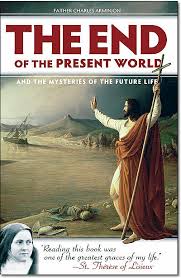 Fr. Charles Arminjon's End of the Present World and the Mysteries of the Future Life (Sophia Institute, 2008), was a life-changer for St. Therese of Lisieux. The book consists of a series of conferences given by Fr. Arminjon at the Cathedral of Chambery (Savoy). I quote from one of the notes:
St. Ambrose held that a life free of trials was a certain sign of divine malediction, and said, "I should not wish to live for a single night under the roof of a man who has never suffered." Another saint said, "Why attach any importance to afflictions? Temporal life is but a transition. A whole lifetime of pain in this world is of no more consequence than an uncomfortable night in a bad hostelry."[Hat tip to Sir A.S.]
Tuesday, October 06, 2009
Tridentine Travelogue: Public Displays of Catholicism in Bavaria
Tridentine Community News (October 4, 2009):
Germany has been getting quite a bit of bad press recently in traditional Catholic circles. One hears of renegade bishops, liturgical abuses, architectural oddities, low Mass attendance, encroaching secularism in the society, and outright antagonism towards the Extraordinary Form. All is not lost, however. During a recent trip to Bavaria, this writer was struck by public displays of Catholic piety that would be hard to imagine in North America.[Comments? Please e-mail tridnews@stjosaphatchurch.org. Previous columns are available at www.stjosaphatchurch.org. This edition of Tridentine Community News, with minor editions, is from the St. Josaphat bulletin insert for October 4, 2009. Hat tip to A.B.]
Wayside ShrinesScattered along main avenues, side roads, twisting mountain access roads, and in fields are small shrines. Most consist of a crucifix sheltered inside a wooden frame. Others have a small statue of our Blessed Mother. Fresh flowers are often placed on shelves below, indicating that someone cares enough to maintain the shrine. Some are memorials to deceased individuals, some are traditional places to pause for prayer during long journeys, and others are there simply to inspire devotion. Mountain tops are also often capped with crucifixes, quite a symbol of a goal to be reached for hikers.
Central Churches and Mountain Chapels
Bavaria is home to numerous small towns nestled between the majestic Alps. Unlike the comparatively sparsely populated areas around the Rockies, one alpine town is not far from the next. In almost all of them, a Catholic church with an onion-dome steeple is the center of the town and its most prominent architectural feature. The church is typically surrounded by a handful of one to three story chalet-style buildings, timeless in design.
Many of the mountains surrounding these towns have cable cars, gondolas, and cogwheel trains that operate year-round, ferrying skiers in the winter and hikers and tourists in warmer weather. The mountains are an extension of the town. In Garmisch-Partenkirchen, for example, seven mountains have cable cars, supported by a mind-boggling number of chairlifts and tow ropes. Restaurants, mountain lodges, homes, and, of course, cows and sheep with cowbells are scattered throughout the mountain landscape. There are even whole villages nestled in the mountains, such as Wamberg, complete with their own prominent parish churches. One can take a cable car up one mountain, walk over to a neighboring mountain, and take another cable car down, and never be far from a place to catch a meal.Scattered throughout the mountain paths, as well as at ground level, are numerous miniature chapels, tiny buildings with a steeple, an altar, and space for perhaps four worshippers. (The tape over the entrance in this photo of a chapel on the Graseck mountain is there to keep the cows out.) Some chapels are privately owned, some owned by the state, and some by the diocese. Not surprisingly, the altars inside are mostly designed for ad oriéntem celebration. The vicariate maintains a web page explaining the history of the chapels in the area: http://www.kath-pfarrei-partenkirchen.de/?s1=kirchen&s2=gedaechtniskapellen
Germany’s tallest mountain is the Zugspitze. A bowl just below the peak hosts virtually year-round skiing. Right in the center of the bowl is Germany’s highest mountain chapel, larger than most, seating about 25.It is open all day, and (Ordinary Form) Mass is celebrated every Sunday at noon. Inside is a photo of Cardinal Ratzinger celebrating Mass there in 1981. Stop and ponder: You take a cable car to the top of the mountain, another one down to the center of the bowl, and you are faced with four options: a restaurant, a gift shop, a number of ski lifts, and a Catholic chapel. What statement does that make about the faith of the Bavarian people, and their priorities?
Lest anyone think that these mini-chapels are just decorative artifacts, we quote the following paragraph from a promotional brochure of the Bayerische Zugspitzbahn, a company that operates cable cars on several mountains: “Lots of holy Masses will be held for visitors and hikers again this summer on our mountains around Garmisch-Partenkirchen and Grainau. All those wishing to enjoy the very special and contemplative atmosphere of the beautiful mountain world are most welcome to attend.”
Where are the Tridentine Masses?
With the exception of the U.K., Europe doesn’t seem to have the plethora of Latin Mass directories that we take for granted in North America. The only one appears to be WikkiMissa: http://honneurs.free.fr/Wikini/wakka.php?wiki=PagePrincipalEn. This site reveals that there are numerous Extraordinary Form Masses sprouting up in Bavaria. It’s probably only a matter of time before one of those picturesque and architecturally suitable mountain chapels plays host to one.
Tuesday, September 29, 2009
Interesting Books
Tridentine Community News (September 27, 2009):
We occasionally come across some books that merit mention in this column. They might interest our readers on a liturgical level, as prayer books, or simply because of their uniqueness.[Comments? Please e-mail tridnews@stjosaphatchurch.org. Previous columns are available at www.stjosaphatchurch.org. This edition of Tridentine Community News, with minor editions, is from the St. Josaphat bulletin insert for September 27, 2009. Hat tip to A.B.]
Pontifical
As has previously been announced, Detroit Archbishop Allen Vigneron will be visiting St. Josaphat Church on November 29 to celebrate the Sacrament of Confirmation according to the Extraordinary Form. Have you ever considered where the texts of Extraordinary Form Sacraments may be found?
To our knowledge, there is no book currently in print that contains the Sacrament of Confirmation as administered by a bishop. Reprinted ritual books, such as the 1950s Weller edition of the Rituále Románum, only contain Confirmation as administered by a priest in case of necessity (yes, that was permitted pre-Vatican II).
Leave it to Fr. Borkowski to come up with a solution: He unearthed a 1934 edition of the Pontificále Románum. This book contains not only the Sacrament of Confirmation, but a variety of other Episcopal ceremonies.
Cantus Históriæ Passiónis
During Holy Week, the Passion of Our Lord is chanted by three voices in the sanctuary, traditionally a priest, a deacon, and a third voice who can sustain the lengthy Narrator part. The music for the Passions is lilting and memorable. It is not found in the conventional altar missal. The music is rather contained in a three-book set, known as the Cantus Históriæ Passiónis Dómini Nostri Jesu Christi. The three volumes are named for each of the chanters: Christus (Christ), normally sung by the celebrant; Synagóga (Crowds); and Chronísta (Narrator). Each volume contains notes only for the individual concerned.
Finding the correct edition for the Extraordinary Form is a challenge. The Vatican Press currently sells a 1989 Novus Ordo Latin single volume version of this book, Pássio Dómini Nostri Iesu Christi Liber Cantus, too different to be useful. The web site www.musicasacra.com offers a downloadable Tridentine edition, however it suffers from two problems: 1) It is a single volume edition, which can be confusing to the singers, and 2) It is an edition from before 1955, and thus the excerpts of the Gospel terminate in the wrong places. Hand editing must thus be done to end the Passion at the right point to match the 1962 edition of the missal.
After years of asking booksellers to notify us, borrowing others’ books, and searching on-line, we finally located and purchased an actually-in-force edition: a 1956 version of the three-book set. Publishers out there: There is a market, albeit small, for a reprinting of these books.Blessed Be God
Are you looking for a comprehensive prayer book, with traditionally-phrased prayers? Back in print is Blessed Be God, a 750 page compendium of numerous devotions, novenas, and the Sacraments. The book is available for $30 from www.pcpbooks.com, or (866) 241-2762.
Daily Roman Missal
It is easy to get spoiled by the various Latin/English hand missals for the Extraordinary Form. They are beautiful aids to prayer.It is worth reminding our readers that at least one reasonably impressive hand missal exists for the Ordinary Form: the Daily Roman Missal, published by Midwest Theological Forum ($49-99 for various editions, from www.theologicalforum.org, (630) 739-9750). MTF also publishes a lovely Novus Ordo Latin Altar Missal we have previously mentioned.
The Daily Roman Missal includes Latin for the Proper Antiphons (Introit, Responsorial Psalm, Alleluia, Communion) and Ordinary of the Mass. Caveat: The Entrance and Communion Antiphons provided are those for spoken (Low) Masses. At sung Masses, different antiphons are used, taken from the 1974 Graduále Románum. This is a peculiar inconsistency for those of us accustomed to be able to trust the antiphons in our 1962 missals.
A collection of devotional prayers are provided at the back of the current edition. Overall, the book generally resembles the Magníficat subscription paperback missal.
While it is not as comprehensive as most Extraordinary Form hand missals, the Daily Roman Missal is the best such product for the Novus Ordo that we have yet seen, and the only one to include Latin. Note that there have been several revisions of this book, with each successive version improving upon the earlier ones.
With the impending changes to the English translations of the Mass, now may not be the best time to invest in an English hand missal. We do expect MTF to issue an updated edition of this missal when the new translations are released, and at that time, this book will likely be worthy of your investigation.
Sunday, September 27, 2009
12th Call to Holiness Conference

National Shrine of the Little Flower
12 Mile and Woodward Ave, Royal Oak
Speakers:
- ("Fr. Z") Fr. John Zuhlsdorf, "Mystery Both Fearsome and Alluring: Holy Mass and True Active Participation"
- Michael P. Foley, "How the Mass Shaped the Western World"
- Bishop Athanasius Schneider, ORC, "The Sacredness of the Holy Eucharist and the Fathers of the Church"
- Fr. Eduard Perrone, "Treasures of the Mass Explored"
- Ronald Prowse, "Let's Sing Sacred Music"
Adults: $25
Students $10
Add $5 fee for at door registration
Clergy, Religious & Seminarians FREE
Register online here
For more information, go to www.calltoholiness.com
Saturday, September 26, 2009
'ONLY ONE CHOICE: TO FIGHT'
Anne Barbeau Gardiner
 Father Stanley L. Jaki died in Madrid on April 7, 2009, with an inoperable hole in his heart. I found it fitting that one whom I've regarded as a living saint should die like his Master, with a pierced heart during Holy Week. Fr. Jaki was 84 years old, yet had just given six talks in Rome. Right before he left for Europe he told me on the phone that he had nearly finished writing a commentary on the Litany of the Precious Blood and was going to do a last bit of research for it in Rome. I replied that I was eager to read that work, having had my devotion to the spouse of Mary rekindled by his commentary on the Litany of St. Joseph.
In his autobiography, A Mind's Matter
, Fr. Jaki declares that in the culture war of our times, "One has only one choice: to fight." Surely if anyone ever fought the good fight without intermission it was Fr. Jaki. The role so suited him that he was the equivalent of a spiritual General Patton leading the struggle to save the remnants of Christian culture. As a historian of science and a philosopher he fought against the encroachments of scientism, or science turned into an idol and demanding to be adored. As a theologian he fought to defend the supernatural, now represented mainly by the Catholic Church and under assault both from without and within, using science used as a weapon. In one of his last books, Archipelago Church, he compared the exponents of naturalism in today's Catholic Church to the Arians of the fourth century.Born in 1924 in Györ, Hungary, Fr. Jaki felt called to the priesthood from around age seven. As he grew, he said he longed "to understand, propagate, and defend my Roman Catholic religion, which, on the intellectual level, is a set of propositions with enormously wide ramifications. Indeed there is no theology so wide in its scope and reach as Catholic theology." After studying with the Benedictines, he joined that order and from age 18 to 23 lived at Pannonhalma, a beautiful fortress-like Archabbey founded in A.D. 996 and situated on a hill near the Danube in Hungary. Fr. Jaki's brother Zeno still resides there as a monk, and there Fr. Jaki's body will finally rest. His other brother, Teodoz, is a Benedictine monk in Györ. I once asked Fr. Jaki, amazed at how hard he worked, "Father, when will you rest?" He replied with an old Hungarian proverb, "When I'm in my grave."
 He did his doctoral work in theology at Sant' Anselmo in Rome, where he was known as a defender of the papacy. His dissertation, published in 1957 -- which Pope Benedict XVI has in a place of honor in his personal library -- critiqued Les tendances nouvelles, or new tendencies in ecclesiology. In 1951 his superiors sent him to teach at St. Vincent's Archabbey in Pennsylvania, but he soon lost his voice in 1953 due to complications from a tonsillectomy. This affliction lasted ten years, during which time he earned a Ph.D. in physics at Fordham University under Dr. Victor Hess, a Nobel Prize winner. By 1965 he was on the faculty at Seton Hall University, where he remained till the end of his life.
I have known, admired, and revered Fr. Jaki for over thirty years. I first met him in the mid-1970s when he came to John Jay College and gave a brilliant talk on what he called the "stillbirths of science" in ancient India, China, Egypt, Babylon, and Greece, and on the "only viable birth" of science in medieval Christianity. His account of the rise of science was a Copernican turn in historiography. All those ancient cultures had come to a stop after making a few steps in the direction of the three laws of motion (the basis of exact science) because they viewed the world as an eternal treadmill, doomed to endless returns after every Great Year (represented by the swastika). For those cultures, the status quo was the most that could ever be achieved. Christians, by contrast, believed in a creation out of nothing and a single one-directional movement in time. No wonder a Christian scholar named Buridan formulated the first law of motion in 1348. Historians of science are mum about these "stillbirths of science" in pagan antiquity and of its "only viable birth" in medieval Christianity. The supposed darkness of the Middle Ages turns out to be the "dark recesses" of the biased minds of historians. For more on this, read Fr. Jaki's Science and Creation.
After his talk at John Jay, I had the chance during the reception to introduce myself to him as a Catholic. I was already awed by his towering intellect and rock-solid judgment, but I found the transparent simplicity of his character most endearing. One could see that he didn't care to please anyone, but wanted only to be faithful to the truth. I never lost touch with him in the ensuing years, profiting greatly from conversations with him. He was another Athanasius contra mundum, a defender of the Catholic Church as the "supremely living organism" with a firm skeletal structure (the ecclesiastical hierarchy) able to produce the "marrow" needed for "truly living flesh." By contrast, as Fr. Jaki shows in The Church of England as Viewed by Newman, the "Anglican system" was a "palace of ice, hard and cold," "the tomb of what was once living." Far from being the patron of ecumenism as he has recently been miscast, Newman saw Anglicanism as corpse-like, and corporate reunion as impossible.
The prevailing dogma in academe was and is that science is the savior of mankind, but Fr. Jaki attacked this belief as far back as 1966, in The Relevance of Physics
. He demonstrated in this seminal work the irremediable "incompleteness" of theories in physics by newly applying to physics Gödel's 1930 "incompleteness theorems" related to mathematics. He also exposed the "regularly recurring illusions" of materialists who use science to issue overconfident statements about countless planetary systems, to speak of a Multiverse (many universes), and to boast of being able to launch universes from their labs. For more on this, read his The Paradox of Olbers' Paradox and Planets and Planetarians.Pierre Duhem, also a great fighter, was an inspiration to Fr. Jaki, who recognized the "quintessence" of his own "mind's matter" in a letter he wrote in 1911 about how urgent it was to counter the false claim that the Catholic Faith had always been opposed to the progress of science. Duhem said we had to hurl in their face "the word lie! Lie in the domain of logic, lie in the domain of history!" While Duhem had argued some years before Fr. Jaki that belief in eternal returns impeded the rise of science among Greeks, cabbalistic Jews, and Muslim philosophers such as Averroes, he had not explored the "stillbirths of science" all across antiquity, nor had he investigated the role of Christ the Logos in the "only viable birth" of science. This groundbreaking work was left to Fr. Jaki. For more on this topic, read his Uneasy Genius: The Life and Work of Pierre Duhem and Savior of Science. In Savior Father explains that Christian belief in the divine Logos meant the universe could be approached as fully coherent. Also, where the Mover and Moved were always in contact in pantheism, in Christianity the Creator gave autonomy to the universe without lessening its dependence on Him.
Scientism was Fr. Jaki's special target. This is the "ideology of those who define science as the art of eliminating God from the ultimate equation." These manipulators of science included 19th-century promoters of an infinite Euclidean universe and 20th-century promoters of an eternal universe, both trying to debunk creation. One could also add all those infatuated with extraterrestrials -- since Darwinism assigns a big role to chance, some want to believe that a species like ours can arise by chance everywhere in the universe. Fr. Jaki has no quarrel with the science of evolution because the Creator can endow matter with sufficient power to obviate His need to intervene in material transformations. At the same time, Fr. Jaki does have a quarrel with spurious philosophies that parade as science -- that is, with arguments against the existence of a "non-material directive force in nature" just because that force cannot be observed scientifically. As he puts it, "The evidence of design, indicative of some purpose, is overwhelming everywhere in nature." But the evidence is philosophical, not mathematical. One is doing philosophy, not science, by arguing for or against design and purpose. For more on this, read God and the Cosmologists and The Purpose of It All, as well as Is There a Universe?
In the last phase of his life, Fr. Jaki became more and more convinced that while quantities play a decisive role in science, it's an error to let them play that role elsewhere. When we erase the "irreducible difference" between quantities and qualities, or between science and the humanities, we turn human beings into one-dimensional creatures. Unfortunately, even humanists today have been seduced by the false doctrine that science is the savior of mankind. Fr. Jaki points out one common and important example of this error -- the misinterpretation of quantum mechanics. While Max Planck and Albert Einstein kept their physics separate from their philosophy, Neils Bohr attached a philosophy to his theory and promoted it for the rest of his life. Werner Heisenberg's principle of indeterminacy was "good physics," but not when it was given an interpretation that amounted to an "elementary misstep in philosophy." This consisted of the following leap from the operational to the ontological -- "an interaction that cannot be measured exactly, cannot take place exactly." Fr. Jaki says that this confusion has become endemic in literature that touches on quantum mechanics. Many humanists have embraced the "indeterminacy principle" as if it were a "vindication of free will"; but it is nothing of the sort because a mathematical formula cannot have an ontological meaning. Sadly, the excessive respect for quantitative considerations in the West has bred an "insensitivity" to philosophical questions, so that the pseudo-ontological interpretation grafted onto quantum mechanics by Bohr now carries the day, even in theology. This error becomes particularly lamentable when Catholic theologians present Christ as a disembodied spirit conjured up by the community of the early Christians and lace their interpretation with references to a supposedly "non-materialistic spirit of modern physics."
Fr. Jaki notes that he has sometimes earned "more resentment than favors" from those for whom he was "fighting" -- that is, from Catholics fearful of standing apart from the secularist mainstream. In the following lines he implicitly compares them to Esau selling his birthright and maybe even to Judas: "A Catholic intellectual should not have for his or her prime objective the gaining of the applause of secular academics. The latter are interested only in Catholics in whom they can spot real or potential traitors to Truth. If only such Catholics suspected the value of enduring riches which they barter for very transient handouts! I mean intellectual riches, valid very much even for science." Thus, Fr. Jaki pleads for cohesion among Catholics in the great fight that lies before us. Newman, he remarks, predicted that different "forms of Protestantism" would collapse ahead of the "great battle" between "the Holy Roman Catholic Church and Antichrist" -- i.e., atheism. Surely we have lived to see it.
Starting with the prestigious Gifford Lectures given in Scotland in 1974-1976, published as The Road of Science and the Ways to God, Fr. Jaki became engaged in a broad philosophical fight partly inspired by the Thomistic philosopher Etienne Gilson. Fr. Jaki argued that the same philosophical realism underlay both the classical proofs of God's existence and science's greatest steps. One had to begin not with the mind, but "with objects, with facts." Tragically, however, the primacy of facts and objects has declined in the West at the same rate as has adherence to Christianity. The subjectively perceived has replaced the objectively real (as seen in the justifications for, and legal rulings on, abortion). For more on this, read Means to Message: A Treatise on Truth
and Universe and Creed.Fr. Jaki speaks of Christ as the "greatest fact of history" and laments bitterly that some recent Catholic scholars write as if the narratives of His Nativity and Resurrection had "no strikingly factual character to them," though many with "at least the same intellectual credentials as the best of them" laid down their lives for the truth of those supposedly "mythical" events. Father demands to know "what remains of the Christian faith if it is no longer anchored in reverence for facts as demanded by Christ?" He grieves over "Aquikantian" theologians who fuse Aquinas and Kant, as well as over fog-making theologians like those called the "Concilium," who have a "bewitching influence" on teachers in seminaries. He finds an "almost farcical aspect" to the "tragic necessity" of the publication of a document such as Dominus Iesus, which "casts a dark light on what Vatican II unwittingly brought about." What would one think if the Royal Society were to issue a warning "that the multiplication table remains valid in spite of all advances in topology, non-linear equations, and chaos theories?"
In several of his last books, Fr. Jaki defends the objective reality of miracles both from a philosophical and theological viewpoint. He does this in Miracles & Physics
and in his Introduction to the 1994 edition of The Voyage to Lourdes, Nobel Prize-winning biologist Alexis Carrel's account of a miraculous cure he witnessed at Lourdes in 1902 of a woman dying of tubercular peritonitis. In addition, Fr. Jaki presents Newman as an "advocate of the reality of miracles," because the "reality of a supernatural dispensation" must result in "ever fresh" miracles throughout history. Doubtless, however, his most important book in defense of miracles is God and the Sun at Fatima. In this work, Fr. Jaki collects all the eyewitness accounts that survive and shows that what happened on October 13, 1917, was an "essentially meteorological phenomenon, though still markedly miraculous." When the sun appeared through thin clouds and turned into a wheel of fire, the physical core of the phenomenon was, he conjectures, an air lens full of ice crystals refracting the sun's rays into various colors as the wheel descended and re-ascended along an elliptical path with small circles imposed on it. This is not to discount the miracle -- far from it. God often employs natural material when performing a miracle, greatly enhancing "its physical components and their interactions." This phenomenon was not observed in Fatima before or after. And besides, the miracle (which had been predicted by the child seers) re-energized the Portuguese Catholics and rescued their country from communism.In his works on Newman, Fr. Jaki engages in yet another big fight, this time against the claim made by theological liberals that Newman was one of them when, in fact, Newman himself said he had spent his whole life fighting "liberalism" -- i.e., the claim "that all religions are equally good," that there is no original sin and so no need for "a supernatural salvation." Fr. Jaki shows that Newman was totally dedicated "to supernatural realities," called devotion to the Blessed Virgin "the ordinary way to heaven," and deplored "the meddling of men of science in matters theological." In his Newman to Converts, Fr. Jaki again does groundbreaking research, analyzing nearly 700 pages of hitherto neglected letters Newman wrote to Anglo-Catholics on the brink of conversion. What Fr. Jaki states about Newman regarding his submission to the Church may also be said about himself: "Newman never regarded his theological views as superior to the official teaching of the Church. And he was always able to distinguish authoritative teaching from theological fashions, to say nothing of mere fads in theology" ("Newman: Myths & Facts," NOR, Nov. 2001).
When I received the news on April 6 that Fr. Jaki was dying in Madrid, I was reading his recent booklet Hail Mary, Full of Grace: A Commentary and -- was it a coincidence? -- I had just paused at "Now and at the hour of our death." Regarding "Now," Fr. Jaki writes that man has no better means for strength and light in order to conform to divine grace than to turn to our Blessed Mother: "She is present at every moment or now when a decision is to be made. This role surely befits the one who made the most decisive decision ever and at a moment's notice. Mary received no advance notice of the Annunciation."
On "the hour of our death," Fr. Jaki states, "The only true satisfaction in life comes from seeing it in retrospect and seeing that one has done something good for others. It is in that sense that the moment of one's death may be the finest moment in one's life." And yet, he then immediately calls to mind the death of St. Stephen Harding, the founder of the Cistercians, who, when he lay dying and heard monks extolling his virtues and saying that he "would enter fearlessly into the presence of God," rebuked them with his last breath: "I assure you, that I am going to God as trembling and as anxious as if I had never done any good at all, and if any fruit has been produced from my littleness, it was through the help of the grace of God: and I fear greatly lest perhaps I have husbanded that grace less jealously and less humbly than I ought to have done." These two passages provide a beautiful perspective on Fr. Jaki himself -- his joy at having fought the good fight to the end, and his humility at the prospect of being judged by the Lord mighty in battle (Ps. 24:8). I was privileged to know these two sides of him for over thirty years. The loss cannot be repaired.
In such short space, one can barely touch on Fr. Jaki's fifty or so works, but let me conclude with a hearty recommendation that NOR readers study at least one or more of his books. You will not be disappointed. These works, which can serve as an antidote to our poisonous secularist culture, are the true legacy of his great heart on fire with love for Jesus Christ, our Blessed Mother, and the Catholic Church. To order, write to: Real View Books, PO Box 10, New Hope KY 40052; phone: 888-808-2882; fax: 270-325-3091; or visit: www.RealViewBooks.com.
The eight talks Fr. Jaki had planned to give in Rome (six of which he lived to deliver) will be published in book form later this year under the title The Mirage of the Conflict Between Science and Religion.
Anne Barbeau Gardiner, a Contributing Editor of the NOR, is Professor Emerita of English at John Jay College of the City University of New York. She has published on Dryden, Milton, and Swift, as well as on Catholics of the 17th century. The foregoing article by Anne Barbeau Gardiner, "The Achievements of Father Stanley L. Jaki," was originally published in New Oxford Review (June 2009), pp. 28-32, and is reproduced here by kind permission of New Oxford Review, 1069 Kains Ave., Berkeley, CA 94706.
Subscribe to:
Posts (Atom)