Wednesday, September 23, 2009

Reverence in the Liturgy

"In all liturgical prayers (orationes) we never turn directly to the Father, but always address Him through the One in Whom alone God is well pleased: per Christum Dominum nostrum. This feeling, that we only dare address God in Christ and through Christ, is one which is deeply opposed to all easy familiarity; it never allows us to forget the awe in which we must always make our approach to God."

"The holy Sacrifice of the Mass is especially penetrated with this spirit: the necessity of sacrificing to God, the impossibility of offering Him an adequate sacrifice because of our poverty... we find this spirit, too, toward all that enters into contact with the Lord's holy Body, in the handling of the paten and the cleansing of the chalice.

"We also find it in all that symbolizes Christ or is dedicated to the divine service, in the kissing of the divine altar and the Gospel book. It is expressed in the bodily comportment of the priest, the faithful and the religious; in the standing up during the reading of the Gospel, during the songs of praise taken from the Gospels, the Magnificat, Benedictus, Nunc dimittis, in the bowing of the head during the Gloria Patri.

"The very fact of the harmonious structure and order of the entire Liturgy, extending even to the outer comportment, contains a profound element of reverence. This unique organic structure, corresponding so clearly to the adequate inner attitude of the one who is standing before God, is the very opposite of slackness; and, in equal measure, it is opposed to the attitude of a military or athletic drill."
-- Dietrich von Hildebrand, Liturgy and Personality: The Healing Power of Formal Prayer (1943; Sophia Inst Pr; Reprint ed., 1993). Dr. von Hildebrand (died 1977) was first Chairman of Una Voce in the United States

[Hat tip to Una Voce America, Summer 2009), p. 11]

Monday, September 21, 2009

Active Participation in the Mass: A Statistical Study - Part 4 of 4

Tridentine Community News (September 20, 2009):
Below we conclude our count of the congregational responses made in the Extraordinary and Ordinary Forms of Holy Mass. Our objective is to see just how much exterior “active participation” there is on the part of the congregation. Longer responses are abbreviated to save space, as the idea is to count the responses, not to write them out in entirety. If you wish to see a complete comparison of both Mass forms, please see the series of columns we presented in early 2008, available at the web site below.

The typical sung Sunday Mass is presented, including the Aspérges. In some churches, the congregation makes the responses to the Prayers at the Foot of the Altar silently, and not out loud. We thus show two counts: The first number includes these responses, while the second, bracketed number does not. It must be stated that the notion of silent responses may be a new concept to those unfamiliar with the Extraordinary Form. We maintain that those are responses nonetheless, just as the priest’s silent Canon is indeed a prayer.

Ordinary Form/Novus Ordo Mass
THE PATER NOSTER, CONTINUED
43. And also with you.

THE AGNUS DEI
44. Lamb of God…

PRAYERS BEFORE HOLY COMMUNION
45. Lord I am not worthy to receive you… (1 time)

COMMUNION OF THE FAITHFUL
46. Amen.

THE COMMUNION ANTIPHON

THE POSTCOMMUNION PRAYER

47. Amen.

THE BLESSING AND DISMISSAL
48. And also with you.
49. Amen.
50. Thanks be to God.

Extraordinary Form/Tridentine Mass
THE PATER NOSTER, CONTINUED

THE AGNUS DEI
42. [27.] (sung) Lamb of God ...

PRAYERS BEFORE HOLY COMMUNION
43. [28.] Lord, I am not worthy that Thou… (3 times)

COMMUNION OF THE FAITHFUL

THE COMMUNION ANTIPHON

THE POSTCOMMUNION PRAYER

44. [29.] And with thy Spirit.
45. [30.] Amen.

THE BLESSING AND DISMISSAL
46. [31.] And with thy Spirit.
47. [32.] Thanks be to God.
48. [33.] Amen.

THE LAST GOSPEL
49. [34.] And with thy Spirit.
50. [35.] Glory be to Thee, O Lord.
51. [36.] Thanks be to God.

Conclusions

On a number-of-responses basis, with good faith allowances for the number of Responsory Psalm responses and Prayers of the Faithful, the Extraordinary Form has essentially the same number of congregational responses as the Ordinary Form. Those who believe otherwise have likely not attempted a similar exercise as this one, or may have an erroneous perception that the congregation is engaged in devotional activities during the Mass. We invite doubters to visit one of our Masses and judge for themselves.

It is said that “those who sing, pray twice.” Certainly singing is a high level of vocal participation. On a what-is-sung basis, the Asperges, Kyrie, Gloria, Credo, Sanctus, and Agnus Dei are always sung in the typical Sunday Tridentine Mass. In the Novus Ordo, the Asperges is rarely chosen as an option, and the Credo is rarely sung, but the Kyrie, Gloria, Sanctus, and Agnus Dei are commonly sung. Both forms have Entrance and Recessional Hymns, plus an Offertory Hymn if the choir does not sing a piece alone at that point. The Ordinary Form typically has a Communion Hymn, but it is not commonly feasible for the congregation to participate. All things considered, there is a greater amount of congregational singing in a typical Sunday Extraordinary Form Mass than in a typical Sunday Ordinary Form Mass.

In summary, if you define “active participation” as vocal engagement, and believe that more of that makes for better liturgy, then we have a place for you: a typical Sunday Mass in the Extraordinary Form.
[Comments? Please e-mail tridnews@stjosaphatchurch.org. Previous columns are available at www.stjosaphatchurch.org. This edition of Tridentine Community News, with minor editions, is from the St. Josaphat bulletin insert for April 26, 2009. Hat tip to A.B.]

Sunday, September 20, 2009

Extraordinary Form Confirmations Scheduled

Tridentine Community News (September 13, 2009):
Fr. Mark Borkowski is pleased to announce that His Excellency Archbishop Allen Vigneron has agreed to celebrate the Sacrament of Confirmation according to the Extraordinary Form on Sunday, November 29 at St. Josaphat Church, following the 9:30 AM Tridentine Mass. The archbishop has requested that the preceding Mass be celebrated by another priest.

All families and individuals requesting Confirmation must contact Fr. Borkowski at (313) 831-6659 or frmarkb@aol.com as soon as possible, even if you have already spoken with him about your interest. Adults and children are both invited. A definitive list of candidates needs to be assembled. Fr. Borkowski will also have to assess the preparedness of each candidate, as Confirmation is bestowed upon those who demonstrate a certain level of understanding of the Holy Catholic Faith.

A note to our readers at Assumption-Windsor: Such an opportunity to receive the Sacrament of Confirmation according to the traditional form may not come again soon. We do not know if it will ever be an option in the Diocese of London. Therefore, if there is any possibility that a family member or friend may want to receive this Sacrament, we suggest that you contact Fr. Borkowski and explain that you are from Assumption.

This will be the first time that an Archbishop of Detroit will be visiting St. Josaphat’s Tridentine Mass Community. It is imperative that we demonstrate the maximum possible support to Archbishop Vigneron. If you do not attend St. Josaphat Church every week, we ask that you make a special effort to attend on that Sunday.

There are several differences between the Novus Ordo and Tridentine versions of the sacrament. In future weeks, this column will provide the complete text of the Extraordinary Form Sacrament of Confirmation, to help our readers prepare for this historic event.

[Adjacent photo of Bishop Michael Burbridge of the Diocese of Raleigh, North Carolina by Philip Gerard Johnson, who carries the report with photos.]

Fr. Borkowski to Celebrate Mass at St. Joseph, Jackson

On Sunday, October 4 at 10:30 AM, Fr. Mark Borkowski will celebrate a special sung Tridentine Mass at St. Joseph Church in Jackson, Michigan. St. Joseph was Fr. Borkowski’s childhood parish. It has been the home of Jackson’s Extraordinary Form Mass for several years. Interestingly, the previous pastor who arranged for the Jackson Tridentine Mass to move from its original location to St. Joseph Church was Fr. Louis Madey, well-known as a celebrant at several local Tridentine Mass sites.

Choir members and altar servers from St. Josaphat and Assumption-Windsor will be traveling to Jackson to assist with this special occasion.

Pilgrim Virgin Statue to Return

As was the case last year, special Tridentine Masses have been scheduled for the visit of the International Pilgrim Virgin Statue of Fatima to the Detroit area:

On Wednesday, October 7 at 7:00 PM, there will be a Tridentine Low Mass at Detroit’s St. Joseph Church.

On Thursday, October 8 at 7:00 PM, there will be a Tridentine Mass at St. Josaphat Church.

On Friday, October 9 at 7:00 PM, there will be a sung Tridentine Mass at Sweetest Heart of Mary Church, followed by a Eucharistic procession, outdoors if weather permits.

A Marian talk conducted by one of the statue’s guardians will precede each Mass. The statue has a long and prominent history with fostering Marian devotion. More information about the statue is available at: www.pilgrimvirginstatue.com.

Fr. Z to Speak at Call to Holiness

The annual metro Detroit Call to Holiness conference always attracts an interesting spectrum of speakers. Many are culled from the roster of regulars on EWTN, familiar faces to Catholics of most every stripe. The 2009 Conference will be held at the National Shrine of the Little Flower on Saturday, October 10.

Among the speakers this year is one of the world’s most prolific apologists for sacred tradition. The king of the Internet-age priests, Fr. John Zuhlsdorf, known as “Fr. Z” in the blogging world, is one of our era’s best-read defenders of sound rubrical practices. His column for The Wanderer newspaper, “What Does the Prayer Really Say?”, began as an effort to provide accurate translations of the Latin Propers of the Ordinary Form of Mass. This work spawned a blog at www.wdtprs.com, which along with The New Liturgical Movement are the two principal sources of news for those interested in matters liturgical. Whether the topic is Tridentine or by-the-books Novus Ordo, Fr. Z is outspoken in his support of reverent celebrations of the Mass and the Sacraments.

Lest there be any confusion, there will not be a celebration of Holy Mass according to the Extraordinary Form at this conference.

Further information and registration details may be found at www.calltoholiness.com.
[Comments? Please e-mail tridnews@stjosaphatchurch.org. Previous columns are available at www.stjosaphatchurch.org. This edition of Tridentine Community News, with minor editions, is from the St. Josaphat bulletin insert for April 26, 2009. Hat tip to A.B.]

Why Jews lean left

Why do Jews lean to the Left? -- a masterful analysis by Irving Kristol (1920-2009), a Trotskyite in the 1930s who would soon sour on socialism, break with the New Left in the 1960s to become the godfather of American "neo-conservatism" and commit the unthinkable -- support the Republican Party, once as "foreign to me as attending a Catholic Mass."

Commentary magazine has opened to the public their archives of his writing spanning his life. Kristol passed away last Friday.

Irving Kristol, "Liberalism & American Jews," Commentary (October 1988).

[Hat tip to C.B.]

Sunday, September 13, 2009

The hollow cult of liturgical Gemütlichkeit

Fr. Aidan Nichols, O.P., writes: "There can hardly be a more important topic than the Liturgy if it really is, as the Fathers of the Second Vatican Council maintained, the source from which the Church's life flows and the summit to which that life is directed." In fact, he continues: "Liturgy, evidently, is too important to be left to liturgists."

Indeed, we have our work cut out for ourselves. As Peter Kreeft once mused: "What's the difference between a terrorist and a liturgist?" Answer? "You can negotiate with the terrorist."

What follows is an excerpt from Fr. Nichol's little book, disproportionately significant for its size, Looking at the Liturgy: A Critical View of Its Contemporary Form (San Francisco: Ignatius Press, 1996):
Today the question should be determined, in my judgment, in relation to the threat of what we can call "cultic immanentism": the danger, namely, of a congregation's covert self-reference in a horizontal, humanistic world. In contemporary "Catholic communalism," it has been said: "Liturgical Gemütlichkeit, communal warmth, friendliness, welcoming hospitality, can easily be mistaken for the source and summit of the faith."1 Not unconnected with this is the possibility that the personality of the priest (inevitably, as president, the principal facilitator of such a therapeutic support-group) will become the main ingredient of the whole ritual. Unfortunately, the "liveliest church in town" has little to do with the life the Gospel speaks of.

Henri de Lubac wrote in The Splendor of the Church:
In the present welcome efforts to bring about a celebration of the liturgy which is more "communal" and more alive, nothing would be more regrettable than a preoccupation with the success achieved by some secular festivals by the combined resources of technical skill and the appeal to the man at his lower level.... The "unanimous life of the Church" is not a natural growth; it is lived through faith; our unity is the fruit of Calvary, and results from the Mass's application to us of the merits of the Passion, with a view to our final redemption.2
De Lubac glimpsed in fact a nightmare prospect that the Church, by misjudged benevolence, could realize August Comte's prediction that Catholicism would find its last end in an apotheosis of humanity.... The dogma of the Incarnation, Comte thought, would see its final fruit in an ecclesiology where the Church becomes the sacrament of humanity, itself the one and only true Supreme Being. And de Lubac comments:
We should not be too quick to cry out in protest, as if there were never any danger of anything like that in ourselves.... No sincere Christian will go so far as to profess a "sociological pantheism"; but that is not to say that everyone will always, both in his emotional reactions and his practical conduct, be effectively strengthened in advance against the present tendency to absorb God into the human community.3
Recalling Torquemada's criticism of the Council of Basel for allowing its members to genuflect when they sang the article of the Creed concerning the Church, de Lubac concludes that a shift in our focus of interest can sometimes symptomize a doctrinal debilitation and hollowness far graver than more obvious errors. I suggest that the concentration on congregation and presider in contemporary eucharistic practice is an example of just such debilitation and hollowness, unfortunately encouraged by the versus populum celebration of the Eucharistic Prayer.

Notes

  1. T. Day, Where Have You Gone, Michelangelo: The Loss of Soul in Catholic Culture (New York, 1993), 107. [back]

  2. H. de Lubac, S.J., Looking at the Liturgy: A Critical View of Its Contemporary Form (San Francisco, 1986), 155-56. [back]

  3. Ibid., 226-27. [back]

[Hat tip to E.E.]

Friday, September 11, 2009

The times, they are a-changin' ...

"It is impossible to reconcile the doctrine of the divine institution of marriage with any modernistic plan for the mechanical regulation or suppression of human birth. The church must either reject the plain teachings of the Bible or reject schemes for the 'scientific' production of human souls.... The suggestion that the use of legalized contraceptives would be 'careful and restrained' is preposterous."

-- Washington Post (editorial, March 22, 1931)

[Hat tip to Howard P. Kainz, Guest Column, New Oxford Review (9/09), p. 39.]

Richard McBrien: Eucharistic Adoration a waste of time, medieval superstition

Would somebody at Notre Dame who still has a conscience and some clout please call the papal nuncio and shut this toxic gasbag up? He's entitled to his noxious opinions, but not to pretend he's a Catholic, let alone the presumption that he is a leading spokesman for Catholicism. If a man is intent on flinging himself headlong into the abyss of hell, I suppose he cannot be stopped, but this hardly means he has the right to take an entire generation of naive and gullible groupies with him.

Obama's Catholic Plan

In case you missed the email:
Five months ago you spoke out against the decision by Notre Dame to honor President Obama.

Thank you for your courage and witness.

Our organization joined you in that protest, by proudly partnering with the Cardinal Newman Society in promoting NotreDameScandal.com. Over 350,000 people signed the petition urging the leadership of Notre Dame to reconsider bestowing such an honor on anyone who proudly defends the Culture of Death.

But much more is at stake.

Let’s face the facts. The elites in this country are aiming to minimize our influence. That’s why President Obama and others are working hard to re-define what it means to be a Catholic voter.

Don't believe this? Consider this ...
  • President Obama is filling his administration with prominent pro-abortion Catholics, including Kathleen Sebelius, Ken Salazar, and Leon Panetta. Catholics Tom Daschle and Bill Richardson were also nominated, but backed out. And don’t forget Vice President Joe Biden!

  • The Obama team is working closely with George Soros funded “Catholic” dissident groups such as Catholics United and Catholics in Alliance for the Common Good. And President Obama recently named Alexia Kelley from Catholics in Alliance to a plum position in his faith-based office.

  • Obama has named anti-Catholic bigot Henry Knox to his faith-based advisory council. Knox has called the Pope a “discredited leader,” and claimed that members of the Knights of Columbus who helped pass the CA marriage amendment were “foot soldiers of a discredited army of oppression.”

  • When speaking earlier this year at Georgetown, Obama staffers demanded that the monogram ‘IHS’ on the pediment over the stage be covered up. IHS is a traditional abbreviation for the name of Christ.
Meanwhile, President Obama took the stage at Notre Dame last May, and elsewhere, to call for common ground, open minds, and respect for those who disagree on the fundamental issue of the right to life.

But the problem is that Obama's so-called ‘common ground’ is a one-way street!

Those who opposed his presence at Notre Dame, or his policies on funding abortion and embryo-killing research with tax dollars are depicted as wackos, or part of the problem.

Obama's strategy on common ground requires our silence. Sure, he's willing to "dialogue." As long as we keep quiet. So long as you keep quiet.

We intend to fight this double-speak with powerful messages of real hope. But our aim is to be a different kind of voice. The image of the cranky, hopeless Catholic is not us. Far from it. Our goal is to speak the truth – with joy. And in doing so, show the world the glory of the truth, and invite others to think.

We aren’t naïve. We know Barack Obama won the election in November. There are areas in we can work together, like promoting fatherhood. But that doesn’t mean this President can dictate what it means to be a faithful Catholic voter.

What happened at Notre Dame only confirmed the need for a strong, authentic Catholic voice engaged in the public debate. That’s what CatholicVote.org is all about. We will never back down. We will never surrender. We will always be a strong voice for Catholics.

The time has come to proudly defend our beliefs – on our terms! But we need to fight in a different way. That’s why we are using the latest online technologies available to deliver provocative, yet appealing programming that speaks directly to the hearts and minds of Americans.

Our election ad last year had 3 million views – one of the most watched online videos of the entire campaign! Our Obama “Super Bowl” ad was seen 2 million times. It’s clear that our videos are having a profound impact. Click the video above and see for yourself.

If you like what we are doing, we’ll keep you updated on our work a few times a month. If you prefer to not receive our e-mails, simply click the unsubscribe link below.

We think the “Catholic vote” is worth fighting for. Politicians know it. The media knows it. But most importantly, our faith requires it.

There is too much at stake to stay quiet.

Sincerely,

Brian Burch
President, CatholicVote.org

P.S.
If you like our approach, please consider helping us here. If you have thoughts about what we ought to be doing, or where we should focus, feel free to reply to this message. We look forward to your thoughts.
Follow us on: Facebook MySpace Twitter

CatholicVote.org, P.O. Box 2709, Chicago, IL 60690 - Tel: 312-201-6559
Support CatholicVote by clicking here.

Related: "Obama's 'Catholic Plan'" (An episode of the Vortex from RealCatholicTV.com.

Monday, September 07, 2009

The Islamization of Christianity

The author of the substantial and timely analysis (linked below) is a friend of mine. In fact, back in my student days, I lived and boarded with him and his family in Switzerland for nearly an entire year in their commodious chalet, a converted bed and breakfast, in Chesières, Switzerland, along with some ten-to-fourteen other house guests and students. Udo Middelmann (pictured left) was a German lawyer before becoming a Christian convert and assuming a leadership role in the L'Abri Foundation, based in Switzerland. Much as I remember his discussions, his essay here is unhurried, deep, and incisive. His is a voice well worth listening to on the subject at issue. (Incidentally, the picture at the head of the linked article is not of Udo Middelmann, but of Francis A. Schaeffer, the founder of the L'Abri Foundation.)

The Islamization of Christianity [link]

by

Udo W. Middelmann

Chalet Les Montaux, CH 1882 Gryon, Switzerland #41 24 498 1656

uddebch@aol.com
Excerpt:
The recent increase in wealth of most Islamic countries due to the oil trade has made the expression of Islamic thought and culture a world wide phenomenon. Mosques or Islamic cultural centers are now found in the major cities of the world. Islam presents itself to many as an alternative to Christianity. For some it is a more hopeful and coherent religion after the perceived failure of Christianity to provide a stable cultural and moral framework. The growth of Islam among non-white people in traditionally European contexts is partially related to Islam declaring to be, with some violence to geography, an African religion.

Sharing the same world, large trade of a commodity needed in the industrialized world and the search for a solution to the Arab/Israeli stand-off have awakened us to an old discussion of the significance and cultural energy of Islam.

These factors contribute in some way to the manner in which we view Islam. Today we respond more favorably to the Islamic world pressing on the belly of the European/American world view. No longer are the gates of Vienna challenged by Islamic hordes. Many invite Islam to challenge our traditional view of the world from a Biblical and rational perspective.

There are two areas in which there is a process of the Islamization of Christianity under way. The first is the attempt to harmonize two different religions, two different ways of explaining the world, the place of the human beings and the purpose of life. The second is a more subtle move of some Christian circles to embrace what is fundamentally an Islamic view of God and man, of life in history. It may turn out to be an insidious merger on the level of theology, coming to a common view of God. I would suggest that while the former is pathetic and culturally superficial, the latter is a destruction of the uniqueness of Christianity and the Bible. In both cases, the result is an embrace of a view point antithetical to our view of God and man in the name of religion. This can not but effect dramatically the way we live, think and morally order our lives.
[Hat tip to J.M.]

Are the Dark Clouds of Persecution Beginning to Gather?

CONSIDERATION OF A HISTORIC PARALLEL

By F. Douglas Kneibert

Mention the words "persecution of the Catholic Church" and eyes begin to roll. What persecution? Are churches in the West being burned, priests being hunted down, and believers being thrown into prison? Obviously, no. But those are the wrong questions. In Western democratic societies, persecution seldom bursts forth on the scene full-blown. It's more likely to come in steadily escalating phases, often disguised as something else -- even as something good. Might we be in the early stages of just such a progression?

To speak of persecution of a religious minority is to be directed to Holocaust studies, which constitute the most exhaustive historical examination we have of how democratic civil and religious rights can be undermined and lost in a remarkably short timespan. The manner in which this process unfolded may have something to say to the Catholic Church today. Obviously, there are vast differences between Germany of the early 1930s and the U.S. today. But there are also some unsettling similarities.

It hardly bears repeating that Germany in the early 20th century was heir to a rich cultural heritage that was far removed from its barbaric origins. Or so many thought. The Constitution of the Weimar Republic, out of which the Third Reich emerged, granted civil and religious rights to its citizens in conformity with the European norm at the time.

Although Germany had a long history of hostility toward the Jews, the first stage of the process that led directly to Hitler's "final solution" was centered in the popular culture during the waning days of the Weimar Republic and the early years of the Nazi regime, which assumed power in 1933. A virulent anti-Semitism found its voice in the media, in books, in motion pictures, and even in children's literature. When it came to demonizing the Jew, Adolf Hitler had literally written the book with Mein Kampf.

Anti-Semitism was pervasive in Germany in all outlets of the popular culture, but newspaper cartoons bear special mention. Here Julius Streicher's Der Stürmer newspaper was in a class by itself, publishing over its 17-year lifespan a vicious series of crude cartoons that caricatured, stereotyped, and condemned Jews for any number of alleged offenses.

Fast-forward to contemporary America, where editorial cartoons ridiculing the Catholic Church have become standard in what used to be called "family" newspapers. Pat Oliphant is the most notable among several cartoonists whose pens fairly drip with anti-Catholic venom. No other religious group approaches the enmity that is heaped upon the Catholic Church in the daily press. In fact, other religions are almost totally exempt from criticism, by the dictates of political correctness.

Anti-Catholic movies like The DaVinci Code have become so common that they constitute their own genre. The same for books, especially those by Dan Brown of DaVinci fame. New York Times bestsellers The Last Templar by Raymond Khoury and The Third Secret by Steve Berry work the same basic plot line -- the uncovering of some long-suppressed truth reveals the Catholic Church to be a gigantic fraud.

Jokes about and contempt for the Church are standard fare for TV comedians and on talk shows. Far-left websites such as The Daily Kos spew out a steady stream of anti-Catholic vitriol. The same for "gay" bloggers, with Bitch Ph.D. and Towleroad perhaps being the most vicious.

If the Jews of 1930s Germany were alive today, they would recognize these things not as scattered occurrences but as part of a pattern with which they were all too familiar. But by the time they could see where things were heading as the Third Reich steadily tightened the screws, it was too late for most of them.

One might argue that the Catholic Church in the U.S. has encountered prejudice throughout her history and what we are seeing today is merely the status quo. However, there are ominous signs that the stakes are being raised. Hear William Donohue, a historian and president of the Catholic League for Religious and Civil Rights: "Today's brand of anti-Catholicism is more virulent and more pervasive than ever before in American history.… The degree of hostility exhibited against the Catholic Church is appalling. Quite simply, Catholic-bashing has become a staple of American society."

For German Jews, the middle stage of persecution, in which they became the target of legal sanctions, began in 1933, when the Reichstag, Hitler's rubber-stamp parliament, enacted a law prohibiting Jews from holding jobs in Germany's vast and all-encompassing civil service. Jews, who had played leading roles in forming the Weimar Republic, found themselves cut off from any voice in the government. Other laws would progressively bar them from other professions and activities, isolating Jews from German public life.

Substitute "Catholics" for "Jews" and switch to Massachusetts in 2006, when the legislature passed a law making it illegal to discriminate against homosexuals in placing adoptive children. Since the law contained no religious exemption, the Catholic Church's long-standing role in arranging one of the most loving services possible -- placing unwanted children with traditional families -- came to an end in the second-most Catholic state in the union. Score one for those who would like to shrink the Church's sphere of public influence.

Last March in Connecticut, two dissident Catholic state legislators who are advocates of same-sex marriage introduced a bill requiring Catholic churches to elect boards to run all parish functions, stripping ecclesiastics of their authority in that area. The bill's stated purpose was "to revise the corporate governance provisions applicable to the Roman Catholic Church and provide for the investigation of the misappropriation of funds by religious corporations." Bridgeport Bishop William Lori denounced the bill as "a thinly veiled attempt to silence the Catholic Church on the important issues of the day, such as same-sex marriage." In the face of massive opposition, the bill was pulled before a hearing could be held. But such a brazen attempt to use the force of statutory law against the Catholic Church in Connecticut was a wake-up call that the field of battle is being expanded.

On the other side of the nation, in California, another official assault on the Catholic Church occurred in 2006. Outraged at the Church's stand against gay adoptions, the city/county governing board of San Francisco passed a unanimous resolution that accused the Church -- which it denounced as "a foreign country" -- of being "insulting to all San Franciscans," "hateful," "defamatory," "insensitive," and "ignorant." That the governing board of a major urban area would engage in such a vicious attack on the Catholic Church would have been unthinkable a decade earlier. Attorneys for the Thomas More Law Center, which filed suit against the Board of Supervisors, argued in court that the "anti-Catholic resolution sends a clear message that Catholics are outsiders, not full members of the political community." That sounds eerily familiar to anyone knowledgeable about the plight of Jews in 1930s Germany.

Lest anyone think that such occurrences are strictly a local phenomenon, consider what happened last spring during Pope Benedict's trip to AIDS-devastated Africa, where he stated that condoms aren't the answer to the crisis. European capitols and the news media erupted in outrage, but things didn't stop there. The Belgian parliament went so far as to pass a resolution calling the Pope's remarks "unacceptable," and demanded that the government make a formal diplomatic protest to the Vatican, which it did. Predictably, this unprecedented condemnation of Catholic teaching -- on the part of an entire nation no less -- came from a country that is overwhelmingly Catholic, at least in name.

The Vatican recognized the Belgian protest for what it was, saying the Pope's remarks had been "used by some groups with a clear intent to intimidate, as if to dissuade the Pope from expressing himself on certain themes of obvious moral relevance and from teaching the Church's doctrine." Like all tyrannies, the emerging politically correct tyranny cannot abide dissent.

In another vitally important area of American life, the federal judiciary, practicing Catholics face steep hurdles in the Senate confirmation process, if not outright rejection. When President George W. Bush nominated Judge Bill Pryor for a seat on a federal appeals court in 2003, Senate Democrats, several of them Catholics (as is Pryor), perceived a possible threat to Roe v. Wade and blocked Pryor's confirmation. Using the coded language in which pro-aborts have become expert, Pryor's "deeply held personal views" disqualified him, despite the Constitution's prohibition of a religious test for public office.

The Conservative Committee for Justice said the only conclusion that can be drawn from the bitter fight over Pryor was that "devout Catholics need not apply" for federal judgeships. Those worrisome "deeply held personal views" arose again in 2005 and 2006 when Bush nominated two other Catholics to the Supreme Court, Judges John Roberts and Samuel Alito. Both were confirmed, but only after the usual Senate suspects raised the same fears that prompted their opposition to Pryor.

Court appointments are vitally important, considering that the federal judiciary all the way up to the Supreme Court (and to a lesser but significant degree the lower state courts) plays a huge role today in determining the kind of society in which we live. Besides often siding with the Culture of Death on the life issues that are so fundamental to Catholic moral theology, judges have also begun legalizing same-sex marriage, bypassing entirely the legislative process and even overturning public referendums.

A historical footnote on this topic: One of the Nazis' earliest acts upon seizing power was to bar Jews from holding judgeships. Later they were prohibited from practicing law as well.

The principles underlying Western law emerged largely from the Judeo-Christian tradition. But when one's Christian beliefs collide with the tenets of liberal orthodoxy, the latter most often prevail. Furthermore, some of our nation's most basic assumptions are being brought into question today -- even by our current President. On at least two occasions Barack Obama has stated that the U.S. "is not a Christian nation," although a 2008 Gallup Poll found that 77 percent of Americans so identify themselves. Whatever Obama intended by those startling words -- which marked a major departure from the past -- they're not a comforting sign at a time when Christian expression is increasingly under attack.

Blaming the Jews for Germany's various ills was a central facet of Nazi propaganda. Economic hard times were blamed on Jewish bankers and merchants. The Jews caused Germany to lose World War I, and the Jews were the force behind Bolshevism. Besides, they were "foreigners," not real Germans (recall the San Francisco Board of Supervisors' depiction of the Catholic Church as a "foreign country").

In like fashion, the Catholic Church is singled out for blame in a variety of areas. By opposing abortion and same-sex marriage, Catholics are against civil rights for women and homosexuals. The Church's stand against embryonic stem-cell research is anti-science. Her opposition to condoms makes the AIDS epidemic worse. The list could go on.

Well versed in the techniques of propaganda, the Nazis realized early on the importance of controlling the media. The infamous Nazi book-burning episode in 1933 sent a clear message that only approved books would be allowed in Germany. Jewish journalists were hounded, and Jews were prohibited from editing newspapers. In a short period of time, all media outlets, including the theater and motion pictures, were brought under the thumb of Josef Goebbels's Ministry of Propaganda and National Enlightenment.

The silencing of dissenting voices is always one of the first steps taken by authoritarian governments. In that respect, what has been happening north of the border is of special interest today, where the so-called Canadian Human Rights Commission (HRC) has been running roughshod over free speech and religious rights -- all in the name of tolerance. But it is an intolerant tolerance.

Consider the case of Fr. Alphonse de Valk, who wrote an article in the Canadian Catholic Insight magazine defending Church teaching on homosexuality. When a gay activist complained to the HRC, Fr. de Valk was charged with promoting "extreme hatred and contempt" toward homosexuals. Although the charges were eventually dropped, the accused was forced to spend several thousand dollars in legal defense fees, not to mention suffering the disruption of his life.

The Rev. Stephen Boisson, an evangelical pastor, was not so fortunate. His letter to the editor of a Canadian newspaper, in which he presented the biblical teaching on homosexuality and criticized societal inroads made by gay activists, cost him dearly. Besides fining him $5,000 for his "hate crime" and ordering him to apologize to the gay complainant, the Alberta Human Rights Tribunal fixed a firm muzzle on his free-speech rights. Because we could soon be seeing something similar in this country, the tribunal's order is worth quoting in part: "Mr. Boisson and The Concerned Christian Coalition Inc. shall cease publishing in newspapers, by e-mail, on the radio, in public speeches, or on the Internet…disparaging remarks about gays and homosexuals.… Further, all disparaging remarks…are directed to be removed from current Web sites…."

Rather than being appalled at such blatant assaults on speech and religious rights, some states in this country have based their own hate-crime laws on Canada's. Eleven states and the District of Columbia have hate-crime statutes that cover sexual orientation. While some give lip service to protecting free speech and religious expressions, in the area of "public accommodations" those rights may not pertain.

In the effort to marginalize Christians, this may well be the most critical battleground today. In some states, Christians have faced charges and been penalized for "discriminating" (as broadly defined) against homosexuals. Let two examples suffice for several.

In 2004, 11 Christians were arrested in Philadelphia for demonstrating against a homosexual "Outfest" event held on public property. Although a judge eventually ruled in their favor, the threat of long prison terms and stiff fines was very real. Last year, the New Mexico Human Rights Commission fined a Christian photographer $6,000 for refusing to photograph a lesbian "commitment" ceremony.

Federal hate-crime legislation that includes sexual orientation -- with all the potential that holds for vastly expanded scope, prosecutions, and penalties -- was being fought over in the Senate as of this writing, the House having already approved it.

Hate-crime laws are Orwellian by their very nature, their model being the "thought crime" laws that Big Brother enforced in 1984. The day is fast approaching when offenders, such as the Catholic Church, may be those who take God's word seriously in the area of sexuality. Will sacred Scripture itself come to be equated with "hate" in the eyes of zealous prosecutors and judges? The message behind these laws is clear: If you follow biblical and Church teaching on sexual morality, be sure you do it behind church walls and not in a public place. But how long will those church walls remain inviolate? Germany's Jews found that their synagogues offered scant protection.

Speaking of hate crimes, the gay furor that broke out following the defeat of same-sex marriage by voters in California last fall saw churches vandalized, religious services interrupted by obscenity-shouting protesters, and some Christians physically assaulted. Hitler's brown­shirts, the main tool for intimidating, beating, and killing Jews in the early years of the Third Reich, would have approved.

For Germany's Jews, their persecutors were on the Right, but those who would silence the Church are overwhelmingly on the Left. Among its constituent elements, militant homosexual groups are by far the most aggressive. The Catholic Church, along with some evangelical bodies, is the only serious impediment to realization of the gay agenda, liberal Protestant churches having sold out to the Spirit of the Age long ago.

As Holocaust studies demonstrate, the value of having an early-warning system is crucial when persecution raises its ugly head. At the moment, that persecution is comparatively mild, especially compared to what Germany's Jews experienced in the early 1930s, residing mainly in the various organs of the popular culture (if "culture" is still the right word). But the warning light is beginning to flash a brighter yellow as the conflict spreads into the legal and legislative arenas.

Jesus warned His followers to heed the "signs of the times." The signs of our time are pointing toward an intensifying battle with those forces that seek to prevent the Church from being the Church. It's a battle that every Catholic who loves her must be prepared to fight.

F. Douglas Kneibert is a retired newspaper editor and a 1999 convert from Protestantism. He writes from Sedalia, Missouri. The foregoing article by F. Douglas Kneibert, "Are the Dark Clouds of Persecution Beginning to Gather?" was originally published in New Oxford Review (July-August 2009), pp. 42-45, and is reproduced here by kind permission of New Oxford Review, 1069 Kains Ave., Berkeley, CA 94706.

Active Participation in the Mass: A Statistical Study - Part 3 of 4

Tridentine Community News (September 6, 2009):
Below we continue our count of the congregational responses made in the Extraordinary and Ordinary Forms of Holy Mass. Our objective is to see just how much exterior “active participation” there is on the part of the congregation. Longer responses are abbreviated to save space, as the idea is to count the responses, not to write them out in entirety. If you wish to see a complete comparison of both Mass forms, please see the series of columns we presented in early 2008, available at the web site below.

The typical sung Sunday Mass is presented, including the Aspérges. In some churches, the congregation makes the responses to the Prayers at the Foot of the Altar silently, and not out loud. We thus show two counts: The first number includes these responses, while the second, bracketed number does not. It must be stated that the notion of silent responses may be a new concept to those unfamiliar with the Extraordinary Form. We maintain that those are responses nonetheless, just as the priest’s silent Canon is indeed a prayer.

Ordinary Form/Novus Ordo Mass

THE NICENE CREED
[In Canada, it is permissible to recite the Apostles’ Creed.]
23. We believe in one God…

GENERAL INTERCESSIONS
24-31. Lord, hear our prayer. [Allowance for typical seven Prayers.]
32. Amen.

THE OFFERTORY
- [-] Blessed be God for ever. [Omitted: hymn is usually sung.]

THE LAVÁBO

THE ORÁTE FRATRES

33. May the Lord accept the sacrifice at your hands…

THE PRAYER OVER THE GIFTS
34. Amen.

THE PREFACE
35. And also with you.
36. We lift them up to the Lord.
37. It is right to give him thanks and praise.

THE SANCTUS
38. Holy, holy, holy…

THE EUCHARISTIC PRAYER
[The people respond with one of the following:]
39. Christ has died, Christ is risen…
39. Dying you destroyed our death…
39. When we eat this bread and drink this cup…
39. Lord, by your cross and resurrection you have set us free…

THE PATER NOSTER
40. Our Father…
41. For the kingdom…
42. Amen.


Extraordinary Form/Tridentine Mass

THE NICENE CREED
31. [16.] (sung) I believe in one God…

THE OFFERTORY ANTIPHON
32. [17.] And with thy spirit.

THE OFFERTORY

THE INCENSING OF THE OFFERINGS

THE LAVÁBO

THE ORÁTE FRATRES
33. [18.] May the Lord receive this sacrifice at thy hands…

THE SECRET PRAYER
34. [19.] Amen.

THE PREFACE
35. [20.] And with thy Spirit.
36. [21.] We have them lifted up unto the Lord.
37. [22.] It is meet and just.

THE SANCTUS
38. [23.] (sung) Holy, holy, holy….

THE CANON OF THE MASS

THE PATER NOSTER
39. [24.] But deliver us from evil.
40. [25.] Amen.
41. [26.] And with thy Spirit.
[Comments? Please e-mail tridnews@stjosaphatchurch.org. Previous columns are available at www.stjosaphatchurch.org. This edition of Tridentine Community News, with minor editions, is from the St. Josaphat bulletin insert for September 6, 2009. Hat tip to A.B.]

Friday, September 04, 2009

By what sorcery?

"By what sorcery could a man, starting with nothing, in the space of a mere ten years totally vanquish seemingly insurmountable obstacles blocking his ascent to power, and how could such a man capture the confidence of millions of people: the unemployed, the workers, the middle class, the intellectuals?" -- Quoted in Maria Hsia Chang, "Perfect Possession," New Oxford Review (May 2009), p. 23.

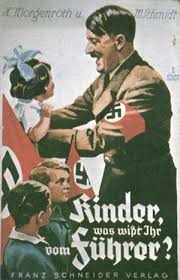
He was a comely, personable fellow, caring, compassionate, a veritable Freund der Kinder. It wouldn't be funny, as one reader writes, if there weren't some truth to it, even if unprecedented in the U.S. (see the "PreK-6 Menu of Classroom Activities" recommended by the U.S. Dept. of Education in response to the President's September 8, 2009 "Address to Students Across America," or these California "Children singing praises of their leader" before his recent election, which isn't a huge jump to this).

It may no longer be so funny, however, when one sees such phenomena erupting within a social milieu so enraptured with the virtues of "tolerance" and "diversity" that it welcomes the airing, by the national network, CBS, of the "'Most vile, Obscene' Attack on Catholic Church 'Ever Aired'" (LifeSiteNews, Sept. 2, 2009), in which Penn & Teller blame Catholicism for all evil (The entire program, "Penn & Teller: Bullsh't" [WARNING: HIGHLY OFFENSIVE AND FOUL LANGUAGE], is posted by the Catholic League for Religious and Civil Rights on its website).

[Hat tip to T.K.]

What is this? Whom does it please?


The University of Detroit Mercy calls THIS [link] the "Mass of the Holy Spirit"? Is it? What "Spirit" here is identified as "Holy"? Is it the Peraclete? Is it holy? Whom does it please? God? The Archbishop? Whom does it honor? Is this Detroit Mercy's understanding of the New Evangelization? What does it communicate to non-Catholics? That Jesus is the "way and the truth and the life," and that no one, in His own words in John 14:6, "comes to the Father except through me"? What does it communicate to Catholics? The urgency of communicating the Gospel to those ignorant of it?

[Hat tip to E.]

Tuesday, September 01, 2009

Two Great Apologists for the Catholic Faith

Peter A. Kwasniewski


The Meeting of the Countess Matilda and Anselm of Canterbury in
the Presence of Pope Urban II
, by Giovanni Francesco Romanelli

Whoever has followed the speeches and homilies of Pope Benedict even to a limited extent is aware that one of his major themes is the harmony of faith and reason—and not just their harmony, but the dependence of human reason on the creative divine Reason or Logos. For Pope Benedict, it is not merely the case that faith does not contradict reason, as if the two are compatible partners on an equal footing. Human reason is a finite and fallible light that derives from the prior, all-encompassing light of God, who is also the font of life, love, freedom, and wisdom. Therefore men can be truly reasonable and free only when they must submit their intellects and wills to this light and live in its radiance. Without this light, men are doomed to the darkness of self-will, the tempest of irrational urges, and ultimately the madness of nihilism. Put differently, unless we embrace God’s revelation in faith, which purifies and elevates the natural light of our mind, our own reason is fated to be its undoing. By refusing or abandoning faith, we undermine reason at its foundation. Those who labor to sweep clean the rooms of their minds, thinking to find in scientific and technical prowess a kind of secular salvation, end up verifying the somber words of our Lord Jesus Christ when he speaks of the demon who, finding his old house “empty, swept, and garnished,” takes with him “seven other evil spirits more wicked than himself” and enters in to dwell there.1 Is this not what we are seeing all around us as our beloved country plummets with accelerating speed into the folly, nay the insanity, of liberalism unbounded, which refuses allegiance even to reason and to nature in its insatiable quest for self without soul, liberty without loyalty?

To the “enlightened” of recent centuries, the Catholic Church was the great enemy of reason, progress, liberty; wrapped in her dark robes of medieval superstition, she sought to enslave men with her dogmas and decrees, despising the goodness of raw nature. From our vantage in the twenty-first century, when for the first time large numbers of people seem incapable of recognizing, much less assenting to, the ironclad results of a valid syllogism or the normalcy of heterosexual love, it is sweetly ironic that the Catholic Tradition is increasingly the only bastion and defender even of nature’s integrity and of the luminosity of reason properly employed. Even while I recognize that rational argument is a dying art with a steadily diminishing potential audience and that the appeal to reason can never be an exclusive means of approach or the last word because, as Pascal observed, “the heart has reasons of which reason knows nothing,” still, I have often thought that our day and age is exactly the right time for a major revival of intelligent apologetics. And, it seems to me, we need to hit the books and begin studying anew the great theological apologists of our incomparable Tradition, both for the deepening of our own faith and for the missionary work Vatican II rightly called each of us to undertake. The stakes are higher than ever: not faith alone, but reason too is besieged. Christian faith is ridiculed as utterly irrational, when in reality, as the best minds have seen for the past 2,000 years, it is supreme and sovereign Reason — God’s Reason. Our own minds can begin to discern this beautiful reasonableness if only we will make the effort. We owe it to our Lord and to ourselves to prize and nurture the gift of reason as we do the gift of faith, so that we can be sane within and talk sanity to a world hell-bent on going mad.

In this article I would like to introduce (or, for some, re-introduce) two towering figures in the history of Catholic theology and apologetics: Saint Anselm and Blaise Pascal—one medieval, one modern, both committed to explaining and defending the mysteries of our holy religion through a judicious use of the God-given gift of reason, always submitting to the primacy of divine revelation and in this way exemplifying what Saint Paul calls the “obedience of faith.”2 Unlike Saint Augustine or Saint Thomas Aquinas, each of whom wrote so much that the official editions of their works run to dozens and dozens of volumes, Anselm and Pascal wrote relatively little; their major religious writings amount to about one modest volume apiece. Since we moderns, surrounded by the constant distraction of emails, cell phones, Twitter, and who knows what else yet to come, simply do not read as much as our forebears (a tragic decline on which the Antichrist is heavily relying in his endgame strategy), this relative brevity is a mercy and an incentive to buy those single volumes and set about reading them. Even so, their works are tough going at times, and perseverance is called for. Those seven demons mentioned by our Lord would, of course, prefer to see the room of your mind “empty, swept, and garnished” with the latest fads and fictions, but you know better than to yield to their desires. In reading Anselm and Pascal (and, needless to say, Augustine, Aquinas, Leo XIII, Benedict XVI, or any Catholic master worth reading), you will furnish your mind with solid truth that no demons, or their unwitting human captives, can gainsay.

The Father of Scholasticism

The future Saint Anselm of Canterbury (1033–1109), the 900th anniversary of whose death we are celebrating this very year, was born at Aosta in the Italian Alps. As a young man he traveled from place to place for his education, a life of “wandering scholarship” not uncommon in the Middle Ages. In 1060 Anselm became a Benedictine monk at the Norman monastery of Bec, where he was made prior in 1063 and abbot in 1078. From 1063 to 1093 he led the quiet life of a monk and scholar, writing several treatises destined to have a huge impact on the intellectual life of Europe, among them two works on the existence of God (Monologion and Proslogion), a work on truth (De veritate), and another on free will (De libertate arbitrii). In the main Anselm followed Augustine as his master, but he incorporated much from the logic of Boethius and Aristotle as well as from the theology of his monastic predecessors. In 1093 Anselm was consecrated Archbishop of Canterbury, in spite of his repeated protests against entering the active life, and in his new role he fought a long battle against the liberties taken by English kings in appointing Bishops apart from papal authority. Nevertheless, in the midst of the duties and controversies of his episcopacy Anselm managed to complete his treatise on the Incarnation, Cur Deus homo (Why God became man), along with a number of smaller works. He died in 1109 and was canonized in 1494. In 1720 Pope Clement XI declared him a Doctor of the Church.

Although much scholarly discussion has centered around the writings of this brilliant theologian, the central characteristic of his life is often forgotten. Anselm was above all a man of intense prayer who placed his entire intellectual life in the hands of God like a child trusting in his father for guidance. He sought rational or logical arguments not because his mind was clouded with doubts but as a way of using his God-given mind to probe the foundations of the faith he already accepted, and to clarify what our language and concepts mean when adapted to mysteries above the domain of natural reason. The contemporary Catholic apologist should therefore learn his first lesson from Anselm’s very life, which wedded prayer and study, words and silence, wisdom and charity.

Anselm’s most important works, the Monologion, the Proslogion, and the Cur Deus homo, each deserves close study. The relevance of the Proslogion’s ontological argument for the existence of God—namely, that all men are capable of forming the concept “that than which no greater can be thought,” to which existence must belong if it is truly that than which no greater can be thought—is rather limited, for three reasons. First, later Western theologians, among them Saint Thomas Aquinas, found the proof defective. Second, a careful reading of the treatise as a whole shows that Anselm is seeking to deepen his grasp of a truth he already accepts in faith, making the argument a meditative response of reason to God’s self-revelation rather than a proof directed towards unbelievers. Finally, most modern people are not patient or schooled enough to follow Anselm’s abstract reasoning or would be tempted to dismiss it as playing with words. Yet the spirit of the treatise has an abiding relevance, and the prayers it contains help the reader to dwell within the luminous truth of God. Anselm’s Monologion, a profound exploration of the divine nature and the mystery of the Trinity, is more immediately useful to an apologist preparing to present or defend the existence of one God in three divine Persons. Anselm’s dialogue on the fittingness of the Incarnation, Cur Deus homo, contributes to an apologetic tradition stretching back to the earliest Fathers of the Church. The infinite holiness of God deserves perfect honor, but man, by sinning against God, has failed to render this honor; therefore God’s majesty is infinitely offended and man is infinitely guilty. If man is to be rescued from his plight, then this perfect honor must be given by him, canceling out his guilt and restoring his friendship with God; but God alone can restore what man has lost, and God alone can forgive the guilt of an infinite offense. Jesus Christ, Word made flesh, true God and true man, undertakes the work of redemption by offering Himself to the Father in an oblation of love on the Cross for the sake of mankind, an oblation fully acceptable to God because it is made by God; man is redeemed by man, the Father’s wrath is appeased and His mercy poured out, and the path to heaven is opened through Christ, the way, the truth, and the life.

Saint Anselm’s generous and positive attitude towards the integration of faith and reason is much needed now, as the encyclical Fides et Ratio repeatedly emphasized, and his humble way of “questioning God” is a model for the Christian thinker seeking to penetrate the mysteries of faith. Consider these words from chapter 2 of Cur Deus homo: “As the right order requires us to believe the deep things of Christian faith before we undertake to discuss them by reason, so to my mind it appears a neglect if, after we are established in the faith, we do not seek to understand what we believe.”

The Grandeur and Misery of Man

Blaise Pascal (1623–1662) was unquestionably one of the most eminent modern apologists for the Christian faith. Despite his poor health, Pascal was a prodigy in mathematics and science from his earliest youth. He performed ground-breaking experiments with water and air pressure, invented a calculating machine, and made striking advances in theoretical mathematics, especially probability theory. However, he came to see more and more that burgeoning empirical-mathematical knowledge could not satisfy yearnings for the ultimate meaning of life, nor could its technological counterpart deliver the earthly paradise it promised. Through his keen observations of people and their self-deceiving efforts to escape the unhappiness that lingers beneath the glitter of distracting pleasures, he became acutely aware of man’s radical need for God and the meaninglessness of life without faith. On November 23, 1654, Pascal underwent an intense spiritual experience, during which he wrote down some phrases on a piece of paper he later sewed into his jacket and always wore about with him:
God of Abraham, God of Isaac, God of Jacob, not of philosophers and scholars. God of Jesus Christ. He can only be found in the ways taught in the Gospel. Joy, joy, joy and tears of joy. This is life eternal, that they might know you, the only true God, and him whom you sent, Jesus Christ. I have cut myself off from him. I have fled from him, denied him, crucified him. Let me never be cut off from him. He can only be kept by the ways taught in the Gospel.3
After receiving this tremendous grace, he retired into seclusion, placed himself under the direction of spiritual advisors at the Port Royal monastery, and turned his attention to the practice of religion and the composition of apologetic works. The greatest of these is entitled Pensées, a collection of notes for a massive apologetic which Pascal did not live to complete. The notes he preserved, ranging in length from a few words to a few pages, contain some of the most profound insights into the heart of man ever written, and deserve to be read and pondered time and time again. He sketches arguments for the truth of the Christian faith and the divine authority of the Catholic Church from a variety of angles: experience of sin and error in the world, the futility of life without a final purpose, the inability of man to save himself from suffering and death, the incongruity between ideals and facts, proofs of natural reason, the correspondence of Old Testament prophecies to the Messiah who fulfills them, the compelling beauty of Jesus and his Covenant, the miracles performed by Christ and the saints throughout the ages. Warring against the rationalism that was starting to conquer European culture, Pascal emphasizes the primacy of the heart in search for God—that is, the centrality of will, conviction, submission—over cold intellectual arguments. “Reason’s last step is to recognize that there is an infinite number of things which surpass it. It is simply feeble if it does not go as far as realizing that.” “Reason would never submit unless it perceived that there are occasions when it should submit. It is right, therefore, that it should submit when it perceives that it ought to submit.”4


Blaise Pascal by Philippe de Champaigne

No apologist has so powerfully insisted on the truth of original sin and, in the face of it, the need for a Redeemer:
If man had never been corrupted, he would enjoy in his innocent state both truth and happiness with confidence. And if man had never been other than corrupted, he would have no notion of either truth or happiness. But in the wretched state in which we are . . . we have an idea of happiness and we cannot achieve it, we feel an image of truth and we possess only untruth. We are incapable both of total ignorance and certain knowledge, so obvious is it that we were once in a state of perfection from which we have unhappily fallen.5
And again:
Certainly nothing shocks us more deeply than this doctrine [of original sin]. Never­the­less without this most incomprehensible of all mysteries we are incomprehensible to ourselves. Within this gnarled chasm lie the twists and turns of our condition. So, humanity is more inconceivable without this mystery than this mystery is conceivable to humanity.6
“Not only is it through Jesus Christ alone that we know God but it is only through Jesus Christ that we know ourselves. We know life and death only through Jesus Christ. Without Jesus Christ we do not know what our life, nor our death, nor God, nor ourselves really are.”7 In the end, one who wants to be honest with himself must either believe in and submit wholly to God, accepting the Messiah whom the Father sent to redeem mankind, or be an atheist in despair, abandoning the search for truth and happiness, substituting in its place a routine of shallow diversions to mask the emptiness of a life poised for immanent death. “It is good to be weary and tired from the useless search for the true good, in order to stretch ones arms out to the Redeemer.”8

The most famous argument in the Pensées has been called Pascal’s Wager. If God exists and the Christian religion is true, then those who believe gain eternal life and those who do not believe earn eternal damnation. Since eternity is infinitely greater than the meager span of one’s life, one ought to wager on the truth of Christianity and embrace it. If it proves to be true, one gains everlasting life. If it proves to be false, then one has merely lost a short life that one had to lose anyhow. But if the religion is true, and one did not embrace it, one has lost infinitely more—one has lost everything. How could an infinitesimal fraction of time have any value in comparison with even the possibility of an eternity of bliss or woe? Here we see Pascal ingeniously using probability theory against the very agnosticism generated by the modern scientific mentality. This argument, like many others in Pascal, was intended to startle and provoke, so that an inquirer after religious truth would search all the more earnestly; it was not intended to be sufficient by itself or to supplant other classical arguments leading in the same direction.

In the later part of his life, Pascal became heatedly involved in political and ecclesiastical controversies surrounding the theology of Cornelius Jansen (1585-1638), Bishop of Ypres, whose interpretation of Saint Augustine’s doctrine of predestination, grace, and free will formed the basis of a heresy, or at least a heretical tendency, subsequently known as Jansenism. Although Pascal fiercely attacked the Jesuits of his time as traitors to Christianity and may have held some questionable theological positions associated with the Port Royal school, by the end of his life he had withdrawn from public controversy to spend his time in prayer, meditation, and works of charity. In the six-month period of his final prolonged sickness, Pascal sold off his carriage, horses, tapestries, furniture, silver, and most of his books, giving the money to the poor. In spite of his own physical sufferings, he earnestly requested those nursing him to go out and find a poor man who might be sheltered under the same roof with him. He died in peace of soul on August 19, 1662, shortly after receiving the last sacraments.

The Editions to Buy

As mentioned above, the major works by Saint Anselm fit snugly in a single volume. Two affordable paperback editions on the market contain almost exactly the same items in different translations: the Thomas Williams edition published by Hackett and the Brian Davies-Gillian Evans edition published by Oxford. While both translations are reliably faithful to the Latin originals and quite readable, on balance my preference goes to the Davies-Evans, for the simple reason that Williams insists on using inclusive language throughout in a way that uglifies the prose and needlessly complicates the theological points Anselm is making. In keeping with centuries of English usage and just plain good sense, Anselm’s famous question Cur Deus homo deserves to be rendered “Why God became man,” not “Why God became a human being.” Is anyone so witless as to think that “man” in this expression means only males of the species? And, more to the point, if anyone does think it, do they not need a lesson in grammar more than a clunky politically-correct translation?

With Pascal, however, the choices for an English Pensées are more numerous, and I can claim no expertise in recommending the best edition. I have always found the Penguin edition by Krailsheimer serviceable; the language is appropriately eloquent for a master controversialist like Pascal, and the content well-organized.9 One could likely find other good translations of this work as well.

A last piece of advice: skip the modern introductions to the volumes and go straight to the author’s own words. Without a doubt some introductions are interesting and helpful, especially for students doing research, but life is short, time is precious, and the wisdom we stand to gain is found in the primary sources, the original writings, of our great Catholic Tradition. Do yourself a favor and make time to read Pascal’s Pensées and, of Anselm’s works, at least Why God Became Man. A noble goal, faith seeking understanding, with two noble guides. May the gracious Lord, Father, Son, and Holy Spirit, grant each of us a consoling foretaste of His sovereign Reason as we walk through this vale of tears toward the light of glory.

Notes

  1. See Mt 12:43-45. [back]

  2. Rom 1:5, 16:26. [back]

  3. From Pascal’s “Memorial” of the event. [back]

  4. Nos. 220 and 205 in the Penguin edition. [back]

  5. No. 164. [back]

  6. Ibid. [back]

  7. No. 36. [back]

  8. No. 524. [back]

  9. Recall that Pascal’s original text is, in fact, a huge assembly of scattered notes, which gives rise to disputes about how best to arrange and present the material. [back]

[Dr. Peter A. Kwasniewski is Associate Professor of Theology and Philosophy at Wyoming Catholic College in Lander, Wyoming. The present article, "Two Great Apologists for the Catholic Faith," was originally published in Latin Mass: A Journal of Catholic Culture and Tradition, Vol. 18, No. 3 (Summer 2009), pp. 6-10, and is reprinted here by kind permission of Latin Mass Magazine, 391 E. Virginia Terrace, Santa Paula, CA 93060.]

Traditional Scholastic courses, anyone?

The International Society of Scholastics -- an association founded among the Roman Pontifical Universities to promote traditional Catholic philosophy -- is trying to spread the word to traditional-minded Catholics about their online courses in Thomism. Their website is www.SocietyofScholastics.org. Their president is Patrick W. McCloskey.

They are currently offering classes in traditional Scholastic Logic and General Ethics. Eventually, they say they will add Natural Philosophy, Economics, Politics, and Metaphysics as well. Their program -- called Sapientis -- is developed by professional philosophers and is the only Thomistic education faithful to the continuous line of traditional Thomistic commentators. They have two levels of course work to accommodate both high school students (especially homeschoolers) and college/adult/continuing education students. It’s their hope "to provide the traditional philosophic education that most schools and pulpits seem to lack these days."

Check it out.