Saturday, June 21, 2008

The "Gregorian Rite"

nIt may not have escaped your notice either. Cardinal Dario Castrillón Hoyos, in his announcement of June 14th before celebrating Mass in the Extraordinary Form at Westminster Cathedral in London, said that this ancient form of the liturgy "will be known as the 'Gregorian Rite'" ("And then the other shoe dropped ...", Musings, June 18, 2008).

David Palm takes an interesting look at the issue in "All Rite! -- They Really Are Two Rites" (The Reluctant Traditionalist, June 18, 2008), where he offers a hermeneutic for working out the prima facie inconsistency between (1) this statement of Cardinal Castrillón Hoyos and (2) Pope Benedict's statement in Summorum Pontificum that the Missal of John XXIII (1962) and the Missal of Paul VI (1970) represent, in fact, "two usages of the one Roman rite." He also refers us to Father Zuhlsdorf's blog entry on this, the upshot of which is, as he puts it, that if the Cardinal put in charge of the implementation of Summorum Pontificum by the Holy Father can speak of the Gregorian Rite, I guess that I can too. Palm writes:
Ultimately (you read it here first?), I think that Article 1 [which refers to "two usages of the one Roman rite"] of Summorum Pontificum will come to be seen as some romanita designed to prevent undue alarm in liberal circles at the promulgation of the document. But I think that, in time and as the divergence of the two rites is made more obvious by the wider celebration of the Gregorian Rite, this way of thinking will give way to the common sense acknowledgment that we really are faced with separate rites. (Well, more than two really, because the Novus Ordo is very far from being one unified rite.)
Having said that, Rorate Caeli's Note (June 19, 2008) stating that the term "Gregorian" is really not new, suggests that one should perhaps not read too much into the expression:
The expressions "Gregorian Mass" (Messe Grégorienne) and "Gregorian Rite" (Rite Grégorien) have been extensively used as alternative names for the Traditional Latin Mass and Traditional Roman Rite in France for several years. Cardinal Castrillón's use of the second expression in English should not be construed as something extraordinary or filled with any mysterious meaning; he just chose to use it then.

In any event, "Gregorian Mass" should not be confused with the ancient and beautiful practice of the Gregorian Masses.
Nevertheless, I do like the term "Gregorian" for the simple reason that it underscores the hoary antiquity of the traditional Mass, resisting the contrarian effort to marginalize it historically as, for example, something idiosyncratically "Baroque."

UK cathedral pushes altar girls in Tridentine Mass

You may recall our recent post on "The 1962 Mass with Post-1970 Innovations: Is It Likely?" (Musings, May 29, 2008), an article by Charles M. Wilson With additional comments by Philip C.L. Gray, JCL and Duane L.C.M. Galles, JD, JCD, in Christifidelis (November 9, 2007).

As an addendum to that post, here is one on a recent incident in Great Britain between the Dean of Cardiff Cathedral, Canon Peter Collins, and representatives of the local Latin Mass Society. Anna Arco, "Traditional Mass called off after row over altar girl" (Catholic Herald, May 23, 2008), writes:
A traditional Latin Mass that was due to be held in Cardiff Cathedral last Sunday was cancelled at the last minute after a row broke out over a female server.

Plans for a Pontifical High Mass in the Extraordinary Form, a joint initiative between the cathedral and Latin Mass Society (LMS), which was supposed to have been celebrated by the Abbot of Belmont Abbey, were scuppered after a disagreement arose over the altar server.

Disagreements escalated during a second training session for the cathedral servers and the Dean, Canon Peter Collins, when one of the cathedral's regular female servers came to the practice. She had not been at the previous training session nor had Canon Collins.

Her presence came as a surprise to members of the Latin Mass Society who were present, as the LMS insists that its policy has always been clear about following the rubrics and laws, which govern the 1962 form of the Roman Rite. This excludes the presence of women in the Sanctuary.

... Kingsley Lewis, the LMS's representative in Cardiff, telephoned Canon Collins the next morning to say that the LMS in conscience could not take part in the Mass if there was a female server present in the sanctuary. Neither party backed down and the Mass was cancelled.

Canon Collins said: "... I had no agenda, and no assumptions that it would be a problem that our normal servers would participate plus the extra servers supplied by the Latin Mass Society....

"I'm unclear as to whether Rome has an opinion on the rubrics of the Extraordinary Form and whether it would prohibit the presence of lady servers, but I will seek clarification on that matter....

Since Pope Benedict XVI published the Motu Proprio Summorum Pontificum which lifted restrictions on the traditional Latin Mass last year, a number of questions about the two forms of the Roman Rite have arisen. It has been reported that the Ecclesia Dei Commission is working on a document clarifying the Motu Proprio though the details of its release remains unclear.

Female altar servers were authorised by the Vatican retroactively in 1994 - so in accordance with Canon Law 230 - that Liturgical services may be carried out by lay people ex temporananea deputatione, according to the judgment of the bishop and where the needs of the Church require it. Permission was given as many parishes were already using girl altar servers. In 2001 Rome issued a clarification, saying that while bishops could give permission for female altar server, they could not force a priest to have women as servers.
[Hat tip to N.B.]

Friday, June 20, 2008

Obama quote generator

A friend of mine forwarded the link below to me from a guy who said in his email:
Hey, I posted one of those quotes on my blog and a few minutes
later someone wired $250 million into my bank account. What am
I supposed to do now?
My friend's comment? "Try it! Then run for president!"

No. 1. Here's where you can try it: Generate a Barack Obama Quote! (Buttafly: the procrastinator's paradise).

No. 2. For some extra fun, run the latest speech of your favorite political ignoramus through Samuel Stoddard's Dialectizer, which will convert it into your choice of "Redneck," "Jive," "Cockney," "Elmer Fudd," "Swedish Chef," "Moron," "Pig Latin," or "Hacker."

Thursday, June 19, 2008

C.S. Lewis and Ronald Knox at Oxford

"This book had led me deeper into [C.S.] Lewis' own writings than any I've read," writes Walter Hooper, longtime trustee and literary advisor to the estate of C.S. Lewis, in his preface to Fr. Milton T. Walsh's new book, Second Friends: C.S. Lewis and Ronald Knox in Conversation (San Francisco: Ignatius Press, 2008). Hooper writes:
This—to quote C.S. Lewis—"is the most noble and joyous book I've read these past ten years." It is also one of the most surprising. After immersing myself in the writings of Lewis for half a century I could not, when I first heard Milton Walsh talk about the book, see how C.S. Lewis and Ronald Knox could benefit from being placed together. I am now totally converted.
Carl Olson of Ignatius Insight interviewed Fr. Walsh about his earlier book, Ronald Knox As Apologist: Wit, Laughter and the Popish Creed (San Francisco: Ignatius Press, 2007) last May, and he said this about his second book:
There are many similarities between Knox and C. S. Lewis, and I am currently writing a book comparing their thought. They both came from Evangelical backgrounds; they both combined a love of logic with a romantic view of life. They were both very much at home in the world of Oxford, and wrote in a variety of genres. Knox was about ten years older than Lewis, so they did not know one another in student days. I have found references to each man's writings in the other man's books and letters; they were familiar with one another's work.

When I went to Oxford a couple of years ago I made an interesting discovery. Every afternoon Lewis used to take a walk in the meadow behind Magdalen College, and Knox would take a walk in Christ Church Meadow. I found out they were practically across the street from each other! They had friends in common, and one of them reports that he invited them to lunch one day in 1936. They hit it off very well, and it is enjoyable to speculate what might have happened had Knox not left Oxford a couple of years later. They may have gotten better acquainted, although Lewis' discomfort with "Papists" (excluding such exceptions as Tolkien), and Knox's reticence to go "convert hunting" may have been enough to keep them apart. I like to think they're together now!
Read an excerpt from Ronald Knox As Apologist and the entire interview.

[Acknowledgement: Carl Olson's review posted at Ignatius Insight on June 12, 2008.]

Wednesday, June 18, 2008

And then the other shoe dropped ...

The first shoe dropped on the Seventh day of the Seventh month of the Seventh year of the new millennium when His Holiness, Pope Benedict caused great wailing and gnashing of teeth among liturgically revisionist Catholics by issuing his long-awaited Motu Proprio, Summorum Pontificum, legally liberating the traditional Latin Mass from the erstwhile (and continuing) resistance of recalcitrant episcopates.

The second shoe dropped, almost exactly a year later, when Benedict's deputy, the senior Vatican cardinal in charge of Latin liturgy as head of the Pontifical Commission Ecclesia Dei, Cardinal Dario Castrillón Hoyos, speaking on behalf of Pope Benedict, announced on June 14, 2008, as he was preparing to celebrate Mass at Westminster Cathedral in London that the traditional Latin Mass -- effectively banned by Rome for 40 years -- is to be reintroduced into every Roman Catholic parish in England and Wales.
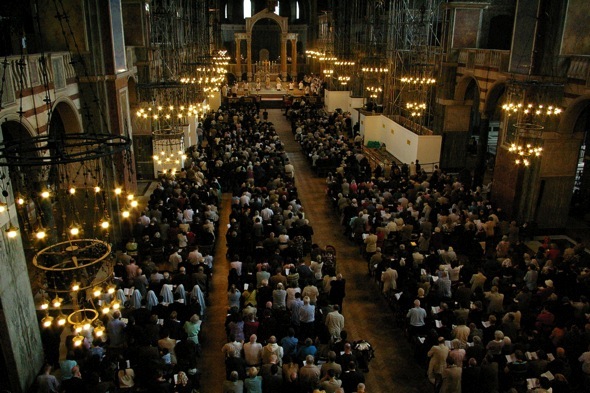

Cardinal Dario Castrillón Hoyos celebrates Mass in the Extraordinary Form
at Westminster Cathedral, London, June 14, 2008


As a point of clarification, when asked whether the Tridentine Mass would be celebrated in many parishes in the future, Cardinal Castrillón Hoyos said: "Not many parishes – all parishes. The Holy Father is offering this not only for the few groups who demand it, but so that everybody knows this way of celebrating the Eucharist."

Damian Thompson, in an article in the London Telegraph entitled "Latin Mass to return to England and Wales" (Telegraph.co.uk, June 14, 2008), wrote:
In addition, all seminaries will be required to teach trainee priests how to say the old Mass so that they can celebrate it in all parishes.

Catholic congregations throughout the world will receive special instruction on how to appreciate the old services, formerly known as the Tridentine Rite.

... Cardinal Castrillón said that the reverent silence of the traditional rite was one of the “treasures” that Catholics would rediscover, and young worshippers would encounter for the first time.

Pope Benedict will reintroduce the old rite – which will be known as the “Gregorian Rite” - even where the congregation has not asked for it. “People don’t know about it, and therefore they don’t ask for it,” the Cardinal explained.

The revised Mass, adopted in 1970 after the Second Vatican Council, had given rise to “many, many, many abuses”, the Cardinal said. He added: “The experience of the last 40 years has not always been so good. Many people have lost their sense of adoration for God, and these abuses mean that many children do not know how to be in the presence of God.”

However, the new rite will not disappear; the Pope wishes to see the two forms of Mass existing side by side.
Needless to say, this announcement is being taken with utmost seriousness by opponents of Benedict's initiative and is certain to stir intense controversy. For his part, the Cardinal stated that the changes would take a few years to implement fully, and insisted -- in line with Benedict's hermeneutic of continuity -- that the widespread reintroduction of the old Mass does not contradict the teachings of the Second Vatican Council.

From Rorate Caeli's summary of events entitled "Cardinal Castrillón in the Archdiocese of Westminster" (June 18, 2008), we also garner the following references:A full photographic record of Cardinal Castrillón Hoyos’s visit and Westminster Cathedral Mass can be seen at: www.traditionalcatholic.org.uk

I think it was a strategic move to make this announcement in England, not because of the evident contemporary resistance to the traditional Mass there, but because of the historic resistance of English Catholics to the banning of the traditional Mass following Vatican II, including the notable success of the late John Carmel Cardinal Heenan (1905-1975) in securing an indult in 1971 from Rome for English Catholics to celebrate the Tridentine Mass, and the support of his successor Basil Cardinal Hume (1923-1999) in preserving the indult. Furthermore, English Catholics have the heroic history of suffering under the penal laws as recusants for refusal to participate in the Anglican liturgy introduced at the hand of Thomas Cranmer during the English Reformation -- a Mass that, in certain respects, looks positively Tridentine compared to the Novus Ordo of Paul VI, produced under the supervision of Archbishop Bugnini in Rome. In other words, many Catholics in Elizabethan England suffered persecution and execution at Tyburn rather than being forced to accept a the new Anglican Mass which looked more "Catholic" in many ways than the new Catholic Mass introduced by Paul VI in 1970. All of these symbolic ironies converge to make England a symbolically and historically strategic site for spearheading this most recent initiative. Let us continue to pray for the revival of the Church and her divine worship.

Of related interest:

Sunday, June 15, 2008

Increase in Masses of the Extraordinary Form

"This Wednesday, June 18, at 7:30PM, Wyandotte's Our Lady of Mt. Carmel Parish will debut a weekly Extraordinary Form Mass. If the Wednesday Masses prove popular, there is a possibility that a Sunday Mass will be added. This is the ninth Tridentine Mass site in the Archdiocese of Detroit. Only the Archdiocese of Chicago, with eleven sites, surpasses the Archdiocese of Detyroit in number of Extraordinary Form Masses."

"Our Lady of Mt. Carmel Debuts Wednesday TLM"
Tridentine Community News, June 15, 2008
St. Josaphat Parish Bulletin

"On Sunday, June 29 at noon, the Feast of Ss. Peter & Paul, historic St. Albertus Church [in Detroit, MI] will host its second Extraordinary Form Mass since the publication of the Motu Proprio, Summorum Pontificum. The celebrant will be Fr. Peter Hrystyk of Windsor's Assumption Church. Music will be provided by a joint St. Josaphat-Assumption choir, under the direction of Wassim Sarweh."

"St. Albertus To Host Second Tridentine Mass"
Tridentine Community News, June 15, 2008
St. Josaphat Parish Bulletin

McCain's son in Iraq

Vetted by Snopes.com in an article entitled "My Three Sons" (April 2008). Status: True. Example:
Mr. McCain, now the presumptive Republican nominee, has staked his candidacy on the promise that American troops can bring stability to Iraq . What he almost never says is that one of them is his own son, who spent seven months patrolling Anbar Province and learned of his father's New Hampshire victory in January while he was digging a stuck military vehicle out of the mud.

Two of Jimmy's three older brothers went into the military. Doug McCain, 48, was a Navy pilot. Jack McCain, 21, is to graduate from the Naval Academy next year, raising the chances that his father, if elected, could become the first president since Dwight D. Eisenhower with a son at war.
[Hat tip to J.S.]

William Buckley on the new liturgy

TheM following piece, attributed to William F. Buckley, can be found at "Buckley on the New Mass" (Saint Louis Catholic, June 13, 2008) where it is linked to an article, "William F. Buckley on the New Mass" from the archives of The Remnant (May 15, 1979):
As a Catholic, I have abandoned hope for the liturgy, which, in the typical American church, is as ugly and as maladroit as if it had been composed by Robert Ingersoll and H.L. Mencken for the purpose of driving people away.

Incidentally, the modern liturgists are doing a remarkably good job, attendance at Catholic Mass on Sunday having dropped sharply in the 10 years since a few well-meaning cretins got hold of the power to vernacularize the Mass, and the money to scour the earth in search of the most unmusical men and women to preside over the translation.

The next liturgical ceremony conducted primarily for my benefit, since I have no plans to be beatified or remarried, will be my own funeral; and it is a source of great consolation to me that, at my funeral, I shall be quite dead, and will not need to listen to the accepted replacement for the noble old Latin liturgy. Meanwhile, I am practicing Yoga, so that, at church on Sundays, I can develop the power to tune out everything I hear, while attempting, athwart the general calisthenics, to commune with my Maker, and ask Him first to forgive me my own sins, and implore him, second, not to forgive the people who ruined the Mass.

William F. Buckley, Jr. (circa 1979)
Editor, National Review


[Hat tip to N.B.]

If only this were true ...

Muhammad Tahir, "The Pope's Special Forces" (Ummah Pulse, February 29, 2008), writes: "Jane's, the world's premier provider of military and strategic intelligence, describes Special Forces personnel (e.g. the SAS) in the following terms:
"These soldiers are different: they have to be intelligent, lateral thinkers, superbly fit and have the mindset that keeps them going when others would give up."
One part of the story concerns the Jesuits as the "special forces" of the Pope, at least historically:
Who are the Jesuits? One revealing description states them to be "what was effectively an elite force of intellectual missionary priests... always at the service of the universal Church."

John Ralston Saul, in his book Voltaire's Bastards, describes the Jesuits as "intellectual mercenaries", whose intellectual talents were placed at the Church's disposal to achieve whatever ends the Church required. He argues that they are the originators of the "tyranny of Reason" - the modern day trap of horrible outcomes (the Holocaust, the nuclear bomb, the global arms industry) which arise from perfectly sound logical thought processes.
The other part of the story concerns "the media launch of a certain Felix Koerner on the BBC who "is a prime mover in the Turkish secularist establishment's latest attack on Islam." Read on.

[Hat tip to M.W.]

The crisis of Holy Trinity in Boston

Readers of this blog may recall that we have followed with some interest the developments involving the historic German parish of Holy Trinity in South Boston. (See our posts Boston's Indult: An Expensive Move [Musings, April 13, 2007] and Old Mass to return to Boston's Holy Trinity [Musings, December 19, 2007], for two examples.)

James Likoudis comments on the latest (and possibly last) development in his article, "A Month After Pope's Visit . . .Cardinal O'Malley Closes German Parish" (Free Republic, June 13, 2008, from Wanderer Press, June 5, 2008). Here are some excerpts:
One month after Pope Benedict XVI made his historic visit to the United States, Sean Cardinal O’Malley ordered the closure of Boston’s oldest German parish, Holy Trinity, and declared all its assets — including $ 242,000 in its bank account — be transferred to Holy Cross Cathedral.

The priests and parishioners of Holy Trinity Church, established by German immigrants in 1844, opened the first parochial school in New England and introduced the Christmas tree and Christmas cards to Puritan Boston, among many other traditions.

Since 1990, the parish has been home for the Traditional Latin Mass community from 1990 to 2007, when the Traditional Latin Mass was relocated to Mary Immaculate of Lourdes Parish in Newton. Following Pope Benedict XVI’s motu proprio, parishioners of Holy Trinity successfully petitioned the pastor administrator, Fr. John J. Connolly, for the Latin Mass. Since January 2008, when the Latin Mass was restored, the congregation at Holy Trinity has tripled, despite a standing-room-only congregation at Mary Immaculate of Lourdes, said C. Joseph Doyle, a member of the Latin Mass Community at Holy Trinity, and executive director of the Catholic Action League of Massachusetts.

For four years, Cardinal O’Malley has been intent on closing Holy Trinity ....

... "The whole so-called reconfiguration process,” Doyle told The Wanderer, “is insane. Venerable churches of great historical significance and architectural and artistic distinction are being destroyed, while churches of no historical or aesthetic value are being preserved. Orthodox congregations are being dispossessed, while parishes that are hotbeds of dissent remain open.”
If you have a stomach for depressing news, read on in the original article. There is plenty more from the rapid decomposition of historic Catholic culture in Boston.

[Hat tip to R.Q.]

New background on the Credo of Paul VI

In his article, "The Credo of Paul VI. Who Wrote It, and Why" (www.chiesa), Sandro Magister sheds new light on the "Credo of the People of God," which was issued by Paul VI in 1968 in response to the upheaval in the Church exemplified by the heterodox Dutch Catechism that emerged at the time. What has now come to light is that the "Credo" was written by Jacques Maritain as a result of a long standing correspondence of 303 letters exhanged between himself and the Swiss theologian and cardinal, Charles Journet. Magister says that Cardinal Georges Cottier – a disciple of Journet, and theologian emeritus of the pontifical household – has already revealed the background of the "Credo" in the international magazine "30 Days," in the cover story of the latest issue.

Magister notes that in one passage of the draft sent by Maritain to the pope, he had "explicitly cited the common witness that the Israelites and Muslims give to the one God, together with Christians," but that in his "Credo," Paul VI simply "gives thanks to the divine goodness for the 'many believers' who share faith in the one God with Christians, without specifically mentioning Judaism and Islam." Among other things, Magister also notes that during the 1950's, "Maritain came close to being condemned by the Holy Office for his philosophical thought, suspected of 'extreme naturalism,' but that "one reason why the condemnation was not issued was that he was defended by Giovanni Battista Montini, the future Paul VI, who at the time was substitute secretary of state and had a longstanding friendship with the French thinker."

[Hat tip to J.]

Friday, June 13, 2008

Censuring "homophobic hate speech"

A friend recently wrote to me, saying:
In his book, Christianity and the Crisis of Cultures (San Francisco: Ignatius Press, 2006), Pope Benedict XVI wrote, "Very soon, it will no longer be possible to affirm that homosexuality (as the Catholic Church teaches) constitutes an objective disorder in the structure of human existence" (p. 35). Interesting article on precisely that issue below.
Indeed. The article is by David Warren, entitled "Deafening Silence" (Ottawa Citizen, June 12, 2008). Warren begins by professing that the pen is ultimately mightier than the sword, that "political power passes away, that truths about God and man resurface, that human freedom is never fully extinguished." He continues:
This is a point worth recalling, as we head into a period in Canada when, owing to malice from an ideological camp, to cowardice on the part of our elected representatives, and to indifference on the part of the people, free speech and freedom of the press will disappear in Canada. Those who deviate from the officially-sanctioned lies of "political correctness" will emigrate, perhaps mostly to USA, or experience that peculiar form of internal exile -- of enforced silence -- that good men have shared in many times and places.

... As free speech disappears in Canada, one looks for instance not at the more celebrated cases of Mark Steyn and Ezra Levant, but at the much less publicized fate of e.g. Rev. Stephen Boisson, convicted by an Alberta kangaroo court ("human rights tribunal") last November for publicly expressing the Christian and Biblical view of homosexuality, on the say-so of an anti-Christian activist from his home town.

Rev. Boisson has now been ordered to desist from communicating his views on this subject "in newspapers, by email, on the radio, in public speeches, or on the Internet" so long as he should live. He has been ordered to pay compensation to Darren Lund, the anti-Christian activist in question, and further to make a public recantation of beliefs he still holds.

... Among the spookiest aspects of these cases is the silence over, and indifference to them, on the part of journalists whose predecessors imagined themselves vigilant in the cause of freedom. As I've learned first-hand through email, many Canadian journalists today take the view that, "I don't like these people, therefore I don't care what happens to them." It is a view that, at best, is extremely short-sighted.
I've long asserted that one of the most formidable practical challenge the Church faces in our time is not women's ordination, a shortage of priests, or church closings. Rather, it is the lack of stalwart response to this problem, which almost nobody seems to want to confront.[Hat tip to Prof. E.E.]

Thursday, June 12, 2008

Eugene Edward Blosser (March 27, 1917 - June 8, 2008)

Just a note to thank all of you for your kind thoughts and prayers for my father, Eugene (age 91), who passed from this life peacefully in his sleep last Sunday morning at 9:17am as my daughter and I were taking a turn sitting with him. We had several good days of sharing happy reminiscences, praying together, and saying our goodbyes before he slipped out of consciousness two days before his death. During those days, he was surrounded by family and friends, several groups of which came by not only to visit but to sing favorite hymns for him. Though there were difficult moments, as when he struggled for breath in his fluid-filled lungs before his medication could be adjusted to allow more comfortable breathing, it was, all-in-all, the kind of death for which one could readily hope for himself -– to be surrounded by loved ones, and happily resigned to meet his Maker.

The funeral was last Monday.

Thanks again for your many expressions of thoughtfulness and prayers.

Kind regards,
Phil

Tuesday, June 03, 2008

Gone for several days

I will be driving out to Iowa tomorrow (Wednesday) to see my father for the last time and make our final farewells. I thank in advance any of you who are able to remember us in your prayers.

Sunday, June 01, 2008

Should liturgy be mysterious or transparent?

Evelyn Waugh, in his book When the Going Was Good (1946), describes assisting at a Mass during a sojourn in Abyssinia (Ethiopia):
As the sun mounted, it became intensely hot. We lay in the tent smoking and dozing until the abuna [Arabic for 'Father', used by Arabic-speaking Christians in addressing a priest] came to conduct us to Mass.

I will not attempt any description of the ritual; the liturgy was quite unintelligible to me, and, oddly enough, to the professor also. No doubt the canon of the Mass would have been in part familiar, but this was said in the sanctuary behind closed doors. We stood in the outer ambulatory. A carpet was placed for us to stand on and we were given praying-sticks, with the aid of which we stood throughout the two hours of service. There were twenty or thirty monks round us and some women and babies from the tukals [small huts or dwellings]. Communion was administered to the babies, but to no one else. Many of the monks were crippled or deformed in some way; presumably they were pilgrims who had originally come to the spring in the hope of a cure, and had become absorbed into the life of the place. There seemed to be very little system of testing vocations in the community. The priests and deacons wore long, white-and-gold cloaks and turbans, and had bare feet. Now and then they emerged from the sanctuary, and once they walked round in procession. The singing was monotonous and more or less continuous, accompanied by a drum and sistrums [Egyptian percussion instruments]. For anyone accustomed to the western rite it was difficult to think of this as a Christian service, for it bore that secret and confused character associated with the non-Christian sects of the East.

I had sometimes thought it an odd thing that Western Christianity, alone of all the religions of the world, exposes its mysteries to every observer, but I was so accustomed to this openness that I had never before questioned whether it was an essential and natural feature of the Christian system. Indeed, so saturated are we in the spirit that many people regard the growth of the Church as a process of elaboration -- even of obfuscation; they visualize the Church of the first century as a little cluster of pious people reading the Gospels together, praying and admonishing each other with a simplicity to which the high ceremonies and subtle theology of later years would have been bewildering and unrecognizable. At Debra Lebanos I suddenly saw the classic basilica and open altar as a great positive achievement, a triumph of light over darkness consciously accomplished, and I saw theology as the science of simplification by which nebulous and elusive ideas are formalized and made intelligible and exact. I saw the Church of the first century as a dark and hidden thing; as dark and hidden as the seed germinating in the womb; legionaries off duty slipping furtively out of barracks, greeting each other by signs and passwords in a locked upper room in the side street of some Mediterranean seaport; slaves at dawn creeping from the grey twilight into the candle-lit, smoky chapels of the catacombs. The priests hid their office, practicing trades; their identity was known only to initiates; they were criminals against the laws of their country. And the pure nucleus of the truth lay in the minds of the people, encumbered with superstitions, gross survivals of obscene nonsense seeping through from the other esoteric cults of the Near East, magical infections from the conquered barbarian. And I began to see how these obscure sanctuaries had grown, with the clarity of Western reason, into the great open altars of Catholic Europe, where Mass is said in a flood of light, high in the sight of all, while tourists can clatter round with their Baedekers, incurious of the mystery. (pp. 118-119)
I find this a fascinating set of observations:
  • First, Waugh reacts to the strangeness of the Abyssinian liturgy much as a Protestant Fundamentalist might react to a Catholic Mass: he says "it was difficult to think of this as a Christian service," he says, because it had the "secret and confused character associated with the non-Christian sects of the East." This could nearly be the reaction of a Catholic habituated in the Novus Ordo to a Tridentine, Byzantine, or Chaldean Catholic Mass.

  • Second, in examining his own reaction, Waugh observes that "Western Christianity, alone of all the religions of the world, exposes its mysteries to every observer ...." At first blush, this looks like an apologia for the Vatican II reforms, if not for the abusive innovations that followed in their wake. One can imagine a partisan of the "Spirit of Vatican II" using this line of thought in derisively dismissing the pre-Vatican II liturgy as egregiously obscurantist, dark, mysterious and encrusted with repetitious ritual bordering on superstition. Waugh is far from such a view, however.

  • Third, because of this historically ingrained openness of Western liturgy, he says, many people anachronistically "visualize the Church of the first century as a little cluster of pious people reading the Gospels together, praying and admonishing each other with a simplicity to which the high ceremonies and subtle theology of later years would have been bewildering and unrecognizable." In other words, they regard the process of the Church's growth as one of "obfuscation." This is the sort of thing one hears constantly from Protestant Fundamentalists who speak endlessly of the "simple Gospel" of the New Testament Church and how it was "corrupted" by post-Constantinian Catholicism.

  • Fourth, Waugh says that at Debra Lebanos, he "suddenly saw the classic basilica and open altar as a great positive achievement, a triumph of light over darkness consciously accomplished ...." Yet when he goes on to explain what he means, it is clear that he means that the early Church was a dark, hidden, underground and often illegal thing in the Roman Empire, and that it took time for the "pure nucleus of truth" in this hidden religion to emerge with the aid of Western reason from the "gross survivals of the paganism" that formed its early social context.
The really interesting question to emerge from Waugh's account concerns what the Catholic tradition calls the Sacred Mysteries at the heart of the Sacrifice of the Mass. The question is: To what extent can or should these Sacred Mysteries be rendered transparent? A further question is: What kind of "transparency" does one mean? It's one thing to seek clarity about what exactly occurs in the Mass in order to participate spiritually in the liturgy as fully as possible. It's another thing for the mysteries to be physically brought out, as Waugh says, upon "the great open altars of Catholic Europe, where Mass is said in a flood of light, high in the sight of all, while tourists ... clatter round ... incurious of the mystery." It's yet another thing to endeavor to eliminate all mystery from the liturgy by rendering it commonplace, if not pedestrian.

I once addressed this subject, in "'Making it Real' - Part II: The Sacrament of the Altar" (March 9, 2007), as follows:
And so, in tandem with the cultural revolution of the 1960s, the taboos and hedges and walls and altar rails have come down in our churches. Tabernacles have been moved out of Sanctuaries, Altars have been pushed out into the nave (if churches still have 'naves'), people receive Communion standing at the head of a moving line, and receive the Host in their hands (although both Paul VI and John Paul II openly opposed the practice before giving in to widespread pressure) -- and there are often so many women helping the priest at the Altar-Table after the Consecration that one sometimes can't help thinking he looks a little lost and out-of-place up there. Clearly, the old taboos are gone, or nearly so.

One particularly instructive example of this trend comes from the Life Teen Masses before the authorities reigned in their excesses, at least in some places. Life Teen Masses were once notorious for gathering gaggles of teenagers right up around the Altar. There they would not kneel, but stand right through the Consecration, sometimes chewing gum, watching the priest as he said Mass. The idea seemed to be similar: If the Mass is a good thing, why not liberate it, like a bird from a cage? Why not bring the kids right up to the "Altar-Table," where they can see everything going on up close? Perhaps it was assumed that this would heighten the intensity of their Eucharistic experience and "active participation."

The effect, however, was almost always the very opposite. Instead of intensifying personal experience, it drained it of any sense of transcendence. Instead of elevating "active participation," it led to boredom and indifference.

What happened?

Please do not be offended, but I want to draw an analogy with another movement of cultural liberation that was concurrently underway alongside the liturgical reforms of the 1960s: the sexual revolution. The thinking was very similar in certain respects, as some of you may recall. If human sexuality is so good, then why hedge it about with so many repressive Victorian taboos? Why not liberate it, like a bird from a cage? In contrast to our ancestors and religious teachers, like St. Paul, who saw something profoundly metaphysical in the coupling act that ought to be confined to the bonds of matrimony, the sentiment of the sixties was that sex needed to be demystified, demythologized, and enjoyed for what it is: "If you can't be with the one you love, love the one you're with."

Furthermore, in the process of increasing exposure to more and more sexual information and imagery, a process of desensitization occurred. If any of you have seen the film Kinsey, you may recall what a sensation he caused both in his classrooms and in the public when he began lecturing on the intimate sexual habits of Americans. People used to blush. Sex education classes have done much the same in our schools. Further, if you track the use of nudity and sex appeal in advertising, you can easily see the progressive desensitization that has occurred over the last decades. I don't imagine Hugh Hefner in the 1960s would have been permitted to have as a Playboy centerfold some of the Dillard department store lingerie ads hanging in shopping malls these days. What you find at the end of this trajectory is, of course, hardcore pornography. But when everything is exposed and all one is left with is the impersonal plumbing of human genitalia, a problem occurs. Something is lost: the Real Presence of the Person. This is why even those trapped by the vice of pornography find it ultimately so unsatisfying and boring. (Try reading the Marquis de Sade's 1200 page Juliette. If you don't fall asleep from boredom in ten or twenty pages, you're a sick puppy indeed.)

It was precisely to protect the Real Presence of the Person that sex was hedged about with all those traditional taboos of courtship, ritual, decorum, and bonds of matrimony to begin with. Persons were never to be treated as mere things, to be 'used' as 'means' to satisfy our own pleasure, but always to be respected as ends-in-themselves. The taboos were a sign that we cared about the Real Presence of the other Person on the altar of sexual union. The dropping of the taboos was a sign that we no longer cared about the depth dimension of sex because we no longer cared about the Presence of the interior and irreducible selfhood of the other Person in the sexual encounter. I remember a film-maker in Switzerland telling me he realized he needed help when he reached the point where he had a different girl nearly every night and was telling her, "Please, don't talk to me. I don't even want to know your name."

Now, how does this translate into our consideration of liturgy? Martin Mosebach, describing his experience assisting at the Altar as a boy (in his book, The Heresy of Formlessness: The Roman Liturgy and Its Enemy, writes:
I always found it embarrassing to see the Host at such close quarters, so vulnerable, as if it were lying naked on the white cloth. It was not something for my eyes, a layman's eyes, to behold. There was something secret going on between the priest and the Host. It was a real relationship: there was a kind of conversation between the Host and priest that was hidden from the eyes of the congregation by the priest's body. I, however, as an altar server, was aware and had to be aware of it, like a nurse who unexpectedly finds herself in the position of having to undress a respected personage. The gentle cracking sound of the Host made when it broke seemed not for my ears, either: it was an intimacy to which I was not entitled.
If the Host is nothing more than a wafer, of course, then such words are no more than the pathological scrupulosities of a superstitious and ignorant little boy. There is no mystery here, but only a wafer. Nothing to inspire fear in a man. Certainly not of the kind Mosebach expresses when he says that even in those days when religion had vanished from his mind, he would never have dared to touch a consecrated Host or chalice, or listened to observations on art history in front of the Tabernacle.

On the other hand, if the Host is Jesus Christ, the Son of the living God, then nothing is more appropriate than the attitude displayed here by Mosebach. How was this attitude instilled? How was Mosebach sensitized to feel and respond as he did in the passage above? Was it by being led straightaway into the presence of the naked Host? No. It was by being habituated in the gestures, postures, and attitudes of reverence by means of all the external formalities of the old Mass -- all of those fastidious outward forms that conform the inward disposition of the soul to discern the Real Presence of the Person upon the Altar of Sacrifice.
If, by "transparent," we mean "clear to the understanding," then part of rendering the Divine Mysteries "transparent" must involve cultivating a certain deference toward this traditional concealment of the Holy, a reticence about throwing its doors open to the public thoroughfare; for this is what it means to clearly understand the sacral nature of the "Divine Mystery" at the heart of the Mass: He Is Here.1

Notes
  1. It is instructive that our Lord Himself never went about directly proclaiming His divinity or even His identity as Messiah, but rather commanded them repeatedly not to reveal to others His identity (See "Messianic Secret"). This isn't to suggest that He wanted His hearers to remain ignorant about the Gospel or His identity as God's Son. Rather, it is to suggest that, as in nearly all forms of intimate knowledge, a personal knowledge of Jesus Christ is not something that can be forced. Instead, as in a personal relationships, it requires approaching the Other on His own terms. [back]