
Tuesday, May 13, 2008
An Evangelical ***yawn*** manifesto?
Evangelicals used to know how to craft a manifesto. The Lausanne Covenant of 1974 was a manifesto that basically defined modern Evangelicalism. On May 7, 2008, however, another group of Evangelicals released a document calling itself a "manifesto" that gives pause. Have Evangelicals lost their touch? Alan Jacobs, in "Come On, You Call This a Manifesto?" (Wall Street Journal, May 9, 2008), suggests that the 20-page document taxes patience, bores the imagination, and conveys a message that boils down to the appeal: "Please don't call us fundamentalists or confuse us with them." Puh-LEEEEZE ... That is like, just so ... yesterday. And how is this supposed to galvanize an increasingly somnolent Evangelical movement? What do these guys have in common with the Call to Action grey hairs with their "Call to Puppery" liturgies? They're fighting the now effectively irrelevant battles of the 60s and 70s. Wake up Neo. It's later than you think.
Saint Pius X, a Backward Pope?
A 1300-page study treatise written by a great scholar, Carlo Fantappiè, overturns that presumption in order to argue what we've known all along: "Saint Pius X, a Backward Pope? No, an Unprecedented Cyclone of Reform" (www.chiesa, May 13, 2008), by Sandro Magister.
Sunday, May 11, 2008
What in the name of Brahman?
 A Catholic woman wrote to me recently to tell me that she had embraced the spirituality of Mātā Amritanandamayī Devi, an Indian spiritual leader named otherwise known as "the hugging saint," or "Amma," which means "Mother." People come from miles, even from other continents, to wait in line for hours to be hugged by Amma in a practice called "Darshan." She has been known to individually hug over 50,000 people a day. This, they tell us, is profoundly "healing." It is one of the ironies of metaphysical monism, which regards individuality as illusiory, that in its diverse religious forms it continues to compromise itself by attachments to individuals, whether as in the chosen ishtas of Bhakti Hinduism or as in the embrace of this singular "Amma." Whereas Christianity tells us to love our neighbor, Hinduism tells us that we are our neighbor. But even if I am you and you are me and he is she and we are ultimately all Brahman, it is as if there is something in the most forlorn Hindu souls (or the most jaded lapsed Catholics who have turned to the East as an alternative to "Western institutional religions"), which longs for the loving and embrace of an individual person (human or divine), almost as if they weren't really illusiory. (Click on the image of Amma, above left, for a video documentary on Amma and her "hugging ministry.")
Pentecost:
What do we have when we have the Spirit? We have everything. This is no exaggeration.... All the treasures of God, hidden away in the depths of God from before the foundation of the world, become ours through the Spirit of Pentecost. At Pentecost, God gives us God Himself: What more can we ask?"Pentecost Homily" (Leithart.com, posted May 9, 2008).
... God put His Spirit in us when we were dead in transgressions, so that we fulfill the righteous requirement of the law, so that Eden is restored.
... The Spirit makes war against the flesh, as the flesh wars against the Spirit, but the Spirit will be the victor. It’s only through the Spirit that we can trample Satan underfoot. By Him, we put on the armor of God to fight principalities and powers and wickedness in high places.
... What do we have when we have the seven Spirits of God? We have creative wisdom, power, effective speech. And more.
... If this is what the Spirit gives and brings, nothing can be more important than to keep the Spirit of Pentecost.
So: Don’t grieve or quench the Spirit. Don’t lie to the Spirit. Don’t test the Spirit. Don’t insult the Spirit of grace. Don’t let your anger and bitterness, your grumbling and complaining, your hardness and your unforgivingness, drive the Spirit from you. Don’t fall short of the seven Spirits of God. If we lose the Spirit, we have lost everything.
Instead: Follow the Spirit. Walk in the rhythm of the Spirit. Sing in the Spirit. Pray with the Spirit. Be filled with the Spirit. Sow to the Spirit. Reap from the Spirit. Preserve the unity of the Spirit. Be borne by the Spirit. Cling to the Spirit. Breathe in the Spirit, and breathe Him out. Drench yourself in the Spirit. Be anointed with the Spirit. Drink the Spirit, and be drunk by Him.
The Spirit is the Pentecostal Gift of God, and if you have the seven Spirits of God, you have everything. So: In all your getting, get the Spirit, keep Him, and trust Him to keep you.
[Hat tip to Dr. E.E.]
Robert Gagnon: Why sexual orientation is not akin to race or sex
You may have heard about the case of Ms. Crystal Dixon, the African American Associate Vice President of Human Resources at the University of Toledo, who was suspended for rejecting a comparison between homosexuality on the one hand and being black or handicapped on the other. Dr. Robert A. J. Gagnon, Associate Professor of New Testament at Pittsburgh Theological Seminary as written a remarkable "Open Letter" to the University President challenging his administration's suspension of Ms. Dixon. It begins like this:  Ms. Dixon, but the smoke-and-mirrors chicanery of contemporary pro-gay "scholarship." If ever the National Gay and Lesbian Task Force had reason to fear complete exposure of this sort of "scholarship," it is from Professor Gagnon. The man is brilliant.
Book recommendation: Professor Gagnon book below is one I am familiar with and is probably the best analysis of the biblical data concerning homosexuality you will find in print:
May 6, 2008Read the rest of this thoroughgoing indictment, not only of the suspension of
President Lloyd Jacobs
University of Toledo
Dear President Jacobs,
Your suspension of Ms. Crystal Dixon, Associate Vice President of Human Resources at the University of Toledo, for rejecting a comparison between homosexuality on the one hand and being black or handicapped on the other hand constitutes, in my view, a gross injustice and an expression of the very intolerance that you claim to abhor. The disciplinary action is also predicated on a lack of knowledge and thus prejudice. I have read of your action first at worldnetdaily.com, then the full exchange at www.toledofreepress.com (the editor’s editorial, Ms. Dixon’s response, your response, and finally the news of the suspension).
Ms. Dixon is absolutely right that sexual orientation is not akin to race or sex. Unlike a homosexual orientation, race and sex are 100% congenitally predetermined, cannot be fundamentally changed in their essence by cultural influences, and are not a primary or direct desire for behavior that is incompatible with embodied structures.
Of course, generally people don't wake up one morning and say, "I think I'll be a homosexual." Yet that is different from arguing that homosexual development is always and only something "given" like race and sex. Even the Kinsey Institute has acknowledged that nine out of ten persons with same-sex attractions will experience at least one shift on the Kinsey spectrum from 0 to 6 during their life; six out of ten will experience two or more shifts. The intensity of impulses, and sometimes even their direction, can and often do change over time. Like various forms of sexual impulses, the degree to which a homosexual "orientation" becomes fixed in an individual's brain and the intensity with which it is experienced, at least in part and for some, can be affected by choices regarding fantasy life, responses to social and environmental factors in childhood and adolescence, the degree to which one acts on impulses, and the degree of self-motivation for change.
Even Edward Stein, a scholar of law and philosophy who is strongly supportive of homosexual unions, has challenged deterministic models of homosexual development. He posits instead a nondeterministic model that incorporates a significant role for choice—often blind, incremental, and indirect but choice nonetheless (The Mismeasure of Desire: The Science, Theory, and Ethics of Sexual Orientation [New York: Oxford University Press, 1999]). This is what the Harvard Gay and Lesbian Review had to say about Stein's book: "A landmark book…. It so pulls the rug out from under biological arguments for lesbian and gay rights that anyone from now on who appeals to such arguments will have to answer to Edward Stein's objections" (from back cover).
Ms. Dixon, but the smoke-and-mirrors chicanery of contemporary pro-gay "scholarship." If ever the National Gay and Lesbian Task Force had reason to fear complete exposure of this sort of "scholarship," it is from Professor Gagnon. The man is brilliant.Book recommendation: Professor Gagnon book below is one I am familiar with and is probably the best analysis of the biblical data concerning homosexuality you will find in print:
Robert Gagnon, The Bible and Homosexual Practice: Texts and Hermeneutics(Abingdon, 2001).
Saturday, May 10, 2008
Questioning Snopes: What does this 1895 Eighth Grade exam show?
This is one time I may disagree with Snopes. Snopes examines and evaluates "urban legends" of the kind that make their way around the cyberspace community via emails. One of these messages -- "1895 Exam" (Snopes, July 9, 2007) -- begins like this:
Now the truly interesting thing about the story, of course, is precisely how daunting the questions are and what this may suggest about the status of education in our own day. In fact, Snopes' own bibliography includes Dan K. Thomson's "A Little Education Once Was a Lot," Scripps Howard News Service (19 June 2001), in which, after reviewing such a story, Thomson says:
I do not deny that what our society considers important today has changed since the 1800s. Yet I think many of these changes have not been necessarily for the better. I do not have in mind so much the topical expansion of education to include many things about such subjects as world history and science that were virtually unknown in 1895 in the U.S. agricultural belt where Salina, KS, is located -- such as the difference between Shiite and Suni Muslims and the virtues of safe sex. Rather, what I have in mind is a sea change in attitudes about the value of substantive and rigorous learning which leave so many graduating from high school and even college today without knowing the most fundamental facts necessary to excelling in a fully human life. Further, students may even graduate without knowing the most basic cultural data considered standard fare by most educators today (See, e.g., our post about the "Culture Quiz" [Musings, June 30, 2006] administered at Lenoir-Rhyne College -- soon to be "University".) I think Snopes missed something on this one.
Could you have passed the Eight Grade in 1895? Probably not ... take a look:The exam continues with portions devoted to Arithmetic, U.S. History, Orthography, and Geography, with equally daunting questions. (Do people even know what "Orthography" means these days?)
This is the eight-grade final exam from 1895 from Salina, KS. It was taken from the original document on file at the Smokey Valley Genealogical Society and Library in Salina , and reprinted by the Salina Journal.* * * * * * * * * *
8th Grade Final Exam: Salina , KS - 1895
Grammar (Time, one hour)
1. Give nine rules for the use of capital letters.
2. Name the parts of speech and define those that have no modifications.
3. Define verse, stanza and paragraph.
4. What are the principal parts of a verb? Give principal parts of 'lie,''play,' and 'run.'
5. Define case; illustrate each case.
6 What is punctuation? Give rules for principal marks of punctuation.
7 - 10. Write a composition of about 150 words and show therein that you understand the practical use of the rules of grammar.
Now the truly interesting thing about the story, of course, is precisely how daunting the questions are and what this may suggest about the status of education in our own day. In fact, Snopes' own bibliography includes Dan K. Thomson's "A Little Education Once Was a Lot," Scripps Howard News Service (19 June 2001), in which, after reviewing such a story, Thomson says:
The object of this exercise was only to reveal what many of us have known for some time. The dumbing down of American public education over the past 100 years has been substantial, particularly in the last 50 years. When Great-grandma says she only had an eighth-grade education, don't smirk.What I find peculiar, though, is Snopes' response to the story. Usually Snopes examines the sources of an "urban legend" to see whether it is authentic, and then offers a verdict: "true," "false," or else it sorts out the parts that are true from those that are false. But what Snopes did with this story was not to authenticate its credentials -- to determine whether the exam was historically authentic or not. In fact, it didn't really question its authenticity or even seem interested in that question. Instead, what Snopes did was to formulate the question it posed for its own investigation, as well as its verdict, as follows:
Claim: An 1895 graduation examination for public school students demonstrates a shocking decline in educational standards.In other words, Snopes is interested in trying to rebut the import of Thomson's claim, and the obvious suggestion of the published exam itself, that our public education today is in any way deficient when compared to that of the 19th century. The Snopes article goes on at considerable lengths to argue why the test should not be taken as betokening a decline in American public education. For one thing, Snopes argues, the exam requires no knowledge of the arts, literature, algebra, trigonometry, foreign languages, or world history. If today's students or even adults "can't regurgitate all the same facts as their 1895 counterparts," says Snopes, "it's because the types of knowledge we consider to be important have changed a great deal in the last century, not necessarily because today's students have sub-standard educations."
Status: False.
I do not deny that what our society considers important today has changed since the 1800s. Yet I think many of these changes have not been necessarily for the better. I do not have in mind so much the topical expansion of education to include many things about such subjects as world history and science that were virtually unknown in 1895 in the U.S. agricultural belt where Salina, KS, is located -- such as the difference between Shiite and Suni Muslims and the virtues of safe sex. Rather, what I have in mind is a sea change in attitudes about the value of substantive and rigorous learning which leave so many graduating from high school and even college today without knowing the most fundamental facts necessary to excelling in a fully human life. Further, students may even graduate without knowing the most basic cultural data considered standard fare by most educators today (See, e.g., our post about the "Culture Quiz" [Musings, June 30, 2006] administered at Lenoir-Rhyne College -- soon to be "University".) I think Snopes missed something on this one.
Speaking of liturgical abominations ...
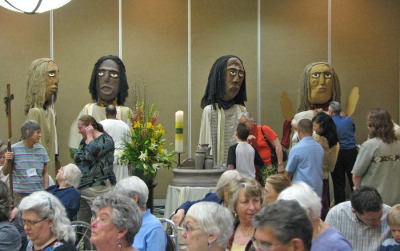
To borrow a phrase from the Simpsons: "Well, I for one welcome our new White Robed Puppet Overlords."
You can't make this stuff up. It makes the Washington Nationals Mass seem almost liturgically tolerable by comparison. Just imagine if Call to Action had been running the show. Pope Benedict might have had put the entire country under an interdict.
Pour yourself a stiff drink, sit down, and watch the video: "Master of Muppets -- Call to Action Liturgy."
Amy Wellborn, "Call to ... Puppery?" (Charlotte was both, May 6, 2008) comments:
Playing “spot the liturgical abuse” is not the point. Nor is snarking at the average age of the participants. (Just heading off the predictable commentary at the pass here. Let’s go deeper.)My own observations are twofold:
What I am just not grasping, despite my pretty strong powers of empathy, is the gestalt at work here.
Why does everyone think the giant liturgical puppets are so awesome?
This has got to be one of the oddest things I’ve ever seen.
First, notice that virtually all the Call to Action crowd "assisting at this Mass" (I use the expression loosely) are old people -- goofy geezers at that. There is very little about any of this that the younger generations would consider 'hip'. It's just goofy old people acting out their recrudescent nostalgic fantasies from the 'revolutionary' 1960s. If you want to find young families excited about assisting at Mass, you'll find many more at a Tridentine liturgy than at anything like this.
Second, as bizarre as this Mass may be, my own perception (based on my own experiences over the last two decades) is that most AmChurch parishes would find participating in such a Mass less alien than assisting at a Tridentine Mass. And that, if true, tells us more than we ever needed to know about where the last 45 years have brought us liturgically. Thank God for Pope Benedict VI.
Of related interest:
"The King of Glory" (Adventures in liturgical dance).
Food for thought
Msgr. Cormac Burke, an Irish Opus Dei priest, was appointed by JPII to the Roman Rota. Very interesting articles on his website: anthropology, marriage, etc.
Fr. Luigi Villa's Paolo VI beato? now in English
A reader just sent me the following bit about the recent translation of a traditionalist Italian book. Here's the background: Alice von Hildebrand gave an interview to Latin Mass magazine in 2001. The interview can be found at "The Church in Crisis -- And Scenarios for a Solution" (Scripture and Catholic Tradition, April 13, 2006). In that interview Von Hildebrand referred to a book by Fr. Luigi Villa, Paolo VI beato? (Brescia: Editrice Civilta, 1998; 2nd ed. 2001). That book is now translated thanks to an Italo-Aussie: Father Luigi Villa, "Paul VI ... beatified?." See also: "Paulo Sesto, Beato? Available in English" (Athanasius Contra Mundum).
[Hat tip to A.S.]
[Hat tip to A.S.]
Heineken offers U.S. market new Beer Tender
Nice. "Heineken rolls out Beer Tender in U.S." (Realbeer.com, March 11, 2008)
Friday, May 09, 2008
Beer
Recommended sites, both by David Palm:
- Catholic Beer Review (De Gustibus non est Disputandum) -- for all your beer needs: Hops? Grow 'em! Russian Imperial Stout? Try it! Old Rasputin? Beware the jinx. Stout floats? You'll love 'em!
- The Reluctant Traditionalist (Reflections on Life, Land, and Traditional Catholicism) -- Rogationtide. The Traditional Latin Mass and the Family. St. Paul contra Sola Scriptura. Maple Syrup Time ... and more.
Thursday, May 08, 2008
The Bible at your fingertips ...
You can now read the Bible at the click of a button..... Check out this innovative Bible research tool from BibleGateway.com (scroll down, and you'll see). Very nice.
Something similar exists for the Douay-Rheims Bible at DRBO.ORG.
Something similar exists for the Douay-Rheims Bible at DRBO.ORG.
Wednesday, May 07, 2008
Cardinal Kasper gets downright Ratzingerian
Damian Thompson, "Rome tells Anglicans: it's time to decide if you are Protestants or Catholics" (Holy Smoke, Telegraph, May 6, 2008), writes:
The Vatican said last night that the time has come for the Anglican Church to choose between Protestantism and the ancient sacramental Churches of Rome and Orthodoxy.[Hat tip to C.B. for the "Ratzingerian" notion as well as for the link]
Cardinal Walter Kasper, president of the Pontifical Council for Christian Unity, told the Catholic Herald that the Anglican Communion must “clarify its identity” and stop hovering between the Catholic and Protestant traditions.
... The cardinal [Kasper] is clearly hoping for some sort of breakthrough – or break-up? – at this summer's Lambeth Conference, which already promises to be a spectacular disaster. But I don't think we should jump to the conclusion that his views represent those of Pope Benedict.
"Pope wants the Latin Mass everywhere"
Damian Thompson, in his slightly cheeky 'Holy Smoke' column in the Telegraph (UK), writes: "Bishops Hollis and Conry, if you have ever thought of jumping ship to the C of E, now might a good time to do so. According to a senior Vatican cardinal, Pope Benedict wants the old Latin Mass celebrated in parishes even where the people have not asked for it." Thompson's article, entitled "Pope wants the Latin Mass everywhere" (Telegraph, May 5, 2008), sports a photo of a priest in Tridentine vestments celebrating the Mass ad orientem in a slightly superman-esque pose, beneath which one reads in bold: "English bishops take note: this is what the Mass looks like." Thompson then continues:
[Hat tip to A.S.]
Well! That will certainly drive a horse and cart through the English bishops’ shameful attempts to ignore Summorum Pontificum, last year’s papal letter removing their power to block the 1962 (Tridentine) Missal.Thompson suggests, however, that the Pope may need to make one additional provision to realize his goal: "New bishops. Lots of them. And fast."
According to the Catholic News Agency, Cardinal Dario Castrillon Hoyos, head of the Pontifical Commission Ecclesia Dei, let the cat out of the bag in an interview for a DVD instructing priests on how to celebrate the Extraordinary Form.
Here’s the money quote: “The cardinal said that parishes and priests should make available the Extraordinary Form so that ‘everyone may have access to this treasure of the ancient liturgy of the Church’. He also stressed that, ‘even if it is not specifically asked for, or requested’ it should be provided. Interestingly, he added that the Pope wants this Mass to become normal in parishes, so that ‘young communities can also become familiar with this rite’.”
[Hat tip to A.S.]
Tuesday, May 06, 2008
Are annulments simply "Catholic divorce"? -- A canon lawyer responds
 Some months ago, in one of our combox discussions, the question posed in the title of this post was raised in a fairly heated discussion between several readers. The suggestion was made that a post could be devoted to the subject of how annulments are understood in the Catholic Church. With this in mind, I asked a colleague of mine who is a noted canon lawyer and author of Annulments And The Catholic Church: Straight Answers To Tough Questions, whether he had any online articles that address the issue, which I could post for discussion in this venue. He did. Hence, with his permission, I offer you the following article which appeared in its original version in Catholic Family (May-June 1998) and is also available online at CanonLaw.info:
Of related interest:Catechetical Issues Related to Annulments
by Dr. Edward N. Peters
Catechists who prepare adults for entrance into the Church need a good understanding of annulments (technically: “declarations of matrimonial nullity”) for at least two reasons. First, virtually all adults seeking to enter the Church have heard of annulments, but most of them labor under one or more serious misperceptions about the process and its purposes. In particular, because of the great increase in the number of annulments being declared by tribunals, questions might be raised about the Church’s commitment to permanent marriage. It is important, therefore, to correct any misunderstandings about annulments before they result in confusion about Catholic teaching on sacramental marriage.
Second, many adults considering conversion to the Catholic Faith are already divorced and remarried outside the Church. Among Catholics, such status, although it no longer results in their excommunication, is considered objectively gravely sinful and prevents their participation in the Eucharist. Similarly, it would be self-defeating to welcome converts into the Church, only to then immediately tell them that, because they are remarried after a civil divorce, they cannot take Communion in the Church they just entered. Thus the matrimonial status of divorced-and-remarried candidates must be assessed before their entering the Church.
In this article we will look at some of the more common issues encountered by catechists regarding annulments. Keeping in mind that most adults seeking to enter full communion with the Church are already validly baptized, we will focus on questions related to marriage cases of the baptized. Even so, however, we must still limit this discussion to those marriage cases which are not complicated by unusual factors such as non-consummation of the marriage or presumed death of a spouse.
What is an Annulment?
The most common misperception among potential converts regarding annulments is that a declaration of matrimonial nullity is simply a Catholic divorce. Obviously, and without denying certain similarities which do exist between divorce and annulments, catechists need to draw clearly the crucial differences between the two. Briefly, a divorce, at least as far as civil law is concerned, ends a marriage which was in existence. In contrast, an annulment declares that what appeared to be a marriage was, from a ecclesiastical point of view, never a marriage in the first place.
The Catholic Church, relying on the teachings of Christ, holds that the marriages of the baptized last until death (Canon 1056). The Church, therefore, unlike the state, does not regard the existence of a civil divorce as sufficient to allow a divorced person to marry again during the lifetime of the first spouse. In order to enter what can be recognized by the Church as a marriage, a divorced person must demonstrate the invalidity of the earlier marriage. The process whereby the possible invalidity of the earlier marriage is examined is the annulment process. Annulment cases can only be heard by ecclesiastical authorities, usually a diocesan tribunal, and are conducted in accord with Church law (Canon 1671).
Broadly speaking, every annulment case comes down to three (or six, if you prefer) questions (Canon 1057): did each of the parties have what canon law considers to be capacity for marriage at the time of the wedding?; did each of the parties express consent to marriage as the Church proclaims it?; and finally, did each of the parties observe whatever level of form might have been required for marriage at the time? — although in non-Catholic weddings, this requirement is usually very easily satisfied and hence rarely serves as a basis for nullity.
Now, canon law presumes that both parties had capacity for marriage at the time of the wedding and it presumes that both parties expressed consent to true marriage (Canons 1058, 1060, & 1101). But, if it can be proven that either or both parties lacked capacity for marriage or that either or both parties did not consent to marriage as the Church teaches it, then such a marriage can be declared ecclesiastically null.
Sometimes a divorced person can demonstrate that the failed marriage was also null by ecclesiastical standards; sometimes not. The mere fact, however, that there has been a sharp rise in the number of broken marriages which have been declared canonically null does not mean that annulments can be obtained simply by doing the paperwork correctly. Each marriage nullity case is heard separately and on its own merits, and the number of rejected annulment petitions is undoubtedly higher than most people believe.
The Catechist’s Role
Catechists should try to make clear that annulments are regarded by the Church as exercises in justice, not charity. In other words, annulments are declared when, and only when, the parties meet the objective canonical requirements for nullity.
Annulments are not given out because tribunal judges feel sorry for certain people (even if such people are clearly sympathetic characters), nor are an annulment petitions rejected because tribunal officials suspect (even if accurately) bad-will on the part of one or both parties. Admittedly, most of the parties involved in annulment cases are pleased when nullity petitions are approved because it will make possible (for both parties) a marriage in the Church. But the fact that most people want their nullity petitions approved does not mean that approval of the petition is the correct result. The tribunal process has not necessarily failed when an annulment petition is denied; the process has not succeeded just because a nullity petition is approved. Annulments are declared when the requirements of canon law are met. They are declined when the requirements of canon law are not met.
Converts, Marriage, and Annulments
It is not unusual for potential converts to the Faith, upon learning that their marriage history might impede their entrance into the Catholic Church, to wonder why the Church is even interested in their earlier marriage(s) in the first place. They might feel that they are unfairly being held to standards that did not apply to them at earlier times in their lives. A couple of observations are in order here.
On the one hand, for example, the requirements of canonical form (what Catholics refer to as “getting married in the Church” according to Canon 1108) are not applied to Protestants. While the violation of canonical form can (and, some 15,000 times a year, does) result in the nullity of the marriages of Catholics, Protestants need not comply with Catholic laws on canonical form and in that regard they are not being held to that Catholic standard for marriage. Of course, because they are not bound by canonical form, Protestants cannot use the fact that they were married, say, in front of a civil magistrate, as proof of the invalidity of their marriage.
On the other hand, some aspects of canon law on marriage are applied to Protestants. To take an obvious example, biological brothers and sisters are canonically incapable of marrying each other, regardless of their religious affiliation (Canon 1091). Such attempts at marriage would be invalid under canon law for Catholics and Protestants alike. Notice, however, that what is at issue in a case like this is not simply a matter of canon law, but one of Divine Law, to which the Church believes all baptized persons are bound. Indeed, when looked at carefully, nearly all of the “Catholic” marriage requirements which are applied to Protestants will be seen to be based on natural or Divine Law.
There are, nevertheless, some significant areas in which Catholic teaching on marriage is applied to Protestants, despite the interdenominational differences which exist on certain points. Let us look at just one, namely, intentions regarding permanence in marriage.
All major Protestant denominations discourage divorce, some of them quite strongly. But none of them currently takes the position of the Catholic magisterium on divorce, to wit, that remarriage is impossible during the lifetime of one’s former spouse. Now, prescinding from whether our cradle Catholics have been adequately educated on this point, it is an accepted part of canonical jurisprudence that anyone who deliberately excludes the intention of remaining in a lifelong marriage attempts marriage invalidly. Therefore, it is possible that the marriage of a Protestant which has ended in divorce can also be declared canonically null based on the fact that the Protestant rejected what the Catholic Church considers to be a true marriage. How? By it being proved that at the time of the wedding the Protestant, quite understandably perhaps, rejected a major facet of the Church’s teaching on marriage (Canons 1056 & 1101). Obviously, great care is taken in hearing nullity cases on these or similar grounds and, as noted above, canon law presumes that all persons consenting to marriage consent to marriage as the Church understands and proclaims it. But such presumptions can be, and sometimes are, overturned in particular cases, resulting in a declaration of matrimonial nullity.
As most catechists know, many people seeking admission to the Church were first attracted to the Church by the strong stand she has taken in defense of innocent human life, her opposition to divorce, and her advocacy of marriage and family life values. I hope the above observations will help catechists allay the fears of some that, through her practice of annulments, the Church is wavering in her proclamation of “marriage until death do us part.” At the same time,however, catechists should feel confident in guiding to the proper ecclesiastical offices those candidates for conversion who are in irregular unions, knowing that the opportunity to have an accurate canonical determination of their true matrimonial status is available. +++
- Edward N. Peters, Annulments And The Catholic Church: Straight Answers To Tough Questions
- Edward N. Peters, Excommunication and the Catholic Church
Subscribe to:
Posts (Atom)