June 18, 2017 - External Solemnity of Corpus Christi[Comments? Please e-mail tridnews@detroitlatinmass.org. Previous columns are available at http://www.detroitlatinmass.org. This edition of Tridentine Community News, with minor editions, is from the St. Albertus (Detroit), Academy of the Sacred Heart (Bloomfield Hills), and St. Alphonsus and Holy Name of Mary Churches (Windsor) bulletin inserts for June 18, 2017. Hat tip to Alex Begin, author of the column.]
The Ambrosian Rite
Disclaimer: These are the author’s initial reactions to his first experience of the Ambrosian Rite Mass and are not meant to be authoritative descriptions of the rite.
This year’s Sacra Liturgía conference was held in Milan, Italy June 6-9. As always, it was an informative and uplifting experience. One feels intimately connected to the worldwide Latin Mass movement at such an event, being part of an international crowd with likeminded interests. Vatican Congregation of Divine Worship Prefect Cardinal Robert Sarah once again delivered the keynote address, in which he reiterated his recommendation from last year for priests to celebrate the Ordinary Form of Holy Mass ad oriéntem. This year His Eminence also made the case for Holy Communion to be received kneeling and on the tongue. Cardinal Raymond Burke delivered an address about the positive effects of the first ten years of Summórum Pontificum. Former Apostolic Nuncio to the United States Archbishop Carlo Maria Viganò was in attendance, as were several other bishops and countless priests.
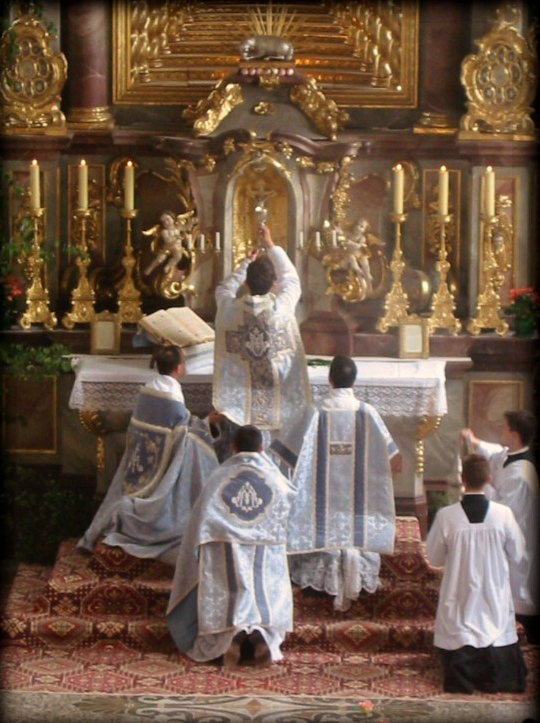
A principal objective of this year’s event was exposing the attendees to the Ambrosian Rite. The rite, named after Milan’s Patron Saint, St. Ambrose, is native to the Archdiocese of Milan; it is also used at a handful of other locations in Italy and Switzerland. Several talks on the history of the rite were presented, and Masses and Vespers in the traditional and modern forms of the rite were offered. An elaborate Traditional Ambrosian Solemn Mass in the Presence of a Greater Prelate [Cardinal Burke] was offered in the standing-room-only Church of Sant’Alessandro in Zebedia. [Photo above; both photos by Sacra Liturgía]
Unlike the Traditional Premonstratensian, a.k.a. Norbertine, Rite, which has only a few variations from the Traditional Latin Mass, the Traditional Ambrosian Rite differs in some significant ways:
There are three readings instead of two. There are two additional chanted Propers: an Antiphon after the Gospel and a Confractórium Antiphon after the Canon during the breaking of the host. The Confractórium takes the place of the Agnus Dei, which is omitted in the Ambrosian Rite.
In both the Masses and the Vespers offered at the conference, there were elements shared with the Byzantine Rite: There were several instances of Kyrie, eleison chanted back and forth. There were Dóminus vobíscum’s at unexpected points, such as before antiphons. Unlike its restrained handling in the Tridentine Mass, the thurible – without a lid – is swung around in an expansive circular motion, almost like a lasso.
Only four priests in the Archdiocese of Milan are familiar with the Traditional Ambrosian Rite. As a result, that version is only offered in two locations.
The Modern Ambrosian Rite shares many of the characteristics of the traditional version, though the celebrant may face the people. This rite is the norm in most parishes in Milan. In the Modern Ambrosian Mass offered at the conference in the Basilica of St. Ambrose, the first reading was, oddly, not taken from Sacred Scripture, but was rather a history of Ss. Ambrose, Gervase, and Protase. The Sign of Peace takes place before the Offertory.
Musically, there is a whole repertoire of Ambrosian Chant, whose sound is quite rich and full, sonically falling somewhere between the often thin Gregorian Chant and complex polyphony. Many of our readers are familiar with the Ambrosian Glória, which the Milanese call Glória Tono Festívo. An updated book of Ambrosian Chant was introduced at the conference.
Perhaps the most moving moment in all of the liturgies offered took place at the beginning of the Modern Ambrosian Rite Mass. As the entrance procession arrived at the altar, the two acolytes and crucifer turned to face the clergy behind them. The clergy and servers in the procession turned to face each other, while the celebrant remained at the back of the procession [photo above]. The choir then began a 12-fold Kyrie, alternating with the clergy. A video of this entrance is here, with the Kyrie beginning at 2:30: https://www.youtube.com/watch?v=Z8kDr4_kPlQ
Tridentine Masses This Coming Week
- Mon. 06/19 7:00 PM: Low Mass at St. Josaphat (St. Julia of Falconieri, Virgin)
- Tue. 06/20 7:00 PM: Low Mass at Holy Name of Mary, Windsor (St. Silverius, Pope & Martyr)
- Sat. 06/24 8:30 AM: Low Mass at Miles Christi (Nativity of St. John the Baptist)
Sunday, June 18, 2017
Tridentine Community News - The Ambrosian Rite; TLM schedule
Tridentine Community News by Alex Begin (June 18, 2017):
Labels:
Catholic opinion,
Detroit,
Latin Mass,
Liturgy,
News
Tridentine Community News - Extraordinary Faith Episode 11: San Francisco Part 2 of 2; TLM scheudule
"I will go in unto the Altar of God
To God, Who giveth joy to my youth"
Tridentine Community News by Alex Begin (June 11, 2017):
June 11, 2017 - Trinity Sunday
Extraordinary Faith Episode 11: San Francisco Part 2 of 2
The last episode of Season 1 of Extraordinary Faith has been posted to YouTube and Vimeo for viewing on-line. This episode, as well as all of the other episodes of Season 1, continues to be re-run on a weekly basis by EWTN on all of their global satellite feeds. EWTN’s strong support for Extraordinary Faith is directly attributable to the feedback they receive at viewer@ewtn.com, and we thank our readers who have taken the time to send in a good word.
Episode 11 – San Francisco Part 2 of 2 – begins with an interview with Fr. Joseph Illo, pastor of Star of the Sea Parish in San Francisco, who is attempting to organize an Oratory of St. Philip Neri there. He explains what an Oratory is, and the noteworthy Oratories in London, Birmingham, and Oxford, England, and Toronto, Ontario, all of which are renowned for traditional liturgy.
The Tridentine Mass isn’t the only form of traditional Catholic liturgy that is regaining popularity in modern times. The traditional Dominican Rite is also enjoying a resurgence, and one of its proponents and celebrants, Fr. Anselm Ramelow, OP, Associate Professor at the Dominican School of Philosophy & Theology in Berkeley, California, explains what it is and how it differs from the Roman Rite. We interview Fr. Anselm in San Francisco’s Dominican parish, appropriately named St. Dominic, and pastor Fr. Michael Hurley gives us a tour of this English Gothic church.
Traditional orders continue to grow and be founded. Fr. Vito Perrone – no relation to Detroit’s Fr. Eduard Perrone – explains the mission of his new order, the Contemplatives of St. Joseph, which offers both the Extraordinary and Ordinary Forms in San Francisco.
Next we head to the southern part of the Bay Area, to San Jose, the hub of Silicon Valley. You would expect to see modern buildings housing tech companies there, but you might be surprised to discover a beautiful historic church, Five Wounds Portuguese National Church, which is home to a Latin Mass community. Canon Olivier Meney of the Institute of Christ the King takes us on a tour.
When you think of Marin County, located north of San Francisco on the other side of the Golden Gate Bridge, you might think of vineyards and beautiful vistas. In the midst of that scenic countryside is the St. Vincent School for Boys, a residential school for disadvantaged young men which has an expansive, architecturally ornate campus. The centerpiece is a stunning chapel which hosts a Tridentine Mass community on Sundays. Facilities Director Jacqui Devine gives us a tour.
Episode 11 may be viewed on the Extraordinary Faith channels on YouTube and Vimeo. A high-res direct link is here: https://vimeo.com/164106931. Soon it will also be viewable – along with some behind-the-scenes photos – on our web site, www.extraordinaryfaith.tv. As always, we encourage you to like the Extraordinary Faith page on Facebook, so you’ll be notified about the latest air dates and additional info about the places we visit.
Season 2 of Extraordinary Faith will debut soon. It begins with a local slant: The first three episodes cover our local Latin Mass scene here in Windsor and Detroit. Details will be provided when EWTN sets their broadcast schedule.
Tridentine Masses This Coming Week
- Mon. 06/12 7:00 PM: Low Mass at St. Josaphat (St. John of San Fecundo, Confessor)
- Tue. 06/13 7:00 PM: Low Mass at Holy Name of Mary, Windsor (St. Anthony of Padua, Confessor & Doctor)
- Sat. 06/17 8:30 AM: Low Mass at Miles Christi (St. Gregory
Labels:
Arts and Culture,
Church architecture,
Detroit,
Latin Mass,
Liturgy,
Mass,
Media
Saturday, June 17, 2017
AIM Report: Did Mueller Know Hoover’s Dark Secret?
The republicans know this but they will not fight against the establishment which hired Mueller to take Trump out."AIM Report: Did Mueller Know Hoover’s Dark Secret?" (Accuracy In Media, April 14, 2002):
Politically, Trump is a dead man walking and his executioner is man whose hands are covered with the same blood that Irish Mobster, and rifleman man Flemmi, spilled in Boston with the knowledge and assistance of the FBI.
Mueller knew....
It may be the worst scandal in FBI history: Joseph Salvati spent three decades in prison for a crime he didn’t commit. He was put there by uncorroborated, false testimony from an informant under the protection of the Federal Bureau of Investigation. There is compelling evidence that the Bureau knew Salvati was an innocent man and then conspired to keep him in prison for more than three decades. Knowledge of the Bureau’s actions seems to have gone right to the very top; documents uncovered recently show that then-Director J. Edgar Hoover monitored the case from Washington.
The FBI scandal was investigated for two years by the House Government Reform Committee, then under the chairmanship of Congressman Dan Burton (R-IN), who introduced legislation to remove Hoover’s name from FBI headquarters as a result of what he learned.
But the scandal gets worse than that. When Burton tried to acquire official records on the case from the Justice Department, he was stonewalled, and Attorney General John Ashcroft persuaded President George W. Bush to invoke “executive privilege” to block the committee’s subpoenas. This was President Bush’s first, and thus far only, use of executive privilege to withhold information from the Congress. Some think Bush is trying to protect current FBI Director Robert Mueller, who was in the U.S. Attorney’s office in Boston during part of the relevant time period. The confrontation with Burton prompted columns on the controversy by William Safire and Robert Novak.
Read more >>
Tridentine Masses coming this week (June 18-24) to metro Detroit and southeastern Michigan
Tridentine Masses This Coming Week
Sunday
- Sun. 7:30 AM and 10:00 AM: Low Mass (Confessions 45 minutes before and after Masses) at St. Joseph's Church, Ray Township [NB: See note at bottom of this post about SSPX sites.]*
- Sun. 8:00 and 10:30AM Low Mass (Confessions 1/2 hour before Mass: call beforehand) at St. Ann's Church, Livonia [NB: See note at bottom of this post about SSPX sites.]*
- Sun. 9:00 AM: Low Mass at St. Joseph Oratory, Detroit
- Sun. 9:45 AM: High Mass at OCLMA/Academy of the Sacred Heart, Bloomfield Hills
- Sun.: [occasional Tridentine Masses: contact parish] at Our Lady of the Scapular Parish
- Sun. 11:00 AM: Solemn High Mass at St. Joseph Oratory, Detroit
- Sun. 12:00 Noon: Orchestral Mass at Assumption Grotto, Detroit Mass with choir and orchestra, Schubert's Mass in A Flat and Tantum Ergo.
- Sun. 12:00 Noon: High Mass at St. Mary Star of the Sea, Jackson
- Sat. 12:30 PM (2nd Sundays): Tridentine Mass at Old St. Patrick's, Ann Arbor
- Sun. 2:00 PM (1st Sundays only):St. Alphonsus Church, Windsor, Canada
- Sun. 2:00 PM (every Sunday except 1st): High Mass at Holy Name of Mary, Canada
- Sun. 3:00 PM (2nd and 4th Sundays): Tridentine Mass (call ahead for Confession times, 989-892-5936) at Infant of Prague, Bay City [NB: See note at bottom of this post about SSPX sites.]*
- Sun. 3:00 PM: High Mass St. Matthew Catholic Church, Flint
Monday
- Mon. 7:30 AM: Low Mass at Assumption Grotto, Detroit
- Mon. 8:00 AM: Low Mass St. Joseph Oratory, Detroit
- Mon. 8:00 AM: Low Mass (Confessions by appointment) at St. Joseph's Church, Ray Township [NB: See note at bottom of this post about SSPX sites.]*
- Mon. 12:00 Noon: High Tridentine Mass at Assumption Grotto, Detroit
- Mon. 7:00 PM: Low Mass at St. Josaphat, Detroit
- Mon. 7:00 PM: Low Mass at Assumption Grotto, Detroit
Tuesday
- Tue. 7:00 AM Low Mass at Assumption Grotto, Detroit
- Tue. 8:00 AM: Low Mass St. Joseph Oratory, Detroit
- Tue. 8:00 AM: Low Mass (Confessions by appointment) at St. Joseph's Church, Ray Township [NB: See note at bottom of this post about SSPX sites.]*
- Tue. 7:00 PM: Low Mass at Holy Name of Mary, Canada
- Tue. 7:00 PM: Low Mass at Assumption Grotto, Detroit
Wednesday
- Wed. 7:30 AM: Low Mass at Assumption Grotto, Detroit
- Wed. 8:00 AM: Low Mass (Confessions by appointment) at St. Joseph's Church, Ray Township [NB: See note at bottom of this post about SSPX sites.]*
- Wed. 12:00 Noon: Low Mass St. Joseph Oratory, Detroit followed by Perpetual Novena to St. Joseph
- Wed. 7:00 PM: Low Mass at Assumption Grotto, Detroit
Thursday
- Thu. 7:30 AM: Low Mass at Assumption Grotto, Detroit
- Thu. 8:00 AM: Low Mass St. Joseph Oratory, Detroit
- Thu. 8:00 AM: Low Mass (Confessions Thursdays: 7:00 - 7:30 PM during Benediction) at St. Joseph's Church, Ray Township [NB: See note at bottom of this post about SSPX sites.]*
- Thu. 7:00 PM: Low Mass at Assumption Grotto, Detroit
Friday
- Fri. 7:30 AM: Low Mass at Assumption Grotto, Detroit
- Fri. 8:00 AM: Low Mass St. Joseph Oratory, Detroit
- Fri. 8:00 AM: Low Mass (Confessions 6:30 PM - 7:30 PM during Holy Hour) at St. Joseph's Church, Ray Township [NB: See note at bottom of this post about SSPX sites.]*
- Fri. 7:00 PM: Low Mass (usually) at Assumption Grotto, Detroit
- Fri. 7:00 PM (1st Fridays only): High Mass at Old St. Mary's, Greektown, Detroit
- Fri. 7:00 PM: Tridentine Mass at St. Joseph, Sarnia, Ontario
- Fri. 7:00 PM (after 6:00 PM Holy Hour, 1st Fridays only): High Mass at St. Joseph Oratory, Detroit
Saturday
- Sat. 7:30 AM: Low Mass at Assumption Grotto, Detroit
- 8:00 AM (1st Saturdays): Low Mass at St. Edward on the Lake, Lakeport
- Sat. 8:00 AM: Low Mass (Confessions 8:30 AM to 9:30 AM) at St. Joseph's Church, Ray Township [NB: See note at bottom of this post about SSPX sites.]*
- Sat. 8:00 AM: Low Mass (Confessions 1/2 hour before Mass: call beforehand) at St. Ann's Church, Livonia [NB: See note at bottom of this post about SSPX sites.]*
- Sat. 8:30 AM: Low Mass at Miles Christi, South Lyon, MI
- Sat. 9:00 AM (1st Saturdays): High Mass at St. Anthony, Temperance
- Sat. 10:00 AM: High Mass and Novena to Our Lady of Perpetual Help at St. Joseph Oratory, Detroit. On this Feast of the Nativity of John the Baptist, Saturday June 24, a High Mass will be offered at 10AM by Fr. Zachary John Akers, FSSP, the present Director of Development for the Fraternity.
- Sat. 6:00 PM: Tridentine Mass at SS. Cyril & Methodius Slovak Catholic Church, Sterling Heights
* NB: The SSPX chapels among those Mass sites listed above are posted here because the Holy Father has announced that "those who during the Holy Year of Mercy approach these priests of the Fraternity of St Pius X to celebrate the Sacrament of Reconciliation shall validly and licitly receive the absolution of their sins," and subsequently extended this privilege beyond the Year of Mercy. These chapels are not listed among the approved parishes and worship sites on archdiocesan websites.

Labels:
Detroit,
Latin Mass,
Liturgy,
music,
News
Fr. James Martin, "bridges," and the triumph of the therapeutic mentality
"One would think that in a book about human sexuality, an author writing from a Catholic perspective would identify the specific sexual struggles of the moral life in Christ as the sixth commandment bears upon them, and the corresponding sexual sins against chastity. But no, they receive no attention; they do not figure in this book at all."
Eduardo Echeverria, "Fr. James Martin, 'bridges,' and the triumph of the therapeutic mentality" (CWR, June 16, 2017).
Echeverria's article carries the following quote as a welcome caveat given the disposition of Fr. Martin's book:
“There is an organic connection between our spiritual life and the dogmas. Dogmas are lights along the path of faith; they illuminate it and make it secure. Conversely, if our life is upright, our intellect and heart will be open to welcome the light shed by the dogmas of faith” (CCC, no. 89).He begins with definition:
By the therapeutic mentality I mean a subjectivist philosophy in which a feeling of well-being, feeling good about oneself, is the only, or dominant, criterion by which we measure what is acceptable or not to us. A good example of this mentality is found throughout the recent book by James Martin, SJ, Building a Bridge: How the Catholic Church and the LGBT Community can Enter into a Relationship of Respect, Compassion, and Sensitivity (New York: HarperOne, 2017; hereafter, BB).
The Catechism of the Catholic Church (no. 2357; hereafter, CCC) teaches: “Basing itself on Sacred Scripture, which presents homosexual acts as acts of grave depravity, tradition has always declared that ‘homosexual acts are intrinsically disordered’.” Fr. Martin doesn’t cite this passage. I’ll return to this matter below. All he cites is the phrase found in CCC that the homosexual inclination is “objectively disordered” (no. 2358). After this, we see the therapeutic mentality at work in the following remark. “The phrase relates to the orientation, not the person, but it is still needlessly hurtful. Saying that one of the deepest parts of a person—the part that gives and receives love—is ‘disordered’ in itself is needlessly cruel” (BB, 46-47).
Fr. Martin doesn’t say that the problem with this term is solely with the language used that otherwise correctly describes the homosexual condition. So, let’s just change the language to describe an expression of human brokenness as a consequence of man’s fallen state. He doesn’t consider whether the term is morally right about homosexual practice; or even whether it is, however inadequately, getting at the reality of the homosexual condition.
Rather, he only considers how the term leaves one feeling about himself, hurt or abused verbally. That’s it. Read more >>
Labels:
Confusion,
Dissent,
Homosexualism,
People
Tuesday, June 13, 2017
The Ends of Marriage
By Unam Sanctam Catholicam. Examining the traditional Catholic understanding of the ends of marriage relating to why homosexual relationships can never be the basis for any authentic marriage. The relation between fertility and marital union and why acts which directly impede or negate fertility are immoral.
Homosexuality and the Bible
"Brought to you by Unam Sanctam Catholicam. Do the Bible and Christian Tradition allow for any acceptance of homosexual actions? This video answers this question with a resounding 'no', addressing common objections including: homosexuality and the Old Testament prohibition on eating shellfish, St. Paul's condemnations of homosexual deviancy, the Catholic saints on homosexuality, the biological ordering of sex to procreation and more."
Sunday, June 11, 2017
Tridentine Masses coming this week to metro Detroit and east Michigan
Tridentine Masses This Coming Week
Sunday
- Sun. 7:30 AM and 10:00 AM: Low Mass (Confessions 45 minutes before and after Masses) at St. Joseph's Church, Ray Township [NB: See note at bottom of this post about SSPX sites.]*
- Sun. 8:00 and 10:30AM Low Mass (Confessions 1/2 hour before Mass: call beforehand) at St. Ann's Church, Livonia [NB: See note at bottom of this post about SSPX sites.]*
- Sun. 9:00 AM: Low Mass at St. Joseph Oratory, Detroit
- Sun. 9:45 AM: High Mass at OCLMA/Academy of the Sacred Heart, Bloomfield Hills
- Sun.: [occasional Tridentine Masses: contact parish] at Our Lady of the Scapular Parish
- Sun. 11:00 AM: Solemn High Mass at St. Joseph Oratory, Detroit
- Sun. 12:00 Noon: High Mass at Assumption Grotto, Detroit with choir and orchestral setting by Schubert (Mass in A Flat).
- Sun. 12:00: High Mass at St. Mary Star of the Sea, Jackson
- Sat. 12:30 PM (2nd Sundays): Tridentine Mass at Old St. Patrick's, Ann Arbor
- Sun. 2:00 PM (1st Sundays only):St. Alphonsus Church, Windsor, Canada
- Sun. 2:00 PM (every Sunday except 1st): High Mass at Holy Name of Mary, Canada
- Sun. 3:00 PM (2nd and 4th Sundays): Tridentine Mass (call ahead for Confession times, 989-892-5936) at Infant of Prague, Bay City [NB: See note at bottom of this post about SSPX sites.]*
- Sun. 3:00 PM: High Mass at St. Matthew Catholic Church, Flint
Monday
- Mon. 7:30 AM: Low Mass at Assumption Grotto, Detroit
- Mon. 8:00 AM: Low Mass St. Joseph Oratory, Detroit
- Mon. 8:00 AM: Low Mass (Confessions by appointment) at St. Joseph's Church, Ray Township [NB: See note at bottom of this post about SSPX sites.]*
- Mon. 12:00 Noon: High Tridentine Mass at Assumption Grotto, Detroit
- Mon. 7:00 PM: Low Mass at St. Josaphat, Detroit
- Mon. 7:00 PM: Low Mass at Assumption Grotto, Detroit
Tuesday
- Tue. 7:00 AM Low Mass at Assumption Grotto, Detroit
- Tue. 8:00 AM: Low Mass St. Joseph Oratory, Detroit
- Tue. 8:00 AM: Low Mass (Confessions by appointment) at St. Joseph's Church, Ray Township [NB: See note at bottom of this post about SSPX sites.]*
- Tue. 7:00 PM: Low Mass at Holy Name of Mary, Canada
- Tue. 7:00 PM: Low Mass at Assumption Grotto, Detroit
Wednesday
- Wed. 7:30 AM: Low Mass at Assumption Grotto, Detroit
- Wed. 8:00 AM: Low Mass (Confessions by appointment) at St. Joseph's Church, Ray Township [NB: See note at bottom of this post about SSPX sites.]*
- Wed. 12:00 Noon: Low Mass St. Joseph Oratory, Detroit followed by Perpetual Novena to St. Joseph
- Wed. 7:00 PM: Low Mass at Assumption Grotto, Detroit
Thursday
- Thu. 7:30 AM: Low Mass at Assumption Grotto, Detroit
- Thu. 8:00 AM: Low Mass St. Joseph Oratory, Detroit
- Thu. 8:00 AM: Low Mass (Confessions Thursdays: 7:00 - 7:30 PM during Benediction) at St. Joseph's Church, Ray Township [NB: See note at bottom of this post about SSPX sites.]*
- Thu. 6:00 PM: High Mass at St. Matthew Catholic Church, Flint on June 15, followed by a procession around the church.
- Thu. 7:00 PM: Low Mass at Assumption Grotto, Detroit
Friday
- Fri. 7:30 AM: Low Mass at Assumption Grotto, Detroit
- Fri. 8:00 AM: Low Mass St. Joseph Oratory, Detroit
- Fri. 8:00 AM: Low Mass (Confessions 6:30 PM - 7:30 PM during Holy Hour) at St. Joseph's Church, Ray Township [NB: See note at bottom of this post about SSPX sites.]*
- Fri. 7:00 PM: Low Mass (usually) at Assumption Grotto, Detroit
- Fri. 7:00 PM (1st Fridays only): High Mass at Old St. Mary's, Greektown, Detroit
- Fri. 7:00 PM: Tridentine Mass at St. Joseph, Sarnia, Ontario
- Fri. 7:00 PM (after 6:00 PM Holy Hour, 1st Fridays only): High Mass at St. Joseph Oratory, Detroit
Saturday
- Sat. 7:30 AM: Low Mass at Assumption Grotto, Detroit
- 8:00 AM (1st Saturdays): Low Mass at St. Edward on the Lake, Lakeport
- Sat. 8:00 AM: Low Mass (Confessions 8:30 AM to 9:30 AM) at St. Joseph's Church, Ray Township [NB: See note at bottom of this post about SSPX sites.]*
- Sat. 8:00 AM: Low Mass (Confessions 1/2 hour before Mass: call beforehand) at St. Ann's Church, Livonia [NB: See note at bottom of this post about SSPX sites.]*
- Sat. 8:30 AM: Low Mass at Miles Christi, South Lyon, MI
- Sat. 9:00 AM (1st Saturdays): High Mass at St. Anthony, Temperance
- Sat. 9:00 AM: Low Mass and Novena to Our Lady of Perpetual Help at St. Joseph Oratory, Detroit
- Sat. 6:00 PM: Tridentine Mass at SS. Cyril & Methodius Slovak Catholic Church, Sterling Heights
* NB: The SSPX chapels among those Mass sites listed above are posted here because the Holy Father has announced that "those who during the Holy Year of Mercy approach these priests of the Fraternity of St Pius X to celebrate the Sacrament of Reconciliation shall validly and licitly receive the absolution of their sins," and subsequently extended this privilege beyond the Year of Mercy. These chapels are not listed among the approved parishes and worship sites on archdiocesan websites.

New Detroit Archdiocese coat of arms design
Do any of you have an opinion about the new Coat of Arms of the Archdiocese of Detroit? Some people seem quite upset by it, like the website that calls it an "Epic Fail," and a logo rather than a coat of arms. I think the archbishop's post-synodal letter will help the viewer to understand some of the imagery in the new design, though whether you like it or not is another question. (Here are images of the designs, old on the left, new on the right.)
Labels:
Arts and Culture,
Catholic practices,
Church history,
Detroit,
News
Friday, June 09, 2017
Catholic Herald: Is there really an Old Mass revival?

Well look for yourself and see. For starters, here is Fr. Z's analysis of the question (Fr. Z's Blog, June 9, 2017).
Labels:
Catholic opinion,
Church history,
Latin Mass,
Liturgy
The epiclesis - a later addition?
Fr. Hunwicke, "The epiclesis of the Roman Rite" (Fr. Hunwicke's Mutual Enrichment, September 2, 2010) writes:
Dear old Fortescue's The Mass records the long debates of liturgists a century ago about where the epiclesis of the Roman Rite originally was before it ... er ... "dropped out". Their assumption, of course, was that the epiclesis was original to Christian liturgy and that the Oriental rites which preserve it were more 'primitive' than the Roman Rite. Now, happily, we know better. We see the Oriental epiclesis as a comparatively late fad in the evolving liturgical tradition. Rather than seeking traces of a lost epiclesis in the Canon Romanus, we realise that the prayer Supplices te rogamus, in which we pray that our offerings be taken to the Heavenly Altar, represents an earlier and lovelier expression of the linkage between our offering and the eternal oblation of the Eternal Son at the Heavenly Altar. Patrimony liturgists such as E C Ratcliffe played a large role here, not to mention Dom Gregory. Read more >>In "Consecration in the Roman Mass 2" (Fr. Hunwicke's Mutual Enrichment, March 15, 2015), Fr. Hunwicke adds:
Why this Gadarene preoccupation, in the 1960s, with epicleses asking the Spirit to be sent to change Bread into Body? The answer is embarrassingly simple. Pretty well all rites except the Roman had an epiclesis. Therefore it must be 'Primitive'. Therefore it was desireable. The alternative possibility, that Rome lacked an epiclesis because it was older than those other rites, occurred to very few. So, for a hundred years or more, the question had been (not why did the other rites add an epiclesis, but) Whatever Happened to the Roman Epiclesis ... deemed to have existed originally but, for some mysterious reason, to have gone missing. Readers who still have on their shelves The Mass by Adrian Fortescue can still find page after page describing the ingenious pursuits, by entire generations of clever and erudite men, of this particular invisible (well, to be frank, mythical) fox. The conviction was bolstered by an inclination to believe that all the existing rites of Christendom must have descended from an Original Liturgy which, at least in its dominant features, was fairly uniform, and could therefore, in principle, be reconstructed from a comparison of existing liturgies. This assumption, as the pendulum swings, is currently highly unfashionable; an Anglican liturgist called Paul Bradshaw has spent most of his life rebutting it. Read more >>[Hat tip to L.S.]
Labels:
Catholic opinion,
Church history,
Latin Mass,
Liturgy,
Mass
Tuesday, June 06, 2017
Think you know anything about the Gift of Tongues?
Take Charles A. Sullivan's two quizzes, and think again!
Monday, June 05, 2017
Fr. Rutler: Pentecost was not an occasion for 'Enthusiasm'
Fr. George W. Rutler's article, "Pentecost Was Not An Occasion for 'Enthusiasm'" (Crisis Magazine, June 1, 2017), has all the appearance of being timed in anticipation of the International Catholic Charismatic Renewal's celebration of it's Golden Jubilee on Pentecost Sunday.
Turning his attention to Phrygia of Asia Minor in what is now Turkey during the second century, Rutler writes:
A convert priest named Montanus stirred up a lot of excitement when he confused himself with the Holy Spirit and proclaimed various “prophecies” while in a trance like a sort of divine ventriloquist. In the manner of a typical fanatic so defined, he was confident that God would agree with him if only God had all the facts. In a languid and dissolute period, the local churches already having become formalistic and arid (contrary to romantic depictions of the uniform zeal of all early Christians, and not unlike the motivation of John Wesley to stir up the dormant Church of England), the ardor of Montanus attracted many as far as North African and Rome itself, not all of whom were innocent of neurosis. Even the formidable mind of Tertullian welcomed it. Sensational outbursts of emotion were thought to be divinely inspired, and the formal clerical structure of the Church was caricatured as the sort of rigidity that quenches the spirit. Avowing that prophecy did not end with the last apostles, new messages were pronounced, false speaking in tongues pretending to be actual languages was encouraged, and women like Priscilla and Maximilla left their husbands and decided that they could be priestesses and prophetesses.More to it, of course, but that seems to be intended nub of something like a warning shot across the bow of the unbridled ubiquitous ebullience of the present season.
In the twentieth century, the Montanist heresy sprung up again. The Pentecostal sects, and even many Catholics were attracted to “re-awakenings” that gave the impression that the Paraclete promised by Christ who never lied had finally come awake having slumbered pretty much since the early days of the Church. While its extreme forms were bizarre, such as dancing in churches and uncontrolled laughter and barking like dogs while rolling on the floor, any quest for novelty quickly grows bored, for nothing goes out of fashion so fast as the latest fashion.
... Heresies are fads. The estimable Servant of God Father John Hardon, whose talks would never be called ecstatic, bluntly said that the modern Charismatics are Montanists. It is true that the Charismatic movement in the Catholic Church wisely was blessed insofar as it not denigrate from or add to authentic dogma. But in the second century the pope Eleutherius was inclined to condone the Montanists too, until the anti-Tertullian theologian Praxeas explained its problems.
Labels:
Catholic opinion,
Charismatic movement,
Church history,
Heresy,
People
Is Pope Francis a 'Postmodernist'?
[Hat tip to J. Likoudis]
Labels:
Catholic opinion,
Pope Francis,
Postmodernism
Sunday, June 04, 2017
Tridentine Community News - More new churches in a traditional style: Our Lady of Good Voyage, Boston; Christendom College Chapel; Restoration of Boston's Cathedral of the Holy Cross; Penecost Octave at Old St. Patrick; TLM schedule
"I will go in unto the Altar of God
To God, Who giveth joy to my youth"
Tridentine Community News by Alex Begin (June 4, 2017):
June 4, 2017 - Pentecost Sunday
More New Churches in a Traditional Style: Our Lady of Good Voyage, Boston
Continuing the theme from last week’s column, we bring to your attention two more churches newly built in a traditional style:
The Archdiocese of Boston is more recently known for closing churches, but in April it opened a new Shrine of Our Lady of Good Voyage to take the place of an older chapel. Designed by Cram & Ferguson, a Massachusetts church architecture firm featured on Extraordinary Faith whose founder designed St. Mary of Redford and Hamtramck’s St. Florian Church, the chapel is traditionally arranged and boasts a relocated and restored High Altar. [Photo by WBUR-FM]
Christendom College Chapel
Many of our readers know Christendom College in Front Royal, Virginia to be one of the most impressive orthodox Catholic institutions of higher learning around. In March the college announced that they would be offering Tridentine Mass exclusively on one Sunday per month, to ensure that all students receive exposure to it. The school already offered the Extraordinary Form on most weekdays and every Sunday (non-exclusively). Now the college is embarking on a plan to construct Christ the King Chapel, a liturgically fitting locale for the Latin Mass, complete with ornate High Altar and Communion Rail.
Restoration of Boston’s Cathedral of the Holy Cross
New construction isn’t the only good news in Boston: The Cathedral of the Holy Cross is being un-wreckovated: As part of a comprehensive restoration of the church, the High Altar, formerly reduced to non-functional decorative use, is being restored, a Communion Rail from the closed Holy Trinity Church is being installed, Side Altars are being restored [pictured], the sanctuary and statuary are being put back to a more traditional arrangement, and the carpet is being removed to improve the acoustics. A Latin Mass community currently using the traditional but cozy lower level chapel expects to increase the frequency of holding Masses in the soon-to-be-more-hospitable-to-the-Tridentine Mass upper church.
Pentecost Octave at Old St. Patrick
Once again this year, Old St. Patrick Church in Ann Arbor is offering Tridentine Masses daily for the Octave of Pentecost. All will be High Masses, with the possible exception of Saturday, June 10. The schedule is:Tridentine Masses This Coming WeekMonday, June 5 – 7:00 PM
Tuesday, June 6 – 7:00 PM
Wednesday, June 7 – 8:30 AM
Thursday, June 8 – 8:30 AM
Friday, June 9 – 8:30 AM
Saturday, June 10 – TBD
Sunday, June 11 – 12:30 PM
- Mon. 06/05 7:00 PM: Low Mass at St. Josaphat (Pentecost Monday)
- Tue. 06/06 7:00 PM: High Mass at Holy Name of Mary, Windsor (Pentecost Tuesday)
- Sat. 06/10 8:30 AM: Low Mass at Miles Christi (Pentecost Saturday)
Subscribe to:
Posts (Atom)