Showing posts with label Universalism. Show all posts

Sunday, October 22, 2017

Truth Decay


Yet another angst-ridden message from our underground correspondent, Guy Noir - Private Eye, this time arriving by bicycle courier in a large envelope. The hand-written message, with splotches of ink, made me wonder if Guy had used a quill pen to compose the missive. In the envelope I also found a pack of four Havana cigars. Nice.

Guy's message referenced a piece by Sandro Magister entitled "World's End Update ..." (Settimo Cielo, October 20, 2017), which I tracked down on the internet. Then followed his brief comments:
It's getting old. This new universalism has by now been so often suggested and homaged by so many recent popes that one could honestly argue it's part of the postconciliar development of doctrine. I no longer know what to say. Ralph Martin's "Who Will Be Saved?" offered a complete, Catholic, and biblical response to it. Trouble being, though, as Bishop Barron pointed out in his online debate over Martin's corrective, the conservatives' ballyhoooed Benedict XVI himself seems to support some sort of universalism in his encyclical on hope. We can laud tradition all we want, but at some point have to admit that postconciliarism is often an apology for, versus a friend of, Tradition. When the Four Last Things are shined up with new porcelain theological caps after receiving a Balthasarian root canal, Developmentalism is becoming the new orthodoxy, no matter how hard the forced smile from places like First Things. We are all Mormons now.
So it goes ...

Saturday, December 12, 2015

Oh, hell. Again.

The underground correspondent we keep on retainer in an Atlantic seaboard city that knows how to keep its secrets, Guy Noir - Private Eye, has once again slammed into that post-Vatican II addiction of many Catholics with universalism in Albert B. Hakim's article, "Hell, Population Zero: Daring to Hope that All Will Be Saved" (Commonweal, December 2, 2015).

What's one to think? These dissident rags, like Commonweal and the National Catholic 'Distorter', are regularly dismissed by conservative Catholics as faux representatives of the Catholic Church. True enough in terms of Church Tradition. But if we took a cross section of the formal membership of the Church today, would they not represent a sizable share -- particularly given the sentiments of many of the leading princes of the Church at the recent October Synod? The confusion sewn throughout the faithful by these conflicting messages is undermining the Church's mission.

Consider the frustration of Mr. Noir himself, who writes:
One reads ALL THE TIME about the importance of clarity of mission.

One also CONSISTENTLY hears the Balthasarian refrain of "hoping" for universal salvation.

[The Commonweal article above] is the latest reminder. Nick Healy should be happy.

So what IS the Church's missions, much less doctrine? "Rescue the perishing?" Haha! Please, what hyperbole! St. Francis Xavier was a well-intentioned fool. Kidding. But really, we are much closer as Catholics to being a spiritual UN now, building a civilization of love. We are UNICEF. with Jesus knocking on the UN tower.

The unkillable quasi-Universalism is not a little deal but a big deal. It explains our current paralysis. One the one hand, these quasi-universalists insist they don't know. On the other hand, they keep insisting we listen. So which is it? If Hans Kung is setting our doctrine weathervane, I for one am outta here. I think Carl Trueman's point holds: "Christian orthodoxy contain[s] a certain level of ineradicable complexity such that, if this [is] lost, the institutional maintenance of orthodoxy [is] nigh...impossible. The doctrine of, say, the Lord’s Supper, stands in positive connection to a network of other doctrines. To change one often requires modifications of others." Belief in Hell is not foundational in one sense, even if creeds DO mention it. On the other hand, Heaven and Hell frame our discussion of salvation. If the bookends themselves are fuzzed to the point of unrecognizability, I am not sure what to say of the library they contain. I for one have trouble even focusing on it. How can a path be clear if the destinations are essentially impossible to reach?

Let's be frank: God as Judge, Sin as Evil, Consequences as real and Wrath as a bonafide attribute of Deity... all these evaporate when Barthian/Balthjasarian/Kungian theology is honored. There's a reason The Attributes of God, that so inspired earlier generations, are no longer part of standard Catholic apologetics or theology: we have determined that God's key attribute is his role as Creator of Man. We are his mirror image. In which case, who even needs the Original? Or scripture? God is not Other... He's us!

These words are typed as a quick protest. The proponents of HvB's proposal, from Fessio at Ignatius and Barron at Word on Fire to John Paul II in the Vatican... they are all seriously and significantly dead wrong. My growing conviction is that it's not a small deal but a very big deal, as big if not bigger than screwing with the Liturgy. Erasing Hell is not just a bad idea, but a deadly one. The polite conversation is close. to b.s.

To get my point across, let's try this line" "The Bible isn't REALLY word-for-word true, attending Mass is not REALLY big deal, and Hell may be empty. Love and let live." How is that for Franciscan gospel? I think Oprah might approve. And if the Church's clarity can be questioned on something clear for centuries, let's just stop all the fuss an ordain lesbians now.
One thing difficult for us former Protestants, who used to belong to communions in which members could be counted on to believe more-or-less the same things, is belonging to a body so large and disparate as "Here comes everybody"! What's maddening is to run into Catholics who are church-attending New Age wackos, for instance. Now, when we're talking about something like a billion people, some of that is to be expected, I suppose. But when the message from the major Catholic media outlets, theologians and bishops of the Church is a gallimaufry of mixed signals and unnuendo, it can be quite unsettling. I suppose our duty remains to live the Catholic Faith as we know it to be. Still, it's disturbing in the extreme when that Catholic Faith isn't supported by a unified voice from the shepherds of the sheeple.

Tuesday, November 10, 2015

Teilhard, Universalism, and the little word 'hell'

Elliot Bougis, "On Excluding Exclusion and the Inclusion Delusion: A Few Things to Know and Share" (1P5, November 6, 2015): Leo XIII: "There can be nothing more dangerous than those heretics who admit nearly the whole cycle of doctrine, and yet by one word, as with a drop of poison, infect the real and simple faith taught by our Lord and handed down by Apostolic tradition’…."

[Hat tip to JM]

Sunday, December 08, 2013

More on "Dare we hope?"

In our November 23rd post, "CWR's long-promised symposium on Salvation & Eternal Destiny" (Musings), we called attention to this flap over Mr. Deavel's review -- once pulled and now published by CWR along with a number of responses.

Dominicus, however, over at Rorate Caeli, in an article entitled "Dare we Hope?" (December 8, 2013), goes in for some serious chop busing, starting with this:
Last week, the results of this symposium were published on the blog at Catholic World Report. Deavel’s original review is posted, as well as a number of other essays on the subject of Vatican II and salvation. However, the president of Ignatius Press, Mark Brumley, in his own essay cleverly sidesteps one of the central accusations that Martin makes against Balthasar, namely that Balthasar makes specious use of his sources, often quoting them out of context or even to make the opposite point of what the author intended.

Instead, Brumley concludes the selection of essays by offering an alternative interpretation of Balthasar that would more easily harmonize with Tradition and Scripture regarding the “hope” of universal salvation.

But what does Scripture and Tradition tell us about hope and salvation? If God created everyone out of love, then surely he would will them all to reach their end - eternal happiness in heaven. And if he wills the end, then surely he wills the means, right? Therefore, all will be saved?
Read more >>

Saturday, November 30, 2013

What must I do to be saved?

A common Protestant 'take' on Catholicism is that it requires you to "earn" your salvation through "good works," thus rendering void the sacrifice of Christ.  A common Catholic 'take' on Protestantism is that it requires nothing of you but "faith alone," thus rendering inconsequential the life of discipleship.

I had to work through this issue for myself in becoming a Catholic 20 years ago, and I've been through it many times since.  There are some good books on the issue, including a very nice, insightful little book by James (Jimmy) Akin, entitled The Salvation Controversy.

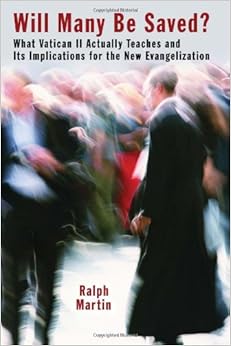
But the question has surfaced again recently, in light of Hans Urs von Balthasar's proto-Universalism, Ralph Martin's incisive response to the issue in Will Many Be Saved? and Fr. Robert Barron's response to that.  Still more recently, there has been the flap over Catholic World Report's removal of Paul Deavel's review of Ralph Martin's book, and it's long-promised symposium, which (re-)published Deavel's review along with a number of responses to it.

Then, even more recently, there was this: Did I read that right? (New Sherwood, November 28, 2013):
At one point (par 165), Pope Francis writes:
“The centrality of the kerygma calls for stressing those elements which are most needed today: it has to express God’s saving love which precedes any moral and religious obligation on our part …”
In other words, if I understand the context, the pope is saying that the evangelizer is not to appeal to moral or religious obligations, such the duty of every man to worship the one true God and obey His laws, because those obligations don’t exist for him until he encounters the Gospel. Do I misunderstand?
Astonishing.
In Lutheran circles, the issue is dealt with in terms of the relation of "Law" to "Gospel" (or "Grace"), and as you might expect, not an eyebrow would be lifted by a statement like that above.  On the other hand, in Lutheran worship services, one does not find the reading of the Decalogue preceding the Agnus Dei as one sometimes does in the Anglican liturgy.  But there is in the Lutheran Book of Worship the Confession that we are (still) "in bondage to sin and cannot free ourselves," a confession that Catholics in a state of grace might find a trifle odd.

My question, then, is whether Catholics would indeed find the above statement of Pope Francis "astonishing," as did the above writer.  How do you think Catholics should understand such a statement.

[Hat tip to JM]

Saturday, November 23, 2013

CWR's long-promised symposium on Salvation & Eternal Destiny

The underground correspondent we keep on retainer in an Atlantic seaboard city that knows how to keep its secrets, Guy Noir - Private Eye, recently called me in a fit over the "long-promised symposium" responding to the controversy over at Catholic World Report -- the controversy over Mark Brumley's pulling Paul Deavel's review of Ralph Martin's book, Will Many Be Saved? What Vatican II Actually Teaches and Its Implications for the New Evangelization (See "CWR removes Deavel's review of Ralph Martin's book," Musings, April 5, 2013, and Brumley's acknowledgement that he pulled Deavel's review HERE).

In fact, although I said that Guy Noir pitched "a fit," it might be more accurate to use the words of Fr. Z and say that he had a spittle-flecked nutty. He said to me:
"So, what happens? In answer to David Paul Deavel's piece, "Vatican II and the 'Bad News' of the Gospel" (CWR, November 21, 2003), they trot out these 'big guns'. Big Guns? Get a load of this! Here's their list of heavy artillery:"Big guns? Did I say 'big guns'? Hey, kid, are you talkin' to me? Are you talkin to ME?!

"Maybe it is just me, but most of this stuff would embarrass any flippin' Evangelical theologian worth his salt. So whazzup wit' these Papists? As for Brumley's screed, (from what I know I like him, and I love Ignatius Press for their books, but) really? His defense is weak to the point of being disingenuous. 'Don't put words in my mouth: I didn't say I want to slap you, I said, you make me feel like slapping you!' Are you talkin' to ME?!

"The take away here for me is the emphasis at VII wasn't on saying what Scripture says; it was on saying what the drafters thought Scripture should say. And as we all want to believe, No one goes to Hell unless it is the ultimate and unavoidable last resort for Hitler- and Stalin-esque cases. And Karl Rove. So we see: It is not a wonder God saves me, but rather it is a scandal anyone is damned. Pffffffft! Per Henri DeLubac and Ron Bluth, All Dogs Go to Heaven. Dare We Hope... All Are Saved? God Is A Woman? I'm OK, You're OK? We Need Genderless Cardinals? I don't know, but none of that inspires much hope. Pfffffffft!"
Like I said, a downright spittle-flecked nutty.

[Hat tip to JM]

Sunday, November 03, 2013

Blogger takes on Barron, Shea, Balthasar

I've saw some chatter in other media outlets recently about this, but hadn't posted anything here.  An article is creating a bit of a stir, however, entitled "Fr. Barron and Mark Shea and Balthasar are Wrong" over at Unam Sanctam Catholicam (November 2, 1013), so here's what was said:
Michael Voris recently came out with a video entitled simply "Fr. Barron is Wrong", challenging the popular priest-evangelist on his repeated statements in favor of the theory proposed by the late Hans Urs von Balthasar in Dare We Hope? that it is acceptable for Christian to have good hope that Hell may be empty. Voris rightly notes that Christ Himself says some souls will definitely go to Hell on numerous occasions, and that the Church's alleged "silence" on the definitive presence of anyone in Hell is not due to any support for the empty-hell theory, but due to the fact that the definitive presence of any one soul in Hell is not part of Divine Revelation and therefore outside the pale of the Church's competence to define. Therefore, the fact that the Church has never "proclaimed" anyone in Hell provides no rationale whatsoever for asserting that Hell is empty.

At this point Mark Shea jumped in and accused Voris of smearing Fr. Barron wrongly with his "poison." It is not my intention here to comment on the antagonism between Voris and Shea; I am more interested in Shea's comments that the Fr. Barron-Balthasar "Empty Hell" theory is "perfectly within the pale of orthodox speculation" and that "at the end of the day, that’s all you have: two schools of opinion–both of which are allowed by the Church." Thus, the Balthasarian "Empty Hell" theory is granted a legitimate place on the spectrum of legitimate opinions upon which Catholics can disagree in good conscience, and the traditional opinion that people do in fact go to Hell is also placed on the spectrum as another legitimate "option."

This defense of Fr. Barron and Balthasar apparently goes back to Shea's position that Tradition itself has two "irreconcilable" aspects of the question of Hell that leave the issue fraught with a certain "tension", which I contest but will leave off for the time being. 

I am more interested in Shea's comments about "two schools of opinion-both of which are allowed by the Church." This is what I object to. Balthasar's "Empty Hell" theory is absolutely not a legitimate position on the Catholic spectrum, nor is the belief that some people actually go to Hell just one of various "schools of opinion." According to Fr. Barron, Shea, and Balthasar, even though it is heresy to say that we know that Hell is empty, it is not heresy to suggest that we can have a good hope that Hell is empty. How Fr. Barron and others can assert this is beyond me, since even this proposition is condemned as a heresy by Bl. Pius IX. Let us recall the Syllabus of Errors, number 17, in which the following proposition is condemned:

"Good hope at least is to be entertained of the eternal salvation of all those who are not at all in the true Church of Christ." -- Encyclical "Quanto conficiamur," Aug. 10, 1863, etc.

This is precisely what Fr. Barron and Balthasar assert, and what Mark Shea says is "perfectly within the pale of orthodox speculation." Fr. Barron says we can at least have a good hope that everyone makes it to heaven, and yet Pius IX specifically condemns this opinion. Not only proclaiming knowledge of universal salvation, but even allowing "good hope" to so much as be "entertained" is condemned. Period.

Our Lord teaches as much when He says, "Enter ye in at the narrow gate: for wide is the gate, and broad is the way that leadeth to destruction, and many there are who go in through it." (Matt. 7:13). He does not suggest that there are many for whom it is possible that they go to destruction but do not actually go; He says "many there are who go through it." Many means many. Many does not mean "nobody."

In discussions about this topic by apologists pushing the Balthasarian opinion, I seldom see any reference to Luke 13, when Jesus is asked the question point blank, "Lord, are only few people going to be saved?" to which Christ responds, "Strive to enter by the narrow gate; for many, I say to you, shall seek to enter, and shall not be able." (v.23-24). You see that? Many shall seek to enter, and shall not be able. This is not the realm of the hypothetical.

Revelation 20:15 is cited by Voris in his video, which says, "And whosoever was not found written in the book of life, was cast into the pool of fire." Again, this is not presented as a hypothetical, but as a real vision of the situation at the Last Judgment. It could be countered that it only says that people not in the book of life get cast into the pool of fire, but does not imply that anyone was actually in this unfortunate position. We do know at least, however, that two individuals will be damned: the Beast and the False Prophet: "And the devil, who deceived them, was thrown into the lake of burning sulfur, where the beast and the false prophet had been thrown. They will be tormented day and night for ever and ever." (Rev. 20:10).

Furthermore, if nobody was actually thrown into the pool of fire, how would John have this knowledge that anyone whose name was not in the book would be thrown in the pool of fire? To put it another way: Suppose I say, "I was uptown yesterday, and I saw the police were ticketing everybody who weren't wearing seat belts." Then suppose you ask, "So how many people got ticketed?" and I say, "Oh, nobody" wouldn't you be utterly confused? The basic grammar of the statement "I saw the police were ticketing everybody who weren't wearing seat belts" implies an action completed in the past, not some hypothetical. This demonstrates the kind of contortions one has to put the Scriptures through to deny the obvious fact that some people will wind up eternally damned.

We could also cite Lumen Gentium 16, which says, "Some there are who, living and dying in this world without God, are exposed to final despair. Wherefore to promote the glory of God and procure the salvation of all of these, and mindful of the command of the Lord, "Preach the Gospel to every creature", the Church fosters the missions with care and attention."

Note that LG 16 says that "there are" some who wind up dying in final despair without God, and then goes on to cite this as one of the reasons for the urgency of the Great Commission, which is in accord with Tradition: the Gospel must be preached in order to save souls from Hell.

Fr. Barron and Shea both assert that the Empty Hell theory of Balthasar seems to be taught by Pope Benedict XVI in Spe Salvi. Having just completed a very thorough study of the late pontiff's encyclical, I dispute this fact, but that is for another post. But it is sufficient to say that, if we are reading the Magisterium in continuity with itself, Spe Salvi can simply not mean what Fr. Barron and Shea suggest, otherwise Benedict XVI contradicts Pius IX.

The "Empty Hell" theory is not one of many legitimate "schools of thought." It is a novelty, toyed with early on by Origen and then virtually abandoned until the modern era. The amount of legerdemain and re interpretive manipulation one has to do to Scripture, Magisterial teaching, history and tradition in order to breathe life into the theories of Fr. Barron and Balthasar on this question is appalling. The evidence in favor of the traditional teaching that there are people in Hell outweighs Balthasar and Fr. Barron's positions as a tidal wave overwhelms a sand castle. That this novelty is being defended by some as a legitimate position within the pale of orthodoxy is sad, especially in light of Syllabus of Errors number 17 which explicitly condemns it. It should also be noted, in case one wants to write off Voris, that very respected mainstream priests and theologians also consider Fr. Barron's opinions very troubling, such as Msgr. Charles Pope of the Archdiocese of Washington (see here) as well as Dr. Scott Hahn, who once stated that Balthasar's theory was absolutely without merit.

I'm not anti-Mark Shea. His book, By What Authority? helped bring me to the Church. But, as Voris said of Fr. Barron, Mark Shea is simply wrong here. I'm not "attacking" him, not "smearing" him, not calling him a heretic. I am just saying he is simply wrong.

Being that we are entering that period of the liturgical year when the readings direct our minds towards the Last Things, for the remainder of November all my posts will relate to this question of Hell, its reality, eternal duration, and the Church's Tradition on this important subject. Next time, I will examine the definitive presence of damned souls in Hell throughout Christian Tradition as established by the Christian sensus fidelium. 
Related:
  • Christopher Blosser, "Balthasar, Universal Salvation, and Ralph Martin's 'Will Many Be Saved?'" (Against the Grain, November 5, 2013). Excerpts:
    Martin's devastating critique of Balthasar, however, comes as more of a surprise. For even with figures as highly esteemed as Avery Dulles, Pope John Paul II, and Pope Emeritus Benedict giving a stamp of theological toleration (and/or approval) to Balthasar's hope for universal salvation -- Martin's detailed exposition of Balthasar's tendency to ignore, misquote or mischaracterize his sources (whether from the Scriptures, the Fathers or the mystics) as well as his questionable theological reasoning should give pause for all....

    Martin devotes a substantial amount of his book to exposing what appears to be, from a standpoint of academic integrity, a rather questionable treatment by Balthasar of myriad sources -- the Scriptures, the Fathers, the mystics, in support of a position that is squarely at odds with the weight of Catholic tradition. Indeed, my experience o Martin was not unlike that of reading the late Ralph McInerney's "Praeambula Fidei": Thomism And the God of the Philosophers, in which he laid bare Henri De Lubac and Etienne Gilson's (mis)interpretation of Cajetan and Aquinas....

    ... If Martin's critique of Balthasar is correct (as McInerney is in his criticism of De Lubac) -- if their scholarship on this particular subject is simply not to be trusted, and found wanting -- it casts some doubt upon the integrity of their work as a whole. Where else could they have gone wrong?

    At the very least, I do find myself reading the work of both De Lubac and Balthasar with a more cautious eye, and a more attentive ear to those sounding the alarm.

    One final piece of theological trivia worth noting -- Balthasar ends Dare we Hope with a lengthy citation from the unpublished theological speculations of Edith Stein, "“which expresses most exactly the position that I have tried to develop.” Stein asserts that while the possibility of the soul's refusal of grace and consequent damnation in principle cannot be rejected, "In reality, it can become infinitely improbable — precisely through what preparatory grace is capable of effecting in the soul." According to Stein,
    The more improbable it becomes that the soul will remain closed to it. . . . If all the impulses opposed to the spirit of light have been expelled from the soul, then any free decision against this has become infinitely improbable. Then faith in the unboundedness of divine love and grace also justifies hope for the universality of redemption, although through the possibility of resistance to grace that remains open in principle, the possibility of eternal damnation also persists.
    But here's the catch: While Balthasar identifies himself completely with this passage from the saint, Stein herself moved beyond it and revised her position in later years:
    Schenk, “Factical Damnation,” p. 150, n. 35, points out that while Balthasar makes this his final position, it was not the final position of Edith Stein herself. Schenk points out that these were passing comments in a work that she herself never published, and that in 1939 in her spiritual testament, she significantly modifies. “The possibility of some final loss appears more real and pressing than one which would seem infinitely improbable.” Hauke, “Sperare per tutti?” pp. 207-8, makes the same point as well as the additional point that not everything a saint or Doctor wrote is honored when they are recognized as saints or Doctors.