By Unam Sanctam Catholicam. Examining the traditional Catholic understanding of the ends of marriage relating to why homosexual relationships can never be the basis for any authentic marriage. The relation between fertility and marital union and why acts which directly impede or negate fertility are immoral.

Tuesday, June 13, 2017
The Ends of Marriage
By Unam Sanctam Catholicam. Examining the traditional Catholic understanding of the ends of marriage relating to why homosexual relationships can never be the basis for any authentic marriage. The relation between fertility and marital union and why acts which directly impede or negate fertility are immoral.
Homosexuality and the Bible
"Brought to you by Unam Sanctam Catholicam. Do the Bible and Christian Tradition allow for any acceptance of homosexual actions? This video answers this question with a resounding 'no', addressing common objections including: homosexuality and the Old Testament prohibition on eating shellfish, St. Paul's condemnations of homosexual deviancy, the Catholic saints on homosexuality, the biological ordering of sex to procreation and more."
Sunday, June 11, 2017
Tridentine Masses coming this week to metro Detroit and east Michigan

Tridentine Masses This Coming Week
Sunday
- Sun. 7:30 AM and 10:00 AM: Low Mass (Confessions 45 minutes before and after Masses) at St. Joseph's Church, Ray Township [NB: See note at bottom of this post about SSPX sites.]*
- Sun. 8:00 and 10:30AM Low Mass (Confessions 1/2 hour before Mass: call beforehand) at St. Ann's Church, Livonia [NB: See note at bottom of this post about SSPX sites.]*
- Sun. 9:00 AM: Low Mass at St. Joseph Oratory, Detroit
- Sun. 9:45 AM: High Mass at OCLMA/Academy of the Sacred Heart, Bloomfield Hills
- Sun.: [occasional Tridentine Masses: contact parish] at Our Lady of the Scapular Parish
- Sun. 11:00 AM: Solemn High Mass at St. Joseph Oratory, Detroit
- Sun. 12:00 Noon: High Mass at Assumption Grotto, Detroit with choir and orchestral setting by Schubert (Mass in A Flat).
- Sun. 12:00: High Mass at St. Mary Star of the Sea, Jackson
- Sat. 12:30 PM (2nd Sundays): Tridentine Mass at Old St. Patrick's, Ann Arbor
- Sun. 2:00 PM (1st Sundays only):St. Alphonsus Church, Windsor, Canada
- Sun. 2:00 PM (every Sunday except 1st): High Mass at Holy Name of Mary, Canada
- Sun. 3:00 PM (2nd and 4th Sundays): Tridentine Mass (call ahead for Confession times, 989-892-5936) at Infant of Prague, Bay City [NB: See note at bottom of this post about SSPX sites.]*
- Sun. 3:00 PM: High Mass at St. Matthew Catholic Church, Flint
Monday
- Mon. 7:30 AM: Low Mass at Assumption Grotto, Detroit
- Mon. 8:00 AM: Low Mass St. Joseph Oratory, Detroit
- Mon. 8:00 AM: Low Mass (Confessions by appointment) at St. Joseph's Church, Ray Township [NB: See note at bottom of this post about SSPX sites.]*
- Mon. 12:00 Noon: High Tridentine Mass at Assumption Grotto, Detroit
- Mon. 7:00 PM: Low Mass at St. Josaphat, Detroit
- Mon. 7:00 PM: Low Mass at Assumption Grotto, Detroit
Tuesday
- Tue. 7:00 AM Low Mass at Assumption Grotto, Detroit
- Tue. 8:00 AM: Low Mass St. Joseph Oratory, Detroit
- Tue. 8:00 AM: Low Mass (Confessions by appointment) at St. Joseph's Church, Ray Township [NB: See note at bottom of this post about SSPX sites.]*
- Tue. 7:00 PM: Low Mass at Holy Name of Mary, Canada
- Tue. 7:00 PM: Low Mass at Assumption Grotto, Detroit
Wednesday
- Wed. 7:30 AM: Low Mass at Assumption Grotto, Detroit
- Wed. 8:00 AM: Low Mass (Confessions by appointment) at St. Joseph's Church, Ray Township [NB: See note at bottom of this post about SSPX sites.]*
- Wed. 12:00 Noon: Low Mass St. Joseph Oratory, Detroit followed by Perpetual Novena to St. Joseph
- Wed. 7:00 PM: Low Mass at Assumption Grotto, Detroit
Thursday
- Thu. 7:30 AM: Low Mass at Assumption Grotto, Detroit
- Thu. 8:00 AM: Low Mass St. Joseph Oratory, Detroit
- Thu. 8:00 AM: Low Mass (Confessions Thursdays: 7:00 - 7:30 PM during Benediction) at St. Joseph's Church, Ray Township [NB: See note at bottom of this post about SSPX sites.]*
- Thu. 6:00 PM: High Mass at St. Matthew Catholic Church, Flint on June 15, followed by a procession around the church.
- Thu. 7:00 PM: Low Mass at Assumption Grotto, Detroit
Friday
- Fri. 7:30 AM: Low Mass at Assumption Grotto, Detroit
- Fri. 8:00 AM: Low Mass St. Joseph Oratory, Detroit
- Fri. 8:00 AM: Low Mass (Confessions 6:30 PM - 7:30 PM during Holy Hour) at St. Joseph's Church, Ray Township [NB: See note at bottom of this post about SSPX sites.]*
- Fri. 7:00 PM: Low Mass (usually) at Assumption Grotto, Detroit
- Fri. 7:00 PM (1st Fridays only): High Mass at Old St. Mary's, Greektown, Detroit
- Fri. 7:00 PM: Tridentine Mass at St. Joseph, Sarnia, Ontario
- Fri. 7:00 PM (after 6:00 PM Holy Hour, 1st Fridays only): High Mass at St. Joseph Oratory, Detroit
Saturday
- Sat. 7:30 AM: Low Mass at Assumption Grotto, Detroit
- 8:00 AM (1st Saturdays): Low Mass at St. Edward on the Lake, Lakeport
- Sat. 8:00 AM: Low Mass (Confessions 8:30 AM to 9:30 AM) at St. Joseph's Church, Ray Township [NB: See note at bottom of this post about SSPX sites.]*
- Sat. 8:00 AM: Low Mass (Confessions 1/2 hour before Mass: call beforehand) at St. Ann's Church, Livonia [NB: See note at bottom of this post about SSPX sites.]*
- Sat. 8:30 AM: Low Mass at Miles Christi, South Lyon, MI
- Sat. 9:00 AM (1st Saturdays): High Mass at St. Anthony, Temperance
- Sat. 9:00 AM: Low Mass and Novena to Our Lady of Perpetual Help at St. Joseph Oratory, Detroit
- Sat. 6:00 PM: Tridentine Mass at SS. Cyril & Methodius Slovak Catholic Church, Sterling Heights
* NB: The SSPX chapels among those Mass sites listed above are posted here because the Holy Father has announced that "those who during the Holy Year of Mercy approach these priests of the Fraternity of St Pius X to celebrate the Sacrament of Reconciliation shall validly and licitly receive the absolution of their sins," and subsequently extended this privilege beyond the Year of Mercy. These chapels are not listed among the approved parishes and worship sites on archdiocesan websites.

New Detroit Archdiocese coat of arms design
Do any of you have an opinion about the new Coat of Arms of the Archdiocese of Detroit? Some people seem quite upset by it, like the website that calls it an "Epic Fail," and a logo rather than a coat of arms. I think the archbishop's post-synodal letter will help the viewer to understand some of the imagery in the new design, though whether you like it or not is another question. (Here are images of the designs, old on the left, new on the right.)
Friday, June 09, 2017
Catholic Herald: Is there really an Old Mass revival?
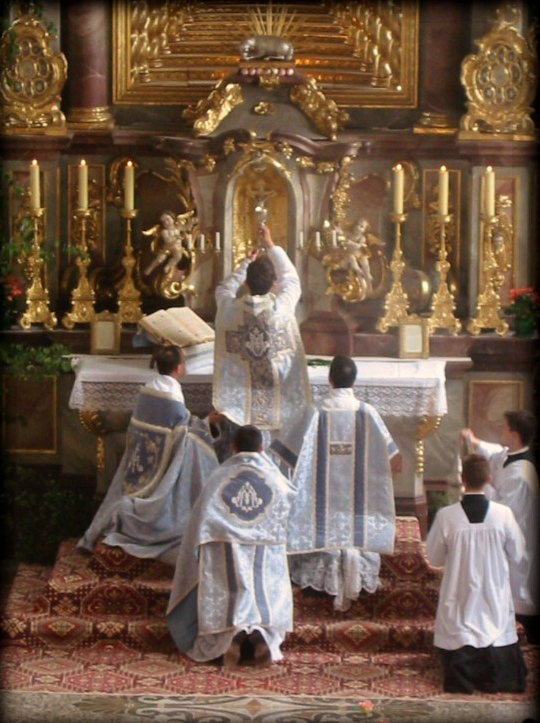
Well look for yourself and see. For starters, here is Fr. Z's analysis of the question (Fr. Z's Blog, June 9, 2017).
The epiclesis - a later addition?
Fr. Hunwicke, "The epiclesis of the Roman Rite" (Fr. Hunwicke's Mutual Enrichment, September 2, 2010) writes:
Dear old Fortescue's The Mass records the long debates of liturgists a century ago about where the epiclesis of the Roman Rite originally was before it ... er ... "dropped out". Their assumption, of course, was that the epiclesis was original to Christian liturgy and that the Oriental rites which preserve it were more 'primitive' than the Roman Rite. Now, happily, we know better. We see the Oriental epiclesis as a comparatively late fad in the evolving liturgical tradition. Rather than seeking traces of a lost epiclesis in the Canon Romanus, we realise that the prayer Supplices te rogamus, in which we pray that our offerings be taken to the Heavenly Altar, represents an earlier and lovelier expression of the linkage between our offering and the eternal oblation of the Eternal Son at the Heavenly Altar. Patrimony liturgists such as E C Ratcliffe played a large role here, not to mention Dom Gregory. Read more >>In "Consecration in the Roman Mass 2" (Fr. Hunwicke's Mutual Enrichment, March 15, 2015), Fr. Hunwicke adds:
Why this Gadarene preoccupation, in the 1960s, with epicleses asking the Spirit to be sent to change Bread into Body? The answer is embarrassingly simple. Pretty well all rites except the Roman had an epiclesis. Therefore it must be 'Primitive'. Therefore it was desireable. The alternative possibility, that Rome lacked an epiclesis because it was older than those other rites, occurred to very few. So, for a hundred years or more, the question had been (not why did the other rites add an epiclesis, but) Whatever Happened to the Roman Epiclesis ... deemed to have existed originally but, for some mysterious reason, to have gone missing. Readers who still have on their shelves The Mass by Adrian Fortescue can still find page after page describing the ingenious pursuits, by entire generations of clever and erudite men, of this particular invisible (well, to be frank, mythical) fox. The conviction was bolstered by an inclination to believe that all the existing rites of Christendom must have descended from an Original Liturgy which, at least in its dominant features, was fairly uniform, and could therefore, in principle, be reconstructed from a comparison of existing liturgies. This assumption, as the pendulum swings, is currently highly unfashionable; an Anglican liturgist called Paul Bradshaw has spent most of his life rebutting it. Read more >>[Hat tip to L.S.]
Tuesday, June 06, 2017
Think you know anything about the Gift of Tongues?
Take Charles A. Sullivan's two quizzes, and think again!
Monday, June 05, 2017
Fr. Rutler: Pentecost was not an occasion for 'Enthusiasm'

Fr. George W. Rutler's article, "Pentecost Was Not An Occasion for 'Enthusiasm'" (Crisis Magazine, June 1, 2017), has all the appearance of being timed in anticipation of the International Catholic Charismatic Renewal's celebration of it's Golden Jubilee on Pentecost Sunday.
 After meandering through a number of typically learned and eloquent distractions, the irrepressible Fr. Rutler comes round to his thesis: how the Catholic Charismatic movement, like the Montanist enthusiasms of the ancient Church, is a heretical distortion. While "not unsympathetic toward the noble integrity of John Wesley," he writes, Monsignor Ronald Knox, in his masterwork entitled Enthusiasm, "holds up the spiritist movements from the second century Montanists to the latter day Quakers, Jansenists, and Quietists as examples of how people go to extremes to confuse themselves emotionally with the Holy Spirit."
Turning his attention to Phrygia of Asia Minor in what is now Turkey during the second century, Rutler writes:
A convert priest named Montanus stirred up a lot of excitement when he confused himself with the Holy Spirit and proclaimed various “prophecies” while in a trance like a sort of divine ventriloquist. In the manner of a typical fanatic so defined, he was confident that God would agree with him if only God had all the facts. In a languid and dissolute period, the local churches already having become formalistic and arid (contrary to romantic depictions of the uniform zeal of all early Christians, and not unlike the motivation of John Wesley to stir up the dormant Church of England), the ardor of Montanus attracted many as far as North African and Rome itself, not all of whom were innocent of neurosis. Even the formidable mind of Tertullian welcomed it. Sensational outbursts of emotion were thought to be divinely inspired, and the formal clerical structure of the Church was caricatured as the sort of rigidity that quenches the spirit. Avowing that prophecy did not end with the last apostles, new messages were pronounced, false speaking in tongues pretending to be actual languages was encouraged, and women like Priscilla and Maximilla left their husbands and decided that they could be priestesses and prophetesses.More to it, of course, but that seems to be intended nub of something like a warning shot across the bow of the unbridled ubiquitous ebullience of the present season.
In the twentieth century, the Montanist heresy sprung up again. The Pentecostal sects, and even many Catholics were attracted to “re-awakenings” that gave the impression that the Paraclete promised by Christ who never lied had finally come awake having slumbered pretty much since the early days of the Church. While its extreme forms were bizarre, such as dancing in churches and uncontrolled laughter and barking like dogs while rolling on the floor, any quest for novelty quickly grows bored, for nothing goes out of fashion so fast as the latest fashion.
... Heresies are fads. The estimable Servant of God Father John Hardon, whose talks would never be called ecstatic, bluntly said that the modern Charismatics are Montanists. It is true that the Charismatic movement in the Catholic Church wisely was blessed insofar as it not denigrate from or add to authentic dogma. But in the second century the pope Eleutherius was inclined to condone the Montanists too, until the anti-Tertullian theologian Praxeas explained its problems.
Is Pope Francis a 'Postmodernist'?
 I'm not sure the discourse of the Holy Father rises (or 'sinks') to the level of academic abstraction sufficient to qualify him as a 'Postmodernist,' but when you read some of the seemingly hyperbolic praise he heaps on the
 likes of nihilistic Postmodern writers like Michel de Certeau (right), you can see how someone might come up with an article like that of the pro-life activist, Fred Martinez, "Pope Francis and Nihilism" (Catholic Monitor, Sunday, May 28, 2017).
[Hat tip to J. Likoudis]
Sunday, June 04, 2017
Tridentine Community News - More new churches in a traditional style: Our Lady of Good Voyage, Boston; Christendom College Chapel; Restoration of Boston's Cathedral of the Holy Cross; Penecost Octave at Old St. Patrick; TLM schedule

"I will go in unto the Altar of God
To God, Who giveth joy to my youth"
Tridentine Community News by Alex Begin (June 4, 2017):

June 4, 2017 - Pentecost Sunday
More New Churches in a Traditional Style: Our Lady of Good Voyage, Boston
Continuing the theme from last week’s column, we bring to your attention two more churches newly built in a traditional style:
The Archdiocese of Boston is more recently known for closing churches, but in April it opened a new Shrine of Our Lady of Good Voyage to take the place of an older chapel. Designed by Cram & Ferguson, a Massachusetts church architecture firm featured on Extraordinary Faith whose founder designed St. Mary of Redford and Hamtramck’s St. Florian Church, the chapel is traditionally arranged and boasts a relocated and restored High Altar. [Photo by WBUR-FM]
Christendom College Chapel
Many of our readers know Christendom College in Front Royal, Virginia to be one of the most impressive orthodox Catholic institutions of higher learning around. In March the college announced that they would be offering Tridentine Mass exclusively on one Sunday per month, to ensure that all students receive exposure to it. The school already offered the Extraordinary Form on most weekdays and every Sunday (non-exclusively). Now the college is embarking on a plan to construct Christ the King Chapel, a liturgically fitting locale for the Latin Mass, complete with ornate High Altar and Communion Rail.
Restoration of Boston’s Cathedral of the Holy Cross
New construction isn’t the only good news in Boston: The Cathedral of the Holy Cross is being un-wreckovated: As part of a comprehensive restoration of the church, the High Altar, formerly reduced to non-functional decorative use, is being restored, a Communion Rail from the closed Holy Trinity Church is being installed, Side Altars are being restored [pictured], the sanctuary and statuary are being put back to a more traditional arrangement, and the carpet is being removed to improve the acoustics. A Latin Mass community currently using the traditional but cozy lower level chapel expects to increase the frequency of holding Masses in the soon-to-be-more-hospitable-to-the-Tridentine Mass upper church.
Pentecost Octave at Old St. Patrick
Once again this year, Old St. Patrick Church in Ann Arbor is offering Tridentine Masses daily for the Octave of Pentecost. All will be High Masses, with the possible exception of Saturday, June 10. The schedule is:Tridentine Masses This Coming WeekMonday, June 5 – 7:00 PM
Tuesday, June 6 – 7:00 PM
Wednesday, June 7 – 8:30 AM
Thursday, June 8 – 8:30 AM
Friday, June 9 – 8:30 AM
Saturday, June 10 – TBD
Sunday, June 11 – 12:30 PM
- Mon. 06/05 7:00 PM: Low Mass at St. Josaphat (Pentecost Monday)
- Tue. 06/06 7:00 PM: High Mass at Holy Name of Mary, Windsor (Pentecost Tuesday)
- Sat. 06/10 8:30 AM: Low Mass at Miles Christi (Pentecost Saturday)


Saturday, June 03, 2017
“No Enemies to the Left” [pas d’ennemis à gauche] — Still!
By Kenneth D. Whitehead
In July-August 2001, Kenneth D. Whitehead, R.I.P., a former U.S. Assistant Secretary of Education, was a writer living in Falls Church, Virginia, and a Contributing Editor of the NOR. His latest book was One, Holy, Catholic, and Apostolic: The Early Church Was the Catholic Church (Ignatius, 2000).
 Ed. Note: Throughout 2017, in commemoration of our fortieth year of publication, we are featuring one article per issue from the NOR’s past. This article originally appeared in our July-August 2001 issue (volume LXVIII, number 7) and is presented here unabridged. Copyright © 2001.
Ideological slogans might not always seem to be very important. Sometimes, however, they can reveal basic and persistent mindsets. This is the case with the slogan that originated in the French Revolution, “No enemies to the Left.” Students of European politics will recognize that this slogan has persisted, and that the ideas behind it still apply to today’s politics.
In his 1928 classic, The French Revolution: A Monarchist History, Pierre Gaxotte describes the inexorable logic of revolutionary “progress”:
Continuing agitation in the country at large, but especially in Paris, kept the streets, the press, the factions, and the clubs in constant ferment. What was taken to be public opinion marched relentlessly forward. Yesterday’s impossible, unthinkable measure became today’s “idea whose time has come”; yesterday’s progressive Assembly member became today’s reactionary, if not traitor to the cause. The revolutionary mechanism ground mercilessly on.
Gaxotte correctly identifies one of the reasons why the more radical revolutionary elements were repeatedly able to displace the successively outmoded “progressives”: In a revolutionary climate, where events are thought to be leading ineluctably to human “liberation,” a “better world,” and the perfecting of the human condition, the more radical forces not only exhibit more consistency and determination toward attaining these ends, they also come to occupy the perceived moral high ground — they are the ones who appear truly dedicated to the cause, and thereby usually gain at least short-term popular support. Meanwhile, those who are more moderate and potentially more reasonable become awed or intimidated by the zeal of the zealots and tend to yield to them.
If, by definition, the Revolution is going to usher in freedom, eliminate oppression and injustice, and create a better world, then those who are more committed, energetic, and intolerant of any kind of compromise with injustice and oppression acquire a considerable psychological and moral advantage — while those who are or have become more lukewarm about the cause, or who, at the very least, have become concerned about their jobs or careers, can no longer effectively oppose the zealots and the true believers.
It is true that power relationships and the abilities and opportunities of individuals, as well as a host of other factors, play important roles in how a particular revolutionary situation develops; but if the whole aim of the Revolution is to clear away the obstacles on the road to human liberation, progress, and a better world, then those least deterred by moral or other considerations in the face of the obstacles encountered will be out in front of others who might have second thoughts, or even scruples, or who are otherwise deterred by various obstacles.
These are among the reasons why, in a revolutionary situation, there are “no enemies to the Left.” For it is the Left, after all, that by definition represents where the Revolution is supposed to go.
In July-August 2001, Kenneth D. Whitehead, R.I.P., a former U.S. Assistant Secretary of Education, was a writer living in Falls Church, Virginia, and a Contributing Editor of the NOR. His latest book was One, Holy, Catholic, and Apostolic: The Early Church Was the Catholic Church (Ignatius, 2000).
Ed. Note: Throughout 2017, in commemoration of our fortieth year of publication, we are featuring one article per issue from the NOR’s past. This article originally appeared in our July-August 2001 issue (volume LXVIII, number 7) and is presented here unabridged. Copyright © 2001.
Ideological slogans might not always seem to be very important. Sometimes, however, they can reveal basic and persistent mindsets. This is the case with the slogan that originated in the French Revolution, “No enemies to the Left.” Students of European politics will recognize that this slogan has persisted, and that the ideas behind it still apply to today’s politics.
In his 1928 classic, The French Revolution: A Monarchist History, Pierre Gaxotte describes the inexorable logic of revolutionary “progress”:
The revolutionary period was characterized by allowing successive avant-garde parties or factions to take political power while riots and disturbances in the streets dictated the actual government policies that were adopted. Against the royal court and the privileged classes, the members of the National Assembly appealed to the turbulent sectors of the capital. Even while privately deploring the excesses committed from July 13 on, they closed their eyes to them because they wanted to hold in reserve the power of the clubs and of the streets. Thus they became prisoners of the alliance they had made; they became prisoners of the formula “no enemies to the left” (pas d’ennemis à gauche).The relative moderates initially responsible for getting the Estates General convoked in order to deal with the financial crisis of the French monarchy were very soon shunted aside by the more radical elements, who quickly resorted to extra-legal means to convert the Estates General into a National Assembly. These revolutionaries in the Assembly soon fell from power, however, giving way to yet more radical elements. Each successive party or faction that came to power faced the same ongoing, volatile revolutionary situation.
Continuing agitation in the country at large, but especially in Paris, kept the streets, the press, the factions, and the clubs in constant ferment. What was taken to be public opinion marched relentlessly forward. Yesterday’s impossible, unthinkable measure became today’s “idea whose time has come”; yesterday’s progressive Assembly member became today’s reactionary, if not traitor to the cause. The revolutionary mechanism ground mercilessly on.
Gaxotte correctly identifies one of the reasons why the more radical revolutionary elements were repeatedly able to displace the successively outmoded “progressives”: In a revolutionary climate, where events are thought to be leading ineluctably to human “liberation,” a “better world,” and the perfecting of the human condition, the more radical forces not only exhibit more consistency and determination toward attaining these ends, they also come to occupy the perceived moral high ground — they are the ones who appear truly dedicated to the cause, and thereby usually gain at least short-term popular support. Meanwhile, those who are more moderate and potentially more reasonable become awed or intimidated by the zeal of the zealots and tend to yield to them.
If, by definition, the Revolution is going to usher in freedom, eliminate oppression and injustice, and create a better world, then those who are more committed, energetic, and intolerant of any kind of compromise with injustice and oppression acquire a considerable psychological and moral advantage — while those who are or have become more lukewarm about the cause, or who, at the very least, have become concerned about their jobs or careers, can no longer effectively oppose the zealots and the true believers.
It is true that power relationships and the abilities and opportunities of individuals, as well as a host of other factors, play important roles in how a particular revolutionary situation develops; but if the whole aim of the Revolution is to clear away the obstacles on the road to human liberation, progress, and a better world, then those least deterred by moral or other considerations in the face of the obstacles encountered will be out in front of others who might have second thoughts, or even scruples, or who are otherwise deterred by various obstacles.
These are among the reasons why, in a revolutionary situation, there are “no enemies to the Left.” For it is the Left, after all, that by definition represents where the Revolution is supposed to go.
Friday, June 02, 2017
"Pope Francis never ceases to amaze"
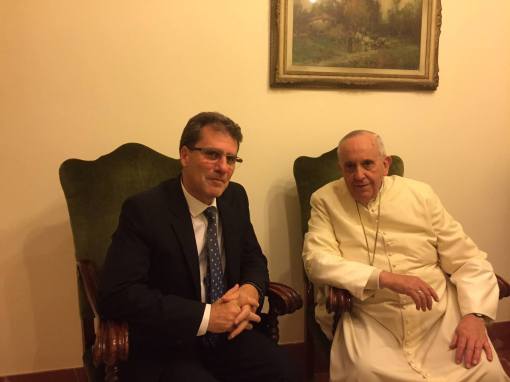
Alessandro Zangrando, Culture and Arts editor for the Venice desk of the national newspaper Corriere della Sera and Rome Correspondent for The Latin Mass magazine, writes:
Pope Francis never ceases to amaze. For readers in Argentina he has created a new weekly edition of L'Osservatore Romano. As director he has named Marcelo Figueroa, the Argentine Protestant pastor of the Presbyterian Church and director for twenty-five years of the Argentine Bible Society. Figueroa is a longtime friend of Bergoglio, who accompanied him on the famous trip to Lund, Sweden, for the celebration of the five hundredth anniversary of the Lutheran Reformation. [Source: The Latin Mass: The Journal of Catholic Culture and Tradition, Vol. 26, No. 1 (Winter/Spring 2017), p. 5]
"Pope Francis, pray for us"???

Commenting on Confitebor's observations about the shameless papalotry represented by this pewter cross in a Catholic religious store -- a cross bearing the image of the Holy Father and the words, "Pope Francis, pray for us" -- Guy Noir - Private Eye, now our mid-Atlantic Piedmont correspondent, declared:
If every recent pope ends up canonized, what should we expect?
The cult of the saints becomes "cult like," encouraging veneration of people that ought to go to God's Son.
I used to think canonizations were exercises in papal infallibility. That confidence has been completely eroded. The modern Church has pushed its credibility on this score past the breaking point, with John Paul II himself, sadly, leading the way via removing the Devil's Advocate. Another example of how the Church's leaders do not seem overly keen to protect its enduring credibility in an age of disbelief. I just don't get it. Sanctity should not need overly aggressive PR hacks.
Prayer request
Please kindly pray for Hannah Cabrini, our daughter, who is scheduled to be confirmed at the Cathedral this Sunday, June 4, at the Mass of the Holy Spirit. She has chosen the Confirmation name of "Perpetua."
Tridentine Masses coming the week of June 4 to metro Detroit and east Michigan
Tridentine Masses This Coming Week
Sunday
- Sun. 7:30 AM and 10:00 AM: Low Mass (Confessions 45 minutes before and after Masses) at St. Joseph's Church, Ray Township [NB: See note at bottom of this post about SSPX sites.]*
- Sun. 8:00 and 10:30AM Low Mass (Confessions 1/2 hour before Mass: call beforehand) at St. Ann's Church, Livonia [NB: See note at bottom of this post about SSPX sites.]*
- Sun. 9:00 AM: Low Mass at St. Joseph Oratory, Detroit
- Sun. 9:30 AM: Orchestral High Mass at Assumption Grotto, Detroit Schubert's Mass in A flat, and Schubert's Tantum Ergo
- Sun. 6/4: NO Mass at OCLMA/Academy of the Sacred Heart, Bloomfield Hills [The Latin Mass will resume as usual at 9:45 AM next Sunday, June 11.]
- Sun. 6/4 12:00 Noon: High Mass at Our Lady of the Scapular Parish
- Sun. 11:00 AM: Solemn High Mass at St. Joseph Oratory, Detroit
- Sun. 12:00: High Mass at St. Mary Star of the Sea, Jackson
- Sun. 12:30 PM (and every day throughout the Octave of Pentecost: see below): Tridentine Mass at Old St. Patrick's, Ann Arbor
Sunday, June 4 12:30 PM Fr. Richard Lobert - Sung Mass
Monday, June 5 7:00 PM Fr. David Bechill - Sung Mass
Tuesday, June 6 7:00 PM Fr. Paul de Soza, Sung Mass
Wednesday, June 7 8:30 AM Fr. Tim Nelson - Sung Mass
Thursday, June 8 8:30 AM Fr. Charles White - Sung Mass
Friday, June 9 8:30 AM Fr. Charles White - Sung Mass
Saturday, June 10 8:30 AM Fr. Brian Hurley - Sung Mass
Sunday, June 11 12:30PM Fr. Richard Lobert - Sung Mass - Sun. 2:00 PM (1st Sundays only):St. Alphonsus Church, Windsor, Canada
- Sun. 2:00 PM (every Sunday except 1st): High Mass at Holy Name of Mary, Canada
- Sun. 3:00 PM (2nd and 4th Sundays): Tridentine Mass (call ahead for Confession times, 989-892-5936) at Infant of Prague, Bay City [NB: See note at bottom of this post about SSPX sites.]*
- Sun. 3:00 PM: High Mass St. Matthew Catholic Church, Flint
Monday
- Mon. 7:30 AM: Low Mass at Assumption Grotto, Detroit
- Mon. 8:00 AM: Low Mass St. Joseph Oratory, Detroit
- Mon. 8:00 AM: Low Mass (Confessions by appointment) at St. Joseph's Church, Ray Township [NB: See note at bottom of this post about SSPX sites.]*
- Mon. 12:00 Noon: High Tridentine Mass at Assumption Grotto, Detroit
- Mon. 7:00 PM: Low Mass at St. Josaphat, Detroit
- Mon. 7:00 PM: Low Mass at Assumption Grotto, Detroit
Tuesday
- Tue. 7:00 AM Low Mass at Assumption Grotto, Detroit
- Tue. 8:00 AM: Low Mass St. Joseph Oratory, Detroit
- Tue. 8:00 AM: Low Mass (Confessions by appointment) at St. Joseph's Church, Ray Township [NB: See note at bottom of this post about SSPX sites.]*
- Tue. 7:00 PM: Low Mass at Holy Name of Mary, Canada
- Tue. 7:00 PM: Low Mass at Assumption Grotto, Detroit
Wednesday
- Wed. 7:30 AM: Low Mass at Assumption Grotto, Detroit
- Wed. 8:00 AM: Low Mass (Confessions by appointment) at St. Joseph's Church, Ray Township [NB: See note at bottom of this post about SSPX sites.]*
- Wed. 12:00 Noon: Low Mass St. Joseph Oratory, Detroit followed by Perpetual Novena to St. Joseph
- Wed. 7:00 PM: Low Mass at Assumption Grotto, Detroit
Thursday
- Thu. 7:30 AM: Low Mass at Assumption Grotto, Detroit
- Thu. 8:00 AM: Low Mass St. Joseph Oratory, Detroit
- Thu. 8:00 AM: Low Mass (Confessions Thursdays: 7:00 - 7:30 PM during Benediction) at St. Joseph's Church, Ray Township [NB: See note at bottom of this post about SSPX sites.]*
- Thu. 7:00 PM: Low Mass at Assumption Grotto, Detroit
Friday
- Fri. 7:30 AM: Low Mass at Assumption Grotto, Detroit
- Fri. 8:00 AM: Low Mass St. Joseph Oratory, Detroit
- Fri. 8:00 AM: Low Mass (Confessions 6:30 PM - 7:30 PM during Holy Hour) at St. Joseph's Church, Ray Township [NB: See note at bottom of this post about SSPX sites.]*
- Fri. 7:00 PM: Low Mass (usually) at Assumption Grotto, Detroit
- Fri. 7:00 PM (1st Fridays only): High Mass at Old St. Mary's, Greektown, Detroit
- Fri. 7:00 PM: Tridentine Mass at St. Joseph, Sarnia, Ontario
- Fri. 7:00 PM (after 6:00 PM Holy Hour, 1st Fridays only): High Mass at St. Joseph Oratory, Detroit
Saturday
- Sat. 7:30 AM: Low Mass at Assumption Grotto, Detroit
- 8:00 AM (1st Saturdays): Low Mass at St. Edward on the Lake, Lakeport
- Sat. 8:00 AM: Low Mass (Confessions 8:30 AM to 9:30 AM) at St. Joseph's Church, Ray Township [NB: See note at bottom of this post about SSPX sites.]*
- Sat. 8:00 AM: Low Mass (Confessions 1/2 hour before Mass: call beforehand) at St. Ann's Church, Livonia [NB: See note at bottom of this post about SSPX sites.]*
- Sat. 8:30 AM: Low Mass at Miles Christi, South Lyon, MI
- Sat. 9:00 AM (1st Saturdays): High Mass at St. Anthony, Temperance
- Sat. 9:00 AM: Low Mass and Novena to Our Lady of Perpetual Help at St. Joseph Oratory, Detroit
- Sat. 6:00 PM: Tridentine Mass at SS. Cyril & Methodius Slovak Catholic Church, Sterling Heights
* NB: The SSPX chapels among those Mass sites listed above are posted here because the Holy Father has announced that "those who during the Holy Year of Mercy approach these priests of the Fraternity of St Pius X to celebrate the Sacrament of Reconciliation shall validly and licitly receive the absolution of their sins," and subsequently extended this privilege beyond the Year of Mercy. These chapels are not listed among the approved parishes and worship sites on archdiocesan websites.
Subscribe to:
Posts (Atom)