Ecclésia Supplet[Comments? Please e-mail tridnews@stjosaphatchurch.org. Previous columns are available at www.stjosaphatchurch.org. This edition of Tridentine Community News, with minor editions, is from the St. Josaphat bulletin insert for May 31, 2009. Hat tip to A.B.]In an earlier column, we discussed the difference between validity of a Sacrament and licitness. To be valid, a Sacrament must have proper matter (in this case, unleavened bread) and form (the words of consecration as specified by the Church). Using the improper words for the Consecration of the Mass renders the Sacrament of the Eucharist invalid, for example.
A Sacrament is licit when it is celebrated under the structures that Holy Mother Church defines. Priests of the SSPX, for example, celebrate valid but illicit Masses, because they are doing so without the approval of the competent authority, who in most cases is the local diocesan bishop.
Jurisdiction is a correlated concept: Certain actions of a priest are only valid if the priest has jurisdiction to perform that activity. Notably, a priest may only hear Confessions in a diocese where he has been given faculties, or permission, to do so. Visiting priests are supposed to request faculties from the diocesan offices if they wish to hear Confessions in that diocese. The form and matter of the Sacrament can be proper, but the Sacrament could still be invalid. The lack of jurisdiction is a case where being illicit also makes a Sacrament invalid.
By way of analogy, a policeman from Detroit would not be able to pull over and ticket a speeder in Windsor. While it might seem a sensible thing for him to do, he does not have the authority to perform that action. A properly filled-out City of Detroit ticket form carries no weight in Windsor.
After our recent series of columns on De Deféctibus, the section of the Extraordinary Form Roman Missal that describes potential flaws in the celebration of Holy Mass and what should be done when they occur, some questions were raised. Shouldn’t the Church be more charitable in assuring validity of the Sacraments? Do the faithful really need to be worried about whether they are actually receiving the Sacraments they think they are getting? Specifically, does the notion of Ecclésia Supplet apply?
Ecclésia Supplet (“The Church Supplies”) is a principle of Canon Law which means that in cases of absent or questionable jurisdiction, Holy Mother Church supplies the jurisdiction in cases of need. This is a charitable concept with many practical advantages, especially in our era when there are insufficient priests to minister to the faithful. Consider this example: A priest is leading a pilgrimage to a rural part of Italy. One of the members of the tour group wishes to make a Confession. None of the local priests speaks English. It is reasonable to think that the pilgrimage-leading priest could validly hear such a Confession because of need. The Church needs order, yes, but She does not want such order to come at the expense of the salvation of souls in cases of need.
An important distinction is made by Sacred Heart Seminary Professor of Canon Law Dr. Ed Peters in his February 22, 2007 posting on www.canonlaw.info: The principle of Ecclésia Supplet is restricted to matters of jurisdiction. It does not apply to matters of Sacramental Form.
Deus Próvidet
Dr. Peters explains that a different but allied concept, Deus Próvidet (“God provides”), applies in certain circumstances. As an example, if a celebrant accidentally neglects to place a ciborium on the corporal prior to praying the words of consecration, it is only logical to believe that God makes up for this unintentional failure and still makes the consecration valid. At the same time, Peters argues that God expects something of his ministers and of the faithful. A priest cannot habitually do, or fail to do, something that results in a Sacrament being invalid.
Likewise, members of the faithful who are aware that a priest did something invalid, such as failing to speak the specified words of absolution in Confession, must act based upon this knowledge. One must either ask the priest to say the approved words of absolution, or one must go to another confessor and reconfess one’s sins. As mature Catholics, we are expected to be able to distinguish between a one-time mistake and a bad habit. As long as priests are available, we do have a right to receive Sacraments that are valid.
As with so much of our Catholic Faith, the bigger picture concept is logical and reasonable: Was it an accident? Was the recipient of the Sacrament unaware of the error? Then God understands. But God expects more of those to whom He has given greater knowledge. Those individuals need to take responsibility for celebrating and receiving valid Sacraments. And this is where the beauty of De Deféctibus lies: It is an instructional piece whose goal is simply to form the priest better, so that the faithful have less likelihood of receiving an invalidly consecrated Eucharist.

Sunday, May 31, 2009
Valid sacraments & canon law: with a little help from Dr. Ed Peters
Tridentine Community News (May 31, 2009):
Preparing for martyrdom
Guillotined by the Nazis on August 9, 1943, Franz Jägerstätter was beatified by Pope Benedict XVI on October 26, 2007. Denver Archbishop Charles J. Chaput uses the story of Jägerstätter as the basis for his article, "New Life in Christ: What it Looks Like, What it Demands" (First Things, May 11, 2009). My purpose here is not to relate the story of Blessed Franz Jägerstätter, which you owe to yourself to read sometime if you don't know it. All I want is to offer you a few excerpts I liked from Abp. Chaput's article:
I want to quote something Franz wrote in a letter to his godson. He wrote: “I can say from my own experience how painful life often is when one lives as a halfway Christian. It is more like vegetating than living.” Believers today are relentlessly tempted to accept a halfway Christianity, to lead a “double life” -- to be one person when we’re in church or at prayer and somebody different when we’re with our friends or family, or at work, or when we talk about politics.[Hat tip to E.E.]
... Jesus didn’t come down from heaven to tell us to go to church on Sunday. He didn’t die on the cross and rise from the dead so that we’d pray more at home and be a little kinder to our next-door neighbors. The one thing even non-believers can see is that the Gospels aren’t compromise documents. Jesus wants all of us. And not just on Sundays. He wants us to love God with all our heart, all our soul, all our strength, and all our mind. He wants us to love our neighbor as ourselves. In other words, with a love that’s total.
... Love the Church; love her as your mother and teacher. Help to build her up, to purify her life and work. We all get angry when we see human weakness and sin in the Church. But we need to remember always that the Church is much, much more than the sum of her human parts.
... And this is crucial: Know and revere what the Church teaches. What the Church teaches is what Christ wants you and everyone else to know¯for our own good and for our salvation. Know what the Church teaches so you can live those teachings and share those teachings with others.
The leaders of today’s secularized societies like to fancy themselves as true humanists and humanitarians. But these same societies justify killing millions of babies in the womb and dismembering embryos in the laboratory. We dispatch the handicapped and the elderly and call it “death with dignity.” ...
Only the Church stands up against these inhuman trends in our societies. It’s your mission, as lay men and lay women, to ensure that Christ’s teaching is preached and explained and defended at every level of our society¯in politics, in the workplace, in the culture.
... Blessed Franz wrote beautiful letters to his wife from prison. In one of them he talked about the great martyrs of the Church. He wrote: “If we hope to reach our goal some day, then we, too, must become heroes of the faith...."
Mr. Obama: our nation's second Stephen Douglas
"What emerges from this episode, so effectively told in The Audacity of Hope, is that its author really, really does not like being compared to Stephen Douglas on the issue of abortion, even if the analogy is entirely apt—once it is granted that abortion is first and above all a civil-rights issue," writes Edward T. Oakes, S.J., in "Can Barack Obama Be Converted on Abortion?" (First Things, May 5, 2009). "And something about that civil rights argument gnaws at Mr. Obama, as he describes here:
[Hat tip to E.E.]
What they [my supporters] didn’t understand was that I could not help but take Mr. [Alan] Keyes seriously. For he claimed to speak for my religion—and although I might not like what came out of his mouth, I had to admit that some of his views had many adherents within the Christian church.Is this a guilty conscience? If so, does Mr. Obama have one still? God knows. One thing for sure: even if Alan Keyes had zero chance of defeating Obama in the Illinois senate race of 2004, he totally succeeded in getting under his skin. We've also learned something important here: if any argument stands a chance of getting under the skin of Obama and those in his constituency, we now know what kind of argument that is.
... Alan Keyes presented the essential vision of the religious right in this country, shorn of all caveat, compromise, or apology. Within its own terms, it was entirely coherent, and provided Mr. Keyes with the certainty and fluency of an Old Testament prophet. And while I found it simple enough to dispose of his constitutional and policy arguments, his readings of Scripture put me on the defensive. Mr. Obama says he’s a Christian, Mr. Keyes would say, and yet he supports a lifestyle that the Bible calls an abomination. Mr. Obama says he’s a Christian, but he supports the destruction of innocent and sacred life. What could I say? That a literal reading of the Bible was folly? That Mr. Keyes, a Roman Catholic, should disregard the pope’s teachings? Unwilling to go there, I answered with the usual liberal response in such debates—that we live in a pluralistic society, that I can’t impose my religious views on another, that I was running to be a US senator from Illinois and not the minister of Illinois. But even as I answered, I was mindful of Mr. Keyes’s implicit accusation—that I remained steeped in doubt, that my faith was adulterated, that I was not a true Christian.
[Hat tip to E.E.]
Saturday, May 30, 2009
Great debate (errr ... 'discussion'): R. George v. D. Kmiec
A very interesting debate (termed a "discussion") between Robbie George and Doug Kmiec was hosted by Catholic University of America on May 29, on the topic: "The Obama Administration and the Sanctity of Human Life: Is there a common ground on life issue? What is the right response by ‘Pro-Life’ Citizens?"
This is a very interesting video through C-SPAN (length 1:20).
Of related interest
This is a very interesting video through C-SPAN (length 1:20).
Of related interest
- George Neumayr, "Ex Corde Ecclesiae and the Notre Dame affair" (Catholic World Report, May 2009): "Will they let this charade continue? Or will they finally enforce Ex Corde, not just at Notre Dame but at all Catholic colleges? Divided against themselves they cannot stand."
L'Osservatore Romano: a diagnosis
Following up on "L'Osservatore Romano Editor: 'Obama not pro-abortion" (Musings, May 22), an excellent diagnosis of the malady by Michael Novak, "All the Confusion Fit to Print" (NRO, May 26, 2009).
[Hat tip to T.K.]
[Hat tip to T.K.]
Friday, May 29, 2009
Point-counter-point on Christopher West: David Schindler v. Janet Smith
- David L. Schindler, "Christopher West's Theology of the Body" (Headline Bistro, May 2009)
- "Dr. Janet Smith calls Schindler attack 'puzzling' (Defense of Christopher West)” (California Catholic Daily, May 29, 2009)
Thursday, May 28, 2009
Sex and Catholic religious culture: Is there a problem?
Peter Kreeft once noted that our post-modern culture, far from being a-moral, is in fact highly moralistic about everything from smoking and sexism, to recycling and politically correct language. Our culture, he said, is not decidedly a-moral about anything, he said, except for "pelvic issues" -- that is, anything related in some way to sex.
Hard on the heels of the recent flap over Christopher West's ABC Nightline discussion of John Paul II's theology of the body as representing the "sexiest" religion in the world ("A theology of the body too far?" Musings, May 11, 2009) came news of "Ex-Archbishop Weakland coming out of the closet" (Musings, May 17, 2009). Given this recrudescence of pelvic issues in recent news, perhaps the theme warrants a more deliberate revisiting.
This, of course, is a huge subject, just as huge as the pelvic obsessions of our culture, which have led to the proliferation of pornography, legalized contraception (Griswold v. Connecticut, 1965), widespread recreational sex, a bull market in sex-enhancement drugs, prostitution, sex toys, sex bars, sex slaves, rampant adultery, runaway divorce, legalized abortion (Roe vs. Wade, 1973), broken homes, single-parent families, skyrocketing numbers of welfare moms, child abuse, the mainstreaming of homosexualism, same-sex 'marriage' and sodomy, and the greater part of those social and moral toxins that afflict us in our fatally diseased Culture of Death.
The issue of sex has been addressed thoroughly in a positive light by the late John Paul II in his Theology of the Body -- now famous, thanks to the publicity of Christopher West. Yet the issue continues to present itself as a problem for the Church in multiple ways -- not only through quotidian pastoral questions about personal sexual sins, contraception, autoeroticism, homosexual acts, pre-marital cohabitation, divorce, annulments, remarriage, women's ordination, and the like; but through questions raised by the legacy of the huge sex-abuse scandal involving the priestly molestation of (mostly) young boys publicized by the Boston Globe in 2002, as well as proximate questions raised by the continuing debate over priestly celibacy, recently fueled by comments by former New York Archbishop Cardinal Edward M. Egan (March 12, 2009) and his successor, Archbishop Timothy Dolan (May 16, 2009).
This last issue of priestly celibacy is often perceived, it seems, whether rightly or wrongly, as a point of vulnerability in the current discipline of the Church, as well as in Catholic tradition, and a means by which her general attitude to sex and gender is frequently called into question.
Ordinarily I confess that I find it difficult to take seriously criticisms of the Catholic tradition of priestly celibacy, since I think the aboriginal antiquity and legitimacy of the tradition has been amply demonstrated -- for example, by Ignace de la Potterie, "The biblical foundation of priestly celibacy" (Vatican website), or by Christian Cochini's Apostolic Origins of Priestly Celibacy (Ignatius, 1990). Moreover, no arguments I have so far encountered against the ongoing practice of priestly celibacy have struck me as the least bit convincing, and I can think of ample reason for supporting it -- not only St. Paul's counsel that an unmarried man retains his freedom to give his undivided attention to things of the Lord, while the married man is inevitably filled with worldly cares about how to care for his family and wife (1 Corinthians 7:32-33) -- although that may be reason enough: I have often wondered how Blessed Fr. Damien's priestly vocation among the lepers of Molokai might have fared had he been married and had wife and family to go home to each night. I have also wondered how St. Francis Xavier's vocation as a missionary in Asia would have fared had he not been able to win the confidence of the indigenous peoples by demonstrating that he and his fellow Jesuits and Franciscans were sworn to chastity, poverty, and obedience, and were thus no threat to their women, their wealth, or their government. Yet there are also other reasons, too, such as the stark counter-cultural witness of a priest's consecrated celibacy to the deeper spiritual reality of the Church's nuptial fidelity to Christ within a culture of narcissistic sexual self-indulgence.
Even so, various tangentially-related issues often arise alongside the question of priestly celibacy that may warrant further consideration. A challenging example of how this can occur is found in a recent post by my friend, Gregory Krehbiel.[1]
The post is entitled "There is something deeply troubling about the Catholic Church’s problem with sex" (Crowhill Weblog, May 15, 2009). What he says in his post is troubling indeed. On one level, it can be read as sounding an alarm about certain (mostly recent) trends he claims to detect in Catholic and religious culture -- or, at the very least, in broadly-held views of Catholic and religious culture. On another level, the post can be read as expressing certain doubts that have arisen in his own mind about various attitudes and practices within Catholic culture. Frankly, I am not sure whether to take the post as setting forth propositions that Krehbiel himself takes firmly and unambiguously to be his own and clearly and unambiguously true. Maybe so; maybe not. The post raises more questions than it answers, except for the obvious problem of the sex-abuse crisis and the possible feminization of Catholic parish culture at certain levels. A constant thread running through the post is Krehbiel's disgust with the sex-abuse scandal and distaste for a general 'sissified' drift he claims to detect in Catholic culture. I do not agree with key elements of his assessment, and neither will many of you; yet I think that most of the questions raised here are of sufficient importance to warrant a substantial analysis and discussion. If there is any truth in the propositions that follow, they should concern us indeed.
What follows is his post (green) with my comments (red): (Spence Publishing Company, 1999), and looked forward to reading it when it first came out, I found it disappointing on several levels. First, I thought the historical parts of the book were weak. Second, I thought that although he made some good points about the feminization of contemporary Catholic parish culture, his attempt to generalize that claim historically foundered, as exemplified in the quotation above. The historical accusation amounts to little more than empty conjecture. Certainly, as a victim of sexual abuse himself -- he says he was sexually assaulted by a classmate in seminary -- Podles has personal reasons for his animus, and for the sequel he has published, entitled Sacrilege: Sexual Abuse in the Catholic Church (Crossland Press, 2007). Yet, although the facts remain virtually untouched by the media, some honest statistical reporting on sexual abuse among Protestant clergy show figures ranking neck-and-neck, if not surpassing, those of the recent Catholic scandal. I think there's plenty of sin to go around; but what does that prove? Surprise, surprise -- only that we are all sinners.]
The bottom line is that there’s a huge problem here that many Catholics aren’t willing to face up to. Perhaps JPII saw this and that was part of his reason for promoting his “theology of the body.” I doubt it, but ... maybe.Notes
Hard on the heels of the recent flap over Christopher West's ABC Nightline discussion of John Paul II's theology of the body as representing the "sexiest" religion in the world ("A theology of the body too far?" Musings, May 11, 2009) came news of "Ex-Archbishop Weakland coming out of the closet" (Musings, May 17, 2009). Given this recrudescence of pelvic issues in recent news, perhaps the theme warrants a more deliberate revisiting.
This, of course, is a huge subject, just as huge as the pelvic obsessions of our culture, which have led to the proliferation of pornography, legalized contraception (Griswold v. Connecticut, 1965), widespread recreational sex, a bull market in sex-enhancement drugs, prostitution, sex toys, sex bars, sex slaves, rampant adultery, runaway divorce, legalized abortion (Roe vs. Wade, 1973), broken homes, single-parent families, skyrocketing numbers of welfare moms, child abuse, the mainstreaming of homosexualism, same-sex 'marriage' and sodomy, and the greater part of those social and moral toxins that afflict us in our fatally diseased Culture of Death.
The issue of sex has been addressed thoroughly in a positive light by the late John Paul II in his Theology of the Body -- now famous, thanks to the publicity of Christopher West. Yet the issue continues to present itself as a problem for the Church in multiple ways -- not only through quotidian pastoral questions about personal sexual sins, contraception, autoeroticism, homosexual acts, pre-marital cohabitation, divorce, annulments, remarriage, women's ordination, and the like; but through questions raised by the legacy of the huge sex-abuse scandal involving the priestly molestation of (mostly) young boys publicized by the Boston Globe in 2002, as well as proximate questions raised by the continuing debate over priestly celibacy, recently fueled by comments by former New York Archbishop Cardinal Edward M. Egan (March 12, 2009) and his successor, Archbishop Timothy Dolan (May 16, 2009).
This last issue of priestly celibacy is often perceived, it seems, whether rightly or wrongly, as a point of vulnerability in the current discipline of the Church, as well as in Catholic tradition, and a means by which her general attitude to sex and gender is frequently called into question.
Ordinarily I confess that I find it difficult to take seriously criticisms of the Catholic tradition of priestly celibacy, since I think the aboriginal antiquity and legitimacy of the tradition has been amply demonstrated -- for example, by Ignace de la Potterie, "The biblical foundation of priestly celibacy" (Vatican website), or by Christian Cochini's Apostolic Origins of Priestly Celibacy
(Ignatius, 1990). Moreover, no arguments I have so far encountered against the ongoing practice of priestly celibacy have struck me as the least bit convincing, and I can think of ample reason for supporting it -- not only St. Paul's counsel that an unmarried man retains his freedom to give his undivided attention to things of the Lord, while the married man is inevitably filled with worldly cares about how to care for his family and wife (1 Corinthians 7:32-33) -- although that may be reason enough: I have often wondered how Blessed Fr. Damien's priestly vocation among the lepers of Molokai might have fared had he been married and had wife and family to go home to each night. I have also wondered how St. Francis Xavier's vocation as a missionary in Asia would have fared had he not been able to win the confidence of the indigenous peoples by demonstrating that he and his fellow Jesuits and Franciscans were sworn to chastity, poverty, and obedience, and were thus no threat to their women, their wealth, or their government. Yet there are also other reasons, too, such as the stark counter-cultural witness of a priest's consecrated celibacy to the deeper spiritual reality of the Church's nuptial fidelity to Christ within a culture of narcissistic sexual self-indulgence.Even so, various tangentially-related issues often arise alongside the question of priestly celibacy that may warrant further consideration. A challenging example of how this can occur is found in a recent post by my friend, Gregory Krehbiel.[1]
The post is entitled "There is something deeply troubling about the Catholic Church’s problem with sex" (Crowhill Weblog, May 15, 2009). What he says in his post is troubling indeed. On one level, it can be read as sounding an alarm about certain (mostly recent) trends he claims to detect in Catholic and religious culture -- or, at the very least, in broadly-held views of Catholic and religious culture. On another level, the post can be read as expressing certain doubts that have arisen in his own mind about various attitudes and practices within Catholic culture. Frankly, I am not sure whether to take the post as setting forth propositions that Krehbiel himself takes firmly and unambiguously to be his own and clearly and unambiguously true. Maybe so; maybe not. The post raises more questions than it answers, except for the obvious problem of the sex-abuse crisis and the possible feminization of Catholic parish culture at certain levels. A constant thread running through the post is Krehbiel's disgust with the sex-abuse scandal and distaste for a general 'sissified' drift he claims to detect in Catholic culture. I do not agree with key elements of his assessment, and neither will many of you; yet I think that most of the questions raised here are of sufficient importance to warrant a substantial analysis and discussion. If there is any truth in the propositions that follow, they should concern us indeed.
What follows is his post (green) with my comments (red):
I don’t mean to say that the problem is with the doctrines (nor do I mean to support all of them). [I'm not entirely sure what he means by his parenthetical remark, although it seems clear that he has some doubts about the discipline of priestly celibacy, as we shall see.] The problem is in the culture. Something in the Catholic culture re: sex is disturbing at a very deep level. [One catches a hint of something sinister here, though in my view there is little warrant for it. Sex, after all, is like fire -- powerful. It's good, when used properly and treated with respect, but exceedingly dangerous when treated carelessly or abused. If the Church seems deeply ambivalent about sex, my first inclination would be to credit this to her discernment, not to question her sensibilities. Let us wait and see, however; perhaps he means something else.]It may be dark, Lee, but it’s not all that unlikely, IMO. [I admit that I, too, was captivated when I first saw the title of Leon Podles' book, The Church Impotent: The Feminization of Christianity
This has been brewing in my mind for a long time. Part of it is disgust at the sex-abuse crisis and related problems. Part of it is bewilderment re: the insistence on mandatory celibacy for priests.
But a large part of it is just the drip, drip of a general sense of sissiness. There’s a cumulative weight of ... something. I don’t even know if I have the right word for it. Some say the church is too “feminine,” but that doesn’t quite do it because femininity is a good thing. (At least in women.) It might be better to call it “anti-masculinity.” [Here we're getting somewhere -- at something directly addressed by Leon Podles in his article, "The Church Impotent: The Feminization of Christianity," Crisis Magazine (February 1999), as well as his book
The end result if that if you were to take all the messed up things I hated about the 70s, boil it down and make me drink it, that would be a good approximation of how I feel at mass. It’s trite, maudlin, sentimental and drippy. [We've discussed this matter before in Musings, particularly in the context of liturgical questions. Something of this is addressed by Thomas Day's now classic Why Catholics Can't Sing: The Culture of Catholicism and the Triumph of Bad Taste
But I digress.
Let’s review some general trends re: religion and Catholicism and see if they add up to anything.
1. Religion (in general) attracts women in disproportionate numbers.
Lee Podles has done a lot of work on this. The point is not that men aren’t religious, but that women are more religious. Furthermore, the more feminine a religion becomes, the less the men want to be involved. (The opposite does not seem to be true. Masculine forms of religion still attract women.)
I know some people like to dispute this, or say “it’s not like that in my church” (have you counted?), but the people who look for facts and statistics have found a clear trend. [This is a serious issue that nobody seems to want to touch. When it comes to the average suburban parish, the Director of Religious Education (DRE) is nearly always a woman, and so are various and sundry other "ministers" of one sort or another. Why is this? One answer may be that men don't volunteer. Again, why is this? I've heard it said that pastors prefer working with women because they are generally more compliant. However that may be, I have previously noted my own observation that when a priest is surrounded by ten or more female Extraordinary Ministers of Holy Communion at the altar, he looks a bit like an out-of-place gentleman in a kitchen surrounded by bustling women. Leon Podles' description of contemporary churches as "women's clubs with a few male officers," does not seem far off the mark. There is a huge problem here, whether anyone wants to deal with it or not; and I haven't even mentioned the effect on boys serving at the altar.]
2. Catholicism has been down on sex for a long time.
Modern apologists will take issue with this by referring to recent developments like John Paul II’s theology of the body and that sort of thing, but the Catholic Church has a long history of encouraging young women and men to the celibate life by implying that a married life is a sorry, second choice that God will (reluctantly, “Oh, okay, if you have to”) put up with if you can’t do any better (i.e., forsake sex “for the kingdom”). [Calling marriage a "sorry, second choice" overstates the matter, it seems to me. Yet, the fact is that something of this preferential attitude toward celibacy is found in the words of Jesus and St. Paul themselves. Jesus says, for example, that "some men are celibate from birth, while some are celibate because they have been made that way by others. Still others are celibate because they have made themselves that way for the sake of the kingdom of heaven. Let anyone accept this who can" (Matthew 19:12); and St. Paul counsels: "It is good for a man not to marry .... I wish that all men were as I am. But each man has his own gift from God; one has this gift, another has that. Now to the unmarried and the widows I say: It is good for them to stay unmarried, as I am. But if they cannot control themselves, they should marry, for it is better to marry than to burn with passion" (1 Corinthians 7:1, 7-9). Thus, Jesus and Paul both regard celibacy as a gift to which all should aspire, but which is not given to everyone. The Church doesn't force anyone into celibacy anymore than she forces anyone into the priesthood. It goes without saying that Catholic priesthood is not a 'right' but a divine vocation with its proper charisms.]
For those also-rans who elect to marry, the church has a history of trying to regulate the heck out of their sex lives. Not during Lent. Not on Sundays. Etc. etc. When you look at what the church fathers and the medieval penitential writers say about sex, and the list of restrictions they encouraged, it’s pretty much impossible not to conclude that they regarded sex as a necessary evil. To get some idea of this, go to google book search and take a peak inside Law, Sex, and Christian Society in Medieval Europe
Think about the message that’s sent by saying a priest has to be celibate. It doesn’t matter how many caveats and conditions you put on it. The celibacy requirement implies that holiness means no sex. It implies that you can choose girls or God, but not both. It’s like Merlin in some book I read — sex messes up the magic. [It is an ancient Judeo-Christian tradition that fasting from sex, like fasting from food, promotes spiritual clarity, insight, and personal holiness. Why did the Jews in the Old Testament abstain from conjugal relations when preparing for divine worship, or St. Paul mention sexual abstinence for the sake of prayer?][3]
Obviously that’s not the whole story. Marriage is a sacrament, of course, and for every cultural trend you can find a counter-trend. (There are married saints ... but very few. And I’ll bet I wouldn’t want to imitate their sex lives.)
My point is that there’s a strong anti-sex theme within Catholicism, and that theme has had an effect on the church to this day. To some extent people are getting over it, but it’s still a problem. (I suppose someone could argue that making marriage a sacrament actually goes along with the anti-sex attitude. I.e., “Ha ha, it’s a sacrament so we get to regulate it!”) [This strikes me as rather superficial, like a comment one might get from the secular media, and Mr. Krehbiel would probably agree; however, I recognize the frustration here and the difficulty of the issue. On the one hand, the Church affirms the goodness of sex within conjugal relations open to life, and in this respect a Catholic could readily affirm the view I've heard attributed to a prominent Dominican that sanctimonious prissiness has no place in the marriage bed -- that, on the contrary, the marriage bed should positively rattle the rafters during conjugal lovemaking. On the other hand, however, the Church seems extremely sensitive to the uncanny dangers of sex, as clearly emerges in the warnings of saints like Augustne and Thomas Aquinas against the dangers of narcissistic lust (reducing one's spouse to a convenient object for self-gratification) even within conjugal relations. St. Thomas even ranks "wife rape" higher in the order of grave sins than adultery (ST II-II, Q 154, a 12). It seems to me that the secular (and Protestant?) world could be missing something important beneath the surface of appearances here.]
3. Catholicism is culturally anti-masculine.[4]
Again, somebody will object to this. Somebody will say the power structure in Catholic Church is an all-boys’ club, the Vatican is full of men, only men can be priests, etc., so how can I say the church is anti-masculine?
For one thing, have you seen the frilly stuff they wear in the Vatican? Serge would just love it.
But seriously, would a masculine church be upset by the death penalty? Would a masculine church spend so much time worrying about gestures and vestments and how to fold the napkin? Would a masculine church allow the feminists to carve “male headship” readings out of the lectionary? Would a masculine church allow an entire profession to be stained by the charge of pederasty? (Imagine, for comparisons’ sake, if some percentage of construction workers were notorious pederasts, and everybody started equating “construction worker” with “pederast.” What do you think would happen?) [A couple of questions here. First, are opposition to the death penalty and "male headship" texts in the Bible a reflection of Catholic tradition, or liberal and feminist influences in contemporary Catholic culture? Second, who benefits the most from those who promote slackness in the observance of liturgical rubrics: orthodox men or heterodox women? And where do you find boys climbing over each other to become altar servers -- in liturgies where sneakers and jeans and slackness (and girls) are permitted, or those where cassock and surplice and months of practice are de rigueur and no female servers are found?]
I realize that I’m being just a little silly in my examples here, but ... look, some things are intuitively obvious. If you don’t believe me, check out the priest in the oovoo commercial. (Why did they portray him that way?) Or google “mark shea masculine and feminine.” Or just read the newspaper. [I remember first running into the argument that Catholicism is historically "feminine" in Podles' book and thinking it weak, where he champions various other Christian traditions (Protestant and Eastern Orthodox) as more masculine and male-affirming than Catholicism. When it comes to the contemporary Catholic parish, I admit, he might have a point. Take any number of songs sung in a typical suburban Catholic parish, like "Be Not Afraid" (St. Louis Jesuits), "Take and Eat" (Michael Joncas), "Sing a New Song" (Dan Schutte), "We Remember" (Marty Haugen), or "We Have Been Told" (David Haas), and compare them with any of the following selections from the Russian Orthodox Divine Liturgy of St. Chrysostom.
4. The priesthood — a gay profession.
Not all priests are gay. Probably not a majority. And manly men can become priests and retain their masculinity. I know some.
But let’s be honest. If religion is somewhat skewed towards the feminine to begin with, and Catholicism is even more skewed in that direction (and towards a deep distrust of sex), and priests are supposed to renounce marriage .... Isn’t that going to influence the kind of men who will apply for the priesthood? Isn’t it going to attract too many men who can’t deal with their sexuality — who are trying to run away from all those questions?
Of course it will.
If you don’t believe me, Google “gay subculture in priesthood” to see what I mean.
[Two things here: first, nobody who has followed the news about the sex-abuse crisis in the Church since 2002 or read Michael S. Rose's Goodbye! Good Men: How Catholic Seminaries Turned Away Two Generations of Vocations From the Priesthood
In this post — If half of this is true, how is it possible to take the Catholic Church seriously? — Lee Podles made the following comment:My darkest suspicion is that pederasty has been entrenched in the clergy as an inheritance from classical antiquity, and that only occasionally does it come to light. St. Peter Damian denounced it in the Middle Ages, but nothing was done to extirpate it.
(Spence Publishing Company, 1999), and looked forward to reading it when it first came out, I found it disappointing on several levels. First, I thought the historical parts of the book were weak. Second, I thought that although he made some good points about the feminization of contemporary Catholic parish culture, his attempt to generalize that claim historically foundered, as exemplified in the quotation above. The historical accusation amounts to little more than empty conjecture. Certainly, as a victim of sexual abuse himself -- he says he was sexually assaulted by a classmate in seminary -- Podles has personal reasons for his animus, and for the sequel he has published, entitled Sacrilege: Sexual Abuse in the Catholic Church (Crossland Press, 2007). Yet, although the facts remain virtually untouched by the media, some honest statistical reporting on sexual abuse among Protestant clergy show figures ranking neck-and-neck, if not surpassing, those of the recent Catholic scandal. I think there's plenty of sin to go around; but what does that prove? Surprise, surprise -- only that we are all sinners.] The bottom line is that there’s a huge problem here that many Catholics aren’t willing to face up to. Perhaps JPII saw this and that was part of his reason for promoting his “theology of the body.” I doubt it, but ... maybe.Notes
- Mr. Krehbiel and I enjoyed a brief correspondence about Catholicism some ten-or-fifteen years ago, back when he was on his way into the Church. I enjoyed reading a number of essays he sent me at that time, and considered them quite insightful. While I can't speak for where he is now religiously, I can say that I've always appreciated his knack for cutting through nonsense, and his nose for hypocrisy. He has a great imagination and energy, has authored a number of novels, brews his own beer, and is a connoisseur of fine Jethro Tull. If you have followed his Crowhill Blog, you will know that his sojourn in the Catholic Church since 1999 has been something less than an altogether sanguine experience. "I'm not one of those cheer-leading Catholic converts," he wrote back in 2006: "On the contrary, I often feel like a man who has spent many years on a difficult quest to join the Arthurian round table only to find a bunch of sissies in velvet playing Chutes and Ladders." [back]
- The Anglican scholar, Peter Brown, is much better in terms of even-handedness, in The Body and Society: Men, Women, and Sexual Renunciation in Early Christianity
- Keils-Delitsch's Biblical Commentary on the Old Testament, Vol. 2: Pentateuch [Exodus], trans. Rev. James Martin (Edinburgh: T. & T. Clark, 1866), p. 393, refers to "the law and custom, of abstaining from conjugal intercourse during preparation for acts of divine worship, or performance of the same (Ex 19:15; 1 Sam. 21:5, 6; 2 Sam. 11:4)"; and Paul himself refers married couples periodically abstaining from conjugal relations "that you may devote yourselves to prayer" (1 Cor. 7:5). Even in Eastern churches, married men may not be ordained bishops, and although married men are permitted to be ordained as deacons and priests, they may not remarry if widowed.
There are obviously two ways to look at all of this: EITHER this attitude toward sex involves the silly repression of a good thing (I would call this the prevailing secular and Protestant view, which I used to get ad nauseam from some of my "sin-boldly-since-grace-abounds" Lutheran friends), OR there are deeper reasons justifying it even if they may be beneath the surface and difficult to easily discern -- like Merlin's magic, perhaps -- only, profoundly Christian. The Church's proscription of autoeroticism clearly falls within this sphere. Those who engage in the activity, are typically inclined to dismiss it as harmless -- a view shared by the Evangelical James Dobson of Focus on the Family, who once famously declared that "masturbation is not much of an issue with God" (Preparing for Adolescence, p. 83) -- though John Paul II seems clearly to have the deeper discernment when he suggests that such activity on the part of men feeds a predatory attitude towards women, in which they are increasingly regarded as objects of use for subjective enjoyment as an end-in-itself. [back] - This has all been said in one way or another by Nietzsche before, who derisively scorned Christianity as weak, effeminate, and life-denying. He championed classical manly virtues, like courage, self-discipline, and strength, and despised the theological virtues (faith, hope, and charity) as weak and female. One can almost hear him reciting the Beatitudes in a mocking, effeminate voice, dripping with sarcasm: "Blessed are the POOR in spirit, the MEEK, the MERCIFUL, the PURE, the PEACEMAKERS ... It's because you're a bunch cowardly wusses and wimps and resent the fact that you don't have what it takes to be real MEN (power, intelligence, wealth, health and good looks) that you've gone and turned morality on its head by saying that God is on the side of the weak and oppressed, the poor and sickly and miserably mediocre and ugly!" The definitive philosophical answer to this, however, is the argument of Ressentiment
Wednesday, May 27, 2009
Where are the sunshine Jewish Patriots who voted for Obama now?
In the face of this: "Iran general says could stop Israel in 'one strike'" (Breibart.com, May 24, 2009), the Obama administration appears, amidst a complacent world, to be signing a warrant for "The Death of Israel" (Newsmax.com, May 24, 2009). Dick Morris & Eileen McGann write:
Whatever you may think, don't get too comfortable: "Half of Israelis back immediate strike on Iran" (Breibart.com, May 24, 2009). And why? "74 percent of those questioned [in a survey published by Tel Aviv University] said they believe that new US President Barack Obama's efforts will not stop the Islamic republic from acquiring atomic weapons."
"Those who cannot remember the past are condemned to repeat it." -- George Santayana
[Hat tip to S.K.]
From Caroline Glick, deputy editor and op-ed writer for the Jerusalem Post, comes alarming news. An expert on Arab-Israeli relations with excellent sources deep inside Netanyahu's government, she reports that CIA chief Leon Panetta recently took time out from his day job (feuding with Nancy Pelosi) to travel to Israel to "read the riot act" to the government warning against an attack on Iran.If a suicide bomber cannot be deterred by the threat of death, can a theocracy be deterred by ... sanctions? Go see a psychiatrist.
More ominously, Glick reports (likely from sources high up in the Israeli government) that the Obama administration has all but accepted as irreversible and unavoidable fact that Iran will soon develop nuclear weapons. She writes, "...we have learned that the [Obama] administration has made its peace with Iran's nuclear aspirations. Senior administration officials acknowledge as much in off-record briefings. It is true, they say, that Iran may exploit its future talks with the US to run down the clock before they test a nuclear weapon. But, they add, if that happens, the U.S. will simply have to live with a nuclear-armed mullocracy."
She goes on to write that the Obama administration is desperate to stop Israel from attacking Iran writing that "as far as the [Obama] administration is concerned, if Israel could just leave Iran's nuclear installations alone, Iran would behave itself."
Whatever you may think, don't get too comfortable: "Half of Israelis back immediate strike on Iran" (Breibart.com, May 24, 2009). And why? "74 percent of those questioned [in a survey published by Tel Aviv University] said they believe that new US President Barack Obama's efforts will not stop the Islamic republic from acquiring atomic weapons."
"Those who cannot remember the past are condemned to repeat it." -- George Santayana
[Hat tip to S.K.]
Monday, May 25, 2009

Dignifying ourselves to death
Thesis
"Washington state woman 1st death under new suicide law" (My Way News, May 23, 2009): "I am a very spiritual person, and it was very important to me to be conscious, clear-minded and alert at the time of my death," said Linda Fleming, 66-year-old woman with late-stage pancreatic cancer, before taking a deadly dose of prescription barbiturates, with family members, her physician and her dog at her side at her home in Sequim, Washington. Fleming became the first person to kill herself under Washington state's new assisted suicide law, known as "death with dignity."
Antithesis
"Undercover sting operation exposes the assisted-suicide group Final Exit Network" (International Task Force on Euthanasia and Assisted Suicide Update, 2009, Vol 23, No. 2):
On February 25, 2009, the organization Final Exit Network (FEN) made headlines across the country. But, it was not good news for the group. Four of its key members had been arrested as a result of an undercover sting operation conducted by the Georgia Bureau of Investigation (GBI). Mainstream media called the organization a "suicide ring" and law enforcement's investigation in nine states a "raid" and a "bust"-much to the dismay of FEN faithful, who view themselves as compassionate, volunteer "exit guides" out to help their fellow members with "intolerable medical conditions" commit suicide. [FEN Press Release, 2/26/09]
... The GBI's investigation revealed the process FEN uses for suicides. After paying a $50 FEN membership fee and applying for suicide assistance, the member is visited by an exit guide, who instructs the member to buy two helium canisters and a clear plastic "Exit Bag" customized with tubing to connect to the helium tanks. On the day of the scheduled suicide, the member is visited by both the exit guide and a senior exit guide who explains the details involved in bringing about the member's death. After the member is dead, the exit guides remove all evidence from the scene and make it look as though the member died naturally. [GBI Press Release, 2/25/09; AP, 3/2/09] "It's grotesque," said ITF Executive Director Rita Marker. "There's no dignity in getting a plastic bag over your head." [LA Times, 2/27/09]
Key in the case against the 3,000-member FEN will be testimony by the GBI undercover agent who infiltrated the organization by claiming to have pancreatic cancer (a claim, the GBI said, FEN accepted without requesting confirmation). [Atlanta Journal-Constitution, 2/25/09] When senior exit guide Ted Goodwin demonstrated what would happen after the agent put the plastic bag over his head, "[Goodwin] got on top of him and held his hands down," explained GBI spokesperson John Bankhead. "[He] firmly held his hands down so he couldn't move." This action, Bankhead said, would have prevented the agent from removing the bag during an actual suicide if he had changed his mind. In the Celmer case, for which Goodwin and Blehr have been charged, both exit guides admitted they held Celmer's hands down. [NBC News 11, 2/27/09; NY Times, 3/11/09]
FEN's new president, Jerry Dincin, denied the allegation that exit guides restrain the hands of soon-to-be dead members. While he admits that holding hands is a part of the assisted-suicide process, he said exit guides do it "in the way that you would a frightened child, to calm them." But FEN's own "First Responder Information" form reportedly outlines why exit guides might want to firmly hold a member's hands down: once the process starts, if the flow of helium is interrupted, severe brain damage could result-and they would have a botched suicide on their hands. [Sunday Paper (Atlanta), 3/29/09]
Sunday, May 24, 2009
Next Tridentine Mass at St. Albertus Scheduled
Tridentine Community News (May 24, 2009):
[Comments? Please e-mail tridnews@stjosaphatchurch.org. Previous columns are available at www.stjosaphatchurch.org. This edition of Tridentine Community News, with minor editions, is from the St. Josaphat bulletin insert for May 24, 2009. Hat tip to A.B.]St. Josaphat’s neighbor down Canfield Avenue, and Detroit’s first Polish parish, St. Albertus Church, will be holding its next Extraordinary Form Mass on Sunday, June 7 at noon. Fr. Mark Borkowski will be celebrant, and musicians and servers from Assumption-Windsor and St. Josaphat will be assisting.
St. Albertus has had quite a bit of press recently because of two bold, and unfortunate, thefts of copper from their roof. Fortunately, the bandits were caught, and security around the church has been improved.
Readers may recall that the organ at St. Albertus, which had not functioned for many years prior, was made playable once again in 2008 for the last Tridentine Mass. However, the stops, which control the sounds that an organ can make, were not functional; the organ had to be played with all pipes on. In the intervening months, the console (keyboard) of the organ has been rebuilt, with new ivory key covers and new electrical contacts under the keys and stop levers, thereby enabling the organist once again to select the sounds the instrument can make.
Each pipe in the instrument has been or will be removed and cleaned by volunteers under the direction of organ-builder Vladimir Vaculik – the same Vladimir who substitutes at St. Josaphat and Sweetest Heart of Mary, and who plays most weeks for the Tridentine Mass at All Saints Church in Flint. Approximately half of the pipes have been refurbished thus far. St. Albertus leaders wanted to achieve a reasonable degree of completion of this second phase of organ reconstruction before the next Tridentine Mass was held.
Concurrent with the organ project, St. Josaphat and Assumption substitute organist Dr. Steven Ball, an expert in bell systems, has offered to repair St. Albertus’ long-dormant tower bells this summer. God willing, they will once again ring out at the Consecration at a Tridentine Mass in the near future.We encourage all of our readers who have not yet been to St. Albertus to see a Mass held in this ornate and expansive house of worship, and to thank the dedicated volunteers there for making improvements to their edifice to benefit the Extraordinary Form. One has to wonder, is there any other place on earth where three such majestic churches stand so near one another on one street, and all regularly host Tridentine Masses?
Pilgrim Virgin Statue to Return
Arrangements have been made for the Pilgrim Virgin Statue of Fatima to return this fall. As in 2008, the statue will visit St. Joseph, St. Josaphat, and Sweetest Heart of Mary Churches on three successive days. Tridentine Masses will be held at each of the three churches in the evening.
Fr. Bisig Visits Flint Tridentine Community
On Sunday, May 10, our sister Tridentine Mass Community at All Saints Church in Flint, Michigan welcomed guest celebrant Fr. Josef Bisig, FSSP. Choir members and altar servers from Assumption-Windsor and St. Josaphat were invited to assist at this Mass. A regular visitor to Assumption and All Saints, Fr. Bisig is the co-founder of the Fraternity of St. Peter and current rector of its U.S. Seminary.
It is an honor for St. Josaphat and Assumption to be asked to help with such special liturgical events. How blessed we are to live in an era and region in which there is openness to restoring the classic liturgy to our churches.
Friday, May 22, 2009
What happened to Moral Clarity at Notre Dame
The HBCU (Hist. Black College & University) Correspondent we keep on retainer wired in this item for review:
Update 5/23/09The President "scored big at Notre Dame" Sunday and here is why, according to William McGurn at the Wall Street Journal. President Obama was clear about his principles, while Notre Dame remains clearly ambiguous.
At Notre Dame today, there is no pro-life organization -- in size, in funding, in prestige -- that compares with the many centers, institutes and so forth dedicated to other important issues ranging from peace and justice to protecting the environment. Perhaps this explains why a number of pro-life professors tell me they must not be quoted by name, lest they face career retaliation.At Notre Dame? I thought perhaps the president of ND might have gotten into some hot water, but McGurn's take suggests quite clearly that nothing will come of this whole episode other than another nail in the coffin of moral clarity.
George Neumayr, "Two models of hope (Notre Dame chooses Obama’s over its namesake’s)" (Free Republic, May 18, 2009). Excerpts:[Hat tip to J.M.]"It is not beyond our capacity to know the intentions of God... It is certain, not doubtful, that killing unborn children and the elderly is unjust. It is certain, not doubtful, that man is made for heterosexuality, not homosexuality. It is certain, not doubtful, that God exists and man owes him piety. What is doubtful, indeed destructive, is Obama’s glib notion that a civilized democracy is attainable without these truths.
.... A country that gives Obama’s skepticism and relativism a privileged and honored place in public life while treating the existence of God and the natural moral law as mere “opinions” and uncertainties has stripped away the grounds for hope. ...
Man, as a dependent creature who comes from God and culminates in him, cannot save himself from death nor his society from disintegration. By honoring Obama’s “audacious hope,” Notre Dame has put its faith in princes and forgotten the model of hope that its namesake preeminently embodies.
L'Osservatore Romano Editor: "Obama not pro-abortion"
 Oh, please.... But then, this isn't the first time the Vatican newspaper has drawn the ire of Catholics by its bullish stance on Obama and his toxic jelly-brained policies. George Weigel has already parsed the Vatican newspaper, noting that it has "created more than a little mischief recently, featuring essays by ill-informed European journalists who imagine that they understand American history, the American political scene, and the grave moral issues being contested in these United States." These writers cannot be thought to speak for the Pope.
 Here is the problem, in microcosm, of the Church's media policy. It appears to have none. Who speaks for the Church if not the Pope, and who speaks for the Pope if not L'Osservatore Romano? C'mon folks: get a grip. This isn't a dress rehearsal.
Oh me, Oh my, Obama
In the shadow of President Trueman, Mr. Obama declares: "The Buck Stops Elsewhere!" (NRO, May 21, 2009), by The Editors. His message: I'm Not Taking Responsibility for Anything:
President Obama wants you to know that nothing is ever his fault.The future of geo-politics looks dicey -- especially vis-a-vis Israel and Iran, which, together with Al-Queda, make the Middle East a tinder box.
He gave a speech on national-security matters Thursday the gist of which was: George W. Bush left me a mess, and I’m doing the best I can to clean it up. A more forthright theme would have been: Radical Islam has thrust the United States into a defensive war, and it’s now my duty to protect the nation — despite legal complications created by left-wing lawyers, many of whom are now working in my administration.
President Obama described Bush’s counterterrorism program as an “ad hoc legal approach for fighting terrorism that was neither effective nor sustainable ...."
In point of fact, the Bush administration’s counterterrorism campaign was anything but ad hoc. It was extraordinarily effective, and it is entirely sustainable — which President Obama has shown by sustaining its major elements.
Thursday, May 21, 2009
Alleluja, Ascendit Deus in Jubilatione!
tubae, alleluja." -- Psalm 46:6
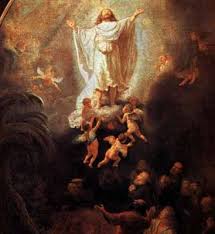 The Feast of the Ascension reminds us of the pledge of our salvation that is ours through Christ. It brings to mind the thought, echoed somewhere in St. Athanasius, that as God became man in Christ without losing His divinity, so we shall become partakers of the divine nature (1 Peter 1:4) without losing our humanity. Why? Because in the Ascension, He elevates our humanity in His own Person to the right hand of God the Father.
Two things struck me at the Mass of the Ascension today, which in the old calendar is not moved to the closet Sunday for those who find the joy of assisting at Mass on a weekday an inconvenience. The first was our priest's homily, about which I will say more momentarily. The second was the delight of singing Salve Regina coelitum in the traditional Latin.
What struck me about the homily was Father's exceptional giftedness, of which he probably is not in the least conscious. As far as he's concerned, the impression I get is that he just sees himself as having a job to do, and he does it. But the remarkable thing is how well he does it. It is not just that he is utterly fearless in preaching those things that we Catholics need to hear but too often don't, even at the risk of stepping on toes. That alone would make such a priest an exceptional gift to any parish. Rather, what I have in view here is his natural gift for communicating important things in a simple and accessible way.
In this evening's homily he pulled together in a neat synthesis a remarkable number of items from the liturgical calendar, traditional devotions, biblical exposition, and hortative applications. He began by noting that in the calendar of the Extraordinary Form of the Roman Liturgy, Ascension Thursday falls precisely 40 days after Easter, just as Jesus, according to the New Testament narratives, remained for 40 days with His Apostles before His Ascension.
Tomorrow begins the mother of all novenas, the Novena to the Holy Spirit, the most ancient of novenas, culminating in the descent of the Holy Spirit upon the Apostles and Blessed Mother at Pentecost, exactly ten days hence. As the Catholic Encyclopedia says:
... for every novena of preparation, as also for every novena of prayer, not only the best explanation but also the best model and example was given by Christ Himself to the Church in the first Pentecost novena. He Himself expressly exhorted the Apostles to make this preparation. And when the young Church had faithfully persevered for nine full days in it, the Holy Ghost came as the precious fruit of this first Christian novena for the feast of the establishment and foundation of the Church.St. Luke records in Acts 1:1-11 (the Epistle for today) that Jesus "commanded them that they should not depart from Jerusalem, but should wait for the promise of the Father." What follows upon this awaited promise of the Holy Spirit? Authority and power. Before His Ascension, Jesus says: "... you shall receive the power of the Holy Ghost coming upon you, and you shall be witnesses unto Me in Jerusalem, and in all Judea and Samaria, and even to the uttermost part of the earth." Likewise, St. Mark 16:14-20 (the Gospel for today) juxtaposes the new signs and wonders that the Apostles may expect to perform with the imperative: "Go ye into the whole world and preach the Gospel to every creature. He that believeth and is baptized shall be saved: but he that beliveth not shall be condemned."
Thus the liturgical feast days, the traditional novena, and Biblical texts fit together seamlessly. What made the homily exceptional, however, was the way Father developed the Biblical narrative in experiential terms that helped it come alive. While I cannot hope to reproduce his homily with all his illustrations properly connect here, I offer a few thoughts in following.
How indescribably stunning the rapid succession of these events must have been for Jesus' little band of Apostles: He rises from the dead; and as if that weren't enough to keep them reeling in vertigo, forty days later He ascends from the earth and disappears into the heavens! How dizzying it must have been for them.
In the interval, Jesus spent forty days with them, but they did not at first fathom the reality of His Resurrection. Jesus once appeared to them after a night of fishing on the Sea of Tiberias, in which they caught nothing; but they did not recognize Him. St. John writes: "Early in the morning, Jesus stood on the shore, but the disciples did not realize that it was Jesus" (Jn. 21:4). Only after Jesus tells them to cast their nets on the other side of their boat, and their nets were miraculously filled to overflowing, did John say to Peter: "It is the Lord!" and Peter jumped into the water and rushed to Him. "When they had landed, they saw a fire of burning coals there with fish on it, and some bread," writes John (v.9). Remarkable: Jesus fixed them breakfast and had it waiting for them!
This was the third time that Jesus had appeared to them, and yet they had trouble believing that He had truly risen. Then, only a week or two later, Jesus stood before them on a mountain, and, having finished instructing them, was lifted up before them and ascended into Heaven.
One of the themes Father developed was that of parting -- of all good things coming to an end. Once it sank into their heads that Jesus had really returned to them from the dead, the Apostles must have found the departure of Jesus a precipitous and shocking disappointment. How often do we, too, find ourselves dreading the moment when some pleasant experience draws to a close, when friends, family members, or relatives must leave or be parted from one another. The son or daughter must go off to kindergarten, and the mother feels the pangs of sadness at the parting, no less than the child. A vacation draws to a close. The festivities of a Polish Christmas Eve or family reunion comes to an end, and grandmother and grandfather, or grandchildren, must leave. Then, of course, there is the ultimate separation of death.
What we have difficulty grasping, however, is the greater good that comes only via these partings. The kindergartener graduates and moves on through successive grades in order to grow into a mature adult. Jesus leaves His followers and ascends to Heaven, in order that He might send us the gift of the Holy Spirit. The final separation of death is but a prelude to the Eternal Reunion of the heavenly family. As C.S. Lewis once put it, when seeing off a friend in a crowded London train station, having turned and walked across the street through the crowd, and turning again to shout back at his friend over the mass of heads between them: "Christians never have to say Goodbye!"
Salve Regina coelitum
1. Sálve Regína coélitum,
O María. Sors única terrígenum,
O María.
Jubiláte Chérubim,
exsultáte Séraphim,
consonáte pérpetim.
Sálve, sálve, sálve Regína.
2. Máter misericórdiae,
O María. Dúlcis párens cleméntiae,
O María. Jubilate ...
3. Tu vítae lux, fons grátiae,
O María. Cáusa nóstrae laetítiae,
O María. Jubilate ...
4. Spes nostra, salve, Domina
O Maria. Exstingue nostra crimina!
O Maria. Jubilate ...
Wednesday, May 20, 2009
Rampant Evolutionist fideism
"Missing Link Found, 'Eighth Wonder of the World'" (Sky News, May 20, 2009) and "Scientists Unveil Missing Link In Evolution" (SkyNews, May 20, 2009).
If this were a Pentecostal revival tent meeting, it would be one thing; but it's not. It's an Evolutionist revival tent meeting, with true believers waiving their arms in the air, babbling in tongues, rolling in the aisles, and falling in dead faints in front of the klieg lights and cameras.
These supposedly sober men of science have just unveiled a fossilized skeleton of a monkey that was actually found over 20 years ago. Why precisely now, during the bicentenary of Darwin's birth? Well, there's money to be made in all this hype, of course; and, given waxing interest in such "horrors" as Intelligent Design theory, it's high time for a new springtime in the New Evolutionist Evangelization, to shore up the flagging faith of the true believers. It's not likely they're really interested, however, in discussing these facts.
Oh, no, they breathlessly tell us, they've been secretly preparing to unveil the "eighth wonder of the world"!!! "[P]roof of this transitional species [they KNOW this, of course!] finally confirms Charles Darwin's theory of evolution"!!! Darwin "would have been thrilled" to have seen this fossil"!!!!
Unconfirmed reports continue to circulate that, according to reliable eyewitnesses, Richard Dawkins became so excited upon hearing this report that he soiled his trousers.
Dubbed "Ida," the fossil "tells us [FINALLY!] who we are and where we came from"!!! Right. And the fossil is precisely "47 million years old!" The scientific researchers, of course, KNOW that the figure could not have been, say, 42.3 million years, or 24.5 million years. This is HARD SCIENCE, after all ...
If you find that you have some difficulty mustering the kind of stratospheric leaps of faith called for by these true-believer Evolutionist pulpiteers, when they invite you, with every head bowed and every eye closed, to get up out of your seat and walk that sawdust trail up to the altar of self-congratulatory "scientific" enlightenment, you may want to try something a bit less emotional, more rational and level-headed.
I recommend Mortimer Adler, The Difference of Man and the Difference It Makes (New York: Fordham University Press, 1993).
Every bit as timely now as when it was first written, this is a remarkably well-researched book ... No, that is far too modest: the research is of breathtaking breadth, such as only a polymath intellectual like Adler could muster.
Adler phrases his title advisedly, precisely in the way he poses the problem. By focusing on the "difference" of man from non-man, he shows that the question at issue is of the sort that cannot be answered by any single discipline. Traditionally philosophy and theology have monopolized the subject of human nature; but neither philosophy or theology cannot presume to answer the question alone, as they cannot claim exclusive jurisdiction over the broad-ranging aspects of the question. Many facets of the question must be addressed by various special sciences, he shows, including biology, paleontology, neurology, psychology, and even computer science and research in artificial intelligence. But then, none of these special sciences is competent to reflect with epistemological self-consciousness upon their own first principles. That requires a philosophical mind, if not one versed also in matters of theology.
It is the single, most level-headed and most thoroughly researched discussion of the question I have seen. Highly recommended.
[Oh, then again, Adler is so gauche as to use the word "MAN" in his title. So what could he possibly know?]
Of related interest
If this were a Pentecostal revival tent meeting, it would be one thing; but it's not. It's an Evolutionist revival tent meeting, with true believers waiving their arms in the air, babbling in tongues, rolling in the aisles, and falling in dead faints in front of the klieg lights and cameras.
These supposedly sober men of science have just unveiled a fossilized skeleton of a monkey that was actually found over 20 years ago. Why precisely now, during the bicentenary of Darwin's birth? Well, there's money to be made in all this hype, of course; and, given waxing interest in such "horrors" as Intelligent Design theory, it's high time for a new springtime in the New Evolutionist Evangelization, to shore up the flagging faith of the true believers. It's not likely they're really interested, however, in discussing these facts.
Oh, no, they breathlessly tell us, they've been secretly preparing to unveil the "eighth wonder of the world"!!! "[P]roof of this transitional species [they KNOW this, of course!] finally confirms Charles Darwin's theory of evolution"!!! Darwin "would have been thrilled" to have seen this fossil"!!!!
Unconfirmed reports continue to circulate that, according to reliable eyewitnesses, Richard Dawkins became so excited upon hearing this report that he soiled his trousers.
Dubbed "Ida," the fossil "tells us [FINALLY!] who we are and where we came from"!!! Right. And the fossil is precisely "47 million years old!" The scientific researchers, of course, KNOW that the figure could not have been, say, 42.3 million years, or 24.5 million years. This is HARD SCIENCE, after all ...
If you find that you have some difficulty mustering the kind of stratospheric leaps of faith called for by these true-believer Evolutionist pulpiteers, when they invite you, with every head bowed and every eye closed, to get up out of your seat and walk that sawdust trail up to the altar of self-congratulatory "scientific" enlightenment, you may want to try something a bit less emotional, more rational and level-headed.
I recommend Mortimer Adler, The Difference of Man and the Difference It Makes
(New York: Fordham University Press, 1993). Every bit as timely now as when it was first written, this is a remarkably well-researched book ... No, that is far too modest: the research is of breathtaking breadth, such as only a polymath intellectual like Adler could muster.
Adler phrases his title advisedly, precisely in the way he poses the problem. By focusing on the "difference" of man from non-man, he shows that the question at issue is of the sort that cannot be answered by any single discipline. Traditionally philosophy and theology have monopolized the subject of human nature; but neither philosophy or theology cannot presume to answer the question alone, as they cannot claim exclusive jurisdiction over the broad-ranging aspects of the question. Many facets of the question must be addressed by various special sciences, he shows, including biology, paleontology, neurology, psychology, and even computer science and research in artificial intelligence. But then, none of these special sciences is competent to reflect with epistemological self-consciousness upon their own first principles. That requires a philosophical mind, if not one versed also in matters of theology.
It is the single, most level-headed and most thoroughly researched discussion of the question I have seen. Highly recommended.
[Oh, then again, Adler is so gauche as to use the word "MAN" in his title. So what could he possibly know?]
Of related interest
- Mortimer J. Adler, Intellect: Mind over Matter
Sunday, May 17, 2009
Weakland comes out of closet
Laurie Goodstein, "Ex-Archbishop Speaks About Catholic Church and Homosexuality" (New York Times, May 14, 2009).
Is this repentance? What part of this is redeemable? And, I'm sad to say, a very low point for the William B. Eerdmans Publishing Company, cashing in on unprincipled prurience.
Is this repentance? What part of this is redeemable? And, I'm sad to say, a very low point for the William B. Eerdmans Publishing Company, cashing in on unprincipled prurience.
End of Christian America?
Where's the smart money on this? Jon Meacham, whom Hunter Baker calls "the new Harvey Cox" (remembered for his book The Secular City), wrote a piece called "The End of Christian America" (Newsweek, April 4, 2009).
Hunter Baker, in "End Times for Christian America?" (Acton Commentary, May 13, 2009), responds by saying that "the meme will make for good newsprint," but is "severely premature."
[Hat tip to E.E.]
Hunter Baker, in "End Times for Christian America?" (Acton Commentary, May 13, 2009), responds by saying that "the meme will make for good newsprint," but is "severely premature."
“Christianity is important in America!” is no more a story than “dog bites man.” “The death of Christianity,” on the other hand, grabs eyeballs....Well put.
The wise observer will be more cautious. It was less than five years ago that Garry Wills, flustered by the re-election of George W. Bush, wrote histrionically for The New York Times about “The Day the Enlightenment Went Out.”
... The smart money is on Christianity to be around and relevant for as long as the American republic endures. The even smarter money says the faith will outlast the republic just as it did the empire into which it was born.
[Hat tip to E.E.]
The end is surely near
From the "Buddy Christ" to, now, this: "'Jesus in jeans' sculpture unveiled" (Telegraph.co.uk, May 13, 2009).
[Hat tip to N.B.]
[Hat tip to N.B.]
Do we deserve these leaders?
If it's true that a democracy gets the leaders it deserves, this is downright embarrassing.
U.S. Pres throws Israel under the bus
Puts country on collision course with Israel. Why is this all as predictable as a Hollywood script?
[Hat tip to S.K.]
[Hat tip to S.K.]
From our allies at Westminster
I was pleasantly surprised to hear about the contribution being made in the culture wars by my alma mater, Westminster Theological Seminary, via the post by Carlos Antonio Palad, "The Truth about Angels and Demons: A Short Review" (Rorate Caeli, May 14, 2009):
[Hat tip to J.M. for the notice, and Mr. Palad for the Rorate Caeli post]The Westminster Theological Seminary, a very conservative seminary in the the Reformed-Presbyterian (Calvinist) tradition, has just launched The Truth About Angels and Demons. This website is dedicated to educating people about the misinformation -- both on scientific matters and on Catholic institutions -- in that novel and the film based on it. This continues the said seminary's fight against Mr. Brown's "novels" that was begun with its site on the Da Vinci Code.
While written from a Protestant perspective and thus bearing traces of Protestant errors, this website is not anti-Catholic. Noteworthy is the account on Galileo, which records that he was opposed by “traditionalists” (not, of course, the Traditionalists of today) instead of repeating the usual line – so beloved by Evangelical and secularist apologists alike -- that he was opposed by the “Catholic Church.” The page on the differences between Catholicism and Protestantism is respectful, despite some factual errors there and in other parts of the website ([the Council of] Ephesus was not about Pelagianism but about the Theotokos, and the cardinals are no longer bound to elect a pope within ten days of the decease of the last one).
In asserting that Protestantism is in agreement with Catholicism in accepting the contents of the first seven Ecumenical Councils (called “universal church councils” in the website), this Calvinist website says something usually heard only in the more “Catholic” wings of the Lutheran and Anglican communities, and then not even in the name of Protestantism as a whole. The statement that “most” Protestants accept the teaching of Nicaea II (which defended the veneration of icons) is not what one would one expect from the Calvinist side; it is in fact a wildly optimistic statement, albeit pleasant to read. I happily note the admission that the veneration of icons is not worship – a distinction all too often lost on many (if not most) Protestant communities.
The Catholic Church has taken the approach of being dismissive of Angels and Demons, and there is much to be said for this tactic. Nevertheless, the fact that too many souls have been (and are being) led astray by Dan Brown’s literary fantasies cannot be ignored. Inspite of the flaws in this project, it is good to see a thoroughly Protestant institution taking the initiative to defend Catholic institutions against the new wave of disinformation about to be released by “Angels and Demons,”’ and it is equally good that this project is being carried out in a way that reveals some openness to Catholic truth.
These steps nearer to the truth need to be seen and encouraged, hence this note in Rorate.

Anti-abortion as the Catholic marker?
Most of us understand the Catholic Faith as something eminently positive. It is not something defined primarily by what it is against, but by what it promotes: Christ and His teaching. Yet one of our correspondents has raised a serious and interesting question concerning whether this is truly the case in our public life, and what that might mean:
Of related interest:
I have often been struck by the fact that the ONLY thing that really unifies conservative Catholics, the only thing on which there is holy indignation, is a negative: abortion.[Hat tip to J.M.]
Now this from Joseph Bottum, "Catholic Culture and the Notre Dame Protests" (First Things, May 15, 2009):... the whole mess at Notre Dame reveals itself as a fight over Catholic culture. The protesters are certainly a minority among self-identified Catholics, but they are also the wire through which the most current is flowing in American Catholicism today. “Opposition to abortion doesn’t stand at the center of Catholic theology. It doesn’t even stand at the center of Catholic faith,” I noted in the Weekly Standard. Still, at the current moment, “Opposition to abortion is the signpost at the intersection of Catholicism and American public life.”
Should it be so? Catholic theology would be peculiar if it had at its root a negation rather than an affirmation. Catholic faith would be unreal if at its deepest heart lay opposition to abortion rather than embrace of Jesus Christ. You don’t have to travel far in theology or faith to arrive at knowledge of the absolute evil of abortion, but neither theology nor faith properly begin there.
Still, Catholic culture—and the Catholic intersection with the princes and powers of earth—must always be adversarial in some ways. We have in this world no perfect home, and if right now the adversarial element is expressing itself most forcefully in opposition to abortion, then the culture of the faithful is manifesting something that deserves respect—something that deserves agreement.
To this kind of claim, my friend, the conservative Georgetown professor Patrick Deneen,recently responded, “The singular focus upon abortion as the issue over which conservative Catholics will brook no divergence and around which we are called to rally reveals, to my mind, not evidence of robust Catholic culture as much as its absence.”
That’s right—and yet, it isn’t. The key word here is robust. I’ve been fascinated recently by the odd and interesting ways in which, it appears to me, an attempt is being made to use homeschooling as a replacement for the devices that used to transmit Catholic culture, among those most hungry for the existence of such a culture. What will come of that is hard to say.
Still, for the moment, at least, opposition to abortion remains the clear marker of the public presence of what Catholic culture exists. And as I wrote in “When the Swallows Come Back to Capistrano”:For the development of a new Catholicism, this doesn’t look the most-promising start. Rich local cultures may produce great works, but few people in the United States have that kind of cultural wealth anymore. Certainly not many Catholics. The number of Americans who grew up in a profoundly Catholic setting is smaller than it ever has been before—which creates a problem for a new culture. If Catholicism is something elected rather than received, can Catholics achieve what earlier cultures did?A robust Catholic culture? No, not yet. Not by a long shot. But the people who are upset by Notre Dame’s honoring of a strong supporter of legalized abortion—they’re serious, and they’re on the ground, and they’re deeply moved by a genuinely Catholic principle, and they’re what we have.
Their children, perhaps, will come from a thick-enough world that they can write the kind of strong Catholic novels, make the kind of strong Catholic art, prior ages knew. But in the meantime, a rebellion against rebellion doesn’t escape the problems of rebellion, and a chosen tradition is never quite the same as an inherited one.
Besides, they’re right.
Of related interest:
Obamanation Day
- Catholics Who Back Obama's Visit Raise Voices With Newspaper Ad (US News & World Report, May 14, 2009)
- US Catholic activists demand removal of "anti-Catholic" Obama adviser (Catholic Culture, May 13, 2009).
- D'Arcy Opposes Terry's 'Circus' (NCRegister.com, May 15, 2009).
- Obama to Acknowledge Controversy in Notre Dame Remarks (Politics, May 15, 2009).
- Poll: Most Americans 'pro-life' for First Time Since Polling Began (Political Intelligence, May 15, 2009).
- Blogging Notre Dame's Commencement (American Papist, May 17, 2009).
- This University's religion is in vain (Rorate Caeli, May 17, 2009).
De Deféctibus – Part 4 of 4
Tridentine Community News (May 17, 2009):
We conclude our presentation of the 1962 Roman Missal instruction, De Deféctibus (On Defects Occurring in the Celebration of Mass), which displays the Church’s concern for the Blessed Sacrament and the validity of the Eucharist that the faithful may receive.[Comments? Please e-mail tridnews@stjosaphatchurch.org. Previous columns are available at www.stjosaphatchurch.org. This edition of Tridentine Community News, with minor editions, is from the St. Josaphat bulletin insert for May 17, 2009. Hat tip to A.B.]
X. Defects Occurring in the Celebration of the Rite Itself (con’t.)
41. If the Blood freezes in the chalice in winter time, the chalice should be wrapped in cloths that have been warmed. If this is not enough, it should be placed in boiling water near the altar until the Blood melts, but care should be taken that none of the water gets into the chalice.
42. If any of the Blood of Christ falls, if it is only a drop or so, nothing need be done except to pour a little water over the spilled drops and dry it afterwards with a purificator. If more has been spilled, the corporal or the altar cloth or other place is to be washed in the best way possible, and the water is then to be poured into the sacrarium.
43. If, however, all the Blood is spilled after the Consecration, the little that remains is to be consumed, and the procedure described above is to be followed with the rest which has been spilled. But if none at all remains, the priest is to put wine and water into the chalice again and consecrate from the words Símili modo, postquam cenátum est, etc., after first making an offering of the chalice, as above.
44. If anyone vomits the Eucharist, the vomit is to be gathered up and disposed of in some decent place.
45. If a consecrated Host or any Particle of it falls to the ground or floor, it is to be taken up reverently, a little water is to be poured over the place where it fell, and the place is to be dried with a purificator. If it falls on clothing, the clothing need not be washed. If it falls on a woman's clothing, the woman herself is to take the Particle and consume it.
46. Defects may occur in the celebration of the rite itself also if the priest does not know the rites and ceremonies to be observed, all of which have been fully described in the above rubrics.
Commentary – Is All of This Really Necessary?
Some might claim that this is the liturgical equivalent of a nun’s slap of the ruler on a student’s knuckles. But let us consider that the Ordinary Form Missal does not have an equivalent preamble. It only contains the General Instructions of the Roman Missal, equivalent to the Rubrics of the Roman Missal. The only formal instructions are positive (what one must do), not negative (what one must not do).
In his book, Liturgical Question Box, Bishop Peter Elliott addresses the lack of such a section by citing and reapplying the original points in De Deféctibus to the modern realities and requirements of the Ordinary Form Mass. For example, he states that when there are additional vessels to be consecrated when the Precious Blood is to be distributed to the faithful at Mass, the requirement to have all of the vessels on the corporal on the altar in order to be validly consecrated no longer makes sense. Simply to have the vessels on the altar, and for the celebrant to have the intention to consecrate them, is sufficient for a valid consecration. This is indeed logical; after all, a corporal should not have the dimensions of a towel.
The trouble with such a proposition is that while Bishop Elliott is without a doubt one of the top living scholars of the rubrics of the Ordinary Form of Mass, he speaks with no authority other than his own scholarship. He is speculating as to what the Church intends, no matter how logically. For such an important topic as the rubrics of Holy Mass, it is peculiar that clearer official guidelines have simply disappeared in the new Missal.
Fortunately, De Deféctibus is still in force for the Extraordinary Form of Holy Mass. If you don’t identify the potential problems, how can you correct them? We might find certain examples to sound dated, but standards for the Sacred Liturgy do need to be set. What’s worse, chuckling over the absurdity of how unlikely some of the circumstances mentioned in De Deféctibus are to occur, or being presented with potentially invalid matter at Holy Communion?
Proof of the Existence of Particles of the Host
On a recent day, the sun was so bright that one could see dust floating in the air. This, coupled with some recent discussion on a liturgical blog, inspired an experiment. Your author took an unconsecrated priest’s host, and under the sun’s bright rays, against a black background, broke the host in two just as the priest does before Holy Communion. The bright sunlight revealed a shower of tiny, dust-sized particles emanating from the host.
When we empty a bag of new, unconsecrated hosts into a ciborium before Mass, there are almost always crumbs and broken hosts in the bag. Think about the last time you opened a large box of cookies – weren’t one or two a little crumbly? It is therefore within reason to think that as Holy Communion is being distributed to the faithful from a ciborium, a crumb may fall when a particular Host is lifted out of the ciborium.
While we don’t advocate a hyperbaric chamber around the celebrant of Holy Mass or similar impractical extremes, we do believe that this experiment provides yet more evidence of the benefit of distribution of Holy Communion on the tongue, accompanied by a server holding a paten. It’s simply responsible: it’s the liturgical equivalent of swabbing alcohol on the spot where a nurse is going to draw blood. In the latter case germs, and in the former case Particles of our Lord, will still be there, whether we see them or not, or acknowledge them or not. Fortunately, the Extraordinary Form of Holy Mass strives to avoid accidental sacrilege via its prescriptions for careful handling of the Blessed Sacrament at all points in the liturgy.
Subscribe to:
Posts (Atom)